
 = Partner Site
Fahrenheit 451 Reading Level: a Complete Guide
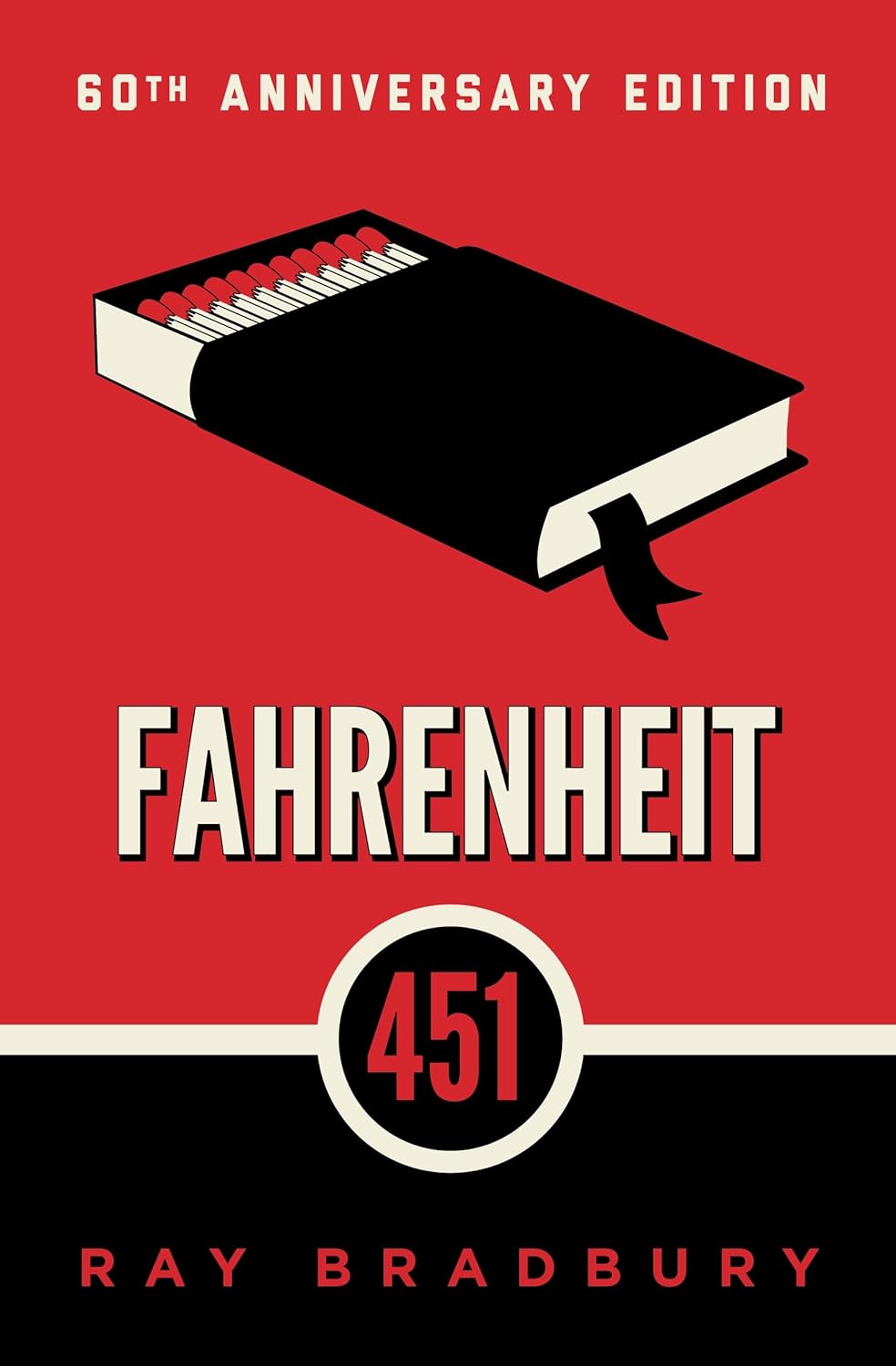
Fahrenheit 451 is a 1953 dystopian novel by Ray Bradbury set in a future America where books are banned and government “firemen” burn any that are found. Its protagonist, Guy Montag, is a fireman who begins to question the world he has been trained to enforce after an encounter with his unusual teenage neighbor Clarisse, who asks him whether he is happy. One of the most widely assigned novels in American high school curricula, it is both a classic of science fiction and a foundational text in discussions of censorship, conformity, and the purpose of literature. This guide covers the book’s reading level, age appropriateness, themes, characters, and teaching resources for high school students, parents, and educators.
For Parents
Fahrenheit 451 is one of the most commonly assigned novels in American high schools, and its content is appropriate for most readers ages 13 and older. The novel contains some violence—including a character being struck by a car and the burning of a woman alive with her books—but is not graphic. Its themes of censorship, conformity, and the emptiness of mass media entertainment are highly relevant to contemporary life and generate rich family discussion. It is a relatively short, fast-paced novel that most readers find accessible and engaging.
For Teachers
Fahrenheit 451 is a cornerstone text for units on dystopian literature, censorship, media literacy, and the purpose of reading. Bradbury’s dense, allusive prose—packed with literary and mythological references—rewards close reading instruction. The novel pairs naturally with 1984 and Brave New World (the three great mid-century dystopias), with the history of McCarthyism, and with contemporary discussions of book banning, algorithmic media feeds, and what it means to be informed in a digital age. Its own remarkable censorship history—expurgated by its publisher without Bradbury’s knowledge—provides an irresistible teachable moment.
Fahrenheit 451 at a Glance
Find on Amazon →| Author | Ray Bradbury |
| Published | 1953 |
| Grade Level | 8–10 (our assessment) |
| Recommended Age | 13–16 |
| Flesch-Kincaid Grade | 5.2 |
| Word Count | ~46,000 |
| Pages | ~158 (standard paperback) |
| Parts | 3 (“The Hearth and the Salamander,” “The Sieve and the Sand,” “Burning Bright”) |
| Genre | Dystopian fiction / science fiction |
| Setting | Future United States (unnamed city), mid-24th century |
| Awards | Prometheus Hall of Fame Award (1984); Retro Hugo Award for Best Novel (2004) |
For official Lexile and AR levels, visit Lexile.com or AR BookFinder. ReadingVine provides independent editorial assessments.
What Reading Level Is Fahrenheit 451?
ReadingVine places Fahrenheit 451 at a grade 8–10 reading level, with a Flesch-Kincaid score of approximately 5.2. The score reflects the accessible surface of Bradbury’s prose—his sentences are often short and punchy, his dialogue is direct, and the plot moves quickly. A confident middle school reader can follow the story without significant difficulty at the word level.
The real complexity is in Bradbury’s style rather than his syntax. He writes in a highly imagistic, allusive manner—dense with metaphor, mythology, and literary reference—that rewards close reading and often requires unpacking. The novel also operates on multiple allegorical levels simultaneously, and its richest meanings emerge when students understand the McCarthyism context in which it was written and can engage with its arguments about conformity, mass media, and intellectual life. Most teachers find it works best in grades 8–10, with strong discussion support to help students move beneath the exciting surface plot to what Bradbury is actually arguing.
For official Lexile and AR scores, visit Lexile.com or AR BookFinder.
What Age Is Fahrenheit 451 Appropriate For?
ReadingVine recommends Fahrenheit 451 for readers ages 13–16. The novel’s content is significantly less mature than other canonical high school dystopias—there is no sexual content, moderate language, and the violence, while present and meaningful, is not gratuitous. It is frequently assigned beginning in 8th grade and is appropriate for most teenagers with classroom context. The most challenging element is not content but conceptual: students need some historical grounding in McCarthyism, the Cold War, and 1950s American culture to fully appreciate what Bradbury was warning against.
Fahrenheit 451 contains several scenes of violence: a woman chooses to burn alive with her books rather than surrender them to the firemen, which is depicted vividly; a character is struck and killed by a speeding car; and the novel ends with a city being destroyed by nuclear bombing. There is mild profanity. The novel features characters who are emotionally numbed and dependent on drugs and television—specifically Montag’s wife Mildred, whose overdose on sleeping pills is a central early scene. These elements are purposeful and handled with literary intent. There is no sexual content. The novel is widely assigned beginning in 8th grade and is considered appropriate for most teenagers.
What Is Fahrenheit 451 About?
Guy Montag is a fireman in a future American city—but in this world, firemen don’t put out fires, they start them. Books are illegal. When a citizen is found to own one, the firemen come and burn the house. Montag has been doing this job for ten years and never questioned it. Then he meets his new neighbor, seventeen-year-old Clarisse McClellan, who is strange and curious in a world that values conformity above all else. She asks Montag things nobody asks: Do you read the books you burn? Are you happy? The question haunts him. He goes home and finds his wife Mildred unconscious from an overdose of sleeping pills—a fact she will deny remembering in the morning, and the technicians who pump her stomach and replace her blood treat as routine.
Montag begins stealing books from the houses he burns, hiding them in his home. His intellectual mentor becomes Professor Faber, a retired English professor he meets secretly, who helps him understand what books actually are and what their destruction has cost. Meanwhile, his fire captain Beatty—a brilliantly educated man who has chosen to become an instrument of censorship—delivers increasingly elaborate speeches arguing that books make people unhappy, that the firemen are doing the world a kindness. When Montag’s wife informs on him and his own house is ordered to be burned, he turns his flamethrower on Beatty and flees the city. He finds Granger and a community of book-people—intellectuals who have each memorized a work of literature, becoming living books, waiting for civilization to be ready to receive what they carry.
Bradbury wrote the first version of the story—a short work called “The Fireman”—in a library, on a rented typewriter, in nine days in 1950. He later recalled the irony of writing a book about the burning of books in a place whose purpose was their preservation. The novel was published in full in 1953 and has sold over ten million copies. Bradbury consistently insisted, against many scholarly interpretations, that the novel’s central concern was not government censorship but the voluntary surrender of reading to mass media—the danger of a society that burns its own books through indifference rather than decree.
Fahrenheit 451 Characters
Is Fahrenheit 451 Banned?
Fahrenheit 451 has one of the most ironic censorship histories in American literature—a novel explicitly about the burning of books has itself been repeatedly banned, challenged, and expurgated. Most remarkably, Bradbury discovered in the late 1970s that his own publisher, Ballantine Books, had been quietly censoring the novel’s school editions for years, removing or altering approximately 75 passages containing language deemed offensive—this for a book about the danger of censorship. Bradbury was furious and demanded the restoration of the original text. In 1992, a California middle school gave students copies with all “obscene” words blacked out. A 2006 challenge in Texas objected to the book’s language, portrayal of Christians, and depictions of firemen. It has appeared on the ALA’s challenged books lists multiple times.
The novel has also been banned in apartheid South Africa and restricted in various other contexts. Bradbury himself addressed the censorship of his own anti-censorship novel with characteristic directness, writing that the experience proved his point more eloquently than any argument could. The novel remains among the most widely assigned texts in American middle and high schools, and is universally available in school and public libraries.
Fahrenheit 451 Themes and Lessons
Bradbury was insistent, in interviews throughout his life, that Fahrenheit 451 is not primarily a novel about government censorship—it is a novel about a society that has voluntarily stopped reading, numbed itself with television and noise, and then barely noticed when the government formalized its indifference by making books illegal. The firemen, in Bradbury’s vision, are not the cause of the problem; they are the symptom. Captain Beatty explains that the firemen were only needed after the books had already been abandoned—after the people had already chosen the parlor walls over the printed page. This reading gives the novel a contemporary relevance that straightforward anti-totalitarianism cannot: Bradbury is warning not against a dictator but against ourselves, against the voluntary surrender of thought to entertainment.
Running through this is Bradbury’s passionate argument for what books actually do—not their content, specifically, but the act of engaging with them. Faber tells Montag that books have “pores,” that they show the human face in all its imperfection, that they give us time to think rather than filling every second with sensation. What the firemen burn is not just information but the capacity for sustained attention, for sitting with difficulty, for being changed by something larger than yourself. Discussion questions: Is Bradbury’s concern about mass media more or less relevant today than when he wrote the novel? What is Beatty right about? What would Bradbury make of the internet? What does it mean that Granger’s people have become the books they memorized?
How Many Pages Are in Fahrenheit 451?
Fahrenheit 451 is divided into three named parts rather than numbered chapters: “The Hearth and the Salamander,” “The Sieve and the Sand,” and “Burning Bright.” The standard Simon & Schuster paperback runs approximately 158 pages. At roughly 46,000 words, it is one of the shorter novels commonly assigned in high school—comparable in length to The Great Gatsby and shorter than Lord of the Flies or Of Mice and Men. An average high school reader will complete it in 3–5 hours. Most teachers assign it over one to two weeks, with significant class time devoted to unpacking Bradbury’s dense figurative language and discussing the novel’s allegorical dimensions.
Books Similar to Fahrenheit 451
About Ray Bradbury
Ray Douglas Bradbury (1920–2012) was born in Waukegan, Illinois, and grew up during the Great Depression, largely educating himself at the Los Angeles Public Library after his family moved to California. He never attended college, famously crediting libraries rather than universities as the source of his education. He began publishing science fiction stories in pulp magazines in the late 1930s and achieved his first major critical success with The Martian Chronicles (1950), a linked collection of stories about the colonization of Mars. Fahrenheit 451 followed in 1953 and became his most famous and most taught work. Bradbury was a prolific author across his career—novels, short story collections, screenplays, poetry, and plays—and was awarded the National Medal of Arts in 2004. He was also awarded a special Pulitzer Prize citation in 2007 for his distinguished, prolific, and deeply influential career as an unmatched author of science fiction and fantasy. He died in Los Angeles in 2012 at age 91. In a characteristic piece of irony, Bradbury—who wrote a novel celebrating the importance of books—never learned to drive and spent much of his career working at libraries and writing in their basements.
Fahrenheit 451: Frequently Asked Questions
What is the reading level of Fahrenheit 451?
ReadingVine places Fahrenheit 451 at a grade 8–10 reading level, with a Flesch-Kincaid score of approximately 5.2. Bradbury’s prose is fast-paced and accessible at the surface, but dense with metaphor, mythology, and literary allusion that rewards careful unpacking. It is most commonly and productively assigned in grades 8–10 with strong classroom discussion.
What awards did Fahrenheit 451 win?
Fahrenheit 451 won the American Academy of Arts and Letters Award in Literature (1954) and the Commonwealth Club of California Gold Medal (1954) upon publication. It later received the Prometheus Hall of Fame Award (1984) and a Retro Hugo Award for Best Novel (2004). Ray Bradbury was awarded a special Pulitzer Prize citation in 2007 for his distinguished career, and the National Medal of Arts in 2004.
What does the title Fahrenheit 451 mean?
The title refers to the temperature at which book paper ignites and burns—451 degrees Fahrenheit. It appears on the title page of the novel itself as a kind of epigraph: “Fahrenheit 451—The temperature at which book paper catches fire and burns.” The title immediately establishes the novel’s central conceit and signals what kind of book you are holding: one that knows it could be burned.
Is Fahrenheit 451 really about government censorship?
Bradbury repeatedly insisted it is not—or at least not primarily. He argued throughout his life that the novel’s true subject is the voluntary abandonment of reading by a society that has found television and mass entertainment more comfortable than thought. The government in the novel formalizes and enforces a trend that the citizens themselves began. Captain Beatty’s argument is essentially that the firemen are giving the people what they want. Bradbury considered this the more chilling and more realistic warning: not that a government will force us to stop reading, but that we will stop reading ourselves, and eventually not notice that the books are gone.
Why was Fahrenheit 451 itself censored?
In a celebrated irony, Bradbury discovered in the late 1970s that Ballantine Books had been quietly censoring school editions of Fahrenheit 451 for years without his knowledge, removing or altering approximately 75 passages containing language deemed inappropriate for young readers. This for a novel about the burning of books. Bradbury was furious and demanded that all future editions restore the original text. The episode has become a standard teaching example of the very phenomenon the novel warns against. He addressed it publicly and forcefully, calling the censorship of an anti-censorship novel the ultimate proof of his thesis.
What do the “book people” represent at the end of Fahrenheit 451?
Granger’s community of exiles—each of whom has memorized a book—represents Bradbury’s vision of intellectual resistance and the preservation of culture across catastrophe. They are not fighting the government; they are waiting. Each person has become a living book, carrying human knowledge in their memory until civilization is ready to receive it again. Bradbury is arguing that the survival of literature depends not on libraries or institutions but on individual people who love and internalize what they read. The books only survive because specific human beings cared enough to make them part of themselves.
How does Fahrenheit 451 end?
After Montag kills Beatty and flees the city, he finds Granger and the community of book people in the wilderness. As he arrives, the city is destroyed by a nuclear bombing—the background war that has been mentioned throughout the novel finally arrives. In the aftermath, Granger’s group begins walking toward the city to help with whatever comes next. The ending is not triumphant: the destruction is real and the world that follows is uncertain. But the book people are still there, still carrying what they know, ready to begin again. It is one of the most quietly hopeful endings in dystopian literature.
How many pages and words is Fahrenheit 451?
Fahrenheit 451 is approximately 158 pages in the standard Simon & Schuster paperback edition, divided into three named parts rather than numbered chapters. Its word count of approximately 46,000 makes it one of the shorter major novels in the high school curriculum—comparable in length to The Great Gatsby. An average high school reader will complete it in 3–5 hours of reading time.