
 = Partner Site
First Day Jitters Reading Level: A Complete Guide
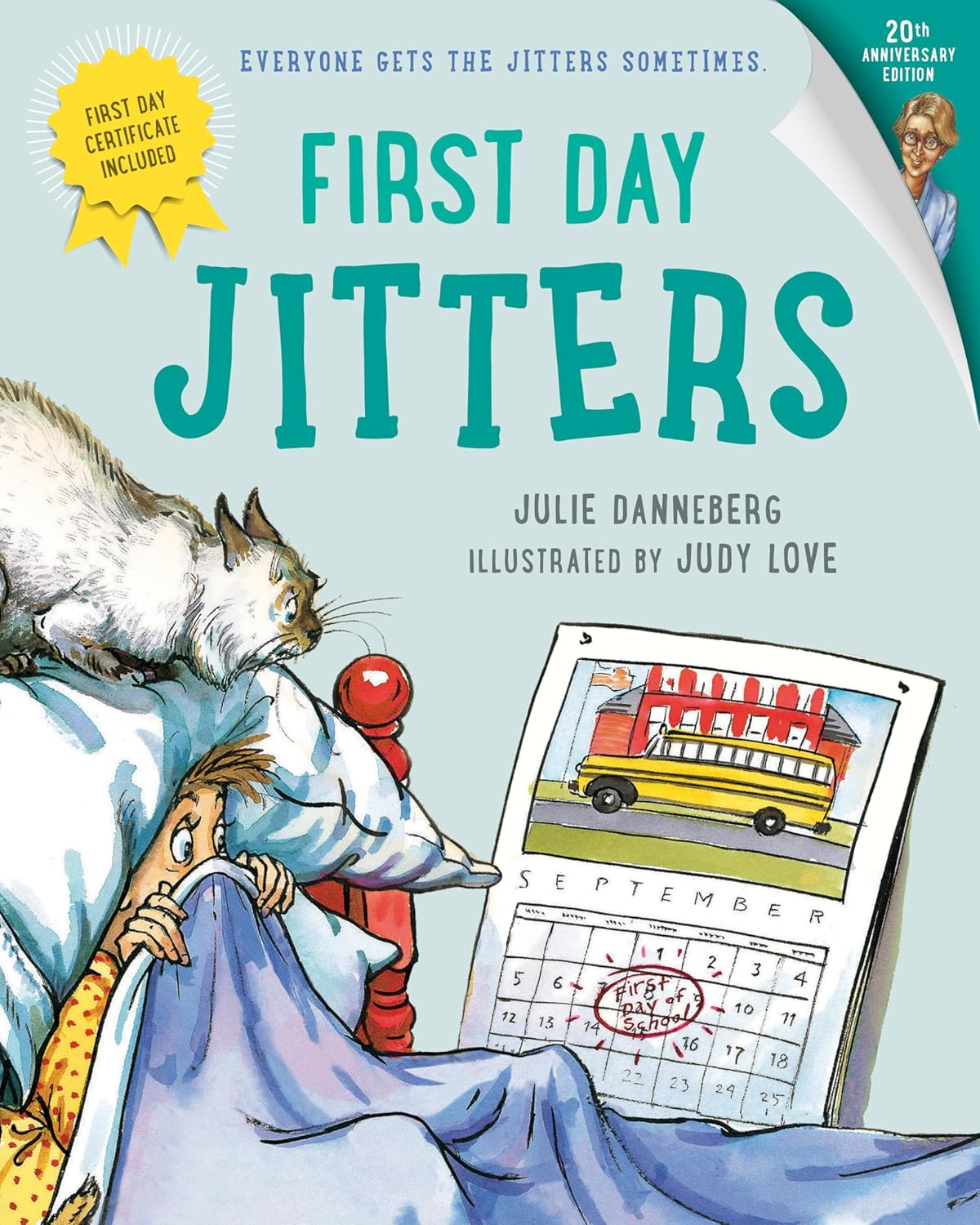
First Day Jitters, written by Julie Danneberg and illustrated by Judy Love, is a 32-page picture book about Sarah Jane Hartwell, who has a sinking feeling in the pit of her stomach and absolutely does not want to go to her new school. She doesn’t know anybody. Nobody knows her. It will be awful. She just knows it. Her husband Mr. Hartwell coaxes her out of bed, into the car, and up the school steps, and when they arrive, the principal leads Sarah Jane to her classroom and introduces her to the waiting faces inside. The book ends with a twist that makes every adult who reads it laugh out loud and every child who reads it want to read it again. Published in 2000 by Charlesbridge, it has become one of the most widely used first-day-of-school picture books in American classrooms — a back-to-school staple for more than twenty-five years, beloved equally by the children who find the jitters relatable and by the teachers who read it to them and understand the twist better than anyone. This guide covers First Day Jitters‘ reading level, whether it’s a read-aloud or independent read, what it’s about, its themes, how long it takes to read, and similar books — designed for parents and teachers of K–2 readers.
For Parents
A funny, warm picture book about first-day anxiety — with a twist ending that reframes the whole story and reassures children that even grown-ups get the jitters. Best for ages 4–8. No content concerns. The single best picture book to read the night before school starts.
For Teachers
The first-day-of-school classroom read-aloud — beloved by teachers specifically because the twist ending belongs to them. Read it on day one; the laughter it generates and the conversation it opens are among the best ways to begin a year. Pairs naturally with Wemberly Worried for back-to-school anxiety units.
First Day Jitters at a Glance
Find on Amazon →| Author | Julie Danneberg |
| Illustrator | Judy Love |
| Published | 2000 (Charlesbridge) |
| Grade Level | PreK–2 (our assessment) |
| Recommended Age | 4–8 |
| Lexile | 210L–AD520L (varies by edition) |
| ATOS Level | 2.4 |
| Guided Reading Level | L |
| Word Count | ~600 |
| Pages | 32 |
| Genre | Picture book / humor / back-to-school |
For official Lexile and AR levels, visit Lexile.com or AR BookFinder. ReadingVine provides independent editorial assessments.
What Reading Level Is First Day Jitters?
First Day Jitters has an ATOS level of 2.4 and a Guided Reading Level of L. The Lexile score varies by edition — the original Charlesbridge hardcover shows 210L, while some Scholastic paperback editions show AD520L — a discrepancy that reflects different scoring runs rather than different texts. Our editorial assessment places it at PreK–2, ages 4–8. The prose is accessible and conversational; the vocabulary is entirely within reach for kindergartners and first-graders, and the story’s momentum carries even struggling readers forward. The surprise ending is the book’s primary reading challenge — not because it is linguistically difficult but because it requires re-reading the entire book with new understanding, which is one of the most satisfying reading experiences a picture book can offer.
The ATOS 2.4 and GRL L are consistent with comfortable independent reading at the K–1 level for strong readers, and with read-aloud for the preschool and kindergarten range. For official Lexile and AR scores, visit Lexile.com or AR BookFinder. ReadingVine’s assessments are independent editorial judgments.
Is First Day Jitters a Read-Aloud or Independent Read?
This works beautifully as both a read-aloud for ages 4–8 and an independent read for ages 5–8 — but the read-aloud experience is something special. The twist ending lands differently when a teacher reads it to a room full of children who are experiencing their own first-day jitters: the laughter that follows is recognition, relief, and the specific delight of understanding something surprising all at once. Teachers who read this book on the first day of school report that the moment of the twist — “Good morning, class. I’d like you to meet your new teacher, Mrs. Sarah Jane Hartwell” — produces the kind of room-wide reaction that bonds a class together.
For independent reading, a confident K–1 reader can work through the text. The foreshadowing in Judy Love’s illustrations rewards a second independent reading after a first read-aloud: children who know the twist will go back through the pictures finding all the clues they missed, which is excellent comprehension practice disguised as pure fun.
Do not reveal the ending. Read it straight through the first time and let the twist land. After the laughter settles, ask: “Did you notice any clues that Sarah Jane might not be a student?” Then go back through the book together looking for them — the way Mr. Hartwell calls her “dear,” the fact that she is never shown clearly in the illustrations, the adult-sized worries about what people will think of her. The clue-hunt is as much fun as the twist itself.
What Is First Day Jitters About?
Sarah Jane Hartwell does not want to get out of bed. She does not want to go to her new school. She does not know anybody, and nobody knows her. What if the kids are mean? What if she can’t find her classroom? What if she gets lost? Mr. Hartwell — patient, cheerful, gently persistent — coaxes her through each stage of the morning: out of bed, through breakfast, into the car, up the school steps. Sarah Jane imagines increasingly dire scenarios; the illustrations mirror her fears with comic exaggeration. Mr. Hartwell reassures her that everything will be fine.
At school, the principal greets them warmly and leads Sarah Jane to her classroom. She is introduced to the children waiting inside: “Good morning, class. I’d like to introduce you to your new teacher, Mrs. Sarah Jane Hartwell.” The book ends with Sarah Jane facing her students, still nervous, as one of the children says: “Don’t worry, we’ll take care of you!”
The twist reframes everything that came before. Sarah Jane’s fears — of not knowing anyone, of not fitting in, of being new — were the fears of an adult on her first day at a new school as a teacher. Her husband’s patience. The principal’s warm welcome. The children’s greeting. All of it reads differently the second time through. The book’s central reassurance — that everyone gets the jitters, including grown-ups, including teachers — is made not through statement but through the structure of the story itself.
The Twist Ending — and Why It Matters
The twist in First Day Jitters is not a trick — it is the book’s argument. Danneberg spent the entire story building a child’s first-day anxiety and then revealed that the person experiencing it was an adult. This does two things simultaneously: it gives children laughing at the surprise the immediate reassurance that their own anxiety is normal and shared — if even a teacher feels this way, how could a child’s jitters be wrong? — and it gives teachers and parents something true to admit to the children in their care. The joke is also the comfort.
The foreshadowing is deliberate and generous. Judy Love’s illustrations keep Sarah Jane partially concealed throughout — she is under the blankets, in the car with her face averted, seen from behind. The size of Mr. Hartwell relative to Sarah Jane, the adult bedroom, the car she arrives in rather than the bus, the principal’s specific welcome — all of it is visible on re-reading, and none of it is obvious the first time through. The book invites and rewards exactly the kind of close looking and inference that teachers spend years building in young readers.
First Day Jitters Characters
Sarah Jane Hartwell is the book’s protagonist — a new teacher whose anxiety is depicted with total seriousness and total comedy simultaneously. Her fears are recognizable to any child who has ever been new: not knowing anyone, worrying about what people will think, imagining the worst. The fact that these are a grown-up’s fears is the book’s most generous gesture to anxious children. Mr. Hartwell is the patient, cheerful husband whose confidence that everything will be fine is vindicated at the end — he was right all along, and his calm reads differently once you know who Sarah Jane is. The principal and the welcoming students complete the book’s reassurance: the school is kind, the children are friendly, and the new person is welcomed. The cat and dog running a subplot of their own through the illustrations — their battle of wills in the background of each domestic scene — is Judy Love’s gift to the adults who read the book multiple times and notice things they missed before.
First Day Jitters Themes and Lessons
The book’s central argument is made structurally rather than stated directly: everyone gets first-day jitters — including the person who is supposed to know what they are doing. This argument is only available through the twist, which is why the twist is not a gimmick but the point. The anxiety that children feel on the first day of school is not a sign that something is wrong with them; it is the universal experience of anyone who is starting something new, regardless of age or preparation. Sarah Jane Hartwell, who is trained and credentialed and adult, is still huddled under her blankets not wanting to go.
The book is also, for teachers who read it, an act of honesty. Every teacher who reads this to their class on the first day of school is admitting something true: they were nervous too. Some teachers preface the reading by saying so; others let the book say it for them. Either way, the moment of recognition — “Don’t worry, we’ll take care of you!” — is one of the most generous exchanges a picture book can generate between a class and their new teacher.
Talking with your child: How did Sarah Jane feel about going to her new school? Were her feelings the same as yours before the first day? What was the surprise at the end — did you guess it? Can you find the clues in the pictures that told us Sarah Jane was the teacher? Do you think grown-ups really get nervous about new things?
How Long Is First Day Jitters?
First Day Jitters is 32 pages with approximately 600 words — a comfortable single read-aloud session of about six to eight minutes. It is the first book in Danneberg’s Jitters series; Last Day Blues (2006) is the companion, following Sarah Jane’s class at the end of the school year as the children are sad to leave and she is quietly celebrating. The two books together make a complete year. The series also includes Homework Blues and Valentine’s Day Blues. Many teachers keep both First Day Jitters and Last Day Blues as classroom staples for the bookend moments of the school year.
Books Similar to First Day Jitters
About Julie Danneberg and Judy Love
Julie Danneberg grew up in Colorado and taught elementary and middle school for many years before turning to writing full-time. She has said that First Day Jitters drew on her own experience of first-day anxiety as a teacher — not just as a child — and that the twist ending was the book’s premise from the beginning: she wanted to write a book that told the truth about the universality of first-day nerves by making the narrator an adult. She is the author of the full Jitters series, including Last Day Blues (2006), Homework Blues, and Valentine’s Day Blues, all illustrated by Judy Love. She lives in Boulder, Colorado.
Judy Love is an illustrator whose ink-and-watercolor style gives First Day Jitters its warm, energetic visual comedy. Her illustrations are full of action — Sarah Jane’s imagined disasters, the school’s looming facade, the final classroom reveal — and contain the book’s most important secret: Sarah Jane is always partially hidden, always shot from an angle that keeps her identity ambiguous. The cat-and-dog subplot running through the domestic scenes is Love’s addition and is the detail that most rewards adult readers on second and third readings. She has illustrated numerous picture books and educational materials.
First Day Jitters: Frequently Asked Questions
What reading level is First Day Jitters?
First Day Jitters has an ATOS of 2.4 and a Guided Reading Level of L. Lexile varies by edition (210L to AD520L). Our assessment: PreK–2, ages 4–8. Accessible prose; the primary reading experience is the twist ending, which rewards re-reading with close attention to foreshadowing. For official Lexile and AR scores, visit Lexile.com or AR BookFinder.
What is the twist ending of First Day Jitters?
Sarah Jane Hartwell, who has spent the whole book dreading going to her “new school,” is introduced at the end not as a new student but as the new teacher — “Mrs. Sarah Jane Hartwell.” Her husband was taking her to school as a teacher, not dropping off a child. The foreshadowing is visible on re-reading: she is always partially hidden in the illustrations, called “dear” by her husband, and driven rather than bused. The twist reframes the entire book: even teachers get first-day jitters.
What is First Day Jitters about?
Sarah Jane Hartwell does not want to go to her new school — she is nervous, doesn’t know anyone, and imagines everything going wrong. Her husband coaxes her through the morning and delivers her to school, where the principal introduces her to her new classroom. The surprise ending reveals she is the new teacher, not a new student — and the children welcome her: “Don’t worry, we’ll take care of you!”
Is First Day Jitters good for a child who is anxious about school?
It is one of the most widely used picture books for exactly this purpose. The book’s reassurance — that even grown-ups, even teachers, get first-day jitters — is delivered through the twist rather than stated, making it more effective than a direct “don’t worry.” Booklist named it a companion to Wemberly Worried for this reason. Reading it the night before or morning of the first day is standard classroom and family practice.
Is there a sequel to First Day Jitters?
Yes — Last Day Blues (2006), also by Danneberg and Love, follows Sarah Jane’s class on the last day of school, when the children are sad to leave and Sarah Jane is quietly celebrating. The two books together bookend a school year. The Jitters series also includes Homework Blues and Valentine’s Day Blues.
How long does it take to read First Day Jitters aloud?
About six to eight minutes for the first reading. Budget additional time for the conversation that follows the twist — and for looking back through the illustrations finding the clues that were always there. The second reading often takes longer than the first because everyone is looking more carefully.