
 = Partner Site
Hello, Universe Reading Level: A Complete Guide
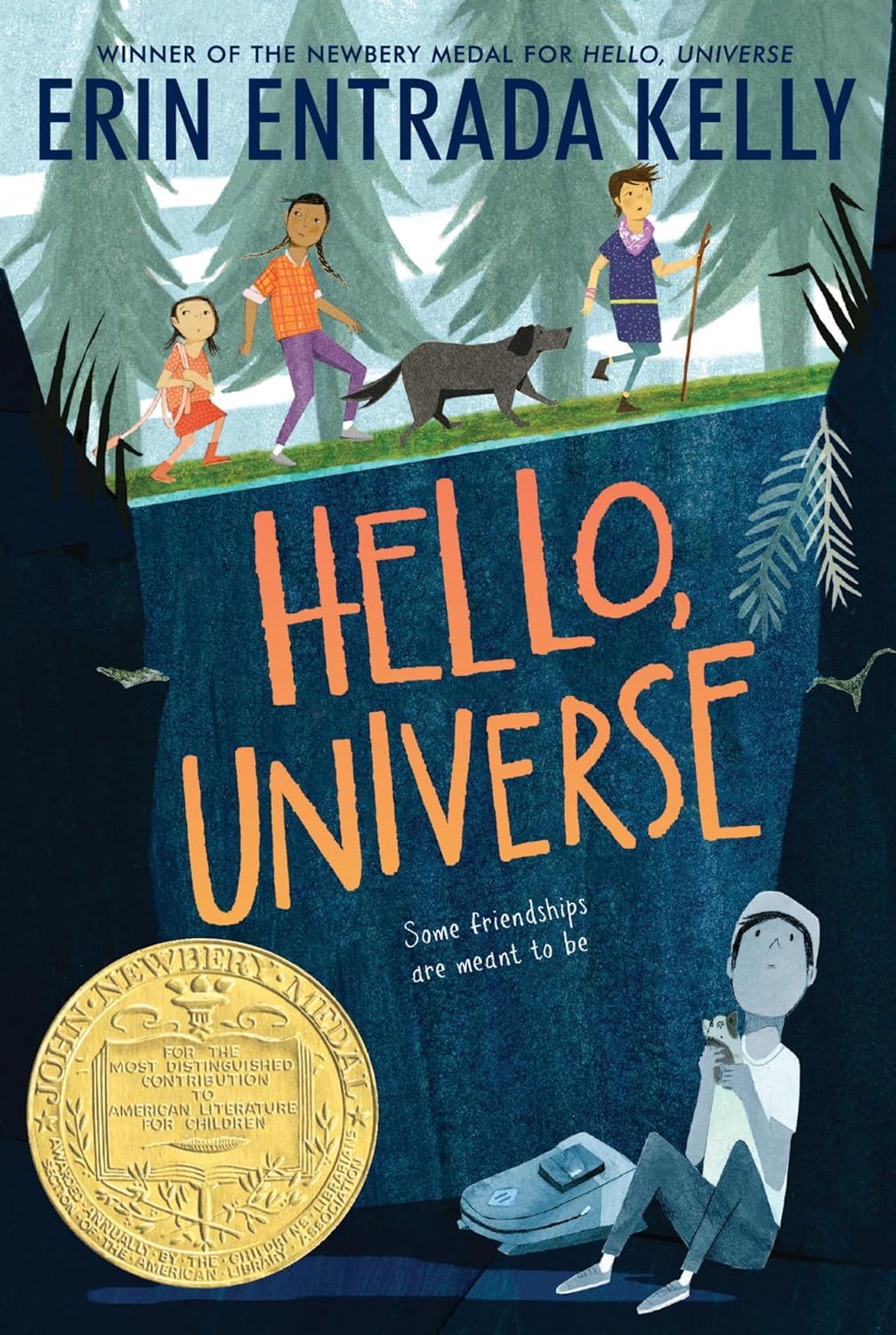
Hello, Universe by Erin Entrada Kelly is a Newbery Medal novel that follows four children through a single eventful day in a Philadelphia neighborhood — a shy Filipino-American boy, a deaf girl who speaks to spirits, a girl who calls herself a psychic, and a bully who is himself more frightened than frightening. First published in 2017, it is a warm, gently magical novel about the unexpected ways lonely people find each other and the particular courage required to ask for help. This complete guide covers Hello, Universe‘s reading level, recommended age, content considerations, characters, themes, and books similar to Hello, Universe, designed for parents, teachers, and students.
For Parents
Hello, Universe is a gentle, big-hearted novel with an ensemble cast of distinctly drawn children who are all, in their different ways, on the outside of something. It deals honestly with bullying, loneliness, and disability without being heavy or didactic about any of them. Best for readers ages 8–12, it is one of the more joyful Newbery Medal winners of recent years and reads with genuine warmth from the first page.
For Teachers
A Newbery Medal winner well suited to grades 4–6, Hello, Universe is an excellent text for teaching multiple points of view — each of its four narrators has a distinct voice and a partial perspective on the day’s events — and for discussing disability representation, cultural identity, and the relationship between loneliness and courage. Pairs well with Wonder for a unit on belonging and difference, or with Front Desk for a unit on contemporary fiction featuring Asian-American protagonists.
Hello, Universe at a Glance
Find on Amazon →| Author | Erin Entrada Kelly |
| Published | 2017 |
| Grade Level | 4–6 (our assessment) |
| Recommended Age | 8–12 |
| Flesch-Kincaid Grade | ~4.2 |
| Word Count | ~45,000 |
| Pages | 320 (Greenwillow paperback) |
| Chapters | 47 |
| Genre | Realistic fiction / magical realism |
| Setting | A Philadelphia neighborhood, contemporary, single summer day |
| Awards | Newbery Medal (2018) |
For official Lexile and AR levels, visit Lexile.com or AR BookFinder. ReadingVine provides independent editorial assessments.
What Reading Level Is Hello, Universe?
By our editorial assessment, Hello, Universe reads at a grade 4–6 level. The Flesch-Kincaid formula places it at approximately grade 4.2 — accessible to a confident third-grade reader at the sentence level, with clear, flowing prose and short chapters that make the page count feel much more manageable than 320 pages sounds. Kelly writes in a warm, immediate style, shifting between four distinct narrative voices in a way that is easy to follow and that gives the novel a natural momentum.
The novel’s modest linguistic difficulty sits alongside a genuine emotional sophistication — Kelly is handling loneliness, disability, cultural identity, and the interior lives of a bully with more nuance than the sentence-level reading level suggests. Readers at the lower end of the age range (8–9) will follow the story easily and feel its warmth; readers 10–12 will begin to register the fuller weight of what each character is carrying. The multiple-narrator structure, in which the same day is seen through four different sets of eyes, is a technique worth pointing out explicitly to readers encountering it for the first time.
For official Lexile and Accelerated Reader scores, visit Lexile.com or AR BookFinder. ReadingVine’s assessments are independent editorial judgments.
What Age Is Hello, Universe Appropriate For?
We recommend Hello, Universe for readers ages 8–12. The novel contains no sexual content, no profanity, and no significant violence. Its most intense sequence — in which a child is trapped at the bottom of a well — is resolved without serious harm and is handled with suspense rather than darkness. The bullying Virgil endures is depicted honestly but not graphically, and the novel is careful to render the bully, Chet, as a frightened child rather than simply a villain.
The novel touches on grief — Valencia’s deafness has shaped her family in ways that involve loss, and Virgil’s grandmother speaks of dead relatives with casual familiarity — and on the loneliness that comes from feeling different. These themes are handled with lightness and warmth. There is nothing in Hello, Universe that requires parental preview or discussion preparation; it is among the most content-safe Newbery Medal winners of recent years, and one of the most reliably enjoyable for the full recommended age range.
What Is Hello, Universe About?
Virgil Salinas is eleven years old, shy to the point of near-invisibility, and convinced that the universe has arranged itself specifically to overlook him. His large Filipino family is loud, confident, and bewildered by his quietness; his only friend is a guinea pig named Gulliver. He is working up the courage to talk to Valencia Somerset, the deaf girl he has admired from a distance all school year, when Chet Bullens — the neighborhood bully, whose particular gift is identifying exactly the thing a person most wants to hide — intercepts him on his way to Virgil’s grandmother’s house and drops Gulliver’s carrier down a well.
Virgil falls in after it, and the novel’s central crisis is set: he is at the bottom of a well with his guinea pig and no way out, and no one knows where he is. Kelly crosscuts between four narrators to tell the story of how he gets found. Valencia, who is deaf and navigates the world through lip-reading and a fierce, solitary self-reliance, is walking in the woods for reasons of her own. Kaori Tanaka — self-described psychic, younger sister Suay her devoted assistant — has been given a vision she doesn’t yet understand. And Chet, who put Virgil in the well and told himself it was an accident, is going home to a father who uses the same logic Chet uses on everyone else.
The novel is less a plot-driven adventure than a character study of four children who are each, in their different ways, isolated — by shyness, by disability, by the performance of a self they don’t quite believe in, by fear — and who are brought into contact with each other by a day that refuses to go as planned. Kelly is interested in the specific texture of loneliness and in the small, improbable acts of connection that sometimes interrupt it. The universe of the title is not metaphorical: the novel is full of a sense that things arrange themselves meaningfully, that coincidence has intention, and that paying attention is its own form of courage.
Hello, Universe Characters
Is Hello, Universe Banned?
Hello, Universe has not been banned or formally challenged in American schools or libraries and does not appear on any lists of frequently challenged books. It is widely shelved and assigned without controversy and is considered a distinguished, age-appropriate work of contemporary children’s fiction. Its depiction of Filipino-American family culture and its inclusion of a deaf protagonist have been noted by educators and reviewers as examples of meaningful representation rather than sources of concern.
Hello, Universe Themes and Lessons
The novel’s central preoccupation is loneliness — specifically the different forms it takes in four children who have each, for different reasons, ended up more alone than they should be. Virgil is lonely because his quietness is misread. Valencia is lonely because her deafness has made self-reliance a reflex. Kaori is not quite lonely — she has her sister and her missions — but she is on the outside of the social world in ways she has chosen to embrace rather than fight. And Chet is lonely in the way that bullies so often are: isolated by the behavior that keeps others at a safe, frightened distance.
What Kelly is interested in is how these particular lonelinesses might become something else, given the right day and the right coincidences. The novel does not argue that loneliness is easily resolved or that connection is simple — Virgil will still be shy tomorrow, Valencia will still navigate a hearing world on her own terms — but it argues that the universe occasionally arranges things so that lonely people find each other, and that when it does, the right response is to pay attention and reach out. Virgil’s central act of courage is not fighting Chet or saving himself from the well; it is asking Valencia for help. This is, Kelly suggests, the harder and more important thing.
The novel’s treatment of Chet is its most distinctive element. Kelly gives him chapters, gives him a father, gives him an inner life — and makes clear that understanding why he does what he does is not the same as excusing it. This is a more nuanced treatment of a bully than children’s fiction usually attempts, and it is the thing most worth discussing explicitly with readers who encounter it.
Discussion questions for classrooms and families: How is each of the four narrators lonely, and are their lonelinesses the same? What does it mean that the novel gives Chet his own chapters — does knowing his home life change how you feel about what he did? What does Lola Nena’s way of seeing the world have to do with the novel’s title? Why is asking Valencia for help the most courageous thing Virgil does? What does the novel suggest about the difference between being alone and being lonely?
How Many Pages and Chapters in Hello, Universe?
The Greenwillow paperback edition of Hello, Universe is 320 pages across 47 short chapters. At approximately 45,000 words, the page count is generous for the word count — chapters average around six to eight pages, and Kelly’s brisk, warm prose moves quickly through them. Most readers in the target age range will finish it in a week of comfortable reading, and many will do it in fewer days because the short chapters and multiple-voice structure make it very easy to read just one more.
For classroom use, the novel works well in a two-to-three week unit. The multiple-narrator structure is the most productive formal element to discuss — tracking what each narrator knows, what they don’t know, and how their perspectives on the same events differ is an excellent introduction to point-of-view techniques for readers encountering them for the first time. The novel’s single-day structure also makes it a useful text for discussing narrative compression and the relationship between time and pacing.
Books Similar to Hello, Universe
About Erin Entrada Kelly
Erin Entrada Kelly was born in Lake Charles, Louisiana, to a Filipino father and a Cajun mother, and grew up between those two cultures in ways that shaped both her sense of identity and her fiction. She has spoken in interviews about the experience of being a mixed-race child in the American South — feeling neither fully Filipino nor fully American, belonging completely to neither world — and this experience is visible throughout her work in the particular attention she pays to children who stand at the edges of the groups they most want to belong to.
Kelly studied creative writing at the University of Southern Mississippi and worked for many years in publishing before her debut novel, Blackbird Fly, was published in 2015 to strong reviews. Hello, Universe, her second novel, won the Newbery Medal in 2018 — a recognition that surprised some observers, who had expected the medal to go to a more formally ambitious book, and that others felt was exactly right for a novel whose formal achievement is precisely its warmth and its precision with ordinary, unheroic children. Her subsequent novels include You Go First and Lalani of the Distant Sea. She lives in Philadelphia — the city where Hello, Universe is set — and teaches in the graduate creative writing program at Rosemont College.
Hello, Universe: Frequently Asked Questions
What reading level is Hello, Universe?
Hello, Universe has a Flesch-Kincaid grade level of approximately 4.2. Our editorial assessment places it at grades 4–6 (ages 8–12). The prose is clear and accessible, but the emotional sophistication of its multiple narrators and its nuanced treatment of bullying and disability make it most rewarding for readers 9 and up. For official Lexile and AR scores, visit Lexile.com or AR BookFinder.
What grade is Hello, Universe appropriate for?
We recommend grades 4–6 as the primary range. Strong 3rd-grade readers can access the text comfortably, and the novel remains engaging through 7th grade. It is most commonly assigned in 4th and 5th grade and works equally well as an independent read or a whole-class text.
How many pages are in Hello, Universe?
The Greenwillow paperback is 320 pages across 47 short chapters. Word count is approximately 45,000 words — the page count is generous for the word count because the chapters are short and the pacing is brisk. Most readers in the target age range finish it in about a week.
What is Hello, Universe about?
Four children — a shy Filipino-American boy, a deaf girl, a self-styled psychic, and a bully — spend a single summer day in a Philadelphia neighborhood that brings them into unexpected contact with each other. When the bully drops the shy boy’s guinea pig down a well and the boy falls in after it, the other three are drawn into finding him. It is a novel about loneliness, connection, and the small acts of courage that change things.
Is Hello, Universe a good book for a 9-year-old?
Yes — it is one of the more accessible recent Newbery Medal winners for the 8–10 age range. The content is gentle, the multiple-narrator structure is easy to follow, and the warmth of the novel is immediate. A 9-year-old who has felt shy, different, or on the outside of a social group will find something of themselves in at least one of its four characters.
Why does Hello, Universe give the bully his own chapters?
Kelly gives Chet Bullens his own point-of-view sections to make the argument that cruelty has a source — that Chet is a frightened child with a frightening father, and that understanding this is not the same as excusing what he does. This is one of the novel’s most deliberate choices and one of its most worth discussing: why does it matter that we understand why Chet does what he does, even as we don’t forgive him for it?
Why did Hello, Universe win the Newbery Medal?
Hello, Universe won the Newbery Medal in 2018 for the quality of its writing — specifically for the warmth and precision of Kelly’s prose, the distinctiveness of its four narrative voices, the authenticity of its Filipino-American and deaf characters, and the care with which it renders the interior lives of ordinary, unheroic children. It was recognized as a novel that takes its readers seriously without asking anything of them that they are not ready to give.
Is Hello, Universe part of a series?
No. Hello, Universe is a standalone novel. Erin Entrada Kelly’s other novels — including Blackbird Fly, You Go First, and Lalani of the Distant Sea — are separate works featuring different characters. There are no sequels.