
 = Partner Site
Merci Suárez Changes Gears Reading Level: A Complete Guide
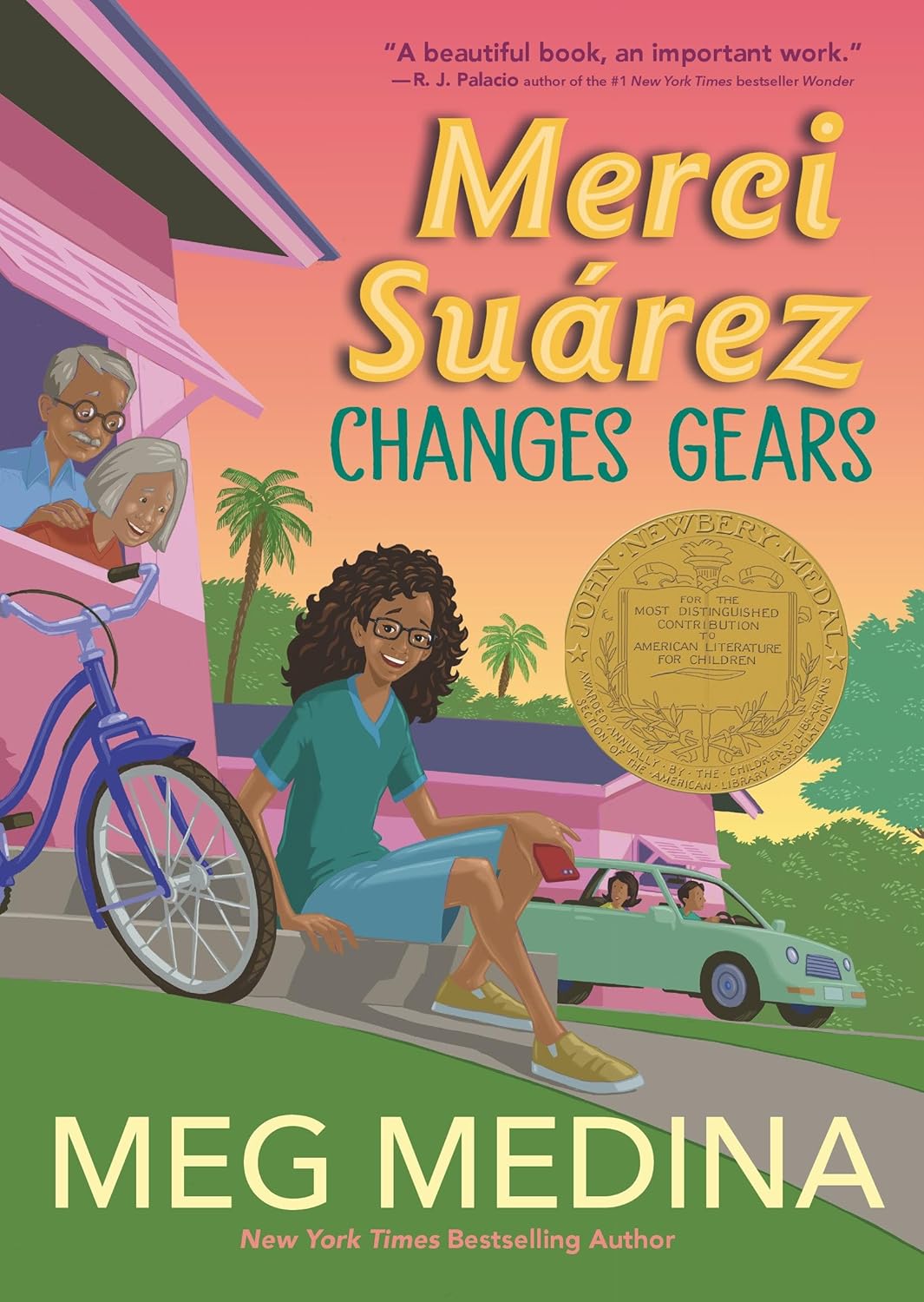
Merci Suárez Changes Gears by Meg Medina is a Newbery Medal novel about a sixth-grade girl from a tight-knit Cuban-American family in Florida who is navigating a new school year, new social pressures at her private school, and the slow, frightening changes in her beloved grandfather as he begins to show signs of dementia. First published in 2018, it is a warm, honest, and precisely observed novel about family, belonging, and what it means to grow up inside a culture that is entirely your own and entirely complicated. This complete guide covers Merci Suárez Changes Gears‘s reading level, recommended age, content considerations, characters, themes, and books similar to Merci Suárez Changes Gears, designed for parents, teachers, and students.
For Parents
Merci Suárez Changes Gears deals honestly with dementia — its gradual onset, its specific indignities, and the way a family organizes itself around a person who is slowly becoming someone else. Merci’s story is warm and often funny, but parents should be prepared for a novel that handles illness and loss with honesty rather than comfort. Best for readers ages 10–14, it is one of the most fully realized portraits of a Latinx family in recent middle-grade fiction.
For Teachers
A Newbery Medal winner well suited to grades 5–8, Merci Suárez Changes Gears is an excellent text for teaching first-person voice, the navigation of multiple social worlds, and the experience of being a scholarship student at a private school. Medina’s portrait of Merci’s Cuban-American family is specific, warm, and careful to avoid generalization. Pairs naturally with Hello, Universe for a unit on contemporary fiction featuring children of color, or with The House on Mango Street for a unit on Latinx voices in American literature.
Merci Suárez Changes Gears at a Glance
Find on Amazon →| Author | Meg Medina |
| Published | 2018 |
| Grade Level | 5–7 (our assessment) |
| Recommended Age | 10–14 |
| Flesch-Kincaid Grade | ~4.9 |
| Word Count | ~60,000 |
| Pages | ~352 (Candlewick paperback) |
| Chapters | 30 |
| Genre | Realistic fiction |
| Setting | South Florida, contemporary |
| Awards | Newbery Medal (2019) |
For official Lexile and AR levels, visit Lexile.com or AR BookFinder. ReadingVine provides independent editorial assessments.
What Reading Level Is Merci Suárez Changes Gears?
By our editorial assessment, Merci Suárez Changes Gears reads at a grade 5–7 level. The Flesch-Kincaid formula places it at approximately grade 4.9 — accessible to a confident fourth-grade reader at the sentence level. Medina writes in Merci’s first-person voice with warmth and precision, and the prose flows naturally without the kind of linguistic complexity that would impede younger readers. Spanish words and phrases appear throughout, always with sufficient context to understand them, and they deepen rather than complicate the reading experience.
The novel’s real demands are emotional and social. Merci is navigating the specific, grinding pressures of being a scholarship student among wealthier peers, the divided loyalties of a girl who belongs fully to her family and partially to a world her family doesn’t quite inhabit, and the particular grief of watching someone she loves change in ways no one can fix. These are not difficulties that resolve into tidiness. Readers at the lower end of the age range (10–11) will follow the story easily; readers 12 and up will register the fuller weight of what Merci is carrying and are likely to find the novel most resonant.
For official Lexile and Accelerated Reader scores, visit Lexile.com or AR BookFinder. ReadingVine’s assessments are independent editorial judgments.
What Age Is Merci Suárez Changes Gears Appropriate For?
We recommend Merci Suárez Changes Gears for readers ages 10–14. The novel contains no sexual content, no profanity, and no violence. Its primary content consideration is its treatment of dementia — Merci’s grandfather Lolo is experiencing the early stages of Alzheimer’s disease, and the novel depicts this with specificity and honesty, including episodes of confusion, personality change, and physical decline.
The central emotional difficulty of the novel is the depiction of a beloved grandparent’s dementia. Lolo’s illness is rendered with care and specificity — readers see him become confused, repeat himself, lose words, become occasionally frightened or aggressive in ways that are foreign to his usual warmth, and require increasing supervision. The family’s grief at these changes, and their efforts to protect each other from full awareness of what is happening, are handled honestly rather than sentimentally. Parents of children who have a family member with dementia or Alzheimer’s disease should be aware that the novel engages these experiences directly and may prompt strong feelings. For many readers in this situation, this honesty will make the book particularly valuable; for some it may make it particularly difficult. The novel also touches on social exclusion and the specific humiliations of navigating class difference at a private school, which may be worth discussing with children who have their own experience of economic difference among peers.
For readers ages 10 and up who are not in acute grief around a family member’s illness, Merci Suárez Changes Gears handles all of these elements with the craft that earned it the Newbery Medal. The novel is ultimately life-affirming — Merci is funny, capable, and deeply loved — and its difficult elements are in service of a story that takes its characters seriously.
What Is Merci Suárez Changes Gears About?
Merci Suárez is eleven years old and starting sixth grade at Seaward Pines Academy, the private school where she and her older brother Roli attend on scholarship. The Suárez family lives in three houses on the same property in Lavapiés, Florida — Merci and her parents and brother in one, her aunt and her family in another, and her grandparents Lolo and Abuela in the third — a compound arrangement that is the novel’s emotional geography. The family is Cuban-American, loud, opinionated, and present in each other’s lives in the total, sometimes suffocating way of people who have chosen to stay close.
Sixth grade brings new pressures. Merci is paired as a Sunshine Buddy with Edna Santos, a popular girl who is simultaneously befriending her and using her, and she is finding it harder to know where the line is between fitting in and losing herself. A boy named Michael notices her in a way that is new and confusing. Her best friend Hannah seems to be drifting toward other friends. The school’s social landscape, with its unspoken rules about money and appearance and who belongs where, is harder to navigate than it was in elementary school.
Running beneath all of this is the thing Merci cannot quite name to herself or to anyone else: something is wrong with Lolo. He is forgetting things. He is getting lost on walks he has taken a thousand times. He called her by the wrong name. The family is managing around it, minimizing it, finding explanations — but Merci sees it, and the gap between what she sees and what anyone will say out loud is the novel’s central tension. Medina handles Lolo’s illness as the thing it is in a family: not a plot event but a slow, ongoing grief that changes the texture of every ordinary day.
The novel moves between these two worlds — the school social drama and the family grief — with a sure hand, and what it is ultimately about is the particular position of a girl who belongs fully to a world that is rich, specific, and entirely hers, and who is also trying to find a place in a world that doesn’t quite know what to do with her. Merci is not divided between these worlds; she is navigating them simultaneously, with the competence and occasional exhaustion of someone who has always had to hold multiple things at once.
Merci Suárez Changes Gears Characters
Is Merci Suárez Changes Gears Banned?
Merci Suárez Changes Gears has not been banned or formally challenged in American schools or libraries and does not appear on any lists of frequently challenged books. It is widely shelved and assigned without controversy and is considered a distinguished, age-appropriate work of contemporary middle-grade fiction. Its portrayal of a Cuban-American family, its treatment of dementia, and its depiction of class dynamics at a private school have been noted by educators and reviewers as examples of meaningful, honest representation.
Merci Suárez Changes Gears Themes and Lessons
The novel’s title is a metaphor Merci’s father uses about cycling — the idea that changing gears is not a failure but an adjustment, a way of managing what the terrain requires. This is what the whole novel is about: the specific skill of a girl who must constantly shift between the register of her family world and the register of her school world, who carries the weight of both without being wholly claimed by either, and who is learning to do this not as a betrayal of where she comes from but as a form of capability.
Medina is particularly precise about what it means to be a scholarship student at a school built for wealthier families — the small, constant adjustments required, the awareness of what you can and cannot afford to do or say, the way a single misstep in the social landscape can cost you more than it would cost someone with a safety net. Merci is not resentful of this in any simple way; she is realistic about it, and that realism is part of what makes her such a compelling narrator.
The dementia thread is handled as a family experience rather than just an individual one. Medina is interested in how a family organizes itself around an illness it cannot fix — the roles each person takes, the things each person protects each other from knowing, the grief that is too large to name directly and so gets expressed in the ordinary business of every day. Merci’s awareness of what is happening, and her inability to make anyone talk about it, is one of the most honest portraits of how families manage illness that middle-grade fiction has produced.
Discussion questions for classrooms and families: What does it mean that Merci’s family lives in three houses on the same property — what does this arrangement tell us about them? How does Merci navigate being a scholarship student at Seaward Pines, and what does it cost her? What is the family not saying about Lolo, and why? What does the cycling metaphor of changing gears mean for Merci’s life as a whole? How does Merci’s relationship with Abuela change over the course of the novel?
How Many Pages and Chapters in Merci Suárez Changes Gears?
The Candlewick paperback edition of Merci Suárez Changes Gears is approximately 352 pages across 30 chapters. At roughly 60,000 words, it is a mid-length novel for its age range — chapters average around eleven pages, a comfortable length that allows scenes to develop without dragging. Most readers in the recommended age range will finish it in one to two weeks of steady reading at 30–45 minutes per session.
For classroom use, the novel works well in a three-week unit. The school and family threads weave together throughout, and the most productive discussion points tend to cluster around the moments when Merci must choose between the two worlds — the Edna friendship subplot, the family dinner scenes, and the novel’s climax, which brings the two threads into direct contact. The Spanish-language passages throughout are worth discussing as a formal choice: Medina uses them to signal when Merci is fully inside her family world, and their presence and absence mark a kind of code-switching that is worth making visible to students.
Books Similar to Merci Suárez Changes Gears
About Meg Medina
Meg Medina was born in Queens, New York, to Cuban immigrant parents and grew up in a household shaped by the particular combination of cultures — American and Cuban, English and Spanish, the world outside and the world of family — that she would later bring to her fiction. She has spoken in interviews about growing up as a first-generation American and the specific experience of being the cultural translator for a family that is entirely your home and partially foreign to the world you must navigate every day.
Medina worked for years in nonprofit communications before publishing her first picture book in 2010. Her middle-grade novels include Merci Suárez Changes Gears, which won the Newbery Medal in 2019, and Merci Suárez Can’t Dance, a sequel published in 2021 that follows Merci into seventh grade. Her young adult novel Burn Baby Burn, set in 1970s Queens during the Son of Sam murders, is considered one of the finest YA novels of the past decade. She has been a tireless advocate for diverse representation in children’s publishing and has served on the board of We Need Diverse Books. She lives in Richmond, Virginia.
Merci Suárez Changes Gears: Frequently Asked Questions
What reading level is Merci Suárez Changes Gears?
Merci Suárez Changes Gears has a Flesch-Kincaid grade level of approximately 4.9. Our editorial assessment places it at grades 5–7 (ages 10–14). The prose is accessible and immediate, but the emotional complexity of Merci’s situation — navigating class difference, cultural identity, and a grandparent’s dementia simultaneously — makes it most rewarding for readers 10 and up. For official Lexile and AR scores, visit Lexile.com or AR BookFinder.
What grade is Merci Suárez Changes Gears appropriate for?
We recommend grades 5–7 as the primary range, most commonly assigned in 6th grade. Strong 5th-grade readers will engage with it successfully; the novel’s treatment of dementia and class difference is better suited to readers 10 and up, who will bring enough life experience to understand what Merci is navigating.
How many pages are in Merci Suárez Changes Gears?
The Candlewick paperback is approximately 352 pages across 30 chapters. Word count is roughly 60,000 words. Most readers in the target age range finish it in one to two weeks of steady reading.
What is Merci Suárez Changes Gears about?
Eleven-year-old Merci Suárez starts sixth grade at the private school she attends on scholarship, navigating new social pressures and a shifting friendship while her beloved grandfather Lolo begins to show signs of dementia. The novel follows her through a school year in which both worlds — the school and the family compound where she grew up — are changing at the same time, and neither change is one she chose or can control.
Is Merci Suárez Changes Gears good for a 10-year-old?
Yes, for most 10-year-olds — with the awareness that the novel deals honestly with a grandparent’s dementia, which may prompt strong feelings in children who have their own experience of a family member’s illness. A 10-year-old who is a confident reader and is not in acute grief around a family illness will find it warm, funny, and deeply recognizable in its portrait of navigating two worlds at once.
Is there a sequel to Merci Suárez Changes Gears?
Yes. Merci Suárez Can’t Dance, published in 2021, follows Merci into seventh grade as she navigates a new school year, a school musical she has been drafted into against her will, and the ongoing changes in her family in the wake of Lolo’s illness. It is a true sequel with the same characters and setting and is a natural next read for anyone who loved the first book.
Why did Merci Suárez Changes Gears win the Newbery Medal?
It won the Newbery Medal in 2019 for the quality of Medina’s writing — specifically for the warmth and precision of Merci’s first-person voice, the specificity and authenticity of the Cuban-American family at the novel’s center, the honesty of its treatment of dementia as a family experience, and the care with which it renders the social landscape of a scholarship student at a private school. It was recognized as a novel that takes both its characters and its readers seriously.
What does the title Merci Suárez Changes Gears mean?
The cycling metaphor comes from Merci’s father, who uses it to explain that changing gears isn’t giving up — it’s adjusting to what the terrain requires. The title describes Merci’s whole situation: she is constantly shifting between the register of her family world and the register of her school world, learning to manage the demands of both without losing herself in either. Changing gears is not a failure; it is a skill.