
 = Partner Site
Hilo: The Boy Who Crashed to Earth Reading Level: A Complete Guide
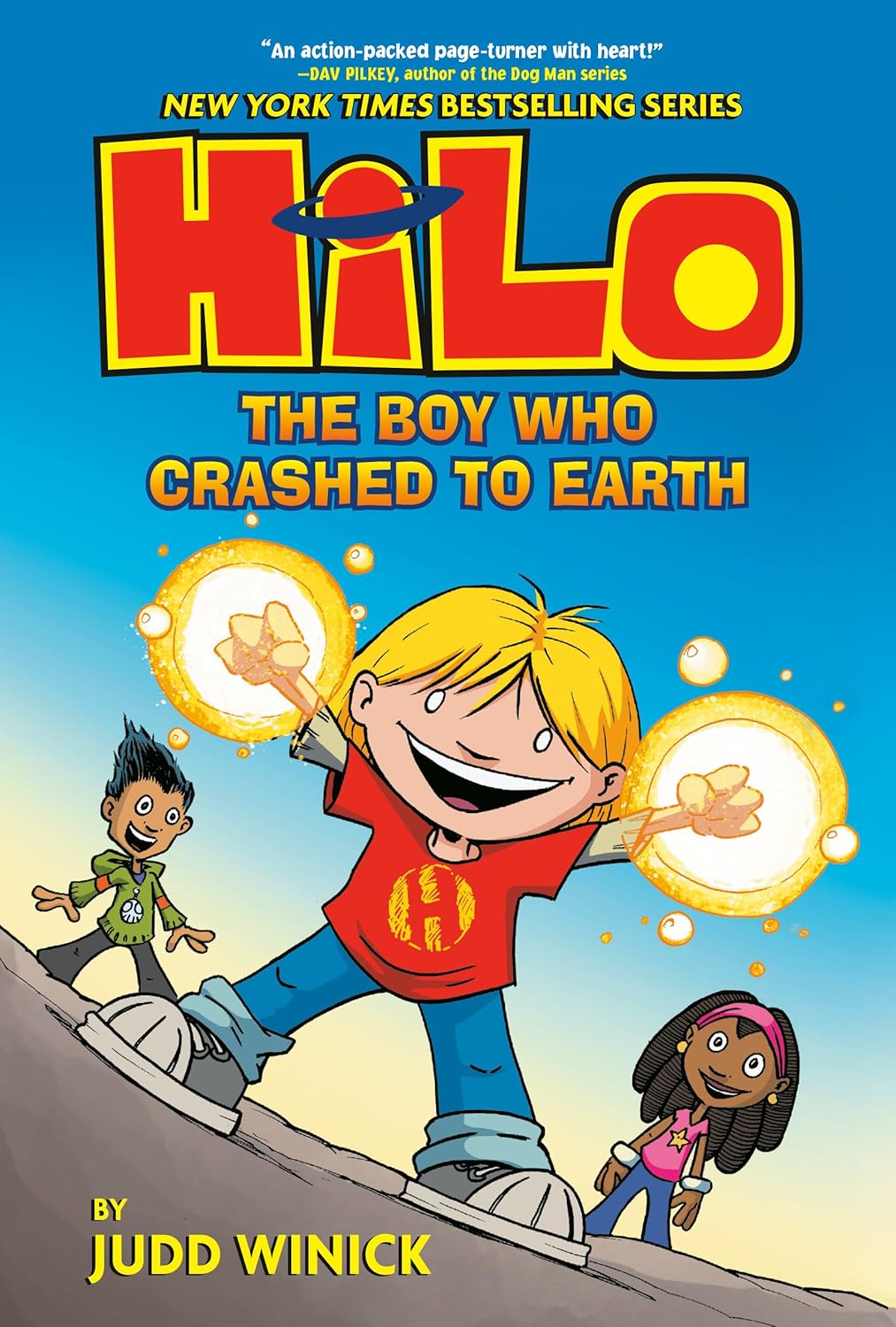
Hilo: The Boy Who Crashed to Earth, written and illustrated by Judd Winick, is a 193-page graphic novel about D.J. (Daniel Jackson Lim), an ordinary boy in a family of extraordinary siblings, who witnesses a boy falling from the sky in a giant explosion and finds him in a smoking crater — wearing only his underwear and remembering nothing. The boy is Hilo, and he is not a boy exactly. He is a robot from another world, cheerful and powerful and completely baffled by the customs of Earth — including why humans wear pants. D.J. and his best friend Gina befriend Hilo and try to help him pass as a normal kid long enough to figure out where he came from and why something dangerous seems to have followed him to Earth. Published in 2015 by Random House and a New York Times bestseller from its first week, it received starred reviews from Kirkus and School Library Journal, won the Children’s Choice 5th–6th Grade Book of the Year Award, and launched a series that now spans more than ten volumes. Kirkus called it “Solid. Expect this series to receive the same reverence as Jeff Smith’s Bone.” Dav Pilkey, creator of Dog Man, called it “an action-packed page turner with heart.” This complete guide covers Hilo Book 1‘s reading level, recommended age, content considerations, key characters, themes, and similar books — designed for parents, teachers, and students.
For Parents
A hilarious, big-hearted graphic novel about a robot boy falling to Earth and the two ordinary kids who become his best friends — one of the most popular graphic novel series for elementary readers since Diary of a Wimpy Kid. Ages 7–12, grades 2–5. No content concerns. An excellent book for reluctant readers and for anyone who has ever felt like the ordinary one in a family of overachievers.
For Teachers
A grades 2–5 classroom staple for graphic novel units and for motivating reluctant readers — one of the most requested graphic novel series in elementary school libraries. The diverse cast (D.J. is Asian American), the friendship themes, and the “feeling ordinary in an extraordinary family” premise generate strong student identification. The series now spans 10+ volumes; once students find Book 1, they read the rest without prompting.
Hilo Book 1 at a Glance
Find on Amazon →| Author & Illustrator | Judd Winick (author & illustrator) |
| Published | 2015 (Random House Books for Young Readers) |
| Grade Level | 2–5 (our assessment) |
| Recommended Age | 7–12 |
| Lexile | GN460L (Graphic Novel Lexile — see below) |
| Fountas & Pinnell | O |
| Word Count | 5,575 (text only; does not account for visual content) |
| Pages | 193 |
| Format | Graphic novel (full color) |
| Genre | Graphic novel / science fiction / adventure / humor |
| Series | Hilo (10+ volumes) |
| Awards | Children’s Choice 5th–6th Grade Book of the Year; NY Public Library Best Book for Kids; starred reviews from Kirkus and SLJ |
For official Lexile and AR levels, visit Lexile.com or AR BookFinder. ReadingVine provides independent editorial assessments.
What Reading Level Is Hilo: The Boy Who Crashed to Earth?
Hilo Book 1 has a Lexile of GN460L — the “GN” prefix designates a Graphic Novel Lexile measure, which is a separate scale from the standard Lexile used for prose. Graphic Novel Lexiles are not directly comparable to prose Lexile scores: a GN460L does not mean the same as 460L in a prose book. The GN scale was developed specifically for graphic novels because the reading demands of graphic novels are fundamentally different from prose — readers process panels, dialogue balloons, visual storytelling, panel sequence, and the relationship between image and text simultaneously. A graphic novel at GN460L may be appropriate for readers who can handle prose at a significantly higher Lexile.
The Fountas & Pinnell Level O places the book’s prose complexity at approximately second grade — reflecting the relatively simple dialogue and caption text in a graphic novel format. The word count of 5,575 represents the text only and significantly understates the book’s full reading demands, which include visual literacy: reading the panels in sequence, inferring action between panels, understanding the visual pacing Winick uses to build comedy and tension. Our editorial assessment places it at grades 2–5, ages 7–12. It is appropriate for independent reading by confident second-graders and enjoyable for middle schoolers who love the genre. For official Lexile and AR scores, visit Lexile.com or AR BookFinder. ReadingVine’s assessments are independent editorial judgments.
What Age Is Hilo Appropriate For?
We recommend Hilo Book 1 for readers ages 7–12, grades 2–5. There are no content concerns: the robot-versus-predator violence is entirely cartoon-level, nothing frightening or graphic, and the humor is clean and physical. The book is explicitly appropriate for reluctant readers — the graphic novel format, the short and punchy dialogue, and the constant visual humor make it far more accessible than its page count suggests. A child who finds 193 pages of prose daunting can move through this book in one sitting and want more immediately.
How to Read a Graphic Novel — A Note for Parents
Graphic novels require a specific set of reading skills that are different from prose skills and that are genuinely worth developing. Reading a graphic novel well means: reading panels in the correct sequence (usually left to right, top to bottom, with exceptions for effect); understanding that the white space between panels (called the “gutter”) represents time passing and that the reader’s imagination fills in what happened in between; tracking dialogue balloons and identifying which character is speaking; reading the visual cues in characters’ facial expressions and body language; and understanding how panel size and shape convey pacing and emotional emphasis.
Children who are “learning to read” in the traditional sense can and should read graphic novels — the visual literacy skills they develop are genuine literacy skills, and the reading confidence they gain from finishing a book independently is transferable. Parents who wonder whether graphic novels “count” as reading should know that the research supports graphic novels as a fully legitimate reading format and that many children who resist prose books are enthusiastic graphic novel readers who later transition to prose.
Winick’s panel work in Hilo is exceptionally clear: the action sequences are easy to follow, the emotional beats are visually telegraphed, and the comedy is timed with panel breaks in ways that reward exactly the kind of visual reading the format requires. It is a very good graphic novel to start with for children who are new to the format.
What Is Hilo: The Boy Who Crashed to Earth About?
D.J. (Daniel Jackson Lim) is the middle child in a family of overachievers — his siblings are all extraordinary at something, and D.J. has not yet found his thing. His best friend is Gina, who is moving away soon, which makes everything worse. Then a meteor crashes near town, and inside the crater D.J. finds a boy — standing, cheerful, wearing only his underwear, and glowing faintly at the edges. The boy says his name is Hilo. He has no memory of where he came from or why he is here, but he can fly, has superhuman strength, and shoots energy blasts from his hands. He is also delighted by everything on Earth, which is entirely new to him.
D.J. and Gina help Hilo navigate the extremely confusing customs of human life — pants, school, eating with utensils — while working to figure out who or what Hilo is and where he came from. They discover that Hilo is not the only thing to fall from his world: giant robot predators have followed him, and they are not friendly. Hilo has powers but no memories; D.J. and Gina have memories and good sense but no powers. Together, the three of them are more capable than any of them alone — which is the book’s central argument delivered with maximum comic energy and genuine emotional warmth.
Hilo Characters
Hilo Themes and Lessons
The book’s most productive emotional premise — and the one that has made it one of the most beloved graphic novel series in elementary schools — is D.J.’s ordinariness. He is not the gifted one. He is the middle child who watches his siblings excel and wonders when his thing will arrive. This is a remarkably common experience for children, and Winick takes it seriously: D.J.’s lack of an obvious superpower is not treated as a problem to be solved by the book’s end. It is treated as a situation that his friendship with Hilo and Gina begins to address in a different way — by showing D.J. that being the connective tissue in a friendship, the person who holds a group together, is itself a kind of extraordinary.
Hilo’s central question — whether a robot can have real feelings, whether what he experiences constitutes genuine emotion — is handled with more seriousness than the comic format might suggest. Winick does not answer it definitively in Book 1, which is the right choice: the question is the series’ engine, and it is a question that children can feel rather than just think. Children who have ever wondered whether their feelings were “real” will recognize something of themselves in Hilo’s uncertainty.
Talking with your child: Why do you think D.J. felt ordinary even though his family loved him? Do you think Hilo’s feelings are real — how can you tell? What does Gina do for the group that the other two don’t? Have you ever been the ordinary one in a group of extraordinary people — and what did you do about it?
The Hilo Series
The Hilo series now spans more than ten volumes, each continuing the adventures of D.J., Hilo, and Gina across increasingly epic storylines. The series maintains its trademark combination of visual comedy, emotional warmth, and genuine action-adventure stakes across every volume. Key titles include: Hilo Book 2: Saving the World and Beyond (2016), Hilo Book 3: The Great Furball (2017), and continuing books that gradually expand the mythology of Hilo’s origin and the threat to both Earth and his home world. The series is available as a boxed set of the first ten books — one of the most popular gift items in the children’s graphic novel category. Once students find Book 1, the series sell-through rate across subsequent volumes is among the highest in middle-grade publishing.
How Long Is Hilo: The Boy Who Crashed to Earth?
Hilo Book 1 is 193 pages of graphic novel. Most children ages 7–12 read it in one to two hours — significantly faster than a prose book of comparable page count because the visual storytelling carries much of the narrative load. Many children read it in a single sitting and immediately seek out Book 2. The page count is the best reference for reading time rather than the word count, which at 5,575 understates the full reading experience. An epic boxed set of the first ten books is available and makes an excellent birthday or holiday gift for any child who loves the series.
Books Similar to Hilo
About Judd Winick
Judd Winick was born on February 12, 1970, on Long Island, New York. He grew up reading X-Men comics and Bloom County and watching Looney Tunes — the specific combination of superhero adventure, satirical wit, and physical comedy that runs through every page of Hilo. He studied at the University of Michigan and became nationally known in 1994 as a cast member of MTV’s The Real World: San Francisco, where his roommate was AIDS educator and activist Pedro Zamora. Zamora died of AIDS in 1994; Winick wrote Pedro and Me (2000), a graphic memoir about their friendship that became one of the most acclaimed young adult graphic novels of its era and is still widely used in classrooms.
Winick went on to write bestselling comic book series for DC Comics, including Batman, Green Lantern, Green Arrow, Justice League, and Star Wars, and was head writer on the Cartoon Network animated series The Life and Times of Juniper Lee and the Hulu series The Awesomes. He created Hilo specifically for his son, who was a reluctant reader — he wanted to make a book that his son would actually want to read, which he considers one of the most useful design constraints he has ever worked with. He lives in the San Francisco Bay Area.
Hilo: The Boy Who Crashed to Earth — Frequently Asked Questions
What reading level is Hilo: The Boy Who Crashed to Earth?
Lexile GN460L — the GN prefix designates a Graphic Novel Lexile, a separate scale not directly comparable to prose Lexile scores. Fountas & Pinnell Level O. Our assessment: grades 2–5, ages 7–12. The text word count (5,575) significantly understates the reading experience, which includes substantial visual literacy demands. For official Lexile and AR scores, visit Lexile.com or AR BookFinder.
What is Hilo: The Boy Who Crashed to Earth about?
D.J., an ordinary kid in a family of overachievers, witnesses a boy fall from the sky in a giant explosion. The boy — Hilo — is a robot from another world with no memory of who he is or why he is here. D.J. and his best friend Gina help Hilo navigate Earth life (including pants) while discovering that something dangerous has followed Hilo to our planet and must be stopped.
Is Hilo good for reluctant readers?
It is one of the most effective graphic novel series for reluctant readers in the elementary catalog. The graphic novel format, short and punchy dialogue, constant visual humor, and nonstop action make it far more accessible than its page count suggests. Many children who resist prose books read all ten-plus volumes of Hilo in a matter of weeks. It has been used successfully by librarians and teachers to engage reluctant readers and bridge them toward longer prose texts.
How many Hilo books are there?
The Hilo series spans more than ten volumes as of 2026. The first ten are available as a boxed set. Each volume continues D.J., Hilo, and Gina’s adventures across increasingly epic storylines while maintaining the humor, friendship, and emotional warmth of the first book. Once readers find Book 1, the series sell-through rate is among the highest in middle-grade publishing.
What does GN460L mean — is it a low reading level?
GN460L is a Graphic Novel Lexile score — a separate scale developed specifically for graphic novels because their reading demands are fundamentally different from prose. A GN460L score is not directly comparable to a 460L prose score; graphic novel readers process panels, dialogue balloons, visual storytelling, and image-text relationships simultaneously. The GN Lexile should not be used to compare this book to prose books at any level. Our assessment: grades 2–5, ages 7–12, based on overall reading experience rather than the GN Lexile score alone.
Why is D.J. named D.J.?
D.J. stands for Daniel Jackson — Daniel Jackson Lim is his full name. He is Asian American, part of a diverse family, and is almost universally called D.J. throughout the series. The name is one of several details Winick has said he thought carefully about — he wanted a protagonist whose background was not the default, who was unambiguously Asian American, and whose name was casual and accessible to all readers. D.J. is one of the more naturally drawn diverse protagonists in middle-grade graphic novels.