
 = Partner Site
I Love My Hair! Reading Level: A Complete Guide
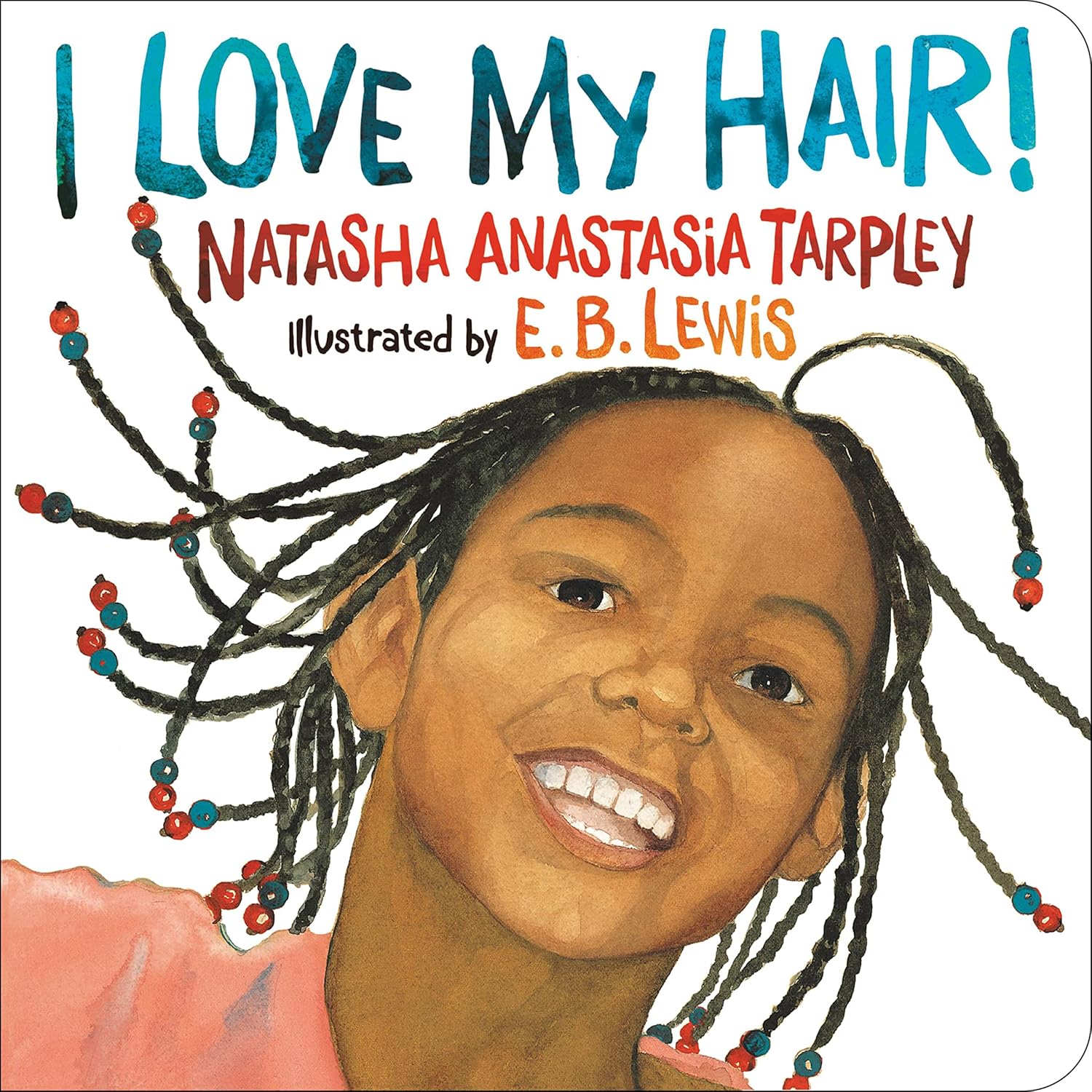
I Love My Hair!, written by Natasha Anastasia Tarpley and illustrated by E.B. Lewis, is a 32-page picture book about a young Black girl named Keyana whose mother sits her down each night to comb her thick, beautiful hair — sometimes painfully, always tenderly — and who, in the telling, discovers all the reasons she loves what grows from her head. Published in 1998 by Little, Brown, it appeared more than twenty years before Hair Love and Sulwe, and it is the book that established the tradition those books continued: a picture book that celebrates natural Black hair not as something to be managed or explained to others, but as something to be loved by the person who wears it. Illustrated with E.B. Lewis’s full-bleed, photo-realistic watercolors, it received starred reviews from Booklist and warm reviews from School Library Journal and Publishers Weekly, has been continuously in print since publication, and has earned a place on the recommended-reading lists of school and library systems around the world. This guide covers I Love My Hair!‘s reading level, whether it’s a read-aloud or independent read, what it’s about, its themes, how long it takes to read, and similar books — designed for parents and teachers of K–2 readers.
For Parents
A warm, lyrical picture book about a Black girl learning to love her natural hair through her mother’s care and stories — the foundational text in the catalog’s celebration of Black hair. Best as a read-aloud for ages 3–8. No content concerns. The book that was saying this before it was common to say it.
For Teachers
A K–2 classroom staple for identity and self-acceptance units — predating the current wave of Black hair celebration books by over two decades and establishing the language those books use. The afro passage connects hair to cultural history and political identity in ways appropriate for early discussion. Pair with Hair Love, Sulwe, and Crown for a complete unit on Black beauty and self-celebration.
I Love My Hair! at a Glance
Find on Amazon →| Author | Natasha Anastasia Tarpley |
| Illustrator | E.B. Lewis |
| Published | 1998 (Little, Brown Books for Young Readers) |
| Grade Level | PreK–2 (our assessment) |
| Recommended Age | 3–8 |
| Lexile | AD840L |
| ATOS Level | 3.3 |
| Pages | 32 |
| Genre | Picture book / realistic fiction / lyrical prose |
For official Lexile and AR levels, visit Lexile.com or AR BookFinder. ReadingVine provides independent editorial assessments.
What Reading Level Is I Love My Hair?
I Love My Hair! has a Lexile of AD840L and an ATOS level of 3.3 — the highest reading level scores of any picture book in this K–2 catalog, and notably higher than its closest companions, Sulwe (AD580L) and Hair Love (AD480L). These scores reflect Tarpley’s lyrical, metaphor-rich prose: she writes in a voice that is warm and conversational but consistently elevated, reaching for imaginative comparisons (“thick as a forest, soft as cotton candy”) that place genuine linguistic demands on early readers. The ATOS 3.3 corresponds to approximately mid-third grade for independent reading.
The AD designation — Adult Directed — indicates the book is designed primarily as a read-aloud. The prose rewards the kind of attention and expression that an adult reading aloud can bring; a child reading independently will follow the story but may move too quickly past the metaphors that make the language memorable. Most children will encounter the book as a read-aloud first and return to it independently once they know the text. For official Lexile and AR scores, visit Lexile.com or AR BookFinder. ReadingVine’s assessments are independent editorial judgments.
Is I Love My Hair a Read-Aloud or Independent Read?
This is primarily a read-aloud for ages 3–8, with independent reading most accessible for strong second- and third-graders who have heard the book multiple times. The lyrical prose and extended metaphors — Keyana’s hair compared to a forest, to cotton candy, to the wings that let her fly — are best experienced when they are given sound and pacing, and E.B. Lewis’s full-bleed watercolors reward the kind of unhurried attention that a read-aloud makes possible.
For independent reading, the ATOS 3.3 places comfortable independent reading at approximately mid-third grade. Strong second-graders can work through the text with effort and the support of the illustrations; it is a slight stretch for most K–1 independent readers but very accessible as a read-aloud for the same children.
Pause at each hairstyle and ask your child: “Have you ever worn your hair like this — or seen someone who has?” The book’s power is in its specificity, and connecting each style to something in your child’s own experience deepens the reading. If your child has hair that is styled by a caregiver, ask: “What do you think about that time — does it feel like the time Keyana has with her Mama?” The nightly ritual is the book’s emotional anchor.
What Is I Love My Hair About?
Every night, Keyana’s mother sits her down and begins to comb her hair. It is thick — “thick as a forest” — and sometimes the combing hurts. “Mama, stop!” Keyana cries when the comb tugs too hard. But her mother is always gentle, always patient, and always talking: telling Keyana how lucky she is to have this hair, how beautiful it is, how many ways it can be worn.
The book moves through those ways, one by one, each becoming its own small story. Braided into cornrows, Keyana’s hair holds the memory of her ancestors and the fields they walked and the sky they looked up at. Pulled into a puffy bun with a big bow, she is dressed up and proud. Grown into an afro, she carries the history and the pride of a people who wore this shape as a statement — the book is explicit that the afro is not just a hairstyle but a cultural and political act, a claim on identity that was worn publicly when claiming identity was itself an act of resistance. Pulled into two ponytails, her hair slaps in the air like wings and she feels free enough to fly.
Keyana ends the book certain of what she has been told and now believes herself: her hair is beautiful, and she can wear it any way she chooses. The nightly ritual of combing is transformed from something painful into something precious — the occasion for her mother’s stories, her mother’s touch, and the accumulation of knowledge about who she is and where she comes from.
I Love My Hair Characters
Keyana is the book’s narrator — a young Black girl whose voice is candid, imaginative, and entirely her own. She does not pretend the combing doesn’t hurt; she begins the book by asking her mother to stop. Her journey from resistance to celebration is the book’s arc, and it is grounded in something real: the discovery that the thing that is sometimes hard is also the thing that is yours, and that what is yours is worth loving. Her mother is the book’s wisdom figure — patient, skilled, and consistent in what she tells Keyana: your hair is beautiful, it is yours, it holds your history. The mother’s night-by-night care and conversation is the delivery mechanism for everything the book knows, and her presence makes the book’s celebration feel earned rather than declared.
I Love My Hair and the Tradition It Established
Published in 1998, I Love My Hair! appeared more than two decades before Hair Love (2019) and Sulwe (2019) — the two books in this catalog that most directly share its project. It is worth naming this clearly: Tarpley wrote a celebration of natural Black hair for Black children at a moment when doing so was unusual, and the tradition of such books in American children’s publishing is partly the tradition she helped establish. The Kirkus review of Hair Love compared it directly to I Love My Hair!; the Unleashing Readers review of Sulwe listed it as a companion read.
Together, these three books form a twenty-year arc of Black hair celebration in American picture book publishing: I Love My Hair! (1998) established the language, the mother-daughter ritual, and the afro’s cultural-political dimension; Hair Love (2019) moved the celebration into the father-daughter relationship and made it go viral; Sulwe (2019) expanded from hair to skin tone, from celebration of style to celebration of darkness itself. Reading all three together is reading a tradition in motion.
Tarpley also wrote Bippity Bop Barbershop (2009), also illustrated by E.B. Lewis — a companion book from the boy’s perspective, now sitting alongside Crown (2017) in the catalog’s barbershop cluster. The parallel is exact: Tarpley established the mother-daughter hair ritual and the father-son barbershop visit as picture book subjects; later books built on both.
I Love My Hair Themes and Lessons
The book’s most distinctive moment — and the one that distinguishes it most clearly from later hair celebration books — is the afro passage. Tarpley writes that wearing an afro is partly a political statement, and she connects it explicitly to a history in which Black people claimed their natural hair publicly as an act of pride and resistance. This is not simplified or softened for a children’s audience; it is presented as fact, as something Keyana is told and accepts as part of who she is. The afro has a history, and her hair participates in that history. This is a richer and more specific argument than the general “your hair is beautiful” message most similar books offer, and it gives older readers and their parents something more substantial to discuss.
E.B. Lewis’s watercolors are the book’s second great argument. His realistic, full-bleed spreads treat Keyana and her mother with the full attention of a portraitist — the same quality of seeing that Gordon C. James brought to Crown‘s barbershop. Booklist called his watercolors “masterful.” Each spread gives the reader time to look at a Black girl’s face and her hair as something worth looking at carefully and long, which is itself part of what the book is doing.
Talking with your child: What does Keyana’s mother do every night — and why do you think it’s so important? Which hairstyle is your favorite from the book? What does it mean that wearing an afro is partly a political statement? Is there something about yourself that you have learned to love that was hard to love at first?
How Long Is I Love My Hair?
I Love My Hair! is 32 pages. The prose is lyrical and unhurried, which makes it longer to read aloud than many picture books of the same page count — most adults will take about eight to ten minutes, pausing to look at Lewis’s full-bleed watercolors, which fill each spread completely and reward attention. The book is also available in a board book edition for the youngest readers, and in a Spanish-language edition. Tarpley’s companion book Bippity Bop Barbershop (2009) tells a parallel story from the perspective of a boy getting his first haircut, also illustrated by E.B. Lewis.
Books Similar to I Love My Hair
About Natasha Anastasia Tarpley and E.B. Lewis
Natasha Anastasia Tarpley began writing at age seven and has said she understood from an early age that stories could change the world. She is the author of more than a dozen books for children and adults, including Bippity Bop Barbershop (2009), also illustrated by E.B. Lewis, and The Me I Choose to Be. A former reporter for Fortune magazine, she is the recipient of a National Endowment for the Arts Fellowship and the co-founder of Voonderbar! Media, a project working to expand depictions of children of color in media. She lives in Chicago, Illinois.
E.B. Lewis is one of the most celebrated illustrators in American picture book publishing, with more than fifty books to his credit. He studied at Temple University’s Tyler School of Art and is a professor of illustration at the University of the Arts in Philadelphia. His realistic watercolor style — warm, deeply observed, and attentive to the specific textures of Black skin and hair — has made him the illustrator of choice for some of the most important picture books in Black American children’s literature. He has received three Caldecott Honors for his illustrations and multiple Coretta Scott King Illustrator Awards. Booklist described his watercolors for I Love My Hair! as “masterful.” He collaborated with Tarpley again on Bippity Bop Barbershop in 2009.
I Love My Hair: Frequently Asked Questions
What reading level is I Love My Hair?
I Love My Hair! has a Lexile of AD840L and an ATOS level of 3.3 — the highest reading level scores of any picture book in this K–2 catalog, reflecting Tarpley’s lyrical, metaphor-rich prose. Our assessment: read-aloud for ages 3–8; independent reading for strong second- and third-graders. For official Lexile and AR scores, visit Lexile.com or AR BookFinder.
What is I Love My Hair about?
Keyana, a young Black girl, has her hair combed by her mother every night — an experience that is sometimes painful but always loving, always accompanied by her mother’s stories about why her hair is beautiful and what it means. The book moves through the different ways Keyana can wear her hair — cornrows, a puffy bun, an afro, ponytails — each becoming a small story about beauty, history, and pride.
Who is the illustrator of I Love My Hair?
E.B. Lewis, one of the most celebrated illustrators in American picture book publishing. His full-bleed, photo-realistic watercolors for this book were described by Booklist as “masterful.” He has received three Caldecott Honors across his career and collaborated with Tarpley again on Bippity Bop Barbershop (2009).
How is I Love My Hair different from Hair Love?
I Love My Hair! (1998) tells the story from Keyana’s perspective — a girl experiencing her mother’s nightly hair care ritual and learning to love what grows from her head. Hair Love (2019) tells the story from the father’s perspective — a dad who has to figure out his daughter’s hair while Mommy is away. Both celebrate natural Black hair; the mother-daughter bond in I Love My Hair! and the father-daughter bond in Hair Love make them ideal companion reads.
How long does it take to read I Love My Hair aloud?
About eight to ten minutes as a read-aloud, pausing to look at E.B. Lewis’s full-bleed watercolors on each spread. The lyrical prose rewards a slower pace than most picture books; rushing past the metaphors misses much of what makes the language memorable.
Is there a companion book to I Love My Hair?
Yes — Bippity Bop Barbershop (2009), also written by Natasha Anastasia Tarpley and illustrated by E.B. Lewis, tells the parallel story from a boy’s perspective: his first visit to the barbershop with his father. Together the two books cover the mother-daughter hair ritual and the father-son barbershop visit as complementary rites of passage in Black family life. Bippity Bop Barbershop sits in the same tradition as Crown: An Ode to the Fresh Cut (2017).