
 = Partner Site
Jumanji Reading Level: A Complete Guide
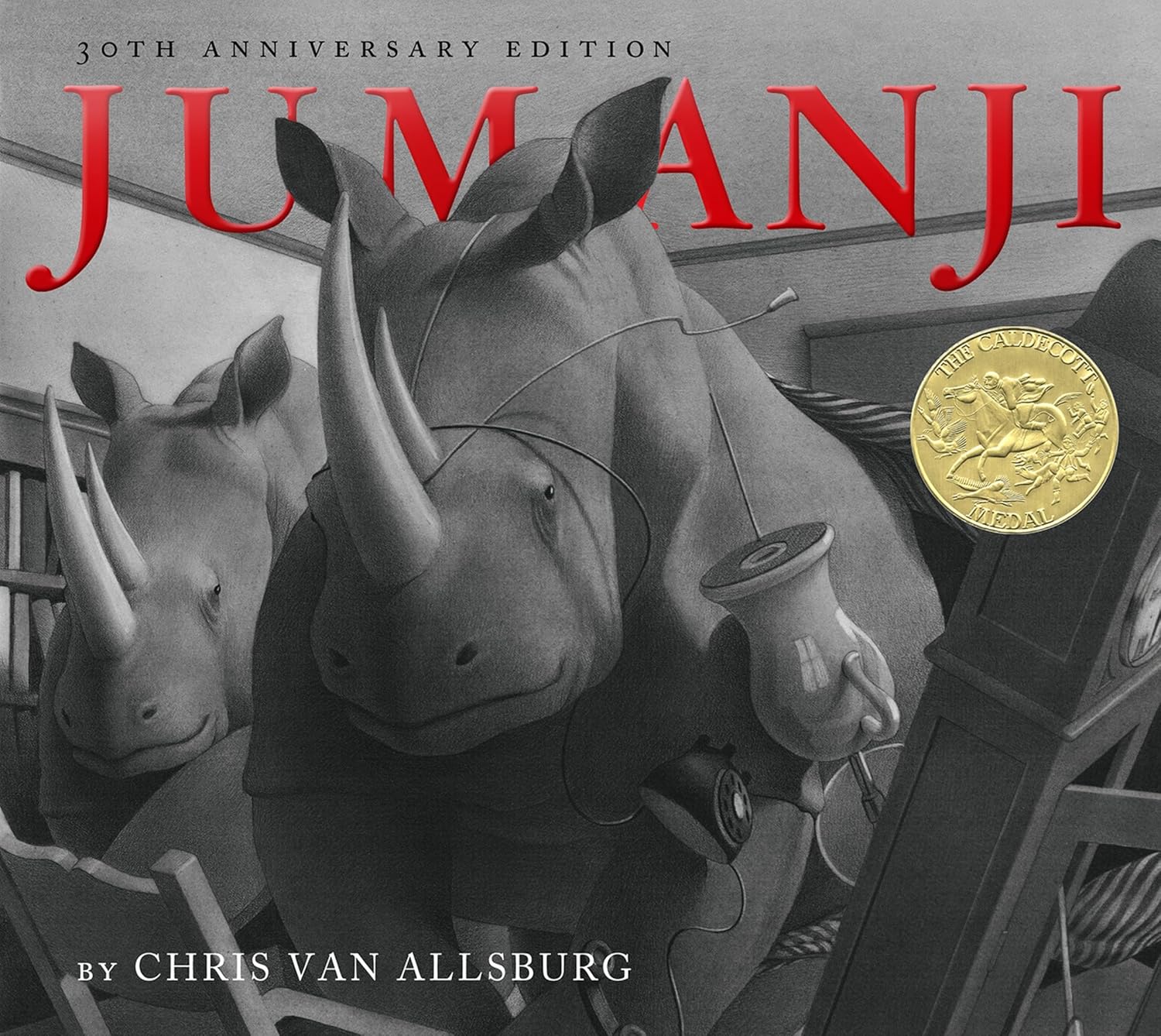
Jumanji, written and illustrated by Chris Van Allsburg, is a 32-page picture book about two bored children — Judy and Peter — who find a mysterious board game under a tree in the park. The box warns them that the game, once started, must be finished — and that anyone who leaves it unfinished will be trapped in the jungle forever. They begin to play. With every roll, the instructions on each square come literally true: a lion appears on the piano, monkeys overturn the kitchen, a monsoon soaks the living room, a python coils around the bookcase, an eight-foot rhinoceros charges through the hall. Published in 1981 and winner of the Caldecott Medal and the National Book Award, it is one of the most celebrated picture books in American publishing history. Van Allsburg’s signature black-and-white pencil illustrations — precise, photorealistic, charged with an atmosphere of controlled menace — give the jungle animals an uncanny solidity in the domestic setting that makes the book’s central tension entirely convincing. It is the book that launched three Hollywood films and the book that established Van Allsburg as one of the defining picture book creators of his generation. This guide covers Jumanji‘s reading level, whether it’s a read-aloud or independent read, what it’s about, its themes, how long it takes to read, and similar books — designed for parents and teachers of K–2 readers.
For Parents
A suspenseful, visually stunning picture book about a magical board game that brings the jungle into the house — genuinely exciting rather than scary, with a controlled menace that makes it compelling for children and adults alike. Best for ages 5–9. No content concerns; some animals may startle very young children. The book that the Robin Williams and Dwayne Johnson films are based on — and quite different from both.
For Teachers
A K–4 classroom staple for units on fantasy vs. reality, cause and effect, and following instructions. Van Allsburg’s black-and-white illustrations are exceptional for art studies and for discussing how visual choices create atmosphere. The hidden Fritz Easter egg rewards careful looking. The companion book Zathura (2002) extends the story and makes a natural pairing for a Van Allsburg author study.
Jumanji at a Glance
Find on Amazon →| Author & Illustrator | Chris Van Allsburg (author & illustrator) |
| Published | 1981 (Houghton Mifflin) |
| Grade Level | K–4 (our assessment) |
| Recommended Age | 5–9 |
| Lexile | AD620L |
| ATOS Level | 3.9 |
| Guided Reading Level | R |
| Word Count | 1,800 |
| Pages | 32 |
| Genre | Picture book / fantasy / adventure |
| Awards | Caldecott Medal (1982); National Book Award (1982); ALA Notable Book; Boston Globe–Horn Book Honor |
For official Lexile and AR levels, visit Lexile.com or AR BookFinder. ReadingVine provides independent editorial assessments.
What Reading Level Is Jumanji?
Jumanji has a Lexile of AD620L and an ATOS level of 3.9, with a Guided Reading Level of R and a grade level equivalent of 3. These scores reflect a picture book with significantly more text than average — at 1,800 words across 32 pages, it is one of the longest picture book texts in this catalog, comparable to the demanding Two Bad Ants (1,232 words, ATOS 4.7). Van Allsburg’s prose is clear and well-paced but not simple: the sentences are complete and grammatically complex, the vocabulary includes words like “monotonous,” “stampede,” and “unconscious,” and the narrative requires readers to track a sequence of escalating consequences across the full length of the book.
Despite these scores, the book is widely used as a read-aloud from kindergarten onward because the story’s suspense carries even very young listeners through the text, and the illustrations provide strong visual anchoring for children who cannot yet process the prose independently. Our editorial assessment: read-aloud for ages 5–9 across K–2 grades; comfortable independent reading at grades 2–4. For official Lexile and AR scores, visit Lexile.com or AR BookFinder. ReadingVine’s assessments are independent editorial judgments.
Is Jumanji a Read-Aloud or Independent Read?
This works excellently as both a read-aloud for ages 5–9 and an independent read for strong readers at grades 2–4. As a read-aloud the suspense builds naturally — each new animal or jungle event is a genuine surprise, and Van Allsburg’s controlled, matter-of-fact prose makes the escalating absurdity more rather than less alarming. The lion on the piano, the monsoon in the living room, the python on the bookcase — each is described with the same calm specificity, which is exactly the right tone for a story about children who are trapped and must keep playing no matter what.
For independent reading, the ATOS 3.9 places it comfortably for third- and fourth-graders who are ready for sustained narrative in picture book form. Strong second-graders who have heard it read aloud will return to it independently with growing comprehension. The book’s ending — which opens a door to the Zathura companion — rewards the kind of careful rereading that finds the two boys running with the game and asks: what happens next?
Look for Fritz — the bull terrier who appears hidden in every Chris Van Allsburg book. In Jumanji he appears as a small toy dog on wheels in the third illustration. Children who find him first get bragging rights, and looking for him across Van Allsburg’s other books (Two Bad Ants, The Polar Express, and others) becomes one of the most satisfying Van Allsburg reading games. Ask before you start: “Van Allsburg hides a dog named Fritz in every book he illustrates. Can you find him?”
What Is Jumanji About?
Judy and Peter are bored. Their parents have gone to the opera and the afternoon stretches out, dull and quiet. They go to the park, where they find a long, flat box under a tree. Inside is a board game called Jumanji, with a note: “Free game, fun for some but not for all. P.S. Read instructions carefully.” The instructions warn that the game, once started, must be finished — and that the jungle will not disappear until one player reaches the golden city of Jumanji and calls out the name.
They take the game home and begin. Peter rolls first and lands on a square: “Lion attacks, move back two spaces.” A lion appears, real and full-sized, on the piano. They roll again. Monkeys appear and overturn the kitchen. A monsoon begins in the living room. Peter rolls a guide who is lost and cannot direct them, then tsetse flies that make Judy fall into a sleeping sickness, then a rhinoceros stampede through the hall, then a python coiled around the bookcase. With each new disaster, both children are terrified, and both are also aware that the only way out is through — they must finish the game.
Judy finally rolls and lands on Jumanji. She calls out the name. Everything disappears — the lion, the monkeys, the python, every trace of the jungle. The house is as it was. Their parents return from the opera and notice nothing. The children put the game back in its box and return it to the park, leaving it under the tree. On the last page, two boys who had been warned not to take anything from the park are seen running toward home — one of them carrying the Jumanji box.
The Book vs. the Films
The 1995 film starring Robin Williams takes the book’s premise — a magical jungle board game — in an entirely different direction. In the film, a boy named Alan Parrish is trapped inside the game for twenty-six years when another player rolls him into the jungle, and the story concerns his eventual rescue decades later. None of this is in the book: the book’s Alan does not exist, no one is trapped inside the game, and the story takes place in a single afternoon. Parents and children who love the film will find the book both familiar and surprising — the same game, the same fundamental idea, and a much more contained story.
The 2017 and 2019 films (*Welcome to the Jungle* and *The Next Level*) take the premise even further from the original book, placing characters inside a video game version of Jumanji and featuring entirely different characters and storylines. They share only the game’s name and basic conceit with Van Allsburg’s original. For families who know the films, reading the original book is a productive exercise in understanding how an adaptation works — what is kept, what is changed, and why.
The direct companion to the original book is Zathura (2002), also by Van Allsburg, which follows the two boys seen on the last page of Jumanji as they discover the science-fiction board game hidden inside the Jumanji box.
Jumanji Characters
Judy and Peter are siblings whose individual personalities emerge through their responses to the game’s escalating disasters: Peter tends toward panic and impulsive decisions; Judy is calmer and more strategic, the one who ultimately rolls Jumanji and ends the game. Neither is named in the illustrations — Van Allsburg follows his characteristic practice of keeping faces ambiguous or partially hidden, which gives the story a slightly dreamlike quality. The parents are present only at the beginning and end, oblivious to everything that happened in between; their ordinary conversation when they return (“What did you do this afternoon?”) lands with all the irony Van Allsburg intends. Fritz the bull terrier, Van Allsburg’s hidden signature character who appears in all his books, can be found as a toy on wheels in the third illustration.
Jumanji Themes and Lessons
The book’s central tension — a jungle adventure appearing in a ordinary house — works because Van Allsburg refuses to make it comedic. The animals are described with the same calm precision as everything else; there are no winking jokes; the danger is treated as real. This is what gives the book its specific quality of controlled menace: Judy and Peter are genuinely frightened, genuinely trapped, and genuinely unable to do anything except keep playing. The moral — read the instructions, finish what you start, do not make choices with consequences you have not thought through — is embedded in the structure of the game itself rather than stated by any character.
The ending is the book’s most carefully constructed moment. The house is restored perfectly. The parents return and notice nothing. The children have been through something that leaves no trace. This is a recurring Van Allsburg pattern — the adventure that might or might not have happened, the return to normalcy that does not quite explain what was real — and it is the quality that distinguishes his books from straightforward fantasy. Children argue about whether Jumanji really happened. The book does not resolve the argument.
The last image — the two boys running with the game box — is the book’s most chilling detail. The game is going to start again. Someone is going to play who has not read the instructions. The story does not end with safety; it ends with the cycle beginning again, in someone else’s house. Zathura shows what happens next.
Talking with your child: Why did Judy and Peter keep playing even when things got worse? What would you have done if you found this game? Were the animals real, or was it all a dream — how do you know? What do you think the two boys at the end of the book are about to do? Did Judy and Peter make a mistake by leaving the game in the park?
Fritz: The Hidden Dog in Every Van Allsburg Book
Chris Van Allsburg hides a small bull terrier named Fritz somewhere in the illustrations of every book he illustrates. Fritz is named after a dog belonging to Van Allsburg’s friend and fellow illustrator David Macaulay, who appears in all of Van Allsburg’s books as a private signature and a reward for careful looking. In Jumanji he appears as a toy dog on wheels in the third illustration. In Two Bad Ants he appears in a different form. In The Polar Express he is there too — and in every other Van Allsburg title. For children who love Van Allsburg’s books, finding Fritz is one of the great small pleasures of reading through his catalog; it makes each new book a puzzle as well as a story. A complete list of Fritz sightings across the books is available on various fan and library websites and makes an excellent classroom extension activity.
How Long Is Jumanji?
Jumanji is 32 pages with 1,800 words — the most text of any picture book in this catalog. Most adults can read it aloud in about twelve to fifteen minutes. The companion book Zathura: A Space Adventure (2002) follows Danny and Walter — the two boys seen at the end of Jumanji — as they find a science-fiction board game hidden inside the Jumanji box and are launched into outer space. Reading both books in sequence gives the full arc of what becomes of the Jumanji game after Judy and Peter leave it in the park. Zathura was also adapted into a film (2005), directed by Jon Favreau, which is substantially more faithful to Van Allsburg’s book than the Jumanji films are to theirs.
Books Similar to Jumanji
About Chris Van Allsburg
For a full biography of Chris Van Allsburg, see our Two Bad Ants guide. Jumanji was Van Allsburg’s second picture book, published in 1981 after his debut The Garden of Abdul Gasazi (1979) received a Caldecott Honor. Jumanji won the Caldecott Medal and the National Book Award in 1982, making Van Allsburg one of only a handful of picture book creators to win both major awards for the same book in the same year. He won his second Caldecott Medal three years later for The Polar Express (1985).
Van Allsburg has said that the idea for Jumanji came from a simple visual premise: what would it look like if a lion appeared, full-sized and real, in an ordinary living room? The question of what made the premise feel genuinely threatening rather than merely absurd led him to the matter-of-fact prose style — describing the animals with the same calm specificity as everything else in the house — and to the black-and-white illustrations, which give the jungle elements the same visual weight as the furniture and walls around them. The game box’s instructions, the warning to finish what you start, and the ending that opens the door to Zathura were all part of the original conception.
Jumanji: Frequently Asked Questions
What reading level is Jumanji?
Jumanji has a Lexile of AD620L, ATOS 3.9, and Guided Reading Level R — grade level equivalent 3. Our assessment: read-aloud for ages 5–9 across K–2; comfortable independent reading at grades 2–4. At 1,800 words it is the most text-dense picture book in this catalog. For official Lexile and AR scores, visit Lexile.com or AR BookFinder.
What is Jumanji about?
Judy and Peter find a board game in the park called Jumanji, which warns that once started it must be finished or the jungle will overtake their world permanently. They begin to play and the game’s instructions come literally true: a lion appears on the piano, monkeys overturn the kitchen, a monsoon floods the living room, a python coils around the bookcase, a rhinoceros stampedes through the hall. They must finish the game to make it stop — and when they do, everything disappears without a trace.
Is Jumanji scary for young children?
The book has genuine suspense and a controlled menace — the jungle animals are described as real threats, not cartoon ones. Most children ages 5 and up find this exciting rather than frightening; children who are sensitive to animals or to loss of control may find some sequences intense. The book has no violence; everything disappears cleanly at the end. Reading it aloud first, with an adult present, is the right approach for children who might be worried.
How is the Jumanji book different from the movies?
Significantly. The 1995 Robin Williams film adds a character (Alan Parrish) trapped inside the game for 26 years, which does not exist in the book. The book’s story takes place in one afternoon with two children, Judy and Peter, and ends with everything restored and the game returned to the park. The 2017 and 2019 films share only the game’s name and basic premise with Van Allsburg’s original. The most faithful companion is Zathura (2002), Van Allsburg’s own sequel.
What is the ending of Jumanji?
Judy rolls and lands on Jumanji, calls out the name, and everything disappears — the lion, the monkeys, the python, every trace of the jungle. The parents return from the opera and notice nothing. The children return the game to the park. On the last page, two boys who had been warned not to take anything from the park are seen running toward home with the Jumanji box — the beginning of the next game, which is told in Van Allsburg’s companion book Zathura (2002).
What is Fritz, and where is he in Jumanji?
Fritz is a bull terrier that Chris Van Allsburg hides somewhere in the illustrations of every book he illustrates — his private signature, named after a dog belonging to his friend and fellow illustrator David Macaulay. In Jumanji he appears as a small toy dog on wheels in the third illustration. Finding Fritz across Van Allsburg’s books is one of the great small pleasures of his catalog and a reliable classroom extension activity.
Is there a sequel to the Jumanji book?
Yes — Zathura: A Space Adventure (2002), also by Van Allsburg, follows the two boys seen on the last page of Jumanji as they find a science-fiction board game hidden inside the Jumanji box. It was adapted into a film by Jon Favreau in 2005, which is considerably more faithful to Van Allsburg’s book than the Jumanji films are to theirs.