
 = Partner Site
Two Bad Ants Reading Level: A Complete Guide
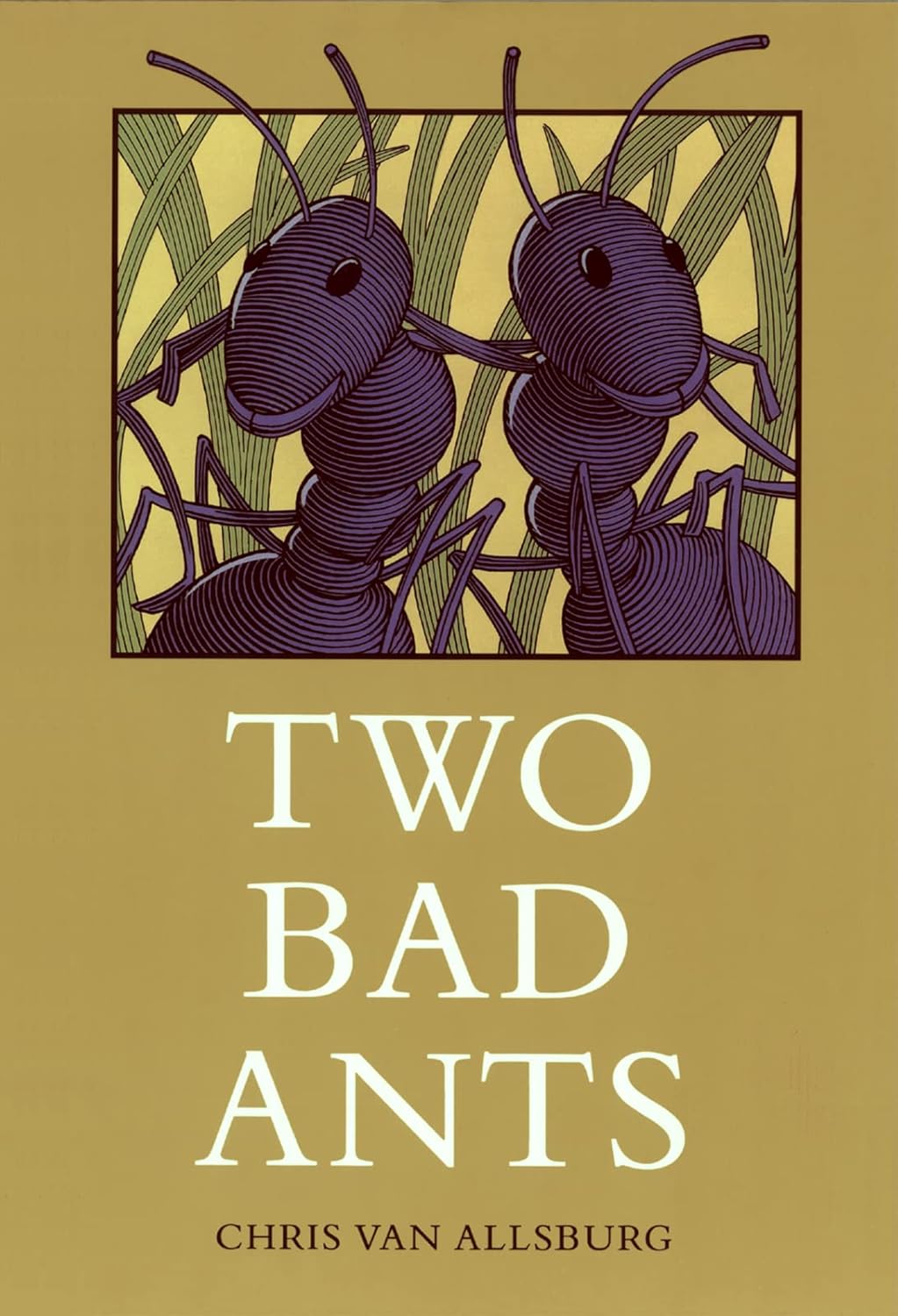
Two Bad Ants, written and illustrated by Chris Van Allsburg, is a 32-page picture book about two ants who, on a mission to collect sugar crystals for their queen, decide to stay behind in the sugar bowl when the rest of the colony departs. The book follows them through the catastrophic morning that follows — swept up in a spoon, dumped into a boiling black liquid, loaded into a glowing metal cave, nearly destroyed by a whirring drain — until they crawl back out the window and return home, grateful for the safety of the ant colony they abandoned. Published in 1988 and illustrated with Van Allsburg’s signature detailed, almost photographic pencil drawings, it is entirely narrated from the ants’ point of view: the kitchen is never named as a kitchen, the coffee cup is never called a coffee cup, and every ordinary household object is described as the ants experience it — vast, alien, and terrifying. The result is one of the most original picture books in American publishing, a masterpiece of sustained perspective that has been used to teach point of view in classrooms from kindergarten through high school. This guide covers Two Bad Ants‘ reading level, whether it’s a read-aloud or independent read, what it’s about, its themes, how long it takes to read, and similar books — designed for parents and teachers of K–2 readers.
For Parents
A visually stunning, narratively inventive picture book told entirely from an ant’s perspective — kitchen objects become alien landscapes, and a morning in the sugar bowl becomes an epic of survival. Best as a read-aloud for ages 4–8, with independent reading accessible for strong third- and fourth-graders. No content concerns. A book that rewards slow, close reading and re-reading with growing appreciation.
For Teachers
One of the most versatile picture books for teaching point of view, perspective, and descriptive language across K–6. At the youngest grades it is a stunning read-aloud; at the older grades it is a model for teaching how perspective shapes description. Van Allsburg never names a single kitchen object — the defamiliarization technique is fully sustained for 32 pages, making it an extraordinary text for discussion of how authors choose what to say and what to leave unsaid.
Two Bad Ants at a Glance
Find on Amazon →| Author & Illustrator | Chris Van Allsburg (author & illustrator) |
| Published | 1988 (Houghton Mifflin / Clarion Books) |
| Grade Level | K–5 (our assessment) |
| Recommended Age | 4–10 |
| Lexile | 780L |
| ATOS Level | 4.7 |
| Word Count | 1,232 |
| Pages | 32 |
| Genre | Picture book / adventure / perspective narrative |
For official Lexile and AR levels, visit Lexile.com or AR BookFinder. ReadingVine provides independent editorial assessments.
What Reading Level Is Two Bad Ants?
Two Bad Ants has a Lexile of 780L and an ATOS level of 4.7 — by far the highest reading level scores of any picture book in this K–2 catalog, and more consistent with independent chapter book reading at the third- to fifth-grade level. These scores accurately reflect the text: Van Allsburg writes in full, complex sentences with sophisticated vocabulary and sustained descriptive passages that describe ordinary objects from an ant’s perspective in deliberately unfamiliar language. A coffee cup becomes “a strange lake.” A toaster becomes “a glowing cave with heated air.” The garbage disposal is described as a whirring, grinding machine of incomprehensible violence.
Despite these scores, Two Bad Ants is graded PreK–6 by TeachingBooks and is widely used as a picture book read-aloud at every grade level. The reason is the illustrations: Van Allsburg’s highly detailed pencil drawings, presented from ant height and ant scale, make the book’s point-of-view technique visible and accessible even to children who cannot yet process the prose independently. A four-year-old who cannot read the word “crystalline” understands the sugar crystal illustration perfectly. The reading level scores describe the text; the experience of the book is considerably more accessible than those scores suggest. Our editorial assessment: read-aloud for ages 4–8 across K–2 grades; independent reading at grades 3–5, ages 8–10. For official Lexile and AR scores, visit Lexile.com or AR BookFinder. ReadingVine’s assessments are independent editorial judgments.
The Point-of-View Technique — What Makes This Book Extraordinary
The defining quality of Two Bad Ants is that Van Allsburg never once names a single object in the kitchen from a human perspective. Not “coffee,” not “toaster,” not “sink,” not “garbage disposal.” Every object is described entirely as the ants experience it: its scale, its sensory properties, its effects on the ants’ bodies. The result is a sustained act of perspective-taking that runs for the book’s entire length and that makes every page a small puzzle for readers who enjoy naming what the ants are experiencing.
The coffee cup: “The ants landed in a dark liquid. It was hot and swirling, like a tiny ocean in a storm.” The toaster: “The ants crawled into a cave of glowing red walls. The air grew hotter. The floor began to vibrate.” The garbage disposal: “A wild spinning thing appeared in the darkness, grinding everything it touched into nothing.” None of these objects are named. All of them are recognizable once you see the illustrations. The gap between what the ants perceive and what the reader knows is the book’s central dramatic irony — and its central teaching opportunity.
This technique — defamiliarization, the literary term for making the familiar strange — is one of the most sophisticated narrative devices in Van Allsburg’s catalog, and he deploys it with complete consistency. There is not a single break in perspective across the book’s 1,232 words. For classroom use, the most productive question is simply: “What is this? How do you know?” — asked at each new object. Children who can answer that question are practicing exactly the kind of inference and close reading that reading instruction aims at.
Is Two Bad Ants a Read-Aloud or Independent Read?
This is primarily a read-aloud for ages 4–8 — one of the great read-aloud experiences in Van Allsburg’s catalog. Read aloud, the perspective-taking happens in real time: the adult reads the ants’ description, children look at the illustration, and the naming game — “it’s a toaster!” — generates genuine excitement. The book’s sustained suspense (will the ants survive?) and the comedy of the misidentified objects keep the reading engaging across its full length.
For independent reading, the ATOS 4.7 and 780L Lexile place comfortable independent engagement at grades 3–5. Strong third-graders who love the book as a read-aloud will return to it independently to work through the descriptions more carefully and name the objects on their own. This is particularly valuable as a reading experience because it requires active inference rather than passive decoding.
Before each new object appears, pause after Van Allsburg’s description and ask: “What do you think this is?” Cover the illustration until your child has guessed. Then reveal it together. This transforms the read-aloud into a collaborative puzzle-solving experience, and it makes Van Allsburg’s perspective technique visceral rather than abstract — your child is doing the work of seeing from the ants’ point of view rather than just hearing about it.
What Is Two Bad Ants About?
The ant colony receives a mission: bring sugar crystals to the queen. The ants march in formation across the terrain — through grass, across pavement, up a wall, through a window — and find their destination: a bowl filled with glittering sugar crystals. Each ant takes one crystal and prepares to march home. But two ants linger. The crystals are extraordinary — the most delicious thing they have ever tasted. They decide to stay. They will live in the sugar bowl and eat the treasure forever.
Night passes peacefully. In the morning, a giant spoon descends and scoops them up along with the sugar. They are dumped into a hot, dark, swirling liquid — a cup of coffee. They survive, scramble out, and hide. They find their way to a flat circular object covered in holes — an English muffin in the toaster — and crawl inside just as the heating coils activate. They escape, burning. They make their way to a shiny cliff edge — a sink — and fall in. A great grinding darkness rises from the drain. They escape again. They crawl into a small cave with two holes and are struck by a great force — an electrical outlet. The world goes white.
When they recover, the two ants look at each other. They make their way back across the vast kitchen landscape, through the window, down the wall, and home to the ant colony. They will never leave again. The last spread shows them, small and safe, among the thousands of other ants, content to do their work and stay where they belong.
Two Bad Ants Characters
The two ants are individualized only by their choice — they are the ones who stay when everyone else leaves, the ones who prioritize immediate pleasure over the safety of the group. They are never named, and their interior lives are rendered entirely through the perspective of what they perceive and how they respond to it. The ant colony functions as the moral contrast: organized, purposeful, returning safely with what they came for. The queen, whose desire for sugar crystals sets the story in motion, is present only as motivation. The kitchen and its objects — coffee cup, toaster, sink, garbage disposal, electrical outlet — function as a set of antagonists whose danger is entirely the product of scale and perspective.
Two Bad Ants Themes and Lessons
The book operates on two levels simultaneously. For children, it is a suspense adventure — will the ants survive the toaster? the garbage disposal? the electrical outlet? — illustrated with enough visual detail to make each danger vividly real. For teachers and older readers, it is a text about perspective: everything in it is an ordinary kitchen object, and the ants’ terror is entirely a function of their scale and their ignorance of what they are encountering. The book argues, implicitly, that perspective determines experience — that the same object can be a tool, a food source, or an instrument of destruction depending entirely on who is encountering it and from what position.
The moral is present but relatively light-handed for Van Allsburg: the two ants suffer the consequences of their greed and their decision to break from the community, and they return home grateful. School Library Journal noted in 1988 that the moral conclusion felt “oddly pallid” relative to the visual intensity of the adventure — and this is accurate. The book’s strongest argument is not the moral but the perspective technique, which is why it has been used across grade levels as a teaching tool long after any lesson about “don’t be greedy” has been absorbed.
Talking with your child: What was the “dark liquid” the ants fell into? What was the “glowing cave”? How did you figure it out — what clues did you use? Why do you think Van Allsburg never tells us what these things really are? What would the story feel like if he described everything the regular human way? Why did the two ants decide to go home at the end — what changed?
How Long Is Two Bad Ants?
Two Bad Ants is 32 pages with 1,232 words — the most text-dense picture book in this catalog by a wide margin. At ATOS 4.7 and with Van Allsburg’s complex descriptive sentences, most adults will take about twelve to fifteen minutes for a read-aloud, particularly if pausing at each object to play the identification game. The book rewards multiple readings: children who know what each object is will bring that knowledge back to the first encounter with each new threat, reading with anticipatory understanding rather than mystery. It stands entirely on its own; Van Allsburg has not written a sequel, though the character of the kitchen as an alien landscape has inspired many classroom extension activities, including writing exercises in which children describe other household objects from an ant’s perspective.
Books Similar to Two Bad Ants
About Chris Van Allsburg
Chris Van Allsburg was born on June 18, 1949, in Grand Rapids, Michigan. He studied sculpture at the University of Michigan and the Rhode Island School of Design, where he later taught. His first picture book, The Garden of Abdul Gasazi (1979), received a Caldecott Honor. He won the Caldecott Medal for Jumanji (1981) and again for The Polar Express (1985) — two Caldecott Medals in four years, which made him one of the most celebrated picture book author-illustrators of his generation. He has also received the Regina Medal for lifetime achievement in children’s literature, a National Book Award, and a Society of Illustrators Original Art Lifetime Achievement Award.
Van Allsburg’s visual style evolved significantly across his career. His early work, including Two Bad Ants, uses highly detailed pencil or charcoal drawings in earth tones and grays, with a photorealistic, almost etching-like quality. His later Caldecott Medal books use rich, luminous color. The illustrations for Two Bad Ants are specifically designed to enhance the perspective effect: the extremely detailed rendering at ant scale makes the kitchen objects feel immense and alien, while the precise line work gives each surface a textural specificity that conventional cartoony illustrations could not achieve. He lives outside of Boston, Massachusetts.
Two Bad Ants: Frequently Asked Questions
What reading level is Two Bad Ants?
Two Bad Ants has a Lexile of 780L and an ATOS of 4.7 — by far the highest reading level scores of any picture book in this catalog, reflecting Van Allsburg’s complex, sustained descriptive prose. Our assessment: read-aloud for ages 4–8 across K–2; independent reading at grades 3–5, ages 8–10. The illustrations make the book accessible to young children as a read-aloud despite the text’s complexity. For official Lexile and AR scores, visit Lexile.com or AR BookFinder.
What is Two Bad Ants about?
Two ants, sent with their colony to collect sugar crystals, decide to stay in the sugar bowl rather than return home. They are then swept through a morning in a human kitchen — dumped into a coffee cup, loaded into a toaster, nearly destroyed by a garbage disposal and an electrical outlet — before escaping and returning home, grateful for the safety they abandoned.
Why does Van Allsburg never name the kitchen objects?
Because naming them would break the ants’ perspective. The entire book is told from the ants’ point of view — they do not know what a coffee cup or a toaster is, so the narrative cannot name them either. This sustained perspective technique is the book’s most distinctive quality and its primary teaching tool: readers must infer what each object is from the ants’ description and the illustration, which is exactly the kind of active reading that develops comprehension and inference skills.
What are the kitchen objects in Two Bad Ants?
In order: a sugar bowl (where the ants spend the night), a coffee cup (the “dark swirling liquid”), a toaster (the “glowing cave” with an English muffin — described as a “giant disc with holes”), a kitchen sink (the “shiny cliff”), a garbage disposal (the “grinding darkness”), and an electrical outlet (the “small cave with two holes”). None are named in the text; all are identifiable from the illustrations.
Who is Chris Van Allsburg?
A two-time Caldecott Medal winner (for Jumanji in 1982 and The Polar Express in 1986) and one of the most acclaimed picture book author-illustrators of his generation. Two Bad Ants (1988) is among his most inventive books — a sustained exercise in perspective-taking that has been used to teach point of view from kindergarten through high school. He lives outside Boston, Massachusetts.
How long does it take to read Two Bad Ants aloud?
About twelve to fifteen minutes, particularly if pausing at each new object for the identification game — “what do you think this is?” before revealing the illustration. This interactive approach transforms the read-aloud into a collaborative puzzle and is the most effective way to experience the book’s perspective technique with young children.