
 = Partner Site
The Polar Express Reading Level: A Complete Guide
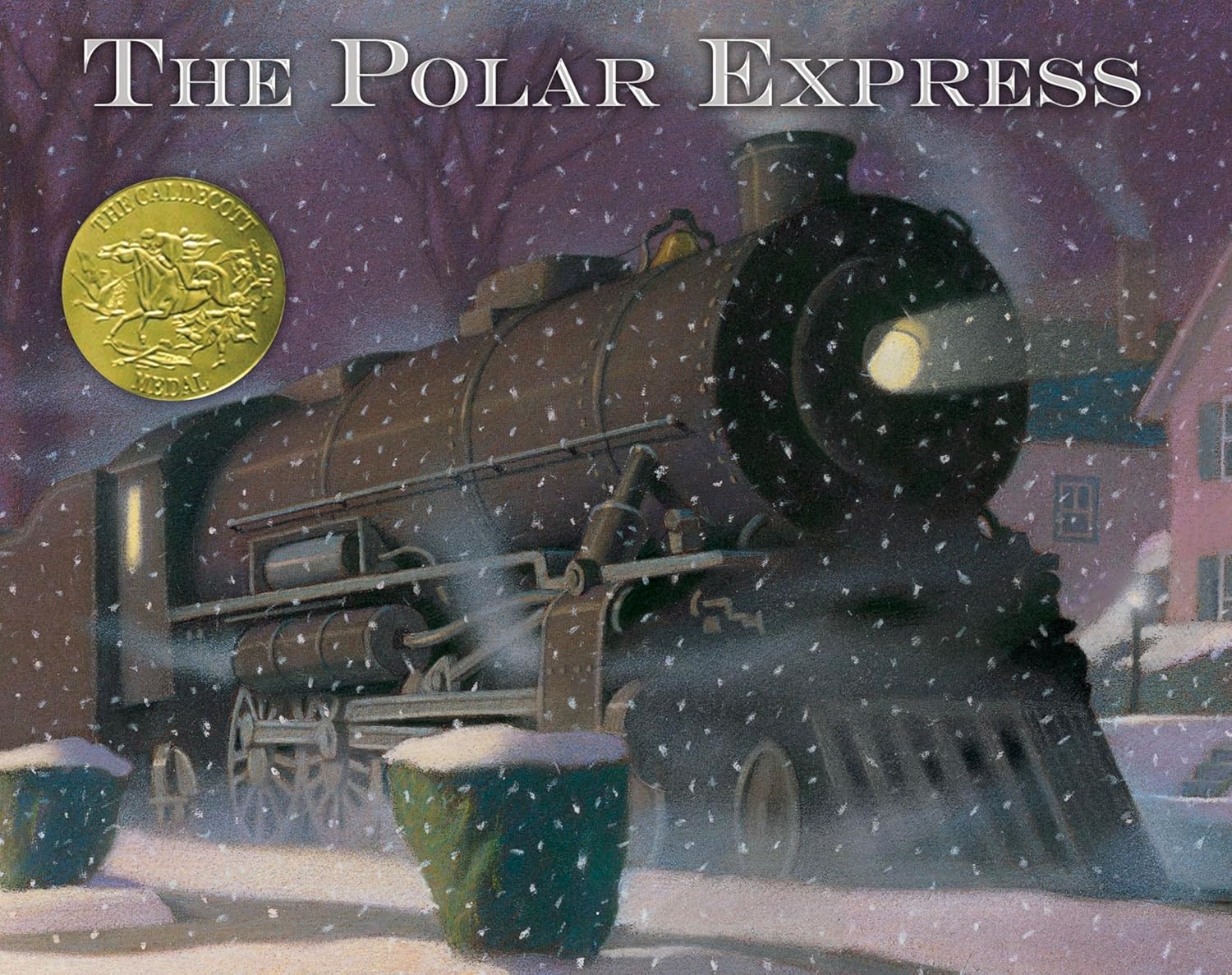
The Polar Express by Chris Van Allsburg is one of the most beloved Christmas picture books ever published — a hushed, dreamlike story about a boy who boards a mysterious train on Christmas Eve and travels to the North Pole, where he asks Santa for the one gift his heart desires: a single bell from the reindeer’s harness, a bell that only those who still believe can hear. A 1986 Caldecott Medal winner, it has sold more than seven million copies and become as central to American Christmas tradition as any picture book in print. This guide covers the reading level, recommended age, read-aloud vs. independent reading guidance, themes, and everything parents and teachers need to know about sharing this classic with young readers.
For Parents
Find out whether The Polar Express works best as a read-aloud or independent read for your child, what age range it suits, and why this Caldecott Medal winner has become one of the most widely gifted picture books of the holiday season year after year.
For Teachers
Grade-level data, read-aloud timing, key themes, and discussion questions for one of the most widely used holiday classroom books in American education. Strong for discussions of belief and doubt, imagination, the sensory experience of winter, and what it means to listen for something you’re not sure is there.
The Polar Express at a Glance
Find on Amazon →| Author & Illustrator | Chris Van Allsburg |
| Published | 1985 |
| Grade Level | K–2 (our assessment) |
| Recommended Age | 4–8 |
| Best For | Read-aloud ages 3–8; independent reading ages 6–8 |
| Flesch-Kincaid Grade | 4.2 |
| Word Count | ~1,050 |
| Pages | 32 |
| Genre | Picture book / fantasy / Christmas |
| Setting | Christmas Eve; a mysterious train; the North Pole |
| Awards | Caldecott Medal (1986); Boston Globe Horn Book Award; NEA Teachers’ Top 100 Books for Children |
For official Lexile and AR levels, visit Lexile.com or AR BookFinder. ReadingVine provides independent editorial assessments.
What Reading Level Is The Polar Express?
The Polar Express is a K–2 reading level by our editorial assessment, with a Flesch-Kincaid grade level of approximately 4.2 — the highest on the K–2 list. The word count is around 1,050 words, but the text is denser and more literary than most picture books: Van Allsburg writes in a measured, atmospheric prose style that uses longer sentences, richer vocabulary, and carefully controlled pacing to build the book’s particular mood of hushed wonder. Words like “roared,” “flickered,” “conductor,” and “harness” are not sounded-out-and-forgotten but are doing real tonal work in the story.
Parents who see the FK score of 4.2 should understand that it accurately reflects the reading complexity, but should also know that the book’s power is almost entirely an aural and visual experience. The illustrations — Van Allsburg’s pastel paintings, rendered in deep greens, blues, and golds with a mastery of light that earned him the Caldecott Medal — carry as much of the story as the words do, and children who hear the book read aloud while looking at the pictures are experiencing it fully regardless of whether they could decode the text independently. This is very much a read-aloud book first.
For parents who use specific reading level systems: we recommend checking your child’s level on Lexile.com or AR BookFinder for official scores, or asking your child’s teacher for their Guided Reading or DRA level.
Is The Polar Express a Read-Aloud or Independent Read?
The Polar Express is primarily a read-aloud for ages 3–8 and can work as an independent read for ages 6–8 with some vocabulary support. As a read-aloud, it is one of the great seasonal performances in picture book literature — Van Allsburg’s prose has a cadence and a gravity that rewards a reader who leans into its quietness, and the book’s atmosphere of hushed wonder is best conveyed by a human voice giving it the time it deserves. Most adults can read it aloud in about 10–15 minutes.
As a read-aloud, the key is pace. The Polar Express is not a fast book — it is a slow, deliberate, increasingly dreamlike journey — and reading it quickly or briskly breaks the spell. The train’s arrival should feel like an intrusion of magic into an ordinary night; the North Pole should feel vast and cold and real; the moment the boy chooses his gift should feel both small and enormous. Van Allsburg’s illustrations reward being looked at for a full beat before turning the page, and the book’s most experienced readers know to let each spread breathe. Christmas Eve, after other books have been read and the house is settling, is the natural setting for it.
For independent reading, a confident second grader can manage most of the vocabulary, though some words — “lurched,” “caribou,” “robe” in the context of the conductor’s uniform — may need brief support. The narrative is linear and clearly structured, which makes the comprehension load more manageable than the FK score suggests. Children who have heard the book read aloud several times before reading it independently will find the experience considerably richer because they already carry the story’s rhythm and atmosphere in their memory.
A note for parents: The Polar Express has a quiet undertow of melancholy. The bell the boy asks for is lost on the way home; he finds it again Christmas morning, but his friends cannot hear it, and eventually his parents and his sister lose the ability to hear it too. The book ends with the boy, now grown, still able to hear the bell — the only one who can. This is the book’s most emotionally true moment, and it catches some families off guard on a first reading. It is worth being present for it.
Before you begin, make the room as dark as comfortable and settle in together — The Polar Express is one of the few picture books that is genuinely improved by reading conditions that match its atmosphere. After the ending, before the lights come back up, ask quietly: “Do you think you could hear the bell?” Most children say yes without hesitation, and that answer — that uncomplicated yes — is the whole point of the book. Let it land before you turn the lights on.
What Is The Polar Express About?
On Christmas Eve, a boy lies in bed listening for the sound of Santa’s sleigh. Instead, he hears a train — the Polar Express — stopped perfectly still outside his house, steam hissing in the cold night. The conductor invites him aboard. The train is full of children in pajamas. It travels through dark forests and snowy mountains, finally arriving at the North Pole — a vast, cold, luminous city of elves and reindeer and a great warehouse of toys. Santa will choose one child to receive the first gift of Christmas. He chooses the boy. The boy asks for one bell from the reindeer’s harness — the most modest gift he could have requested.
On the way home the bell slips through a hole in his pocket and is lost. On Christmas morning he finds it under the tree, wrapped in a small box. It rings with a beautiful, clear sound that only he can hear. His sister can hear it too, for a time. But as the years pass, his parents and eventually his sister lose the ability to hear it. The boy, now a man, still hears it every Christmas — because he has never stopped believing. The bell rings for him still.
The Polar Express Characters
The Polar Express Themes and Lessons
The central theme of The Polar Express is the nature and value of belief — specifically, the choice to believe in something when you cannot prove it, and what you gain and lose as you grow older and that choice becomes harder. The book does not argue that Santa is real in the literal sense; it argues that the capacity for belief is real, and that people who preserve it can hear things that others cannot. The bell that only believers can hear is the book’s most precise image: not a statement about Santa’s existence but about what we are capable of experiencing when we choose to remain open to wonder.
The book’s most emotionally complex moment — when the boy’s parents, and eventually his sister, lose the ability to hear the bell — is Van Allsburg’s most honest acknowledgment that growing up involves loss. The parents are not villains; they simply can no longer hear it. The sister holds on longer, but she too falls silent. Only the boy — now a man — still hears it. This is not presented as a triumph so much as a quiet, precious thing he has managed to keep. Children who hear this ending often feel something they cannot articulate, which is the right response to it.
For teachers, The Polar Express opens naturally into discussions of sensory experience and imagination: what does it mean to hear something others cannot? What does it feel like to believe something you can’t prove? The book also works in units on winter, trains, and the North Pole as a cultural space — Van Allsburg’s North Pole is meticulously imagined, a cold, functional, enormous place that feels genuinely other-worldly rather than merely festive.
Discussion starters for families: Why do you think the boy asked for a bell instead of a toy? Why can the boy still hear the bell when others can’t? What do you think it sounds like? Have you ever believed in something you couldn’t see or prove? What is the most important thing you believe in?
How Long Is The Polar Express?
The Polar Express has 32 pages and approximately 1,050 words. Most adults can read it aloud in about 10–15 minutes. The book benefits from being read slowly — each spread of Van Allsburg’s illustrations deserves a genuine pause, and the atmospheric prose loses its power if rushed. A reading that takes the full 15 minutes and allows for silence at the turning points is considerably more effective than one that moves briskly through it.
A child reading independently at a second-grade level will typically finish in about 12–18 minutes. Because the book is best experienced as a slow, atmospheric event rather than a quick reading, independent reading is best done in a quiet setting — this is not a book to read in a car or with distractions nearby.
Books Similar to The Polar Express
If your child loves The Polar Express, these titles share its atmosphere of hushed wonder, its classic picture book stature, or its place at the heart of the seasonal and Classic PB cluster:
About the Author and Illustrator
Chris Van Allsburg is an American author and illustrator born in Grand Rapids, Michigan, who came to children’s books through an unlikely route: he trained as a sculptor at the University of Michigan and the Rhode Island School of Design, and his first picture book, The Garden of Abdul Gasazi (1979), began as a series of sketches his wife showed to an editor — a casual experiment that became one of the most recognized careers in American children’s publishing. The Polar Express was published in 1985, and The Polar Express was partly set in Grand Rapids, the city where Van Allsburg grew up. The book’s inspiration came from his childhood memories of the Herpolsheimer’s and Wurzburg’s department stores at Christmas, and from a steam locomotive — Pere Marquette 1225 — that he used to play on as a child when it was on static display in the city. The locomotive’s number, 1225, read to him as 12/25: Christmas Day. That locomotive was later used to create the CGI train in the 2004 film adaptation.
The Polar Express won the Caldecott Medal in 1986 — Van Allsburg’s second, after Jumanji won it in 1982, making him one of only a handful of illustrators to win the medal twice. He also received the Boston Globe Horn Book Award for the book. His illustrations for The Polar Express are widely considered some of the finest pastel work in American picture book art: the play of train lights through falling snow, the vertiginous overhead view from Santa’s sleigh, the vast illuminated cold of the North Pole at night. Van Allsburg trained as a sculptor, and his illustrations have the quality of sculpture — forms that feel three-dimensional, light that feels physically present, space that feels genuinely inhabitable. He has since written and illustrated more than 20 books, including The Mysteries of Harris Burdick (1984), Jumanji (1981), and Zathura (2002), and has received the Regina Medal for lifetime achievement in children’s literature.
The Polar Express: Frequently Asked Questions
What reading level is The Polar Express?
The Polar Express is a K–2 reading level by our editorial assessment, with a Flesch-Kincaid grade level of approximately 4.2 — the highest on the K–2 list. Van Allsburg’s measured, atmospheric prose style uses longer sentences and richer vocabulary than most picture books. It works best as a read-aloud for ages 3–8 and as an independent read for ages 6–8. For official Lexile and AR levels, visit Lexile.com or AR BookFinder.
What age is The Polar Express for?
The Polar Express is appropriate for ages 3–8. As a read-aloud it works beautifully from age 3 — the illustrations and the atmosphere carry young children through even when the text is above their independent reading level. As an independent read it suits second graders ages 6–8. It is one of those books that adults find as moving as children do, and it is genuinely a family book in the fullest sense of that word.
Is The Polar Express based on a true story?
Not literally, but it draws on real places and objects from Van Allsburg’s childhood. The book is partly set in Grand Rapids, Michigan, where he grew up, and was inspired by his memories of department stores at Christmas and by a steam locomotive, Pere Marquette 1225, that he played on as a child. The locomotive’s number — 1225 — read to him as 12/25, Christmas Day, and it became the inspiration for the story’s train. That same locomotive was later used as the reference for the CGI train in the 2004 film adaptation.
How long does it take to read The Polar Express aloud?
Most adults can read The Polar Express aloud in about 10–15 minutes. The book benefits strongly from a slow pace — Van Allsburg’s illustrations deserve a genuine pause on each spread, and the atmospheric prose loses its particular magic if rushed. A reading that takes the full 15 minutes and allows for silence at the turning points is considerably more powerful than one that moves briskly through it.
What is The Polar Express about?
The Polar Express is about a boy who hears a train outside his house on Christmas Eve — the Polar Express — and boards it with other children for a journey to the North Pole. Santa chooses him to receive the first gift of Christmas, and he asks for one small bell from the reindeer’s harness. The bell is lost on the way home but found again Christmas morning. Only those who believe can hear it ring. As the years pass, first his parents and then his sister lose the ability to hear it, but the boy — now a man — hears it still. It is a story about belief: what it costs, what it gives, and what happens when you choose to keep it.
Why does the bell in The Polar Express only ring for some people?
The bell rings only for those who believe — in Santa Claus, but more broadly in the spirit of wonder and openness that Santa represents. As children grow up, many lose this capacity gradually; in the book, the boy’s parents and eventually his sister can no longer hear it. The boy, now grown, still can, because he has never stopped believing. Van Allsburg never explains the mechanics of this, and he doesn’t need to. The bell is the book’s central image for something most adults recognize: the things you could once hear clearly that have grown quieter as the years passed, and what it means to be the one who can still hear them.