
 = Partner Site
Oh, the Places You’ll Go! Reading Level: A Complete Guide
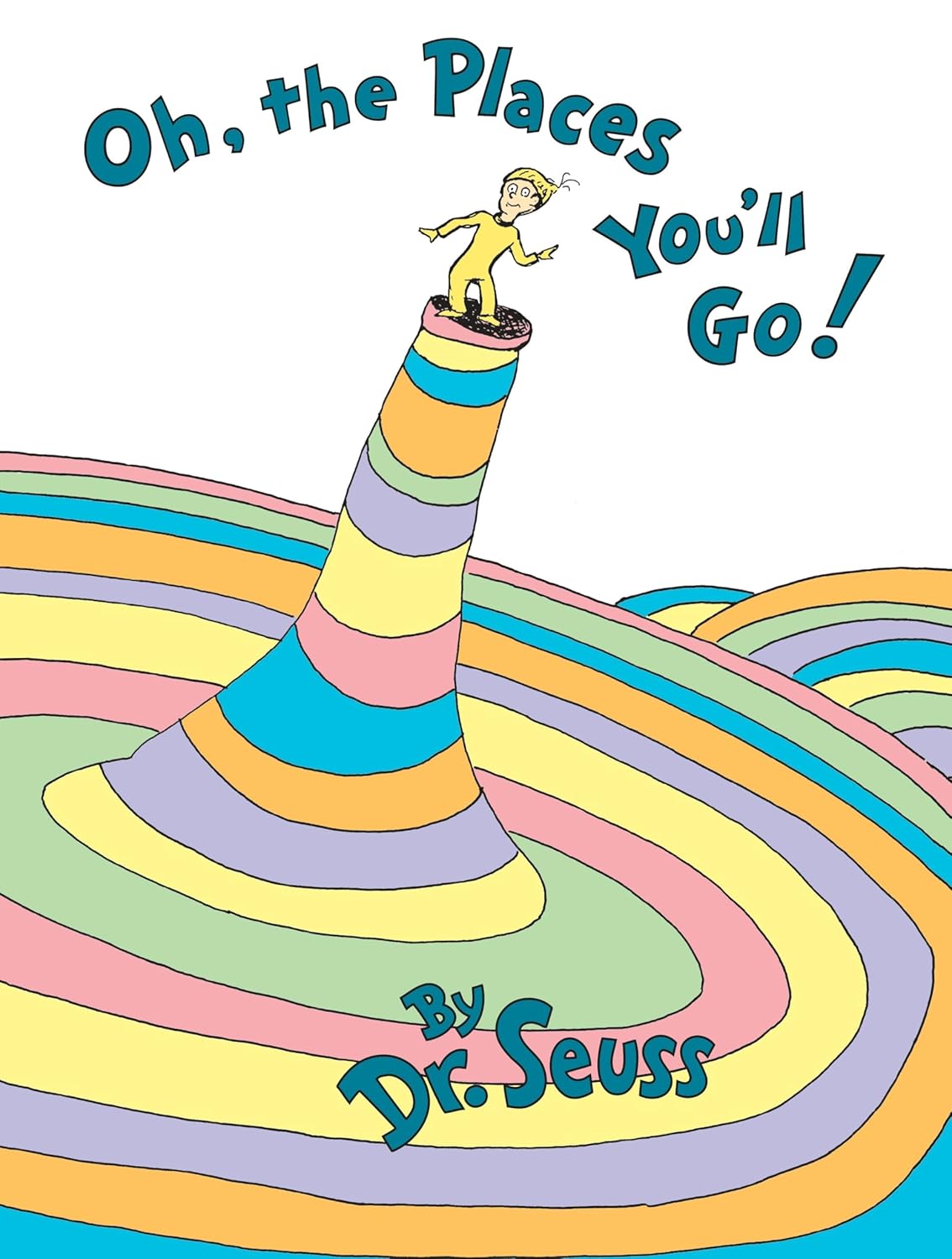
Oh, the Places You’ll Go! by Dr. Seuss is the last book he published during his lifetime — a sweeping, second-person meditation on life’s journey, its high points and low points, its waiting places and mountain-moving moments. Published in 1990, it has become one of the most widely gifted graduation books in American culture, with sales spiking every spring from kindergarten ceremonies to college commencements. This guide covers the reading level, recommended age, read-aloud vs. independent reading guidance, themes, and everything parents and teachers need to know about sharing this book with young readers.
For Parents
Find out whether Oh, the Places You’ll Go! works best as a read-aloud or independent read for your child, what age range it suits, and why this book occupies an unusual place in the Seuss catalog — neither a phonics tool nor a simple story, but something closer to a poem about being alive.
For Teachers
Grade-level data, read-aloud timing, key themes, and discussion questions for a book that works at every grade level simultaneously. Often read at kindergarten graduation and K–2 milestones, it is equally at home in a high school or college ceremony. Strong for discussions of perseverance, resilience, the Waiting Place, and what it means to begin something new.
Oh, the Places You’ll Go! at a Glance
Find on Amazon →| Author & Illustrator | Dr. Seuss (Theodor Seuss Geisel) |
| Published | 1990 |
| Grade Level | K–2 (our assessment) |
| Recommended Age | 4–8 (and beyond) |
| Best For | Read-aloud ages 4–8; independent reading ages 6–8 |
| Flesch-Kincaid Grade | 3.4 |
| Word Count | ~960 |
| Pages | 56 |
| Genre | Picture book / inspirational verse |
| Setting | Fantastical landscapes representing life’s journey |
| Awards | #1 New York Times Bestseller; NEA Teachers’ Top 100 Books for Children |
For official Lexile and AR levels, visit Lexile.com or AR BookFinder. ReadingVine provides independent editorial assessments.
What Reading Level Is Oh, the Places You’ll Go!?
Oh, the Places You’ll Go! is a K–2 reading level by our editorial assessment, with a Flesch-Kincaid grade level of approximately 3.4. At around 960 words it is one of the longer picture books on this list, and unlike The Cat in the Hat or Green Eggs and Ham, it was not written with a controlled vocabulary or a phonics goal. The text is Seuss’s mature verse — longer sentences, more complex rhymes, invented words like “Hakken-Kraks” and “Neetches” — and while it shares the familiar anapestic rhythm of his early readers, the conceptual content is considerably richer.
This is the most important thing to understand about this book’s reading level: the decoding level and the comprehension level point in very different directions. A confident first grader can read most of the words. Very few first graders will fully grasp what the Waiting Place is, or what it means to be “left in a Lurch,” or why “98 and 3/4 percent guaranteed” is both funny and reassuring. The book is genuinely K–2 as an independent read; it is also genuinely meaningful to adults who haven’t opened it since kindergarten. This is not a common thing in children’s publishing, and it is why the book occupies such an unusual place in the Seuss catalog.
For parents who use specific reading level systems: we recommend checking your child’s level on Lexile.com or AR BookFinder for official scores, or asking your child’s teacher for their Guided Reading or DRA level.
Is Oh, the Places You’ll Go! a Read-Aloud or Independent Read?
Oh, the Places You’ll Go! works beautifully as both a read-aloud for ages 4–8 and an independent read for ages 6–8, but it is unusual among books at this level in that the read-aloud audience effectively has no upper limit. Parents read it at kindergarten graduations and college send-offs with equal feeling, because the book addresses the reader directly — “you” — and means it regardless of who is in the room. Most adults can read it aloud in about 10–14 minutes.
As a read-aloud, the book’s second-person address is its most distinctive and most powerful feature. Seuss does not tell a story about a character; he speaks directly to the reader. The cumulative effect of this — the highs, the lows, the Waiting Place, the mountains — is more like a poem than a picture book narrative, and reading it aloud gives the language time to land in a way that silent reading sometimes doesn’t. Seuss’s illustrations for this book are among the most visually inventive of his late career — rich, swirling, geometrically complex landscapes that feel genuinely earned as representations of where life can take you.
For independent reading, a confident first or second grader can handle the text, though some of the invented words and conceptual passages — the Hakken-Kraks, the Lurch, the Waiting Place — will benefit from a brief conversation. The Waiting Place in particular deserves attention: Seuss describes it as “a most useless place” where everyone is simply waiting for something to happen. This is one of the most psychologically precise things he ever wrote, and children often have genuine things to say about it.
There is nothing in this book that requires parental preparation. It is warm, funny, and honest about difficulty in a way that feels encouraging rather than alarming. The acknowledgment that there will be hard times — slumps, lurches, the Waiting Place — is offset at every turn by the book’s fundamental conviction that the reader will be fine. Most children find this reassuring. Some adults do too.
When you reach the Waiting Place, slow down and ask your child: “Have you ever been in a waiting place — somewhere you were stuck, waiting for something to happen?” Most children ages 5 and up have a version of this experience, and connecting it to the book’s language gives them a way to talk about it. Then, when Seuss says “NO! That’s not for you!” and the journey resumes, the escape from the Waiting Place feels genuinely earned rather than abstract.
What Is Oh, the Places You’ll Go! About?
The book addresses “you” directly — a small figure setting out into the world — and follows the journey of a life. You will go up. You will go down. You will soar to high heights and encounter great sights. You will face frightening creeks and howling Hakken-Kraks. You will find yourself in the Waiting Place, where everyone is simply waiting for something to happen — and then you will get out of it. You will win games and lose games, make big decisions, go through lonely stretches, and arrive at places where you will move mountains.
The book does not promise that the journey will be easy. It promises that the reader has what it takes to make it. The tone throughout is warm and bracing in equal measure — Seuss acknowledges the slumps and the lurches and the times when things get strange, then assures the reader that they will find their way through. The book ends with the reader poised at the beginning of their mountain, ready to go. It is Seuss’s final book, published the year before his death, and his biographers have written that he considered it his farewell — “his last parade, Mulberry Street gone worldwide.”
Oh, the Places You’ll Go! Characters
Oh, the Places You’ll Go! has one character: you. The small figure who navigates the book’s fantastical landscapes is explicitly the reader — Seuss uses the second person throughout, addressing “you” directly rather than following a named protagonist. This is unusual in picture books and is the source of the book’s unusual emotional range: it works as a graduation gift for a five-year-old and a college senior for the same reason, because “you” genuinely means whoever is holding the book. The small figure in the illustrations — rendered in Seuss’s characteristic loose line, moving through swirling colors and geometrically complex landscapes — functions as a stand-in rather than a character, giving the reader room to project themselves into the journey rather than observing it from outside.
Oh, the Places You’ll Go! Themes and Lessons
The central theme of Oh, the Places You’ll Go! is resilience in the face of an uncertain journey — the conviction that setbacks, slumps, and waiting places are real and temporary, and that the person facing them has what it takes to get through. This is a more honest version of the “you can do anything” message than most inspirational books deliver, because Seuss doesn’t pretend the difficulties aren’t there. He names them specifically — the Hakken-Kraks howl, the lonely stretches are lonely, the Waiting Place is genuinely useless — and then says: so what, keep going. That acknowledgment of difficulty is what gives the encouragement its weight.
The Waiting Place is the most psychologically rich passage in the book and the one that generates the most discussion at every age level. Seuss describes it as a place where everyone is simply waiting — for a train to go, for a yes or a no, for their hair to grow, for the fish to bite — and calls it “a most useless place.” For young children, this resonates as a description of boredom and restlessness. For adults, it resonates as something considerably more specific. The book’s insistence that the Waiting Place is not for the reader — that the reader has things to do and places to go — is one of the most useful things a children’s book has ever said to the adults who read it aloud.
The book is also a quiet argument for the value of beginning. The reader starts the journey on the first page and the book ends with them about to begin again — mountain waiting, journey ready, today the day. The circular quality of this — the book ends where life always ends, which is at the beginning of the next thing — is more sophisticated than most picture books attempt, and it lands differently for a five-year-old starting kindergarten than for an eighteen-year-old starting college, though it lands truly for both.
Discussion starters for families: What do you think the Waiting Place feels like? Have you ever been stuck waiting for something to happen? What does “you’ll move mountains” mean — do you think it means real mountains? What is one place you’d like to go? What are you setting out to do next?
How Long Is Oh, the Places You’ll Go!?
Oh, the Places You’ll Go! has 56 pages and approximately 960 words. Most adults can read it aloud in about 10–14 minutes. The book’s verse structure means the pacing varies — some passages are brisk and bouncing, others (particularly the Waiting Place) deserve to be read more slowly — and a thoughtful reading naturally takes longer than a straightforward one.
A child reading independently at a first- or second-grade level will typically finish in about 12–18 minutes. Unlike most Seuss books, this one is rarely read multiple times in immediate succession — it is more typically experienced as a single meaningful event, returned to at different moments in life when its particular combination of honesty and encouragement is needed.
Books Similar to Oh, the Places You’ll Go!
If your child loves Oh, the Places You’ll Go!, these titles share its spirit of encouragement, its themes of setting out and persevering, or its place in the canon of meaningful milestone books:
About the Author and Illustrator
Dr. Seuss (Theodor Seuss Geisel, 1904–1991) published Oh, the Places You’ll Go! on January 22, 1990 — his last book to be published during his lifetime. He died on September 24, 1991, at the age of 87. The book is widely regarded by those who knew him as his conscious farewell: his biographers, Judith and Neil Morgan, wrote that “Ted considered Oh, the Places You’ll Go! his farewell salute, his last parade, Mulberry Street gone worldwide.” His wife Audrey has recalled that Geisel worried the book sounded “preachy,” a concern he apparently had about any work that was too directly instructive — and she reassured him it wasn’t. The title itself has a personal origin: at Dartmouth College, where Geisel earned his bachelor’s degree in 1925, students would greet each other with the optimistic exchange “Oh, the places you’ll go!” and “The people you’ll meet!” Geisel’s book immortalizes one half of that salutation.
The book’s commercial trajectory has been remarkable. It reached number one on the New York Times bestseller list immediately after publication, and has returned to the top of bestseller lists multiple times since — driven almost entirely by the annual graduation season, when it reliably becomes the most-purchased book in the United States. It is Dr. Seuss’s best-selling title overall, with more than 12.5 million copies sold. The National Education Association named it one of its Teachers’ Top 100 Books for Children in 2007. The illustrations, drawn from favorite unpublished sketches that Geisel assembled and connected specifically for this book, are considered some of the most visually inventive of his late career. His career awards include the Pulitzer Prize Special Citation, two Caldecott Honors, and eight honorary doctorates, along with three Oscars, three Emmys, three Grammys, and a Peabody for adaptations of his work.
Oh, the Places You’ll Go!: Frequently Asked Questions
What reading level is Oh, the Places You’ll Go!?
Oh, the Places You’ll Go! is a K–2 reading level by our editorial assessment, with a Flesch-Kincaid grade level of approximately 3.4. Unlike Seuss’s early readers, it was not written with a controlled vocabulary or phonics goal — it is mature verse with invented words and conceptual passages. It works best as a read-aloud for ages 4–8 and as an independent read for ages 6–8. For official Lexile and AR levels, visit Lexile.com or AR BookFinder.
What age is Oh, the Places You’ll Go! for?
Oh, the Places You’ll Go! is appropriate for ages 4 and up — with no meaningful upper limit. As a read-aloud it works from age 4, and children find it meaningful and funny. As an independent read it suits first and second graders ages 6–8. As a gift and a shared reading experience, it has been given to kindergartners and doctoral graduates with equal sincerity, because the book addresses “you” directly and means it regardless of who is holding it.
Why is Oh, the Places You’ll Go! given at graduations?
Oh, the Places You’ll Go! became a graduation tradition because it directly addresses a reader who is setting out on something new, acknowledges that the journey will include both highs and hard patches, and conveys genuine confidence that the reader will make it through. It works at kindergarten graduation and college graduation for the same reason — because “you” is genuinely universal, the journey metaphor applies to every new beginning, and the book’s honesty about difficulty makes its encouragement feel earned rather than hollow. Sales spike every year from April through June for exactly this reason.
How long does it take to read Oh, the Places You’ll Go! aloud?
Most adults can read Oh, the Places You’ll Go! aloud in about 10–14 minutes. The Waiting Place passage benefits from a slightly slower pace, and a reading that allows the verse to find its natural rhythm — rather than rushing through the rhymes — often runs toward the higher end of that range. It is worth taking the time.
What is Oh, the Places You’ll Go! about?
Oh, the Places You’ll Go! addresses the reader directly as “you” and follows the arc of a life’s journey — the soaring highs, the frightening places, the lonely stretches, the Waiting Place where nothing happens, and the mountains that are waiting to be moved. It does not promise an easy journey. It promises that the reader has what it takes to make it through. Published in 1990 as Dr. Seuss’s last book before his death in 1991, it is his farewell — warm, honest, and ultimately full of faith in whoever is reading it.
What is the Waiting Place in Oh, the Places You’ll Go!?
The Waiting Place is a passage in which Seuss describes a place where everyone is simply waiting — for a train, for a yes or no, for the phone to ring, for their hair to grow — and calls it “a most useless place.” He then says it is not for the reader, who has things to do and places to go. For young children it resonates as a description of boredom and being stuck. For older readers and adults it often resonates as something more specific — the experience of life pausing and not knowing how to make it move again. It is one of the most discussed passages in any Seuss book, and it generates genuine conversation at every age.