
 = Partner Site
The Cat in the Hat Reading Level: A Complete Guide
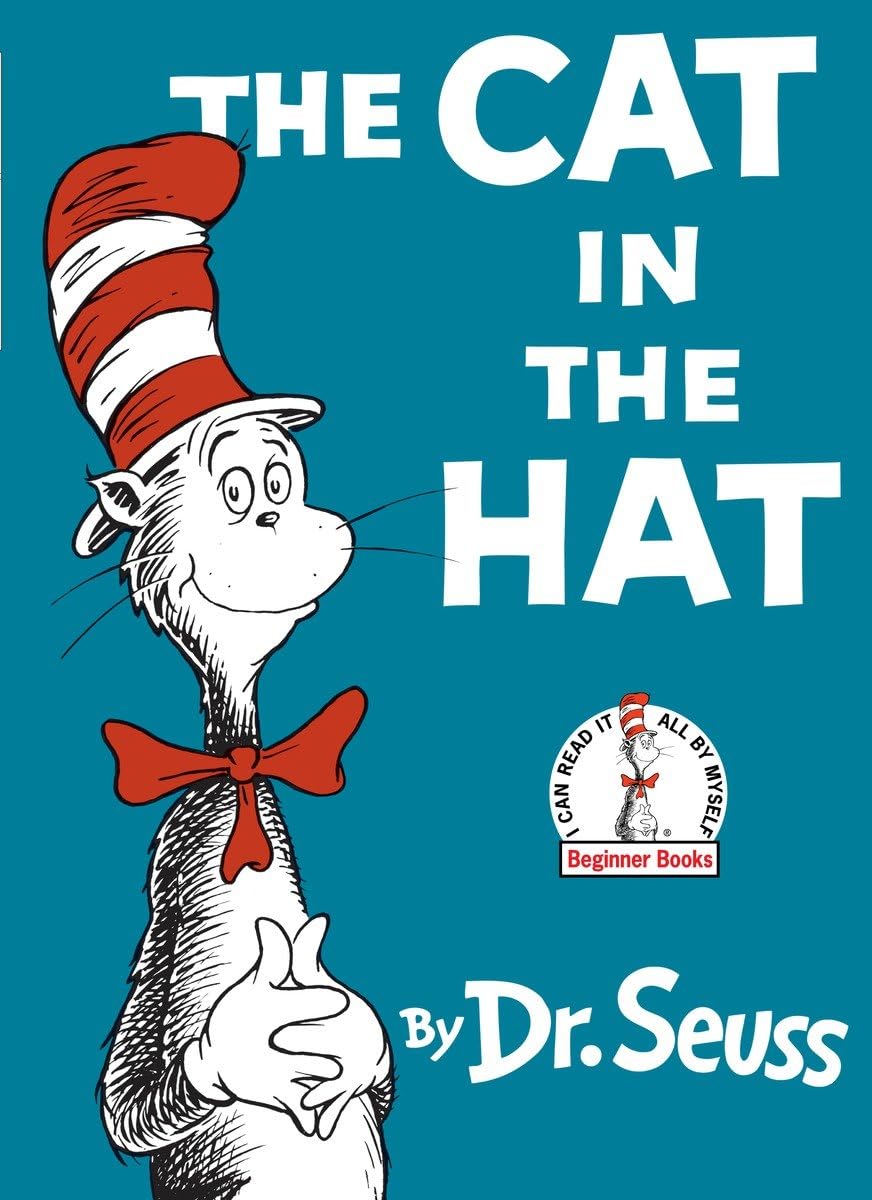
The Cat in the Hat by Dr. Seuss is a highly influential children’s books ever published — not just a beloved story but the book that changed how America taught children to read. Written in 1957 as a deliberate response to the dull, ineffective primers of the era, it proved that early readers could be exciting, funny, and genuinely literary all at once. This guide covers the reading level, recommended age, read-aloud vs. independent reading guidance, themes, and everything parents and teachers need to know about sharing this classic with young readers.
For Parents
Find out whether The Cat in the Hat works best as a read-aloud or independent read for your child, what age range it suits, and why this book has been a cornerstone of early reading instruction for nearly seventy years.
For Teachers
Grade-level data, read-aloud timing, key themes, and discussion questions for the book that launched the Beginner Books imprint and redefined what an early reader could be. Essential for phonics instruction, rhyme families, early reading fluency, and discussions of rules, chaos, and responsibility.
The Cat in the Hat at a Glance
Find on Amazon →| Author & Illustrator | Dr. Seuss (Theodor Seuss Geisel) |
| Published | 1957 |
| Grade Level | K–1 (our assessment) |
| Recommended Age | 4–8 |
| Best For | Read-aloud ages 3–7; independent reading ages 5–7 |
| Flesch-Kincaid Grade | 2.1 |
| Word Count | ~1,600 (using 223 unique words) |
| Pages | 61 |
| Genre | Picture book / early reader |
| Setting | A house on a cold, rainy day |
| Awards | Horn Book Children’s Classic; BILBY Early Readers Award (2004, 2012) |
For official Lexile and AR levels, visit Lexile.com or AR BookFinder. ReadingVine provides independent editorial assessments.
What Reading Level Is The Cat in the Hat?
The Cat in the Hat is a K–1 reading level by our editorial assessment, with a Flesch-Kincaid grade level of approximately 2.1. The entire book was written using a controlled vocabulary of 223 words — selected from a list of words that first-grade readers were expected to know — and Seuss reportedly spent nine months writing it because the constraint was so difficult to work within while still producing something genuinely entertaining. At around 1,600 words it is significantly longer than Green Eggs and Ham, and its sentences are correspondingly more complex.
The 223-word vocabulary makes The Cat in the Hat one of the most carefully engineered early reading texts ever published. Every word was chosen to be decodable by a beginning reader while still serving the story. The rhyme scheme reinforces phonics patterns — hat/cat/that/flat/sat, thing/ring, fish/wish, bump/jump — in a way that makes the word families memorable. Parents who see the FK score of 2.1 should know it accurately reflects the decoding demand, but the book’s narrative complexity — multiple characters, escalating stakes, a comedic structure that requires tracking the accumulation of chaos — places it at the higher end of what beginning readers can comprehend in a single sitting.
For parents who use specific reading level systems: we recommend checking your child’s level on Lexile.com or AR BookFinder for official scores, or asking your child’s teacher for their Guided Reading or DRA level.
Is The Cat in the Hat a Read-Aloud or Independent Read?
The Cat in the Hat works brilliantly as both a read-aloud for ages 3–7 and an independent read for ages 5–7. As a read-aloud, the book is a performance in the best possible sense — Seuss’s anapestic tetrameter demands energy and rhythm, the Cat’s voice rewards theatrical delivery, and the escalating chaos generates genuine anticipation. Most adults can read it aloud in about 10–15 minutes, though a fully committed performance often runs longer.
As a read-aloud, the comedy works on multiple levels simultaneously. The Cat’s showmanship and the Fish’s escalating alarm are funny to children at face value; the question of whether the Cat will clean up the mess before the mother returns provides genuine narrative tension; and Seuss’s illustrations — the deliberately unstable stacking of objects, the fish’s increasingly panicked expressions — add visual jokes that extend the humor of each page. Children who look closely at the pictures often catch things the text doesn’t say.
For independent reading, a confident late-kindergartner or first grader can handle the text, particularly one who has already encountered Seuss’s rhythm in Green Eggs and Ham or other Beginner Books. The 223-word vocabulary means that a child who has mastered basic phonics patterns and common sight words will be able to decode most of the text independently. The longer sentences and narrative complexity make it a more demanding independent read than Green Eggs and Ham, and many children benefit from having heard it read aloud several times before tackling it solo.
There is nothing in this book that requires parental preparation. The Cat’s mischief is exhilarating rather than frightening, the mess is cleaned up, and the mother never knows. The one thing worth noting is the book’s final question — the narrator asks the reader directly whether they would tell their mother — which can open a genuine conversation about honesty and rules, if you want it to.
Let your child be the Fish — the voice of caution and alarm throughout the book. The Fish says “No! No! Make that Cat go away!” and variations on that refrain across multiple pages, and children who take on that role get both a reading participation opportunity and the comedic experience of being completely ignored by the plot. After the book, ask: “Was the Fish right?” The answer is more interesting than it first appears.
What Is The Cat in the Hat About?
Two children — a boy and his sister Sally — are stuck inside on a cold, rainy day with nothing to do. Their mother is away. Then there is a loud bump, and in walks the Cat in the Hat: a tall, improbable figure in a striped top hat who promises to show them good tricks and good games. Their pet fish protests that the Cat should go. The Cat ignores this entirely and proceeds to balance an extraordinary number of objects while standing on a ball, then produces Thing One and Thing Two from a locked box and lets them loose with kites inside the house. The mess grows to spectacular proportions. The fish continues to object. Then the children hear their mother coming home.
The Cat, with his machine, cleans up everything — the fish, the kites, the Things, the entire accumulated chaos — before the mother walks in. She finds the house exactly as she left it. The narrator asks the reader a question: what would you do if your mother asked you what you did that day? The book ends there, leaving the answer to the reader. It is a story about the seductive appeal of chaos, the authority of rules, and the particular thrill of a mess that gets cleaned up just in time.
The Cat in the Hat Characters
The Cat in the Hat Themes and Lessons
The central theme of The Cat in the Hat is the tension between rules and freedom — specifically, the allure of doing something you know you probably shouldn’t while the authority figure is away, and the specific anxiety of whether the evidence will survive your getting away with it. Young children understand this tension intuitively. They know the Cat should probably go. They are thrilled that he doesn’t. The Fish is right, and they know it, and they don’t want to be the Fish. This is one of the more psychologically honest premises in children’s literature.
The book’s famous final question — what would you do if your mother asked you what you did that day? — turns the theme into a direct moral inquiry addressed to the reader. There is no answer given. Seuss leaves it open, which is both braver and more honest than providing one. The question generates genuine classroom discussion because children have real, competing instincts about it: honesty matters, and also getting away with something is part of how childhood works, and also the Cat did clean everything up. These are not simple things to resolve, and the book respects that.
As a literacy tool, the book’s significance goes beyond its phonics value. The Cat in the Hat changed what early reading could look like. When it was published in 1957, the dominant reading primers — Dick and Jane and their equivalents — were safe, simple, and deeply dull. Seuss proved that a book constrained to a beginning reader’s vocabulary could still be exciting, funny, and genuinely worth reading. That proof changed children’s publishing permanently. Every engaging early reader since owes something to this book.
Discussion starters for families: Was the Cat being kind or irresponsible? Should the children have told the Cat to leave? Would you have told your mother what happened? Was the Fish right all along? What would you do if someone offered to show you good tricks in your house while your parents were away?
How Long Is The Cat in the Hat?
The Cat in the Hat has 61 pages and approximately 1,600 words, using a controlled vocabulary of 223 unique words. Most adults can read it aloud in about 10–15 minutes. The escalating structure — the mess grows, the Fish’s objections grow, the tension about the mother’s return grows — means the pacing naturally accelerates toward the end.
A child reading independently at a late kindergarten or first-grade level will typically finish in about 15–20 minutes. Unlike Green Eggs and Ham, which many children read multiple times in a row, The Cat in the Hat is typically experienced as a single satisfying reading event — a story with a beginning, middle, escalating stakes, and a resolution — that children want to return to on subsequent days rather than immediately.
Books Similar to The Cat in the Hat
If your child loves The Cat in the Hat, these titles share its rhythmic energy, its mischievous premise, or its place in the early reading canon:
About the Author and Illustrator
Dr. Seuss (Theodor Seuss Geisel, 1904–1991) created The Cat in the Hat in direct response to a challenge. In 1954, journalist Rudolf Flesch published Why Johnny Can’t Read, a critique of American reading education that argued that the Dick and Jane primers used in most classrooms were so boring they were actively discouraging children from reading. William Spaulding, director of the education division at Houghton Mifflin, approached Geisel with a list of 348 words that a first-grader should know and asked him to write an entertaining book using only those words. The task took nine months. The book used 223 of them. Seuss has said that the title came from searching the word list for two that rhymed and could anchor a character — “cat” and “hat” were the first suitable pair he found.
The Cat in the Hat was published in 1957 and sold out immediately, spreading by playground word of mouth in a way that surprised everyone including the publisher. Its success led directly to the founding of Beginner Books, a publishing imprint that Seuss established with his wife and a colleague specifically to produce more books of this kind — engaging, rhyming, vocabulary-controlled early readers that children would actually want to read. Seuss served as president and editor of Beginner Books, and Green Eggs and Ham, published three years later, was its most famous product.
The book’s legacy is difficult to overstate. Before The Cat in the Hat, the assumption that early reading texts had to be simple, safe, and dull was essentially unchallenged. Seuss demonstrated that a controlled vocabulary was a constraint to write within, not an excuse to write badly. Every engaging early reader published since — the Elephant & Piggie series, Frog and Toad, Fly Guy — owes a debt to what Seuss proved was possible in 1957. Dr. Seuss’s career awards include the Pulitzer Prize Special Award, two Caldecott Honors, and eight honorary doctorates, along with three Oscars, three Emmys, three Grammys, and a Peabody for adaptations of his work.
The Cat in the Hat: Frequently Asked Questions
What reading level is The Cat in the Hat?
The Cat in the Hat is a K–1 reading level by our editorial assessment, with a Flesch-Kincaid grade level of approximately 2.1. The book uses a controlled vocabulary of 223 unique words drawn from a first-grade word list, with approximately 1,600 total words. It works best as a read-aloud for ages 3–7 and as an independent read for ages 5–7. For official Lexile and AR levels, visit Lexile.com or AR BookFinder.
What age is The Cat in the Hat for?
The Cat in the Hat is appropriate for ages 3–8. As a read-aloud it works from age 3 — the rhythm engages children before they can decode the words, and the comedy lands across a wide age range. As an independent read it suits late kindergartners and first graders ages 5–7. It is one of those books that older children and adults find genuinely funny on rereading, which keeps it relevant well past its target age.
Why was The Cat in the Hat written with a limited vocabulary?
The Cat in the Hat was written in direct response to a criticism that American reading primers — Dick and Jane and similar books — were too boring to motivate children to read. Dr. Seuss was given a list of 348 words that a first-grader should know and asked to write an entertaining book using only those words. He used 223 of them. The challenge took nine months because writing something genuinely funny within a vocabulary that small is extremely difficult. The result proved that a controlled reading vocabulary was a constraint to work within, not an excuse to write badly.
How long does it take to read The Cat in the Hat aloud?
Most adults can read The Cat in the Hat aloud in about 10–15 minutes. The book’s escalating structure — the mess grows, the tension about the mother’s return builds — means the second half naturally accelerates, and a committed performance with full rhythm and character voices often runs toward the higher end of that range.
What is The Cat in the Hat about?
The Cat in the Hat is about two children stuck at home on a rainy day when a tall cat in a striped hat arrives uninvited and proceeds to fill the house with chaos — balancing acts, Thing One and Thing Two, kites indoors, and an escalating mess — while their pet fish protests frantically. The Cat cleans everything up just before the children’s mother arrives home. The book ends with the narrator asking the reader directly: what would you do if your mother asked what you did that day? It is a story about rules, freedom, and the specific thrill of a situation that resolves just in time.
How does The Cat in the Hat compare to Green Eggs and Ham?
Both books are by Dr. Seuss and both use controlled early-reading vocabularies, but they were written three years apart and are different kinds of books. The Cat in the Hat (1957, 223 words) is a narrative story with multiple characters, escalating stakes, and a moral question at the end. Green Eggs and Ham (1960, 50 words) is a comedic argument — essentially a very long joke — with two characters and a single reversal. The Cat in the Hat is the more complex reading experience; Green Eggs and Ham is the more constrained vocabulary and the more immediately accessible early reader. Most children who love one are ready for the other.