
 = Partner Site
Green Eggs and Ham Reading Level: A Complete Guide
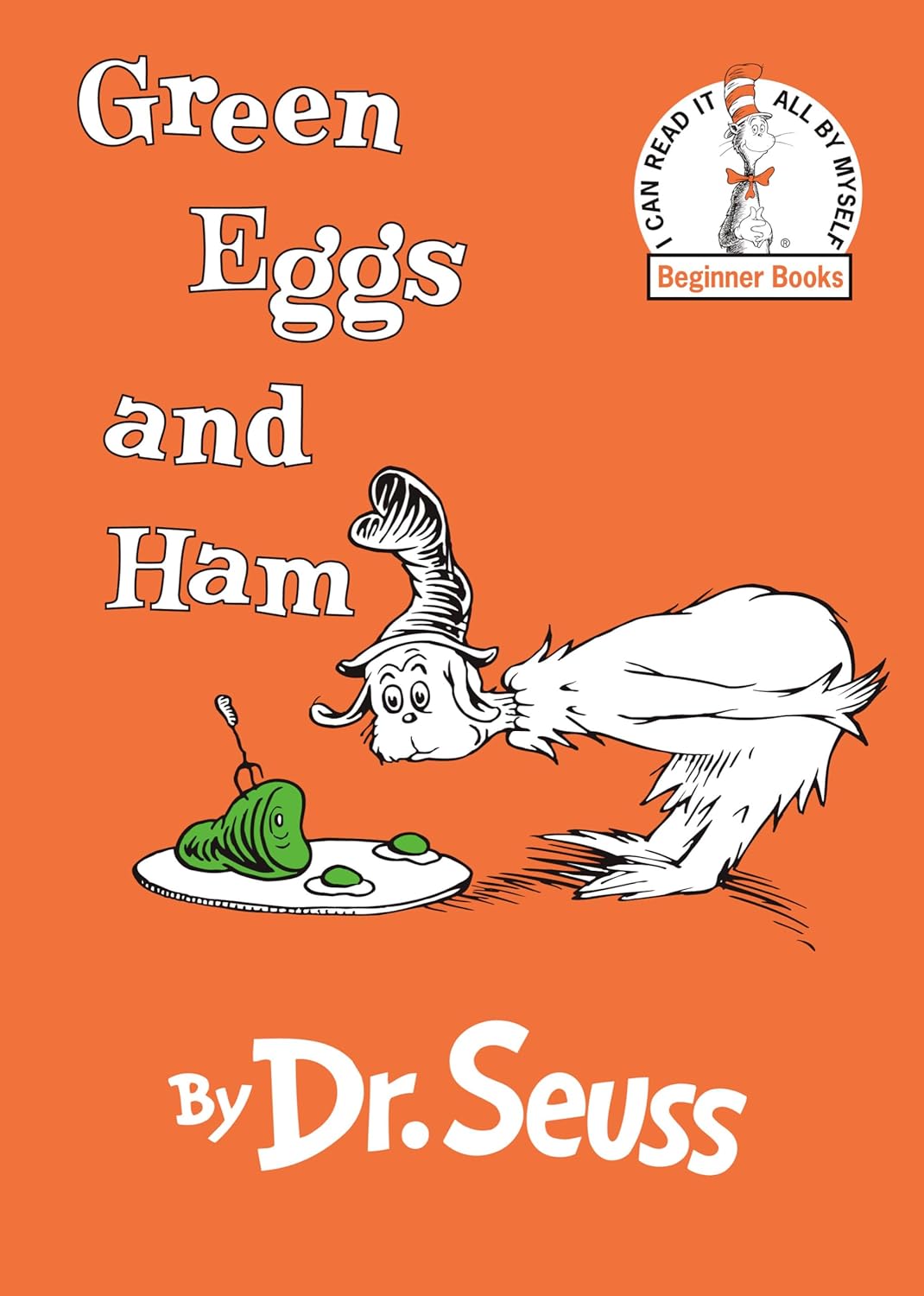
Green Eggs and Ham by Dr. Seuss is a best-selling children’s classic — a relentlessly funny story about a character who refuses to try something new until he finally does, and discovers he was wrong. Written using only 50 words, it is a phonics and early reading masterpiece disguised as a comedy. This guide covers the reading level, recommended age, read-aloud vs. independent reading guidance, themes, and everything parents and teachers need to know about sharing this classic with young readers.
For Parents
Find out whether Green Eggs and Ham works best as a read-aloud or independent read for your child, what age range it suits, and why this deceptively simple book is one of the most effective phonics and early reading tools ever published.
For Teachers
Grade-level data, read-aloud timing, key themes, and discussion questions for a Beginner Books cornerstone. Exceptional for phonics instruction, rhyme families, sight word development, and early reading fluency — all wrapped in one of the funniest books at this level.
Green Eggs and Ham at a Glance
Find on Amazon →| Author & Illustrator | Dr. Seuss (Theodor Seuss Geisel) |
| Published | 1960 |
| Grade Level | K–1 (our assessment) |
| Recommended Age | 3–7 |
| Best For | Read-aloud ages 3–6; independent reading ages 4–7 |
| Flesch-Kincaid Grade | -1.1 (50-word vocabulary) |
| Word Count | ~800 (using only 50 unique words) |
| Pages | 72 |
| Genre | Picture book / early reader |
| Setting | Fantastical locations: a box, a house, a train, a boat |
For official Lexile and AR levels, visit Lexile.com or AR BookFinder. ReadingVine provides independent editorial assessments.
What Reading Level Is Green Eggs and Ham?
Green Eggs and Ham is a K–1 reading level by our editorial assessment. Its Flesch-Kincaid grade level is technically -1.1 — a negative number — because the entire book is written using only 50 unique words, 49 of which are monosyllabic. The single exception is “anywhere.” This is not a coincidence: Dr. Seuss wrote the book on a bet with his editor that he could write a compelling story using fewer words than The Cat in the Hat’s 225-word vocabulary. He won.
The negative FK score is one of the most striking numbers in children’s publishing, and it accurately reflects the decoding demand of the individual words. But it significantly understates what a child needs to make sense of the book, because the repetition accumulates across 72 pages and the cumulative structure — new location added, refusal repeated, list extended — requires a child to track a growing sequence. A child who can decode the words perfectly may still need to hear the book several times before the escalating pattern fully lands. That comprehension dimension is invisible to Flesch-Kincaid.
For parents who use specific reading level systems: we recommend checking your child’s level on Lexile.com or AR BookFinder for official scores, or asking your child’s teacher for their Guided Reading or DRA level.
Is Green Eggs and Ham a Read-Aloud or Independent Read?
Green Eggs and Ham is exceptional as both a read-aloud for ages 3–6 and one of the most effective independent reads for ages 4–7 available anywhere. As a read-aloud, the book is a performance — the rhythm demands energy, the refusals invite dramatic delivery, and the escalating list of locations (“on a boat, with a goat, in the rain, on a train”) almost requires the reader to accelerate. Children who hear it well-performed frequently want it immediately again. Most adults can read it aloud in about 8–12 minutes.
As a read-aloud, Dr. Seuss’s anapestic tetrameter — the bouncing, three-beat rhythm that characterizes most of his work — rewards a reader who leans into it rather than flattening it. The refrain works like a song, and children who know it will chant along. Sam-I-Am’s persistence is genuinely funny when played with committed cheerfulness, and the unnamed narrator’s increasingly desperate resistance is the comedic engine of the whole book.
For independent reading, Green Eggs and Ham is among the best first books for children who are just beginning to decode text. The 50-word vocabulary means that once a child has learned a small set of high-frequency words and basic CVC patterns, they can read most of the book independently. The rhyme scheme reinforces phonics by embedding word families — ham/Sam/am, box/fox, house/mouse, train/rain/plain — in a context that makes them memorable. Children who read this book independently for the first time often genuinely feel the accomplishment of having read something that felt like a real book, because it is one.
There is nothing in this book that requires parental preparation. It is pure fun from beginning to end.
Try reading Sam-I-Am’s lines with relentless, cheerful persistence — as if Sam genuinely cannot understand why anyone would refuse green eggs and ham — while your child reads the narrator’s increasingly exasperated refusals. The comedy of the book lives in that gap between Sam’s baffled optimism and the narrator’s stubbornness, and children who play one character while an adult plays the other experience the humor in its fullest form. After the ending, ask: “Have you ever refused to try something and then found out you liked it?”
What Is Green Eggs and Ham About?
Sam-I-Am wants his grumpy companion to eat green eggs and ham. The companion refuses. Sam-I-Am suggests eating them in a box, with a fox, in a house, with a mouse, on a train, in the rain, on a boat, with a goat — cycling through locations and companions with relentless optimism. The companion refuses every combination, at increasing length and increasing irritation. Finally, cornered and out of objections, the companion agrees to try them. He tries them. He likes them. He would eat them anywhere. He thanks Sam-I-Am.
The story is essentially a joke with a very long setup and a payoff that lands harder the longer the setup runs — which is why 72 pages works, when it should by rights be exhausting. Seuss’s genius is that the refusals escalate in a way that stays funny rather than tiresome, and the final reversal is earned by the accumulated stubbornness that preceded it. The ending is one of the great comedic reversals in children’s literature: everything the narrator insisted was impossible turns out to have been fine all along.
Green Eggs and Ham Characters
Green Eggs and Ham Themes and Lessons
The central theme of Green Eggs and Ham is the value of trying something before deciding you don’t like it — one of the most universally useful lessons a picture book can carry and one of the most directly applicable to the lives of young children, who are frequently asked to eat things they haven’t tried, go places they haven’t been, and do things they’ve already decided they won’t like. The narrator’s final admission — that he was wrong to refuse, that green eggs and ham are in fact delicious — is a lesson that lands without any moralizing, because Seuss earns it through comedy rather than instruction. The humor makes the message genuinely persuasive rather than merely instructive.
The secondary theme is Sam-I-Am’s persistence — his refusal to accept “no” as a final answer and his commitment to finding a new angle rather than giving up. This is a more complicated lesson for young children than it first appears, since persistence in the face of refusal can be either a virtue or an annoyance depending on context, and children know it. Classroom conversations about Sam-I-Am’s behavior — was he right to keep asking? — tend to be genuinely interesting.
As a literacy tool, Green Eggs and Ham is one of the most effective phonics texts ever published for the K–1 level. The word families embedded in the rhyme scheme — am/Sam/ham, box/fox, house/mouse, train/rain/plain/Spain, boat/goat, here/there/anywhere/everywhere — cover a significant portion of the short-vowel and long-vowel patterns that early readers need to internalize. Children who read this book repeatedly are drilling phonics in a context that is so enjoyable they don’t notice the drilling.
Discussion starters for families: Why did the narrator keep saying no? Was Sam-I-Am being annoying or being kind? Have you ever refused to try something and then found out you liked it? What is something you have never tried that you might actually like? Do you think the narrator will eat green eggs and ham again?
How Long Is Green Eggs and Ham?
Green Eggs and Ham has 72 pages and approximately 800 words, though those 800 words use only 50 unique words. Most adults can read it aloud in about 8–12 minutes. The book’s escalating structure — the list of locations grows with each refusal — means the second half runs faster than the first as the rhythm builds momentum.
A child reading independently will typically finish in about 10–15 minutes on a first reading, faster as the text becomes familiar. Green Eggs and Ham is one of those books that children read multiple times in a row once they have the hang of the rhythm — the repetition that makes it an effective phonics tool also makes it compulsively re-readable.
Books Similar to Green Eggs and Ham
If your child loves Green Eggs and Ham, these titles share its rhythm, its phonics power, or its particular brand of comedic persistence:
About the Author and Illustrator
Dr. Seuss (Theodor Seuss Geisel, 1904–1991) was an American author and illustrator whose books have sold more than 600 million copies worldwide and have been translated into more than 50 languages. He is one of the most widely read children’s book authors in history, with titles ranging from the very simple (Hop on Pop, One Fish Two Fish Red Fish Blue Fish) to the philosophically rich (Oh, the Places You’ll Go!, The Lorax, The Butter Battle Book). He received the Pulitzer Prize Special Award in 1984 for his lifetime contribution to children’s literature, as well as two Caldecott Honors and numerous honorary doctorates. His works have inspired three Academy Award-winning animated films and multiple Emmy Award-winning television adaptations.
Green Eggs and Ham, published in 1960, was written under unusual constraints. Seuss’s editor and publisher, Bennett Cerf, bet him $50 that he could not write an entertaining children’s book using fewer than 50 words. The resulting book uses exactly 50 words — a constraint that Cerf apparently never paid off on. It became one of the best-selling children’s books ever published, with more than 200 million copies sold, and is consistently ranked among the top-selling English-language books of all time. Seuss’s anapestic tetrameter — the galloping three-beat rhythm that drives most of his work — is one of the most recognizable sounds in children’s literature, and Green Eggs and Ham is one of its purest expressions: a story told entirely in rhyme, using only the simplest words, that somehow never feels either thin or repetitive.
Green Eggs and Ham: Frequently Asked Questions
What reading level is Green Eggs and Ham?
Green Eggs and Ham is a K–1 reading level by our editorial assessment. Its Flesch-Kincaid grade level is technically -1.1 — a negative number reflecting its 50-word vocabulary, the simplest of any book on the K–2 list by this measure. It works best as a read-aloud for ages 3–6 and as an independent read for ages 4–7. For official Lexile and AR levels, visit Lexile.com or AR BookFinder.
What age is Green Eggs and Ham for?
Green Eggs and Ham is appropriate for ages 3–7. As a read-aloud it works from age 3 — the rhythm engages children well before they can decode the words. As an independent read, it is one of the most accessible early readers available, with many children able to read significant portions independently from late preschool or early kindergarten. Its simplicity of vocabulary and strength of rhyme make it effective across a wide range of early reading development stages.
How many words are in Green Eggs and Ham?
Green Eggs and Ham uses only 50 unique words across its 72 pages — 49 of them monosyllabic, with “anywhere” being the single exception. The total word count including repetitions is approximately 800 words, but the vocabulary is intentionally constrained to those 50. Dr. Seuss wrote the book under a bet from his editor that he couldn’t write a compelling story using fewer than 50 words. He succeeded, and the constraint became one of the book’s defining features as a phonics tool.
How long does it take to read Green Eggs and Ham aloud?
Most adults can read Green Eggs and Ham aloud in about 8–12 minutes. The book’s escalating structure — the list of locations grows longer with each refusal — means the second half naturally accelerates as the rhythm builds, and a fully committed read-aloud performance often runs toward the lower end of that range.
What is Green Eggs and Ham about?
Green Eggs and Ham is about Sam-I-Am, who persistently tries to convince a grumpy companion to eat green eggs and ham. The companion refuses every combination of location and company that Sam suggests — in a box, with a fox, on a train, in the rain, on a boat, with a goat, and more. Finally, after exhausting every objection, the companion agrees to try them. He discovers he likes them very much and thanks Sam-I-Am. It is a story about the value of trying something before deciding you don’t like it, told with relentless comic momentum.
Is Green Eggs and Ham good for learning to read?
Green Eggs and Ham is one of the most effective early reading tools ever published. Its 50-word vocabulary means a child who learns a small set of sight words and basic phonics patterns can read most of the book independently. The rhyme scheme embeds key word families — am/Sam/ham, box/fox, house/mouse, train/rain/plain — in a context so entertaining that children practice phonics without noticing. Many teachers and reading specialists consider it one of the best bridges between a child’s first decoding attempts and genuine independent reading fluency.