
 = Partner Site
Brown Bear, Brown Bear, What Do You See? Reading Level: A Complete Guide
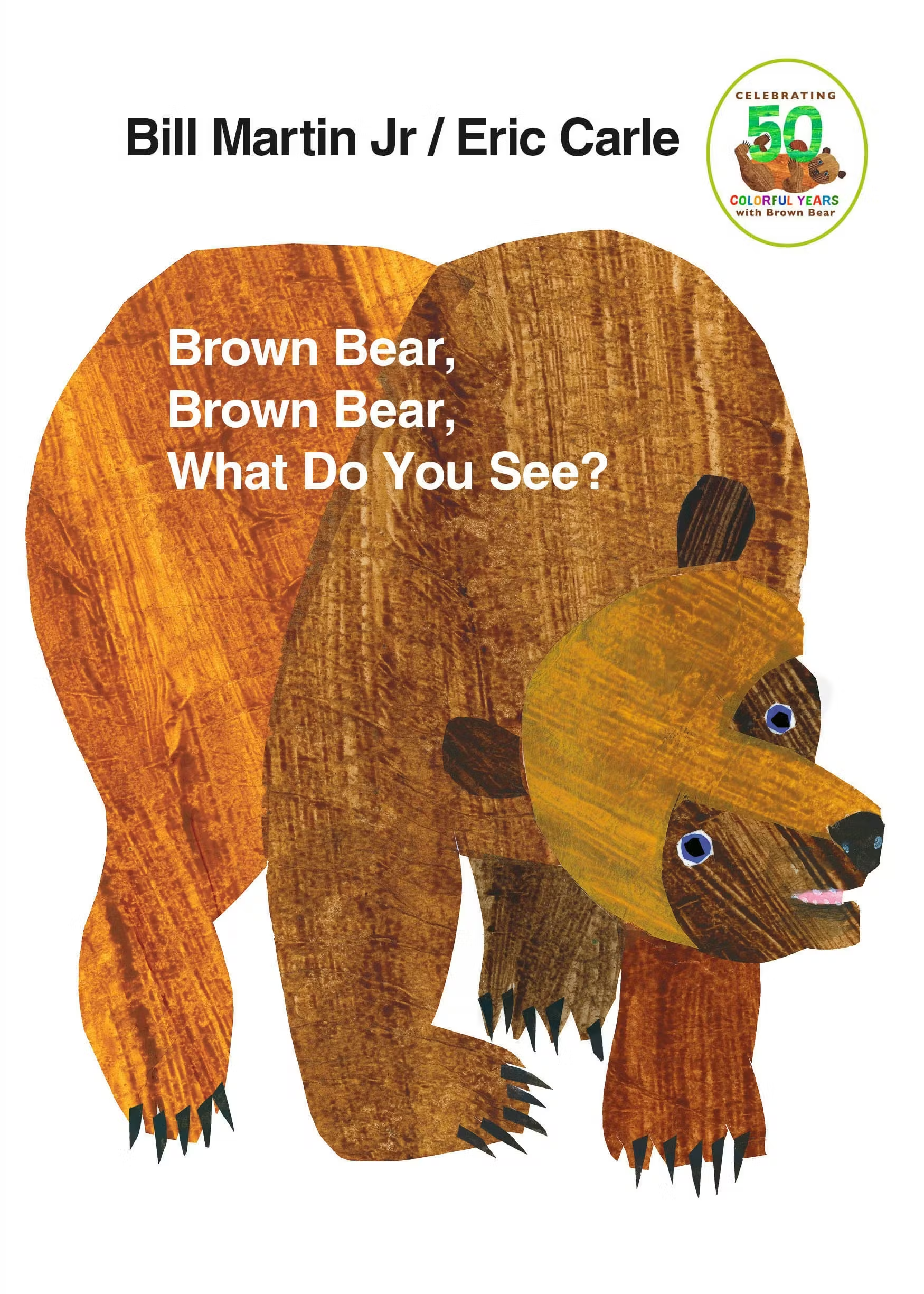
Brown Bear, Brown Bear, What Do You See? by Bill Martin Jr., illustrated by Eric Carle, is one of the most widely used early literacy books in American classrooms — a masterpiece of repetition and rhythm that teaches color words, animal names, and the patterns of language in a format so pleasurable children return to it again and again. This guide covers the reading level, recommended age, read-aloud vs. independent reading guidance, and everything parents and teachers need to know about sharing this foundational picture book with young readers.
For Parents
Find out whether Brown Bear, Brown Bear works best as a read-aloud or independent read for your child, what age range it suits, and why its repetitive structure is one of the most powerful early literacy tools a picture book can offer.
For Teachers
Grade-level data, read-aloud timing, and discussion questions for a PreK–K classroom essential. Central to color recognition, animal vocabulary, predictive reading, and the introduction of question-and-answer text structure.
Brown Bear, Brown Bear, What Do You See? at a Glance
Find on Amazon →| Author | Bill Martin Jr. |
| Illustrator | Eric Carle |
| Published | 1967 |
| Grade Level | PreK–K (our assessment) |
| Recommended Age | 2–5 |
| Best For | Read-aloud ages 1–4; independent reading ages 4–6 |
| Flesch-Kincaid Grade | 1.1 |
| Word Count | ~195 |
| Pages | 32 |
| Genre | Picture book / concept book |
| Setting | N/A — illustrated animal portraits |
For official Lexile and AR levels, visit Lexile.com or AR BookFinder. ReadingVine provides independent editorial assessments.
What Reading Level Is Brown Bear, Brown Bear, What Do You See?
Brown Bear, Brown Bear, What Do You See? is a PreK–K reading level by our editorial assessment — the youngest-skewing book on the K–2 list — with a Flesch-Kincaid grade level of approximately 1.1. At around 195 words, it is the shortest book on this list. The text is built entirely from a single repeating question-and-answer pattern, with color words and animal names as the only vocabulary beyond the pattern itself. There is no simpler picture book text in wide classroom use.
That simplicity is the point. Bill Martin Jr., who had dyslexia and didn’t learn to read until adulthood, understood something important about how language becomes accessible: repetition and rhythm make patterns visible, and visible patterns invite participation. A toddler who can’t yet speak in full sentences will point at the red bird on cue. A preschooler will supply the animal’s name before you turn the page. A kindergartner will read the whole book aloud alongside you. The book works at every stage of early reading development precisely because its structure is so transparent.
For parents who use specific reading level systems: we recommend checking your child’s level on Lexile.com or AR BookFinder for official scores, or asking your child’s teacher for their Guided Reading or DRA level.
Is Brown Bear, Brown Bear, What Do You See? a Read-Aloud or Independent Read?
Brown Bear, Brown Bear is first and foremost a read-aloud for ages 1–4, and transitions naturally into an independent read for ages 4–6 — making it one of the earliest-starting books on the K–2 list on both ends. It is genuinely appropriate as a read-aloud for infants and young toddlers, who respond to the rhythm and the bold animal images even before they can follow the question-and-answer structure.
As a read-aloud, the book is built for participation. The pattern — “[Animal], [Animal], what do you see? I see a [color] [animal] looking at me!” — becomes predictable within the first two spreads, and children begin filling in the answer before you ask the question. Eric Carle’s large, flat collage animals in vivid colors give children’s eyes an anchor on every page — there is always one clear thing to look at and name. Most adults can read it aloud in about 3–5 minutes, though a participatory reading with a very young child almost always takes longer as they point, name, and respond.
For independent reading, a child who knows their colors, can name the animals, and has heard the book a handful of times will often be able to “read” the whole book from memory before they can decode text at all. This kind of emergent reading — following the pattern and turning pages in the right places — is a genuine and important step in literacy development, not pretend reading. When a child’s decoding catches up to their pattern recognition, Brown Bear, Brown Bear becomes one of the first books they can read truly independently. Most children reach that point somewhere in kindergarten.
There is nothing in this book that requires parental preparation. It is one of the most universally welcoming picture books ever made.
After a few readings, try reading the question and then waiting — just waiting — for your child to supply the answer. Point to the animal on the page if they need a prompt. By the third or fourth reading, most children between 2 and 5 can complete every answer without help. When they do, they are practicing the exact text structure — question and answer — that they will encounter in nonfiction reading for the rest of their school lives.
What Is Brown Bear, Brown Bear, What Do You See? About?
A brown bear is asked what it sees. It sees a red bird. The red bird sees a yellow duck. The yellow duck sees a blue horse. And so on through ten animals in ten colors — a bear, a bird, a duck, a horse, a frog, a cat, a dog, a sheep, a goldfish, and a teacher — before the final page reveals all the children in a classroom looking back at the reader. The book ends where it began: with a question, an answer, and the invitation to start again.
There is no plot in the conventional sense, no conflict or resolution. What the book offers instead is the pleasure of a pattern — the satisfying click of question answered, prediction confirmed, page turned. Eric Carle’s bold tissue-paper collage animals, each one rendered in a single bright color against a white background, give the pattern a visual anchor that makes it easy for even the youngest children to follow. The final classroom spread, with its row of children looking outward, brings the book into the reader’s world in a way that feels like a warm invitation.
Brown Bear, Brown Bear, What Do You See? Characters
The characters in Brown Bear, Brown Bear, What Do You See? are its ten animals — a brown bear, a red bird, a yellow duck, a blue horse, a green frog, a purple cat, an orange dog, a white dog, a black sheep, a goldfish, and a teacher — each one rendered by Eric Carle as a bold, flat collage shape in a single vivid color. They are not characters in the narrative sense; they have no personalities or motivations beyond appearing on the page and passing the question along to the next animal. What makes them work is Carle’s visual distinctiveness — each animal is immediately recognizable, and the color-animal pairing on each page gives children two things to name and remember at once. The final page, showing a group of children, invites young readers to place themselves inside the pattern as the last answer.
Brown Bear, Brown Bear, What Do You See? Themes and Lessons
The educational content of Brown Bear, Brown Bear is built directly into its structure: color words paired with animal names, repeated in a question-and-answer pattern that children can predict and participate in from their very first exposure. By the end of a single reading, most young children have heard all ten color words and all ten animal names in a context that makes them easy to remember. By the tenth reading, many can name them without prompting.
The deeper literacy lesson is text structure. Question and answer is one of the most fundamental organizational patterns in both fiction and nonfiction, and Brown Bear, Brown Bear gives children their first experience of it in a form so clear and repeatable that the structure itself becomes visible. Children who internalize this pattern early have a significant advantage when they encounter it in more complex texts — they already know how it works because they’ve chanted it hundreds of times.
The book also teaches predictive reading — the habit of anticipating what comes next based on pattern recognition. This is not a trivial skill. Skilled readers predict constantly, and Brown Bear, Brown Bear is one of the earliest and most effective books for building that habit from the very beginning of a child’s reading life.
Discussion starters for families: Can you name all the colors? Which animal is your favorite? What color would you want to be if you were in the book? Can you think of another animal we could add? What do you think the teacher sees?
How Long Is Brown Bear, Brown Bear, What Do You See?
Brown Bear, Brown Bear, What Do You See? has 32 pages and approximately 195 words — the shortest book on the K–2 list. Most adults can read it aloud in about 3–5 minutes. A participatory reading with a very young child who is pointing, naming, and responding to each page often runs 7–10 minutes.
A child reading independently at a kindergarten level will typically finish in about 5–8 minutes, though children who love this book often read it multiple times in a single sitting. It is one of those books that gets requested again immediately after it ends.
Books Similar to Brown Bear, Brown Bear, What Do You See?
If your child loves Brown Bear, Brown Bear, these titles share the same rhythm, repetition, and early literacy power:
About the Author and Illustrator
Bill Martin Jr. (1916–2004) was an American author and educator who wrote more than 300 books for children over six decades. He had dyslexia and did not learn to read until college — an experience that gave him a profound understanding of what makes language stick for struggling readers, and shaped his lifelong commitment to rhythm, repetition, and the musicality of text as tools for literacy. Brown Bear, Brown Bear, What Do You See?, first published in 1967 with illustrations by Eric Carle, was one of his earliest and most enduring successes. His other well-known titles include Chicka Chicka Boom Boom (with John Archambault) and Polar Bear, Polar Bear, What Do You Hear?, a companion volume to Brown Bear also illustrated by Carle.
Eric Carle (1929–2021) was an American author and illustrator best known for The Very Hungry Caterpillar (1969), though his collaboration with Bill Martin Jr. on Brown Bear, Brown Bear predates that book by two years and was one of the works that established his distinctive tissue-paper collage style. Carle painted sheets of tissue paper in various colors and textures, then cut and layered them to build his illustrations — a technique that gives his animals their characteristic warmth and visual energy. He went on to write and illustrate more than 70 books of his own, and co-founded the Eric Carle Museum of Picture Book Art in Amherst, Massachusetts, which opened in 2002.
Brown Bear, Brown Bear, What Do You See?: Frequently Asked Questions
What reading level is Brown Bear, Brown Bear, What Do You See?
Brown Bear, Brown Bear, What Do You See? is a PreK–K reading level by our editorial assessment, with a Flesch-Kincaid grade level of approximately 1.1. It is the lowest-reading-level book on the K–2 list, built from a single repeating pattern and basic color and animal vocabulary. It works best as a read-aloud for ages 1–4 and as an independent read for ages 4–6. For official Lexile and AR levels, visit Lexile.com or AR BookFinder.
What age is Brown Bear, Brown Bear, What Do You See? for?
Brown Bear, Brown Bear is appropriate as a read-aloud from infancy — the rhythm and bold images engage babies and very young toddlers even before they can follow the question-and-answer structure. As an independent read, it suits children ages 4–6 who are developing letter recognition and early phonics skills. It is genuinely one of the earliest-starting books in wide classroom use at both ends of the range.
Can a kindergartner read Brown Bear, Brown Bear, What Do You See? alone?
Most kindergartners can read Brown Bear, Brown Bear independently, and many preschoolers can “read” it from memory before they can decode text at all. The repeating pattern means that once a child knows the structure and the color-animal pairings, they can follow the book with very little decoding support. It is one of the best early independent reads available precisely because the pattern does so much of the work.
How long does it take to read Brown Bear, Brown Bear, What Do You See? aloud?
Most adults can read Brown Bear, Brown Bear aloud in about 3–5 minutes. A participatory reading with a very young child who is pointing and responding to each page often runs 7–10 minutes. It is one of those books that children frequently request a second time immediately after it ends.
What is Brown Bear, Brown Bear, What Do You See? about?
Brown Bear, Brown Bear, What Do You See? follows a question-and-answer pattern through ten animals in ten colors — a brown bear, a red bird, a yellow duck, and so on — each one asking what the next animal sees. The final page shows a classroom of children looking back at the reader. It teaches colors, animals, and the question-and-answer text structure through pure, pleasurable repetition.
Who wrote and illustrated Brown Bear, Brown Bear, What Do You See?
Brown Bear, Brown Bear, What Do You See? was written by Bill Martin Jr. and illustrated by Eric Carle. It was first published in 1967 — two years before Carle’s The Very Hungry Caterpillar — and was one of the early books that established both Martin’s reputation for rhythmic, participatory text and Carle’s distinctive tissue-paper collage illustration style.