
 = Partner Site
Biscuit Reading Level: A Complete Guide
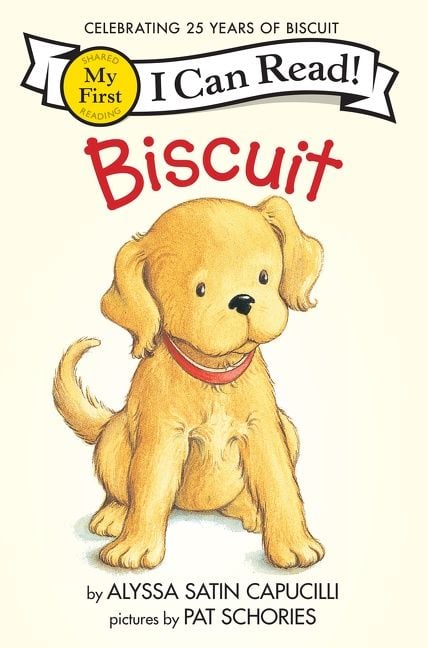
Biscuit by Alyssa Satin Capucilli, illustrated by Pat Schories, is one of the most popular true beginning readers in print — a simple, warm story about a small yellow puppy who does not want to go to bed. This guide covers the reading level, recommended age, read-aloud vs. independent reading guidance, themes, and everything parents and teachers need to know about sharing this beloved book with young readers.
For Parents
Find out whether Biscuit works best as a read-aloud or independent read for your child, what age range it suits, and why this gentle, repetitive beginning reader is one of the best first books for children just starting to read on their own.
For Teachers
Grade-level data, read-aloud timing, key themes, and discussion questions for one of the most widely used true beginning readers in PreK–1 classrooms. Essential for sight word instruction, repetitive sentence patterns, and building early reading confidence.
Biscuit at a Glance
Find on Amazon →| Author | Alyssa Satin Capucilli |
| Illustrator | Pat Schories |
| Published | 1996 |
| Grade Level | PreK–1 (our assessment) |
| Recommended Age | 3–6 |
| Best For | Read-aloud ages 2–5; independent reading ages 4–6 |
| Flesch-Kincaid Grade | 0.8 |
| Word Count | ~115 |
| Pages | 32 |
| Genre | Beginning reader / fiction |
| Setting | A child’s home at bedtime |
For official Lexile and AR levels, visit Lexile.com or AR BookFinder. ReadingVine provides independent editorial assessments.
What Reading Level Is Biscuit?
Biscuit is a PreK–1 reading level by our editorial assessment — the lowest-level beginning reader on the K–2 list — with a Flesch-Kincaid grade level of approximately 0.8. At only around 115 words it is the shortest book on this list by word count, shorter even than Brown Bear, Brown Bear. The text is built almost entirely from high-frequency sight words, short sentences, and the single repeating word “Woof!” — which is Biscuit’s contribution to every exchange and the word most early readers can manage from their very first encounter with the book.
What makes Biscuit work as an early literacy tool despite — or because of — its extreme simplicity is its structure. The girl asks Biscuit to do something; Biscuit “woofs” and does something else instead. The pattern repeats with slight variations through five or six exchanges before the bedtime resolution. Children who have heard it once know what is coming, and that knowledge gives them the confidence to try to read ahead. This is exactly the kind of predictive reading habit that develops fluency, and Biscuit delivers it in the gentlest possible format.
For parents who use specific reading level systems: we recommend checking your child’s level on Lexile.com or AR BookFinder for official scores, or asking your child’s teacher for their Guided Reading or DRA level.
Is Biscuit a Read-Aloud or Independent Read?
Biscuit works well as both a read-aloud for ages 2–5 and an independent read for ages 4–6. It is one of the earliest true independent reads on the K–2 list — a child who knows basic sight words and has heard the book once or twice can often follow the text independently from very early in their reading development. Most adults can read it aloud in about 3–5 minutes.
As a read-aloud, the book’s simple call-and-response structure — the girl asks, Biscuit woofs and disobeys — invites children to supply Biscuit’s “Woof!” before the parent reads it. Pat Schories’ warm, detailed illustrations give the book more depth than the spare text suggests: Biscuit is rendered with enormous expressiveness for such a small dog, and his body language on each page — flopped over, wriggling, refusing to cooperate — tells the story as much as the words do. Young children often narrate what Biscuit is doing in the pictures before or alongside the text, which is its own form of early literacy practice.
For independent reading, Biscuit is designed specifically for children in the earliest stages of reading development — the I Can Read Level 1 “My First” category, sometimes called “shared reading” level. A child who can recognize “said,” “and,” “the,” “one,” and “more” as sight words and can sound out simple CVC words like “cup” will find most of the text within reach. “Woof!” is guaranteed. The short sentences — “Said the little girl. Said Biscuit.” — mean that successful decoding of even one word per sentence constitutes a real achievement, which is exactly the right level of challenge for a child just beginning.
There is nothing in this book that requires parental preparation. Biscuit is gentle, warm, and entirely without anxiety. It is one of the safest possible first books.
Let your child read Biscuit’s “Woof!” every time it appears — it is the easiest word in the book and appears on nearly every page. Then, as your child grows more confident, point to each word as you read and let them try the next one. Biscuit is one of those rare books where the gap between what a child can hear and what they can decode closes noticeably over just a few readings, which is genuinely exciting to watch.
What Is Biscuit About?
A young girl puts her small yellow puppy, Biscuit, to bed for the night. Biscuit has other ideas. He wants one more biscuit. He wants one more hug. He wants his bowl of water. He wants his stuffed bear. He wants the light left on. The girl patiently provides each thing, returns to bed, and Biscuit finds something else he needs. Finally — after one more hug, one more kiss, and one more “I love you, Biscuit” — the puppy curls up and falls asleep. The girl tiptoes out. Biscuit is quiet at last.
The story is a single domestic scene, built entirely on repetition and the small comedy of a puppy who stalls magnificently. There is no conflict beyond the mild standoff between a tired child and a tireless dog, and the resolution — Biscuit asleep, everything finally still — is completely satisfying in the way that only very simple, very true things can be.
Biscuit Characters
Biscuit Themes and Lessons
The thematic content of Biscuit is gentle and domestic: a puppy who needs reassurance before bed, a child who provides it patiently, and the small ritual of getting a pet settled for the night. For young children who have their own bedtime stalling routines — one more drink of water, one more hug, one more story — Biscuit’s behavior is recognizable and funny from the inside. The book does not moralize about this. It simply depicts it with warmth and lets children enjoy the recognition.
As a literacy tool, the more important lesson is structural: Biscuit teaches the pattern of a beginning reader — short sentence, repeated structure, predictable vocabulary, clear illustration support — in its most pure and accessible form. Children who read Biscuit are learning not just the words on the page but what a text looks like when it is designed for them, which is a form of reading confidence that transfers to every book they pick up afterward.
The book also models something quietly useful about care and patience. The girl never gets frustrated with Biscuit’s requests. She meets each one with the same warmth she brought to the first. For children who are themselves sometimes the ones who need one more hug before bed, this is a gentle and reassuring portrait of what patient love looks like in practice.
Discussion starters for families: Why does Biscuit keep asking for one more thing? Do you ever do that at bedtime? What does Biscuit want most of all? How does the girl feel about Biscuit? If you had a puppy, what would you name it?
How Long Is Biscuit?
Biscuit has 32 pages and approximately 115 words — the shortest book by word count on the K–2 list. Most adults can read it aloud in about 3–5 minutes, making it one of the quickest read-alouds available. Many families read it multiple times in a single sitting, which is both fine and useful: repetition builds fluency, and Biscuit is a book that gets better rather than worse with repeated readings.
A child reading independently at a PreK or early kindergarten level will typically finish in about 5–8 minutes on a first independent reading, faster as the text becomes familiar. The brevity is a feature: it means a child who is just beginning to read can experience the complete arc of a story — beginning, middle, end — in a single short sitting, which is an important early literacy milestone.
Books Similar to Biscuit
If your child loves Biscuit, these titles share its warmth, its simple repetitive structure, or its early reader format:
About the Author and Illustrator
Alyssa Satin Capucilli is an American author who has written more than 50 books for young children, including more than 30 books in the Biscuit series — making it one of the longest-running and best-selling beginning reader series in American publishing. The original Biscuit, published in 1996, introduced the small yellow puppy who would go on to have adventures across seasons, holidays, school visits, beach trips, and countless other settings, all in the same gentle, accessible I Can Read format. Capucilli has said that Biscuit was inspired by her own family’s dog and by her observation of how children learn to read best when a text meets them exactly where they are — with familiar vocabulary, predictable patterns, and stories that feel true to their own experience. The series has sold tens of millions of copies and remains one of the most recommended beginning reader series by teachers, librarians, and reading specialists. Capucilli is also the author of the Katy Duck series and several standalone picture books.
Pat Schories is an American illustrator who provided the illustrations for the original Biscuit books and established the visual identity of the series. Her style — warm watercolor and pencil, with particular attention to Biscuit’s expressive ears and tail — gives the books their gentle, cozy atmosphere. Biscuit himself, as Schories drew him, has become one of the most recognized animal characters in beginning reader literature: small, golden, round-faced, and irresistibly soft-looking. The illustrations carry a significant portion of the beginning reader’s narrative work, since young children are often reading the pictures as much as the words, and Schories’ clarity and warmth make that dual reading consistently rewarding.
Biscuit: Frequently Asked Questions
What reading level is Biscuit?
Biscuit is a PreK–1 reading level by our editorial assessment, with a Flesch-Kincaid grade level of approximately 0.8 — the lowest on the K–2 list. At around 115 words it is the shortest book by word count here, built almost entirely from high-frequency sight words and the repeating word “Woof!” It works best as a read-aloud for ages 2–5 and as an independent read for ages 4–6. For official Lexile and AR levels, visit Lexile.com or AR BookFinder.
What age is Biscuit for?
Biscuit is appropriate for ages 2–6. As a read-aloud it works beautifully from age 2 — the simple call-and-response structure and warm illustrations engage even very young toddlers. As an independent read it suits children ages 4–6 who are in the earliest stages of learning to read. It is one of the few books on this list where a child’s first truly independent reading is a realistic and achievable goal in preschool or early kindergarten.
Can a preschooler read Biscuit alone?
Many preschoolers can read Biscuit independently or near-independently, particularly after several read-aloud exposures. A child who knows a handful of basic sight words and can recognize “Woof!” will be able to participate in reading the text from early on. Biscuit is specifically designed for the very beginning of reading development — I Can Read Level 1 “My First” — and is one of the most accessible true independent reads available for children just starting out.
How long does it take to read Biscuit aloud?
Most adults can read Biscuit aloud in about 3–5 minutes — one of the shortest read-alouds on the K–2 list. Many families read it multiple times in a single sitting, which is entirely appropriate: repetition is the point, and Biscuit is designed to be read again and again as children build toward independent reading.
What is Biscuit about?
Biscuit is about a small yellow puppy who does not want to go to bed. His owner — a young girl — patiently provides everything he asks for: one more biscuit, one more hug, his bowl of water, his stuffed bear, the light left on. Each time, Biscuit asks for one more thing. Finally, after one last hug and kiss and “I love you, Biscuit,” the puppy falls asleep. It is a warm, funny, entirely simple story about bedtime stalling and patient love.
Are there other books in the Biscuit series?
Yes — Alyssa Satin Capucilli has written more than 30 Biscuit books, following the puppy through seasons, holidays, school visits, farm trips, beach days, and many other settings. All books in the series are at approximately the same beginning reader level and are appropriate for the same age range. The series is one of the longest-running and best-selling beginning reader series in American publishing, and most children who love the original book work happily through many others in the series.