
 = Partner Site
My Father’s Dragon Reading Level: A Complete Guide
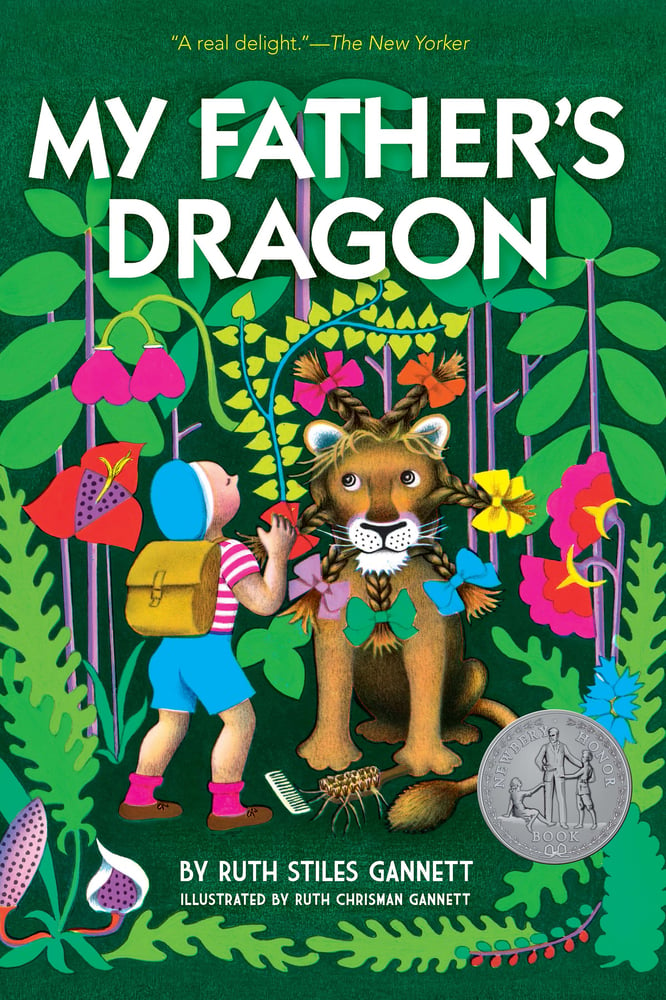
My Father’s Dragon, written by Ruth Stiles Gannett and illustrated by her stepmother Ruth Chrisman Gannett, is a 96-page chapter book about a boy named Elmer Elevator who runs away from home after hearing that a baby dragon is being held captive on Wild Island, forced to serve as a ferry for the animals who live there. Elmer packs a very specific bag of supplies — he knows, from a cat’s instructions, exactly what each animal on the island fears and needs — and makes his way to Wild Island, where he outwits a gorilla with chewing gum, a lion with lollipops, tigers with ribbon, and a rhinoceros with rubber boots, all while making his way through the jungle to the dragon. First published in 1948, it received a Newbery Honor and has been continuously in print for more than seventy-five years. It is a Common Core ELA Text Exemplar for grades 2–3, among the most frequently assigned early chapter books in American classrooms, and one of the most purely delightful adventure stories in the catalog — funny, inventive, and built on a premise that is exactly as specific and absurd as children most love. This guide covers My Father’s Dragon‘s reading level, whether it’s a read-aloud or independent read, what it’s about, its themes, how long it takes to read, and similar books — designed for parents and teachers of K–2 readers.
For Parents
A short chapter book adventure about a boy who rescues a dragon using chewing gum, lollipops, hair ribbons, and rubber boots — funny, clever, and perfectly paced for the transition from picture books to chapter books. Best for independent reading at ages 7–9 and as a read-aloud from ages 5–8. No content concerns. One of the most beloved early chapter books in American children’s literature.
For Teachers
A Common Core Text Exemplar for grades 2–3 and a classroom read-aloud staple for grades 1–3. The clever problem-solving structure — Elmer uses his specific supplies against each animal’s specific weakness — makes it ideal for discussions of planning, prediction, and cause and effect. The Netflix 2022 animated adaptation is a productive companion text. Available free on Project Gutenberg.
My Father’s Dragon at a Glance
Find on Amazon →| Author | Ruth Stiles Gannett |
| Illustrator | Ruth Chrisman Gannett (Gannett’s stepmother) |
| Published | 1948 (Random House) |
| Grade Level | 1–4 (our assessment) |
| Recommended Age | 5–9 |
| Lexile | 970L |
| ATOS Level | 5.6 |
| Guided Reading Level | N |
| Word Count | 7,682 |
| Pages | 96 |
| Chapters | 10 |
| Genre | Fantasy / adventure / early chapter book |
| Awards | Newbery Honor (1949); Common Core ELA Text Exemplar, grades 2–3 |
| Availability | Public domain — freely available at Project Gutenberg |
For official Lexile and AR levels, visit Lexile.com or AR BookFinder. ReadingVine provides independent editorial assessments.
What Reading Level Is My Father’s Dragon?
My Father’s Dragon has a Lexile of 970L and an ATOS level of 5.6 — scores that reflect a short chapter book rather than a picture book and that are significantly higher than any other text in this K–2 catalog. The ATOS 5.6 places it at mid-fifth-grade for comfortable independent reading, which does not match the Newbery Honor context or its Common Core designation as a grades 2–3 Text Exemplar. The explanation is that reading level formulas measure linguistic complexity rather than narrative accessibility — and My Father’s Dragon‘s prose is clear and simple, its sentences are short, but the vocabulary and the length of the text produce scores that skew high relative to its actual difficulty for young readers.
In practice, the book is among the most widely assigned read-alouds in first- and second-grade classrooms and among the most successful independent reads for strong second- and third-graders. The Common Core grades 2–3 Text Exemplar designation is the most reliable guide: this is a book for the second-to-third-grade range, either as a class read-aloud or as an independent reader. Read aloud at a chapter per sitting, most classrooms complete it in two to three weeks. For official Lexile and AR scores, visit Lexile.com or AR BookFinder. ReadingVine’s assessments are independent editorial judgments.
Is My Father’s Dragon a Read-Aloud or Independent Read?
This works excellently as both a chapter-by-chapter read-aloud for grades 1–3 (ages 5–9) and a first independent chapter book for strong readers in grades 2–4 (ages 7–10). As a read-aloud, the ten chapters are short enough for daily classroom or bedtime sessions — each one takes about fifteen to twenty minutes — and the episodic structure means each chapter has its own satisfying problem-and-solution shape. As an independent reader, the book is short enough (7,682 words, 96 pages) to be completed in one or two sittings by a motivated reader, and its humor and inventive problem-solving make it hard to put down.
Gannett’s prose is deceptively simple — clear, direct, always moving forward — and it gives children who are just transitioning from picture books to chapter books the experience of a full narrative without the density that makes longer chapter books daunting. This is exactly what a transitional chapter book should do, and My Father’s Dragon does it as well as any book in the genre.
Before each new animal encounter, ask: “Elmer has these things in his bag — what do you think he’ll use against this animal, and why?” The book’s pleasure is partly in prediction: the contents of Elmer’s bag are listed early, and every item turns out to be exactly right. Children who are tracking the bag’s inventory will feel the satisfying click of each solution landing.
What Is My Father’s Dragon About?
The story is told by an unnamed narrator about their father, referred to throughout as “my father,” who as a boy went on an adventure. One cold rainy day, young Elmer Elevator meets an old alley cat and offers him a warm meal. The cat, grateful, tells Elmer about Wild Island, where a baby dragon is being held captive — the island’s animals tie him to a post and make him fly them back and forth across the river. The cat gives Elmer a map and a list of what the island’s animals fear most.
Elmer runs away from home with a carefully packed bag: chewing gum, lollipops, a toothbrush and toothpaste, six magnifying glasses, a compass, a pink ribbon, rubber boots, a raincoat, and a hand mirror. He stows away on a boat to Cranberry Island, then to Wild Island, and begins making his way through the jungle toward the dragon.
Each animal he encounters is a problem to solve. A gorilla demands to search his bag — Elmer distracts him with chewing gum, which the gorilla and all his friends begin chewing at once, too occupied to notice Elmer slip away. A lion blocks his path — Elmer leaves a trail of lollipops that sends the lion back the way he came, licking candy. A pack of tigers threatens him — Elmer ties their tails together with ribbon and they chase each other in circles. A rhinoceros, a crocodile, and a pack of wild boars are each handled with the remaining items, each solution perfectly matched to each animal’s specific nature and weakness.
At last Elmer finds the dragon — a young, friendly dragon, still tethered and sad. He frees him. The dragon lifts Elmer onto his back. They fly out of Wild Island and into the sky, leaving the island’s animals baffled on the ground. The narrator’s father — a small boy who ran away with a bag of lollipops and came home with a dragon — has done exactly what he set out to do.
My Father’s Dragon Characters
Elmer Elevator is one of children’s literature’s great practical heroes — not brave in a superhuman sense, but resourceful, observant, and possessed of the specific intelligence of a child who listens carefully, plans thoroughly, and keeps his head when things get alarming. He does not fight the animals; he outsmarts them, using exactly the right thing at exactly the right moment. This is more satisfying than fighting would be, and it gives children a model of problem-solving rather than power. The baby dragon is sweet and sad and immediately worth saving — he is never given a name, which makes him available as a projection for any child’s imagination. The old alley cat who begins the adventure is the book’s best supporting character: street-wise, grateful, precise in his information, and exactly the kind of unexpected ally who appears in the best adventure stories.
My Father’s Dragon Themes and Lessons
The book’s central pleasure is the tightly engineered problem-solving: every item in Elmer’s bag is used, every animal’s specific weakness is addressed by exactly the right supply, and no solution is repeated. This makes the book a sustained demonstration of a specific kind of intelligence — the kind that observes, listens, prepares, and then applies the right tool to the right situation. Children who love the book love it partly because Elmer never fights anything. He never needs to be stronger than the gorilla or faster than the lion. He just needs to know that gorillas love chewing gum.
The frame narrative — told by a child about their father’s childhood adventure — gives the book a warm, collaborative quality: the narrator’s father did this; it is a story worth telling to children; and the implication is that the child listening might, in their own way, do something equally adventurous. The cat’s gift (the map and the knowledge of the animals’ weaknesses) is a direct result of Elmer’s ordinary kindness — he fed a cold and hungry cat. This connection between small acts of kindness and large returns is present without being preachy.
Talking with your child: Why did Elmer bring chewing gum — and how did he know it would work? Which animal encounter was your favorite, and why? If you were going to rescue a dragon, what would you put in your bag? Why do you think Elmer didn’t fight any of the animals? What would have happened if he had tried to fight instead?
The My Father’s Dragon Film (Netflix, 2022)
A 2022 animated film adaptation directed by Nora Twomey (who co-directed *The Breadwinner* and worked on *The Secret of Kells* and *Song of the Sea*) was released on Netflix. The film departs significantly from the book: the setting is moved from Wild Island to a fantastical city, Elmer’s motivation is changed, and the dragon’s situation is reimagined with more emotional complexity than the book’s relatively simple rescue premise. The film is animated in the warm, painterly style associated with Cartoon Saloon (the Irish animation studio behind *Wolfwalkers*) and received positive reviews for its visual beauty and emotional depth.
For families who love the book, the film is a productive companion rather than a faithful adaptation — it takes the spirit of the original (a resourceful boy, a dragon worth rescuing, a friendship built through courage) and builds something new from it. For classrooms using the book, the comparison between book and film is an excellent discussion prompt: what did the filmmakers change, and why? What does the film add? What does it lose?
How Long Is My Father’s Dragon?
My Father’s Dragon is 96 pages across 10 chapters with 7,682 words. Most adults can read it aloud at about a chapter per sitting — fifteen to twenty minutes each — completing it in two to three weeks as a classroom or bedtime read-aloud. An independent reader motivated by the adventure can finish it in one or two sittings of one to two hours each. The book is the first in a trilogy: Elmer and the Dragon (1950) continues Elmer and the dragon’s journey, and The Dragons of Blueland (1951) completes the series. All three are available in a single-volume edition titled Three Tales of My Father’s Dragon. The text is in the public domain and available free at Project Gutenberg (gutenberg.org).
Books Similar to My Father’s Dragon
About Ruth Stiles Gannett and Ruth Chrisman Gannett
Ruth Stiles Gannett was born on August 12, 1923, and graduated from Vassar College in 1944. She wrote My Father’s Dragon a few years after graduation — reportedly in a short burst of creative energy — and it was immediately recognized as exceptional, receiving a Newbery Honor in 1949. She followed it with Elmer and the Dragon (1950) and The Dragons of Blueland (1951), completing the trilogy. She wrote a few additional children’s books but My Father’s Dragon remains her primary legacy. She married the artist and calligrapher Peter Kahn and has been known as Ruth Stiles Gannett Kahn since her marriage. The book is public domain and available at Project Gutenberg.
Ruth Chrisman Gannett (1896–1979) was a children’s book illustrator and the stepmother of Ruth Stiles Gannett — making My Father’s Dragon a family collaboration. Ruth Chrisman Gannett had a long career as an illustrator before and after this trilogy; her pen-and-ink illustrations for the book have a warmth and specificity that match the text’s humor perfectly. The animals of Wild Island — in particular the lion with his lollipops and the tigers chasing each other in circles — are rendered with exactly the comic affection they deserve.
My Father’s Dragon: Frequently Asked Questions
What reading level is My Father’s Dragon?
My Father’s Dragon has a Lexile of 970L and an ATOS of 5.6 — scores that overstate its actual difficulty for young readers. It is a Common Core ELA Text Exemplar for grades 2–3 and one of the most widely used early chapter book read-alouds in grades 1–3. Our assessment: read-aloud for grades 1–3 (ages 5–9); independent reading for grades 2–4 (ages 7–10). For official Lexile and AR scores, visit Lexile.com or AR BookFinder.
What is My Father’s Dragon about?
Elmer Elevator runs away from home after learning that a baby dragon is being held captive on Wild Island, forced to ferry the island’s animals across a river. Armed with a bag of carefully chosen supplies — chewing gum, lollipops, ribbon, rubber boots, and more — he outwits each of the island’s animals using exactly the right item against each animal’s specific weakness, and frees the dragon. They fly away together.
Is My Father’s Dragon appropriate for young children?
Yes — it has no content concerns of any kind. The animal encounters are funny rather than frightening; Elmer is never in genuine danger in a way that would distress young listeners; and the rescue is joyful rather than dramatic. It is a Common Core Text Exemplar for grades 2–3 and a classroom read-aloud staple for grades 1–3. As a read-aloud it is appropriate from age 5; as an independent reader from around age 7.
How many chapters are in My Father’s Dragon?
Ten chapters across 96 pages. Each chapter has its own satisfying problem-and-solution structure, making the book ideal for reading a chapter at a time as a classroom or bedtime read-aloud. Total word count is 7,682 — short enough for a motivated independent reader to finish in one or two sittings of one to two hours.
Is there a My Father’s Dragon movie?
Yes — a 2022 animated film directed by Nora Twomey, released on Netflix and produced by Cartoon Saloon (the Irish studio behind Wolfwalkers and The Breadwinner). The film departs significantly from the book’s plot but captures the spirit of the original — a resourceful boy, a dragon worth rescuing, a friendship built through courage. The visual style is warm and painterly, consistent with Cartoon Saloon’s other films.
Is My Father’s Dragon in the public domain?
Yes — the text is freely available at Project Gutenberg (gutenberg.org). Physical editions with the original Ruth Chrisman Gannett illustrations are available from multiple publishers; the Random House/Yearling edition is the most commonly found in classroom libraries.
Is there a sequel to My Father’s Dragon?
Yes — two. Elmer and the Dragon (1950) continues Elmer and the dragon’s journey after escaping Wild Island; The Dragons of Blueland (1951) completes the trilogy. All three are available in a single-volume edition called Three Tales of My Father’s Dragon. All three are also in the public domain and available at Project Gutenberg.