
 = Partner Site
Nim’s Island Reading Level: A Complete Guide
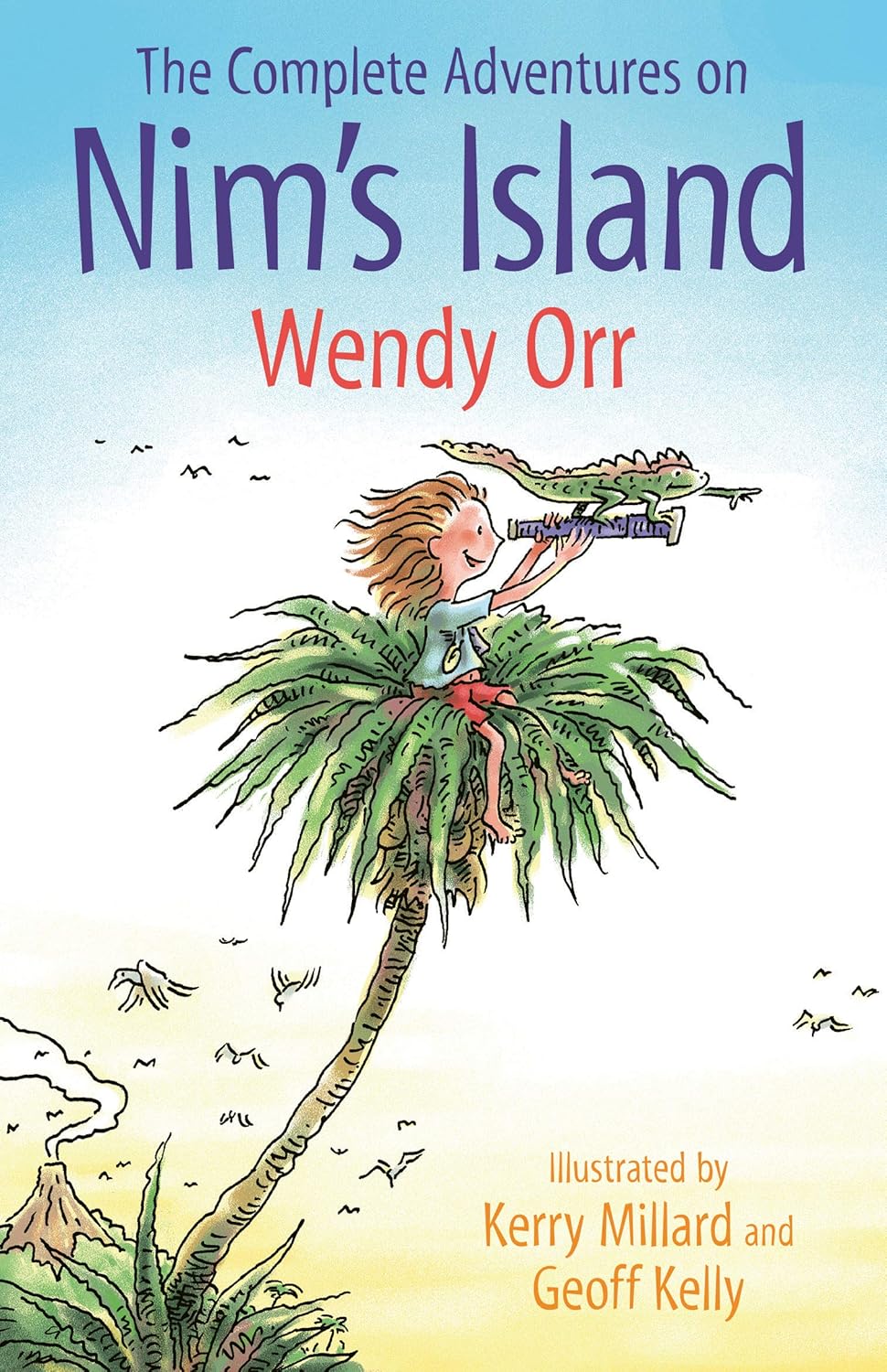
Nim’s Island, written by Wendy Orr and illustrated by Kerry Millard, is a 120-page adventure novel about a girl named Nim who lives with her scientist father Jack on a secret tropical island — a world of palm trees, volcanoes, turtles, sea lions, and a marine iguana named Fred — and who must manage a hurricane, a volcanic eruption, a boatload of unwanted tourists, and her father’s unexplained silence, all while corresponding by email with an adventurous man named Alex Rover who is, it turns out, a woman: Alexandra Rover, an agoraphobic author of adventure novels who has never been more than three feet from her San Francisco apartment. First published in Australia in 1999 and in the United States in 2000, it is one of the most genuinely funny middle-grade adventure novels of the past quarter century — narrated in three distinct voices, illustrated with Kerry Millard’s small, irresistible pen-and-ink drawings, and built on a premise that rewards children who are paying attention: the most capable person in the book lives the smallest life, and the least experienced person in the book lives the largest. The 2008 film adaptation starred Jodie Foster, Abigail Breslin, and Gerard Butler. This complete guide covers Nim’s Island‘s reading level, recommended age, content considerations, key figures, themes, and books similar to Nim’s Island — designed for parents, teachers, and students.
For Parents
A funny, inventive adventure novel told in three narrating perspectives — a resourceful island girl, her missing scientist father, and a famous adventure novelist who has never left her apartment. Appropriate for ages 8–12, grades 3–6. No content concerns; some hurricane and survival tension appropriate for the age range. A book that rewards rereading to catch the jokes you missed the first time.
For Teachers
An excellent grades 3–6 classroom text for multiple perspectives, unreliable narration, and the contrast between fictional adventure and real-world courage. The Alex Rover sections are particularly rich — the joke of a famous adventure author who is terrified of the outdoors generates the best classroom discussions about the relationship between fiction and real life. Strong choice for a class read-aloud or independent novel unit.
Nim’s Island at a Glance
Find on Amazon →| Author | Wendy Orr |
| Illustrator | Kerry Millard |
| Published | 1999 (Allen & Unwin, Australia); 2000 (Random House, USA) |
| Grade Level | 3–6 (our assessment) |
| Recommended Age | 8–12 |
| Lexile | 930L |
| ATOS Level | 5.8 |
| Fountas & Pinnell | ~V |
| Word Count | 21,645 |
| Pages | 120–128 (edition varies) |
| Genre | Adventure / humor / contemporary fiction |
| Setting | A secret tropical island; San Francisco; the Pacific Ocean |
For official Lexile and AR levels, visit Lexile.com or AR BookFinder. ReadingVine provides independent editorial assessments.
What Reading Level Is Nim’s Island?
Nim’s Island has a Lexile of 930L and an ATOS level of 5.8, with a Fountas & Pinnell level of approximately V. These scores place it at a fifth-to-sixth-grade independent reading level, which does not quite capture its actual range: Booklist recommends it for grades 3–6, and it is widely used as a class read-aloud from grade 3 onward. Orr’s prose is lively and accessible in Nim’s sections, more playful and self-aware in the Alex Rover sections — the two styles create a tonal contrast that is itself a reading pleasure but that can require some flexibility from readers who are at the younger end of the recommended range.
At approximately 21,645 words and 120 pages across short, fast-moving chapters, most readers complete it in one to two weeks of casual reading. Classroom read-alouds typically run two to three weeks. For official Lexile and AR scores, visit Lexile.com or AR BookFinder. ReadingVine’s assessments are independent editorial judgments.
What Age Is Nim’s Island Appropriate For?
We recommend Nim’s Island for readers ages 8–12, grades 3–6. There are no content concerns of any significance: the survival tension (hurricane, volcanic eruption, father’s disappearance) is age-appropriate adventure rather than traumatizing danger, the humor is genuinely funny for middle elementary readers, and the book handles Nim’s resourcefulness and independence as cause for celebration rather than alarm. Parents who are concerned about the father’s unexplained absence should know that it is resolved within the story, and that the book never tips into genuine dread despite its adventure stakes.
What Is Nim’s Island About?
Nim Rusoe lives on a secret island in the middle of the Pacific Ocean with her father Jack, a marine biologist, and three animal companions: Fred, a Galápagos marine iguana; Selkie, a female sea lion who has mothered Nim since infancy; and Chica, a turtle. Nim’s mother died when Nim was a baby — lost at sea while researching humpback whales — and Jack has raised Nim on the island ever since. Nim has no school, no other children, and no idea that this is unusual. She is completely capable: she can start a fire, chop bananas, climb palms, and navigate the reef. She has a spyglass, a pocketknife, and an email address.
Jack sails out to collect plankton samples for three days, leaving Nim alone. He has done this before; she is fine. Then the story splits into three simultaneous threads. Jack’s boat is disabled in the open ocean; he is adrift and unable to contact Nim. A volcanic eruption rattles the island. A hurricane is coming. And Nim receives an email from someone named Alex Rover — a fan of her father’s research — asking questions about the island that are, unknown to Nim, research for an adventure novel.
Alex Rover is actually Alexandra Rover, a famous adventure novelist who lives in San Francisco and has not left her apartment in three years because of agoraphobia. Her novels feature a dashing, fearless hero also named Alex Rover who does all the things she is too afraid to do. When Nim’s responses to her emails suggest that Nim is in real danger — alone on an island with a missing father, an approaching hurricane, and a boatload of tourists threatening her privacy — Alexandra must decide whether to do what her fictional hero would do.
The three storylines braid and converge: Jack struggling toward home on his disabled boat, Nim managing increasingly serious crises on the island, and Alexandra overcoming her agoraphobia to fly from San Francisco to the Pacific to help a child she has never met. The resolution is funny, warm, and generous — the book earns its happy ending without cheating for it.
The Three Narrators — The Book’s Most Distinctive Feature
Nim’s Island is told from three alternating perspectives, each with its own distinct voice. Nim’s sections are direct, confident, and sensory — she describes the island and its crises with the matter-of-fact competence of someone who has never known any other life. Jack’s sections are more anxious, his engineering mind working the problem of his disabled boat with systematic efficiency undercut by growing fear for his daughter. Alexandra’s sections are the novel’s comic engine: a woman who writes fearless adventure and cannot open her front door, whose fictional hero Alex Rover periodically appears beside her to urge her toward the courage she cannot manufacture herself.
The Alexandra-versus-fictional-Alex sections are among the funniest in contemporary middle-grade fiction. The joke — that the woman who invented the genre’s most capable hero is herself the most paralyzed person in the book — rewards children who understand what it means to write fiction, and introduces younger children to the concept without requiring prior understanding. The fictional Alex Rover is everything Alexandra is not: tall, dashing, fearless, physically capable. When Alexandra finally boards a plane, swallows a handful of motion-sickness pills, and flies toward the Pacific, she is doing something her hero has done dozens of times in her imagination and that she finds almost impossible in her body.
This structure gives the book two audiences simultaneously: children who read it as a survival adventure (Nim’s story) and children who read it as a comedy about the gap between who you are and who you write (Alexandra’s story). Both are completely valid readings, and the best readers of this book find both at once.
Nim’s Island Characters
Nim’s Island Themes and Lessons
The book’s central joke — that the person who writes the most fearless adventure is the most afraid to leave her apartment — is also its central argument. Alexandra Rover is not a fraud; she is a writer who understands courage better than she can practice it, who has mapped the territory of bravery in her fiction and cannot find the trailhead in her own life. Her eventual breakthrough is not the elimination of fear but the discovery that you can act afraid — that the body will follow if you give it enough external pressure. The plane to the Pacific is not comfortable. She takes it anyway.
Nim’s competence is the book’s other argument, and it is worth taking seriously for the same reason: Nim is not reckless. She is trained. She knows the island; she knows what a hurricane requires; she knows how to manage what she has been given to manage. Her independence is not a romantic fantasy of wilderness survival but the specific, learned capability of someone who has been taught well by a father who loves her. The book is careful about this distinction: Nim is capable because she has been prepared, not because competence falls from the sky.
Discussion questions for classrooms and families: Why do you think Alexandra was able to write about courage so well even though she was afraid to leave her apartment? What made Nim capable of surviving alone — was it something she was born with or something she learned? What does the name “Nim Rusoe” tell us about what kind of story this is going to be? What would you have done if you were Nim, alone on the island, with a hurricane coming?
The Nim’s Island Film (2008)
The 2008 film adaptation starred Jodie Foster as Alexandra Rover, Abigail Breslin (then known for Little Miss Sunshine) as Nim, and Gerard Butler in the dual role of Jack Rusoe and the fictional Alex Rover — a clever casting choice that makes Alexandra’s fantasy of her fictional hero visible. The film is rated PG and runs 96 minutes. It is generally faithful to the book’s central premise and comic structure while adding visual spectacle appropriate to the island setting. The book’s three-narrator structure is preserved in the film through Alexandra’s imaginings of the fictional Alex. Families who love the book will find the film a warm companion; children who see the film first will find the book considerably funnier and more detailed.
How Long Is Nim’s Island?
Nim’s Island is approximately 120 pages with 21,645 words — considerably longer than My Father’s Dragon (96 pages, 7,682 words) but shorter than most full middle-grade novels. At 5.8 ATOS, motivated readers ages 9–11 typically complete it in three to five days. The sequel, Nim at Sea (2007), follows Nim when she stows away on a cruise ship bound for Manhattan and ends up in New York City — the complete reversal of the original book’s situation. A third title, Rescue on Nim’s Island (2013), continues the series. Kerry Millard’s pen-and-ink illustrations appear throughout the text; they are one of the book’s most reliably delightful elements and reward the kind of slow reading that pauses to look.
Books Similar to Nim’s Island
About Wendy Orr and Kerry Millard
Wendy Orr was born in 1953 in Edmonton, Alberta, Canada, and grew up in various countries before settling in Australia. She has said that she wrote the first draft of Nim’s Island when she was nine years old — a story about a girl alone on an island — and that the book published in 1999 is the version that draft eventually became. She studied occupational therapy and worked as a therapist before turning to writing full-time. She has written more than twenty books for children, including the Nim trilogy, Peeling the Onion (an ALA Best Book for Young Adults), and the Anna series. She now divides her time between Australia and British Columbia.
Kerry Millard is an Australian illustrator whose small, precise pen-and-ink drawings for the Nim series are among the most beloved in Australian children’s book illustration. Her drawings of Fred the iguana — frequently described by readers as “killer adorable” — are the visual signature of the series. She has illustrated more than thirty books for children.
Nim’s Island: Frequently Asked Questions
What reading level is Nim’s Island?
Nim’s Island has a Lexile of 930L and an ATOS of 5.8, with a Fountas & Pinnell level of approximately V. Our assessment: grades 3–6, ages 8–12. Booklist recommends it for grades 3–6; TeachingBooks grades 4–8. The three-narrator structure requires some flexibility from younger readers but is accessible with support. For official Lexile and AR scores, visit Lexile.com or AR BookFinder.
What is Nim’s Island about?
Nim Rusoe lives on a secret Pacific island with her scientist father and three animal companions. When her father is stranded at sea on a disabled boat, a hurricane approaches, and Nim is left alone to manage the crises. She corresponds by email with a famous adventure novelist named Alex Rover, who turns out to be a woman — Alexandra Rover — who is terrified of leaving her San Francisco apartment. The three storylines converge as Alexandra overcomes her agoraphobia to fly to the Pacific to help a child she has never met.
Why does Nim’s Island have three narrators?
Wendy Orr alternates between three perspectives — Nim on the island, Jack adrift at sea, and Alexandra in San Francisco — to show the same crisis from three angles and to contrast three different relationships to fear and competence. The structural pleasure is tracking what each character knows and doesn’t know, and watching the three storylines braid together toward their convergence. The Alexandra sections are the funniest: a famous adventure novelist who cannot open her front door, coached by the fictional hero she invented, slowly making herself board a plane.
Is there a Nim’s Island movie?
Yes — the 2008 PG film starring Jodie Foster (Alexandra), Abigail Breslin (Nim), and Gerard Butler (Jack and the fictional Alex Rover). The dual Gerard Butler casting makes Alexandra’s fantasy of her fictional hero visible on screen. Generally faithful to the book’s central premise and comic structure. Families who love the book will find the film a warm companion; the book is funnier and more detailed.
Is Nim’s Island part of a series?
Yes — the sequel Nim at Sea (2007) follows Nim when she stows away on a cruise ship bound for Manhattan, reversing the original book’s island situation entirely. A third book, Rescue on Nim’s Island (2013), continues the series. Each book stands alone while building on the characters.
Who are Nim’s animal companions?
Fred, a Galápagos marine iguana who is small, brilliant, and perpetually unimpressed; Selkie, a female sea lion who has mothered Nim since infancy and is fierce and protective; and Chica, a turtle. All three are real animals with real animal behaviors — not talking animals — and each has a distinct personality in Kerry Millard’s illustrations. Fred in particular is frequently described by readers as the book’s best character.
