
 = Partner Site
Percy Jackson and the Battle of the Labyrinth Reading Level: A Complete Guide
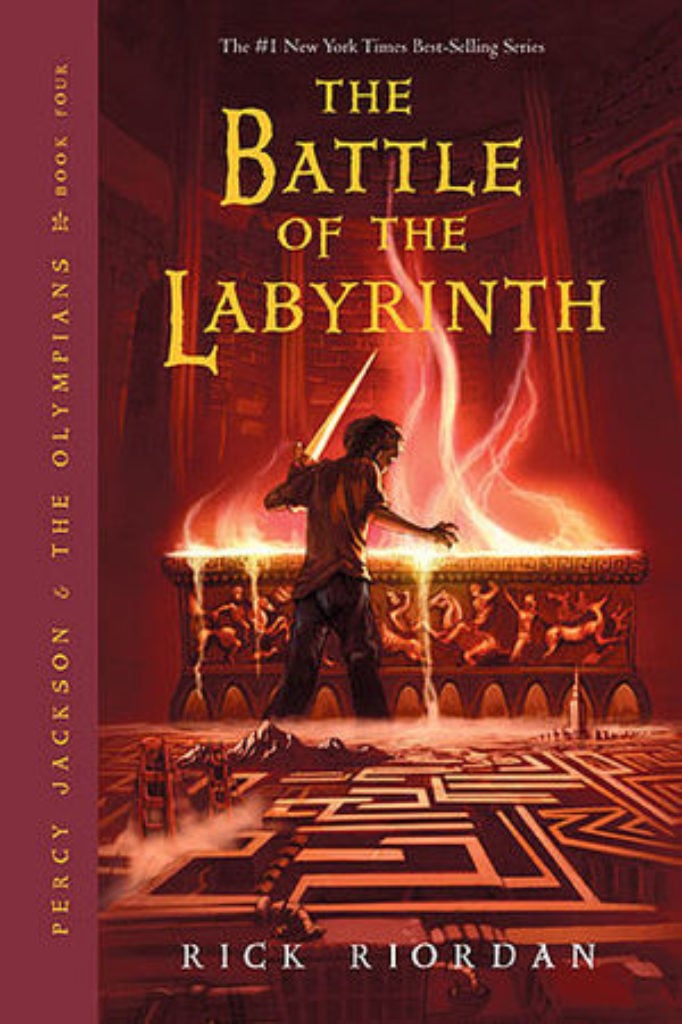
Percy Jackson and the Battle of the Labyrinth by Rick Riordan is the fourth book in the Percy Jackson and the Olympians series, following Percy and his friends as they navigate the legendary Labyrinth of Daedalus — a living, shifting maze that runs beneath the entire continental United States — to find its creator before Kronos’s army can use it to bypass Camp Half-Blood’s defenses and launch an invasion. The longest and most emotionally complex book in the series to this point, it deepens every major character arc while delivering the series’ most inventive mythology and its most significant personal stakes yet. This complete guide covers The Battle of the Labyrinth‘s reading level, recommended age, content considerations, characters, themes, and books similar to Percy Jackson and the Battle of the Labyrinth, designed for parents, teachers, and students.
For Parents
The series’ most emotionally layered volume to this point — character relationships deepen considerably, the threat from Kronos becomes immediate rather than distant, and Nico di Angelo’s arc takes a turn that gives the book real emotional weight. Best for readers ages 9–13 who have read the first three books.
For Teachers
A strong grades 4–7 independent read that draws on the myths of Daedalus and Icarus, the Labyrinth, Pan, and the Telekhines with particular fidelity. The Daedalus subplot — an inventor who made morally catastrophic choices in the service of craft — opens productive classroom discussion on ethics and creation. Pairs naturally with the first three books in a series unit.
Percy Jackson and the Battle of the Labyrinth at a Glance
Find on Amazon →| Author | Rick Riordan |
| Published | 2008 |
| Grade Level | 4–7 (our assessment) |
| Recommended Age | 9–13 |
| Flesch-Kincaid Grade | ~4.7 |
| Word Count | ~100,000 |
| Pages | 361 (Disney Hyperion paperback) |
| Chapters | 22 |
| Genre | Fantasy / mythology / adventure |
| Setting | New York; the Labyrinth; various underground and mythological locations; Mount Saint Helens; contemporary |
| Series | Percy Jackson and the Olympians, Book 4 |
For official Lexile and AR levels, visit Lexile.com or AR BookFinder. ReadingVine provides independent editorial assessments.
What Reading Level Is Percy Jackson and the Battle of the Labyrinth?
The Battle of the Labyrinth reads at approximately a 4th–7th grade level by our editorial assessment, with a Flesch-Kincaid grade level of around 4.7 — consistent with the series and with Percy’s first-person voice. At 361 pages and 100,000 words it is the longest book in the series to this point — significantly longer than The Sea of Monsters — but the pace never drags. Riordan’s chapter hooks remain as reliable as ever, and the Labyrinth setting, which can shift and change without warning, gives the novel a propulsive unpredictability that compensates for its added length.
Where the series’ reading demands have grown is in its emotional complexity. The Battle of the Labyrinth asks readers to track several simultaneous storylines — Percy and Annabeth’s relationship, Nico’s arc, Luke’s growing power, Daedalus’s moral history — with more sophistication than the earlier books required. The mythology is denser here than in any previous volume, and Riordan’s invention in modernizing it — Daedalus as a Silicon Valley engineer, the Labyrinth as a living operating system, Pan’s domain as a dying wilderness — rewards readers who are paying attention. For official Lexile and AR scores, visit Lexile.com or AR BookFinder. ReadingVine’s assessments are independent editorial judgments.
What Age Is Percy Jackson and the Battle of the Labyrinth Appropriate For?
We recommend The Battle of the Labyrinth for readers ages 9–13. The content remains appropriate for the full range — there is no sexual content, no profanity, and the violence is adventure-story combat. The emotional difficulty is higher than in earlier volumes, and there are several specific elements worth noting.
The novel contains the death of the god Pan — handled with genuine sadness and with more philosophical weight than a typical adventure-series death, as his passing represents the end of something real and irreplaceable in the natural world. A character is revealed to have been resurrected from the dead in a way that carries disturbing implications about what they now are, which may unsettle sensitive readers. Percy is trapped in an explosion at Mount Saint Helens and presumed dead for a period, and his absence causes real distress to the characters around him. The threat from Kronos moves from distant to immediate — Luke’s transformation becomes visible and frightening — and the novel ends with the loss of Daedalus, whose death is treated with unusual moral complexity for the series. None of this is gratuitous or graphic, but the book’s emotional range is wider than its predecessors, and parents of younger readers should be aware of it.
For most readers 9 and up, the added emotional complexity is what makes The Battle of the Labyrinth feel like the series becoming fully itself. The humor remains, the adventure is the series’ most inventive, and the emotional weight is earned rather than imposed.
What Is Percy Jackson and the Battle of the Labyrinth About?
The summer before Percy’s sophomore year begins with an explosion at his new school — which turns out to be infested with monsters — and accelerates from there. At Camp Half-Blood, Annabeth discovers an entrance to the Labyrinth beneath the camp’s arena, and Luke’s plan becomes clear: he intends to use the Labyrinth to navigate an army directly into Camp Half-Blood, bypassing its magical defenses. The only way to prevent this is to find Daedalus — the Labyrinth’s inventor — before Luke does and either destroy the Labyrinth or prevent Daedalus from giving Luke the one thing he needs: Ariadne’s string, a way to navigate the maze without getting lost.
Percy, Annabeth, Grover, and Tyson enter the Labyrinth. What follows is the series’ most structurally inventive book: the Labyrinth is not simply a maze but a living, shifting presence that responds to the thoughts of those inside it, and it takes them through Greek mythology rendered in American settings — a ranch in Nevada populated with monsters of Geryon, a spa run by Circe, an underwater kingdom, and eventually the forge of Hephaestus at Mount Saint Helens, where Percy’s attempt to call for help triggers a catastrophe that separates him from his friends and strands him on the island of Calypso.
Running parallel to the Labyrinth quest is Nico di Angelo’s storyline. Grieving his sister Bianca and furious at Percy for failing to protect her, Nico has been pursuing his own investigation into death and resurrection — following a path that leads him to Kronos’s side, then back, and ultimately to the revelation of a secret about his own identity that will be central to the series’ final volume. His arc is the book’s most emotionally serious thread and the one that most clearly sets up what The Last Olympian will need to accomplish.
Daedalus himself is one of Riordan’s finest mythological inventions: an ancient craftsman reborn across centuries in new bodies, haunted by the deaths his genius indirectly caused, still building because it is the only thing he knows how to do. His moral history — the nephew he murdered out of jealousy, the Minotaur he made possible, the Labyrinth that killed his son — gives the novel a thematic weight the earlier books didn’t attempt, and his final decision is the most morally complex act in the series to this point.
Percy Jackson and the Battle of the Labyrinth Characters
Is Percy Jackson and the Battle of the Labyrinth Banned?
The Percy Jackson series has been challenged in some schools and libraries on the grounds that its portrayal of Greek gods promotes paganism or conflicts with religious beliefs. These challenges have not resulted in widespread removal, and the series remains among the most widely available middle-grade fiction in American libraries. The Battle of the Labyrinth does not appear on any major challenged books lists as a standalone title.
Percy Jackson and the Battle of the Labyrinth Themes and Lessons
Daedalus is the novel’s thematic center. His story — a craftsman whose genius produced both wonders and catastrophes, who has spent centuries trying to outrun the consequences of his worst choices by building new things and dying into new bodies — raises a question the series has not previously asked: what do creators owe to those who are harmed by what they make? Daedalus built the Labyrinth at Minos’s request, knowing it would be used to imprison the Minotaur. He gave Ariadne the thread that helped Theseus escape, knowing it would end Minos’s reign. He built wings that killed his son. His moral history is not one of evil intent but of catastrophic consequence, and Riordan treats it with enough complexity to make Daedalus genuinely tragic rather than simply a villain.
Grover’s subplot about Pan makes an unexpected environmental argument — that the wild places of the world are dying not because of any single villain but because of collective human indifference, and that what has been lost cannot be recovered by any single act of heroism. Pan’s death is the series’ most melancholy moment and the one least amenable to the adventure genre’s usual solutions. Riordan does not resolve it tidily: Pan is gone, what he represented is diminished, and the responsibility for what remains is distributed across everyone who cared about it rather than assigned to a hero who can fix it alone.
Nico’s storyline raises the series’ most morally serious question about grief: what happens when the desire to undo a loss overrides every other value? His willingness to deal with forces he knows are wrong — because those forces offer him something he cannot get anywhere else — is treated with sympathy and without excusing the choices. His arc is the series’ most honest portrait of how grief can become destructive without the person grieving intending it to.
Discussion questions for classrooms and families: Is Daedalus responsible for the harm his inventions caused — does it matter that he didn’t intend it? What does Pan’s death say about the relationship between mythology and the natural world? How does Nico’s grief change him, and does it change him in ways that are understandable even if they’re wrong? What does Percy’s time on Calypso’s island reveal about his character?
How Many Pages and Chapters in Percy Jackson and the Battle of the Labyrinth?
The Disney Hyperion paperback is 361 pages across 22 chapters. At approximately 100,000 words it is the longest book in the series to this point — much longer than The Sea of Monsters — and the first volume where the series begins to feel genuinely substantial in hand. Most readers in the target age range finish it in one to two weeks of steady reading. The Labyrinth setting means no two chapters feel the same geographically, which helps the length feel less heavy than it might otherwise. The book ends with the war against Kronos clearly imminent, leaving readers in a direct narrative transition into The Last Olympian.
Books Similar to Percy Jackson and the Battle of the Labyrinth
About Rick Riordan
Rick Riordan was born in 1964 in San Antonio, Texas. He spent fifteen years as a middle school English and history teacher before becoming one of the best-selling children’s authors in the world. He has said that Daedalus was one of the mythological figures he most wanted to bring fully to life in the series — a genius whose story is genuinely tragic in the classical sense, whose inventions changed the world, and whose moral history is too complex to reduce to either hero or villain. The Labyrinth’s depiction as a living, shifting organism rather than a static maze was, Riordan has noted, his way of solving a structural problem: a maze that doesn’t change is just geography, but a maze that responds to its inhabitants is a character.
The Percy Jackson and the Olympians series has sold more than 180 million copies worldwide. A Disney+ television series adaptation premiered in 2023 with a second season covering The Sea of Monsters expected to follow. He lives in Boston.
Percy Jackson and the Battle of the Labyrinth: Frequently Asked Questions
What reading level is Percy Jackson and the Battle of the Labyrinth?
The Battle of the Labyrinth has a Flesch-Kincaid grade level of approximately 4.7. Our editorial assessment places it at grades 4–7 (ages 9–13). The prose is accessible and propulsive; the emotional complexity and mythological density are higher than in the earlier books. For official Lexile and AR scores, visit Lexile.com or AR BookFinder.
What grade is Percy Jackson and the Battle of the Labyrinth appropriate for?
We recommend grades 4–7 as the primary range. Strong 4th-grade readers who have followed the series will handle it comfortably; the book’s emotional complexity — particularly Nico’s arc and Pan’s death — rewards maturity at the upper end of the range.
How many pages are in Percy Jackson and the Battle of the Labyrinth?
The Disney Hyperion paperback is 361 pages across 22 chapters. Word count is approximately 100,000 words — the longest in the series to this point. Most readers finish it in one to two weeks of steady reading.
What is Percy Jackson and the Battle of the Labyrinth about?
Percy and his friends enter the legendary Labyrinth of Daedalus — a living, shifting maze beneath the continental United States — to find its inventor before Luke can use it to navigate Kronos’s army past Camp Half-Blood’s defenses. Along the way they encounter Daedalus himself, the dying god Pan, and the advancing threat of Kronos’s full return.
Who is Daedalus in Percy Jackson?
Daedalus is the legendary Greek craftsman who built the Labyrinth and crafted the wings that killed his son Icarus. In the novel he has survived across the centuries by uploading his soul into new bodies — now living as a Silicon Valley engineer called Quintus. His history of brilliant but catastrophic creations makes him the book’s most morally complex figure, and his final choice is the most significant act of responsibility in the series to this point.
What happens to Pan in The Battle of the Labyrinth?
Pan — the god of the wild — is found by Grover deep in the Labyrinth, ancient and fading. He tells Grover that the wild is dying because humans have stopped caring for it, and that it cannot be saved by any single divine act. Pan dies, releasing his essence to be carried forward by everyone who loved what he represented. It is the series’ most environmental and most melancholy moment, and Grover’s responsibility after Pan’s death shapes his role in the final book.
What is Nico’s secret in The Battle of the Labyrinth?
Nico di Angelo is revealed to be a son of Hades — one of the “big three” gods (Zeus, Poseidon, Hades) whose children are forbidden by a post-World War II pact because their power is too great. This makes him, alongside Percy (son of Poseidon) and Thalia (daughter of Zeus), one of only three living children of the eldest Olympians, and it connects him directly to the Great Prophecy about a half-blood child whose choice will decide Olympus’s fate.
Who is Calypso in Percy Jackson?
Calypso is the immortal daughter of Atlas, condemned by the gods to live alone on the island of Ogygia and offer shelter to heroes who wash ashore — heroes who always leave, and whom she always falls for. Percy is stranded on her island after the Mount Saint Helens explosion and stays long enough for a genuine connection to form before returning to the quest. She is one of the series’ most sympathetically drawn mythological figures, and her situation is treated as a genuine injustice. Her story is continued in the Heroes of Olympus series.