
 = Partner Site
Stone Fox Reading Level: A Complete Guide
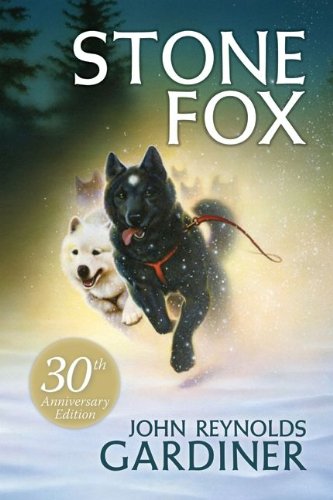
Stone Fox, written by John Reynolds Gardiner and illustrated by Marcia Sewall, is a 96-page novel for middle elementary readers about a ten-year-old boy named Little Willy who enters a dogsled race to save his grandfather’s Wyoming potato farm from tax foreclosure. The prize is $500 — exactly the amount owed. His competition includes Stone Fox, a Shoshone man who has never lost a race and who uses his winnings to buy back land taken from his people. The race is one chapter. The ending, based on a Rocky Mountain legend, is one of the most emotionally devastating in children’s literature. First published in 1980 and winner of the New York Times Outstanding Book Award, it has been continuously in print for more than forty years, sold millions of copies, and been read aloud by classroom teachers to generations of third- and fourth-graders — many of whom remember exactly where they were when they heard the ending. This complete guide covers Stone Fox‘s reading level, recommended age, content considerations, key figures, themes, and books similar to Stone Fox — designed for parents, teachers, and students.
For Parents
A short, emotionally powerful novel about a boy who races a dogsled to save his grandfather’s farm — with an ending that devastates most readers the first time through. Appropriate for ages 8–12. The dog dies at the finish line, graphically and suddenly. Most teachers preview this ending with parents before reading it aloud to a class. No other content concerns.
For Teachers
A grades 3–5 classroom staple — short enough to read aloud in one to two weeks, emotionally powerful enough to generate sustained discussion about sacrifice, loyalty, and the dignity of loss. Read it aloud first; do not assign it cold for independent reading without warning students and parents about the ending. The Stone Fox character’s portrayal invites critical discussion about Native American representation in children’s literature.
Stone Fox at a Glance
Find on Amazon →| Author | John Reynolds Gardiner |
| Illustrator | Marcia Sewall |
| Published | 1980 (HarperCollins) |
| Grade Level | 3–5 (our assessment) |
| Recommended Age | 8–12 |
| Lexile | 650L |
| ATOS Level | 4.0 |
| Guided Reading Level | P |
| Word Count | ~9,000 |
| Pages | 96 |
| Chapters | 10 |
| Genre | Historical fiction / adventure |
| Setting | Wyoming; late 19th century |
| Awards | New York Times Outstanding Book (1980); Maud Hart Lovelace Award; Utah Beehive Award |
For official Lexile and AR levels, visit Lexile.com or AR BookFinder. ReadingVine provides independent editorial assessments.
What Reading Level Is Stone Fox?
Stone Fox has a Lexile of 650L and an ATOS level of 4.0, with a Guided Reading Level of P and a grade level equivalent of 4. These scores are consistent with a grades 3–5 placement, and the interest level (grades 3–7) reflects that the book’s emotional power makes it appropriate across a wide age range. The prose is clear, simple, and very fast-moving — the deceptively low word count means that even a hesitant reader can finish the book in a few sittings. The Lexile 650L is lower than many books at the same grade level because Gardiner writes with extreme economy: short sentences, direct action, minimal description, maximum momentum.
The reading challenge in Stone Fox is not the vocabulary or sentence complexity but the emotional demands of the ending. The book’s final chapter is not difficult to decode; it is difficult to endure. This is worth naming for parents and teachers who are selecting it: the reading level scores say grades 3–5, and they are correct, but the emotional preparation required is more demanding than those scores suggest. For official Lexile and AR scores, visit Lexile.com or AR BookFinder. ReadingVine’s assessments are independent editorial judgments.
What Age Is Stone Fox Appropriate For?
We recommend Stone Fox for readers ages 8–12 and grades 3–5. The primary content consideration is the ending, which needs to be named directly.
Searchlight, Little Willy’s dog, dies in the final chapter — collapsing and dying of a burst heart just before the finish line of the dogsled race. This death is sudden, specific, and depicted with the full emotional weight of a ten-year-old losing his best friend and most faithful companion in the moment of apparent triumph. Teachers who have read this aloud to classes report that children — and adults — cry, sometimes loudly. Parents who are reading it at home with a child should know this is coming. The ending is not gratuitous; it is the legend’s resolution, and Stone Fox’s response to it (described below) is one of the most powerful moments in children’s literature. But it is a genuine loss, depicted seriously, and children who are sensitive to the death of animals in fiction should be prepared rather than surprised.
What Is Stone Fox About?
Little Willy is ten years old and lives with his grandfather on a potato farm in Wyoming. Grandfather has always been full of life and energy, but one morning Willy finds him lying in bed, staring at the ceiling, refusing to speak or move. The doctor says there is nothing physically wrong with him: Grandfather has lost his will to live. Willy and his sled dog Searchlight run the farm themselves — plowing, harvesting, selling — and everything seems to be working until Willy discovers the strongbox is empty. There is a tax debt of $500, accumulated over years when Grandfather had forgotten to pay, and if it is not paid the government will take the farm.
Willy learns about the National Dogsled Race, with a prize of $500. He enters. He begins training Searchlight — who is a farm dog, not a racing dog — for the race. The other competitors laugh. The race takes place in the town of Jackson, Wyoming, and the field includes Stone Fox: a large, silent Shoshone man who has never spoken a word to a white person and who has never lost a race. He runs his five Samoyeds with fierce efficiency, and he uses his prize money, it is eventually revealed, to buy back land that was taken from the Shoshone people.
The race. Willy and Searchlight run brilliantly. Stone Fox is ahead. In the final stretch, on the last hundred yards to the finish line, Searchlight collapses. She has run her heart out — literally — and she dies on the snow. Willy kneels beside her, unable to move. Stone Fox, who has crossed the finish line first, stops his dogs. He walks back. He draws a line in the snow across the track. He looks at the other racers. Without speaking a word, he makes clear that if any of them cross that line, he will kill them. Then he looks at Willy. Willy picks up Searchlight. He carries her across the finish line. Stone Fox lets him win.
A Note on Stone Fox and Native American Representation
Stone Fox is one of children’s literature’s most memorable supporting characters — silent, powerful, principled, and ultimately capable of a gesture of profound humanity. He is also a character whose portrayal has drawn criticism from Native American educators and scholars who note that the book depicts him primarily through the perspective of white Wyoming townspeople (“the Indian who never loses”), never gives him interiority or speech until his final gesture, and uses the term “Indian” throughout. The Shoshone land-buying motivation is sympathetically presented but is also never examined in depth: Stone Fox’s backstory is given in a brief paragraph, and his people’s dispossession is treated as historical background rather than as the ongoing political reality it was in the late 19th century Wyoming setting.
These limitations do not make Stone Fox a villain — he is the book’s most morally complex and ultimately most generous figure — but they do make him a character through whom to discuss how children’s literature of this era depicted Native American people, and what questions are worth asking about who tells these stories and from whose perspective. Teachers using Stone Fox in classrooms have found it productive to pair it with discussions of the Shoshone people, the historical context of land dispossession, and the difference between a sympathetically-drawn character and a fully realized one.
Stone Fox Characters
The Ending: What Happens and Why It Matters
The ending of Stone Fox is based on a Rocky Mountain legend — Gardiner heard it in Idaho and could never verify the specific names or dates, but the legend’s shape was clear: a race, a dog’s death, and a Native American champion’s act of grace. Gardiner made it his first novel because the legend would not leave him alone.
Stone Fox’s final gesture is not merely kindness. He is a man who has never lost a race, who has run every race for his people’s survival, who has never spoken to a white person in the book’s entire narrative. And he stops. He draws a line. He lets a ten-year-old boy carry his dead dog across the finish line. This is not sentimentality; it is recognition — of what Willy has done, of what Searchlight has done, of what the race has cost and what it means. Stone Fox sees Willy fully in that moment, and what he sees makes him capable of the largest possible gesture.
Teachers report that this ending generates some of the most genuine literary discussion they have ever had with elementary students — about what Stone Fox was thinking, about what he understood, about whether this makes him the story’s true hero, about what winning really means. These are adult questions that the book puts into the hands of eight-year-olds, which is exactly what the best children’s literature does.
Stone Fox Themes and Lessons
The book’s central argument is about the relationship between love and effort — specifically the love that sustains effort past the point where effort alone would stop. Willy enters the race because he loves his grandfather. Searchlight runs the race because she loves Willy. Her heart gives out not because she is weak but because she gives more than she has. This is the book’s most honest and most devastating truth: sometimes love costs everything, and the thing it costs is the love itself. Searchlight’s death is not a punishment; it is the fullest expression of what she was.
Stone Fox’s motivation — running to buy back Shoshone land — gives the story a second layer that is more complex and more politically charged than a simple villain’s motivation would be. He is not racing against Willy out of cruelty or arrogance; he is racing for the same reason Willy is, with the same urgency, for the same kind of love. This parallel makes his final gesture all the more extraordinary: he recognizes in Willy what he knows in himself, and he acts on that recognition.
Discussion questions for classrooms and families: Why do you think Stone Fox never lost a race before — and why did he let Willy win this one? What does Searchlight’s death tell us about what loyalty means? Is Stone Fox a villain, a competitor, or something else? Why do you think Grandfather got out of bed — what did Willy winning the race give him? If you were Willy, what would you have done differently?
How Long Is Stone Fox?
Stone Fox is 96 pages across 10 chapters with approximately 9,000 words. It is deceptively short for the emotional work it does — adults can read it in under an hour; children reading independently typically finish it in two to four sittings over two to four days; classroom read-alouds typically take one to two weeks at a chapter per session. Each chapter is short and punchy, with the kind of momentum that makes it hard to stop at chapter breaks. The book stands alone; there is no sequel.
Books Similar to Stone Fox
About John Reynolds Gardiner
John Reynolds Gardiner was born in 1944 in Los Angeles, California. He described himself as “author, engineer, inventor, rock-and-roll singer, door-to-door salesman, songwriter, and Santa Claus” — a biographical note that captures something of the restless, inventive energy in his writing. He studied engineering and worked as an engineer while pursuing writing. Stone Fox was his first published book, inspired by a legend he heard while in Idaho — the story of a Native American man who drew a line in the snow and refused to let anyone cross it so that a boy could carry his dead dog across the finish line. He could never verify the specific names or dates; the legend was vague, but its shape was clear, and it stayed with him until he wrote it down. He traveled widely throughout his life — living in Ireland, Germany, Italy, El Salvador, England, and Mexico — and wrote several other books for children. He died in 2006.
Stone Fox: Frequently Asked Questions
What reading level is Stone Fox?
Stone Fox has a Lexile of 650L, ATOS 4.0, and Guided Reading Level P — grade level equivalent 4. Our assessment: grades 3–5, ages 8–12. The prose is clear and simple; the reading challenge is emotional rather than linguistic, particularly in the final chapter. For official Lexile and AR scores, visit Lexile.com or AR BookFinder.
What is Stone Fox about?
Little Willy, a ten-year-old Wyoming boy, enters a dogsled race to win $500 and save his grandfather’s potato farm from tax foreclosure. His competition includes Stone Fox, a Shoshone man who has never lost a race and uses his winnings to buy back land taken from his people. The race is the book’s final chapter; the ending, based on a Rocky Mountain legend, is one of the most emotionally powerful in children’s literature.
Does the dog die in Stone Fox?
Yes. Searchlight, Little Willy’s dog, collapses and dies of a burst heart just before the finish line. This happens suddenly in the book’s final pages. Stone Fox, who has already crossed the finish line, stops his dogs, draws a line in the snow, and allows Willy to carry Searchlight across the finish line unopposed. Parents and teachers should be aware of this before reading it with children who are sensitive to the death of animals in fiction.
What grade is Stone Fox for?
Grades 3–5, ages 8–12. It is most commonly assigned in grades 3–4 as a class read-aloud or independent reader. The short length (96 pages, approximately 9,000 words) makes it practical as a one-to-two-week classroom novel. The emotional weight of the ending makes it more appropriate for grades 3 and up rather than younger children.
Why does Stone Fox let Willy win?
Stone Fox draws a line in the snow and threatens the other racers so that Willy can carry his dead dog across the finish line alone. The book never explains his reasoning explicitly — he never speaks — but the implication is that he recognizes in Willy’s situation something of his own: a person running for the sake of love and land and something larger than himself. His gesture is one of the most discussed questions the book generates in classrooms: is it generosity, recognition, respect, or all three?
Is Stone Fox based on a true story?
It is based on a Rocky Mountain legend that Gardiner heard in Idaho — the story of a dogsled race, a dog’s death, and a Native American man who drew a line in the snow. Gardiner could never verify the specific names or dates; the legend was vague, but the shape was clear. He describes it in an author’s note at the beginning of the book. The historical setting (late 19th century Wyoming) and the Shoshone land-dispossession context are historically accurate as background.
How many pages and chapters are in Stone Fox?
96 pages across 10 short chapters, approximately 9,000 words. Adults can read it in under an hour; children typically finish it in two to four sittings. Classroom read-alouds at a chapter per session take one to two weeks. There is no sequel.