
 = Partner Site
Tom Gates: A Tiny Bit Lucky Reading Level: A Complete Guide
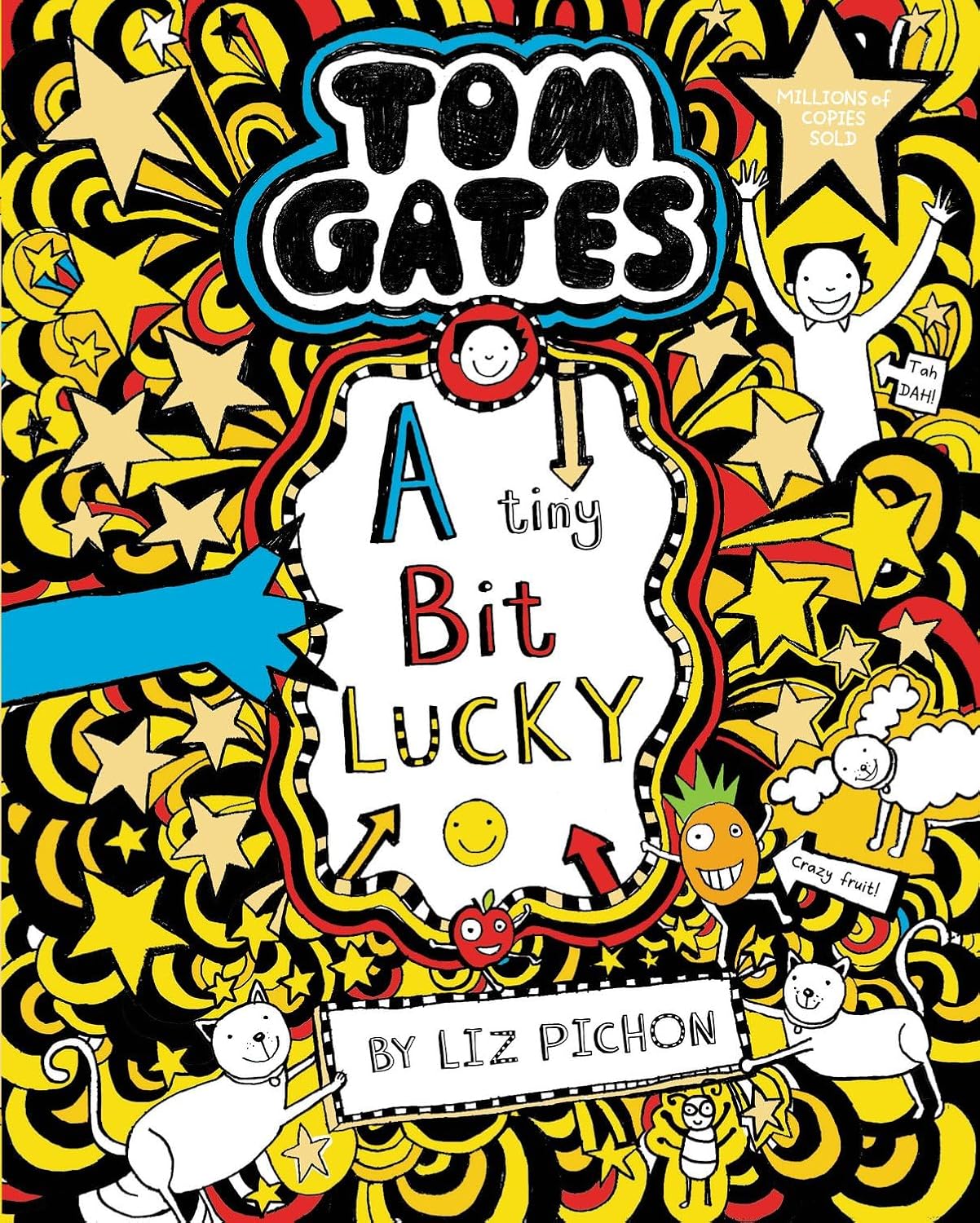
Tom Gates: A Tiny Bit Lucky, written and illustrated by Liz Pichon, is the seventh book in the beloved British illustrated diary series about Tom Gates — a boy whose exercise book is perpetually full of doodles, whose band Dogzombies is perpetually almost-but-not-quite-ready to perform, whose sister Delia is perpetually annoying, and whose life is a series of small disasters and tinier triumphs that he records with cheerful, self-deprecating honesty. In this installment: there is a Band Battle competition that Dogzombies absolutely should enter. There is enrichment week at school, featuring activities Tom would rather avoid. There is a stray cat that keeps showing up. There is his dad’s new kite obsession. There are caramel wafers to eat and an amazing new cartoon on TV and school inspectors making everything more stressful. And through it all, Tom is cataloguing the moments when things go slightly right — a tiny bit lucky. Originally published in the UK in 2014 by Scholastic UK and in the US by Candlewick Press, the Tom Gates series has won the Roald Dahl Funny Prize, the Waterstones Children’s Book Prize, and the Blue Peter Book Award for its first volume and has become one of the most beloved school-humor illustrated series in British publishing, with a dedicated readership in the United States and internationally. This complete guide covers Tom Gates: A Tiny Bit Lucky‘s reading level, recommended age, content, key characters, themes, and similar books — designed for parents, teachers, and students.
For Parents
A warm, funny, doodle-filled diary novel from one of the UK’s most beloved illustrated series — in the same format as Diary of a Wimpy Kid and Dork Diaries but with a distinctly British sensibility and humor. Ages 7–12, grades 3–6. No content concerns. A Tiny Bit Lucky is Book 7; the series can be started here or from Book 1.
For Teachers
A grades 3–6 library and classroom staple for reluctant readers — particularly effective for children who enjoy Diary of a Wimpy Kid and want more in the same format. The series is British, which makes it a natural companion for discussions of British vs. American English and school culture. Pichon’s distinctive hand-drawn doodle style rewards visual literacy discussion.
Tom Gates: A Tiny Bit Lucky at a Glance
Find on Amazon →| Author & Illustrator | Liz Pichon (author & illustrator) |
| Published | 2014 (Scholastic UK; Candlewick Press US) |
| Grade Level | 3–6 (our assessment) |
| Recommended Age | 7–12 |
| Lexile | ~650L (Book 1 confirmed; Book 7 not separately published) |
| Pages | 253 |
| Format | Illustrated diary novel (British) |
| Genre | Humor / realistic fiction / illustrated diary novel |
| Series | Tom Gates (17+ books, 2011–present; ongoing) |
| Series Position | Book 7 of the Tom Gates series |
For official Lexile and AR levels, visit Lexile.com or AR BookFinder. ReadingVine provides independent editorial assessments.
What Reading Level Is Tom Gates: A Tiny Bit Lucky?
The Tom Gates series has a confirmed Lexile of 650L for Book 1 (The Brilliant World of Tom Gates); individual Lexile scores for the later volumes including A Tiny Bit Lucky (Book 7) are not separately published by MetaMetrics. Based on the series’ confirmed Book 1 score, the consistent prose style and format across all volumes, and the publisher’s recommended age range (7–12, grades 3–6), our editorial assessment places the series at approximately 600–680L throughout — consistent with a grades 3–5 independent reading level.
As with Diary of a Wimpy Kid and Dork Diaries, the reading level scores for this format significantly understate the book’s accessibility in practice: the diary-with-doodles format, short entries, and abundant illustrations make it far more engaging for reluctant readers than a formula score alone would suggest. The book is also British — published in the UK with British English spellings (“mum,” “colour,” “practise”) and British school culture references — which adds a small additional layer of comprehension for American readers but is never a serious obstacle. For official Lexile and AR scores, visit Lexile.com or AR BookFinder. ReadingVine’s assessments are independent editorial judgments.
What Age Is Tom Gates Appropriate For?
We recommend Tom Gates: A Tiny Bit Lucky for readers ages 7–12, grades 3–6. There are no content concerns: the humor is clean slapstick and observational comedy, the family and school dynamics are entirely age-appropriate, and nothing in the book is darker than the mild family frustrations (annoying sister, well-meaning-but-chaotic parents) that form Tom’s standard backdrop. The book is appropriate from the younger end of the recommended range for independent reading and will delight older readers who love the format.
Do I Need to Start with Book 1?
The Tom Gates series is structured so that each book is largely self-contained — the recurring characters (Derek, Marcus, Amy, Delia, Mr. Fullerman) are re-introduced with enough context in each volume that new readers can begin anywhere without feeling lost. A Tiny Bit Lucky (Book 7) works as a standalone entry point; readers who love it will want to go back to the beginning and read the full series, which is a feature rather than a problem.
That said, readers who start from Book 1 (The Brilliant World of Tom Gates) will have a richer experience because the relationships are more fully established: Tom’s friendship with Derek, his long-running tension with Marcus, and his ongoing (very slow) progress with Amy are funnier when you know the full history. Our recommendation: start with Book 1 if the child is beginning the series fresh; jump into any book if they’ve been handed one and are excited about it.
What Is A Tiny Bit Lucky About?
Tom Gates is keeping track. Any time something goes even slightly right — any moment of minor, accidental good fortune in what is otherwise a fairly chaotic life — he marks it on his mental Lucky Meter and records it in his diary. Tiny bits of luck: they add up, maybe.
The main things happening in this book: Dogzombies (Tom’s band, featuring Tom on guitar and his best friend Derek on drums) has the chance to enter the Rock Weekly Band Battle competition. They should practice. They do not practice enough. There is enrichment week at school, during which Tom is assigned activities that are not his favorites. There is a stray cat who keeps appearing in the neighborhood and may or may not be adopting Tom’s family. There is his dad’s new passion for kite-making and kite-flying, which the whole family is dragged into. There is Marcus Meldrew, the most annoying boy in school, who manages to insert himself into multiple situations. There are caramel wafers. There is Mr. Fullerman, Tom’s teacher, writing increasingly weary comments in the margins of Tom’s work. And through all of it, Tom draws, doodles, writes, annotates, and produces the book the reader is holding: a document of one ordinary, funny, slightly-lucky life.
Tom Gates as a British Series — What American Readers Should Know
The Tom Gates series was originally published in the UK, where it has won major children’s literary prizes and sold millions of copies, before Candlewick Press brought it to American readers. The books are set in England — Tom attends Oakfield School, his mum packs his lunch, his teacher writes comments in his exercise book, and the cultural references (BAFTA, Blue Peter, British school terms) are British throughout. American editions typically retain the British English rather than Americanizing the text.
This is not a barrier to enjoyment; most American readers find the British setting charming and the cultural differences minor. The humor is universal (annoying siblings, clueless adults, school misadventures) even when the specific references are local. For classroom use, the British setting and vocabulary are actually an asset: they make the book a natural vehicle for discussions of how the same language can differ between countries and cultures, and for comparing British and American school experiences.
Tom Gates Characters
Tom Gates Themes and Lessons
The “tiny bit lucky” conceit — Tom cataloguing the small moments when things go slightly right — is the series’ warmest structural move in this volume. It is not a gratitude journal in any formal sense; Tom is not being instructed to count his blessings. He simply notices, doodles, and records the moments when luck tips slightly in his direction, and the cumulative effect is a portrait of a life that is mostly ordinary and occasionally delightful — which is most people’s actual experience, and which is why the series resonates so widely.
Pichon’s illustration style — loose, hand-drawn, full of energy and slightly chaotic — is the visual equivalent of Tom’s personality, and it rewards looking at as much as reading. The doodles in the margins, the decorated headings, the full-page drawings of the moments Tom is describing, and the teacher’s margin comments all carry additional narrative information and additional jokes that exist only in the visual layer. Children who slow down to look at every drawing get a different and richer book than children who read only the words.
Talking with your child: What does Tom mean by “a tiny bit lucky” — can you find the moments he marks? What is the funniest thing that happens in this book? What does Tom’s doodling tell us about how he sees the world? If you kept a diary like Tom’s, what would the doodles look like?
How Long Is A Tiny Bit Lucky?
Tom Gates: A Tiny Bit Lucky is 253 pages. Like all Tom Gates books, the page count significantly overstates the reading time required — the pages are full of illustrations, doodles, decorated headings, and Tom’s visual storytelling, so the actual prose volume is considerably less than a 253-page novel of conventional density. Most readers ages 7–12 complete it in one to three sittings. The Tom Gates series now spans seventeen-plus books and is ongoing; Pichon continues to produce new volumes that maintain the format and characters consistently across the full series.
Books Similar to Tom Gates
About Liz Pichon
Liz Pichon grew up in England drawing constantly — a habit she has never stopped. She studied art and went on to work as a designer and art director at Jive Records, one of the UK’s major music labels, before turning to children’s books. The Tom Gates series was her breakthrough: The Brilliant World of Tom Gates (2011) won the Roald Dahl Funny Prize, the Waterstones Children’s Book Prize, and the Blue Peter Book Award in the same year — a sweep of the major British children’s book prizes that established the series immediately as a phenomenon. She has since published seventeen-plus Tom Gates volumes and continues the series, all written and illustrated entirely by herself in her characteristically energetic hand-drawn style.
Pichon has said that Tom is partly drawn from her own school experience — she was a daydreamer and doodler who got told off for drawing in class and who did not immediately recognize this as a career path. The series is her argument, delivered in doodles, that paying close visual attention to the world around you is a form of intelligence and expression that conventional schooling does not always reward but that is genuinely valuable. She lives in Brighton, England, with her family.
Tom Gates: A Tiny Bit Lucky — Frequently Asked Questions
What reading level is Tom Gates: A Tiny Bit Lucky?
The Tom Gates series has a confirmed Lexile of 650L for Book 1; Book 7’s individual score is not separately published. Our estimate based on the consistent series format: approximately 600–680L, grades 3–5 for independent reading. Our assessment: grades 3–6, ages 7–12. For official Lexile and AR scores, visit Lexile.com or AR BookFinder.
What is Tom Gates: A Tiny Bit Lucky about?
Tom Gates catalogues the small moments of minor luck in his life while navigating enrichment week at school, his dad’s kite obsession, a Band Battle competition for Dogzombies, a stray cat, the ever-annoying Marcus Meldrew, and all the other ordinary chaos of his very ordinary, frequently funny life. The diary is full of his doodles, his band’s practice notes, his teacher’s margin comments, and caramel wafers.
Do I need to start with Tom Gates Book 1?
Not strictly — each Tom Gates book is largely self-contained and new readers can start anywhere. But reading from Book 1 (The Brilliant World of Tom Gates) gives readers the full history of Tom’s relationships with Derek, Marcus, Amy, and Mr. Fullerman, which makes the series richer and funnier. Our recommendation: start from Book 1 if possible; if you have Book 7, start there and go back.
Is Tom Gates British? Will American readers understand it?
Yes — Tom Gates is a British series set in England, with British English spelling and vocabulary (“mum,” “colour,” “practise”) and British school culture references. American editions generally retain the British English. American readers find the setting charming and the cultural differences minor; the humor is universal even when the references are local. The British setting makes it a natural vehicle for discussions of British vs. American English in classrooms.
How many Tom Gates books are there?
Seventeen-plus books in the main series, ongoing since 2011, all by Liz Pichon. The series shows no signs of ending and Pichon continues to produce new volumes. The full series is available in the UK in boxed sets; individual volumes are available from Candlewick Press in the US.
What awards has Tom Gates won?
Book 1, The Brilliant World of Tom Gates, won the Roald Dahl Funny Prize, the Waterstones Children’s Book Prize, and the Blue Peter Book Award — three of the UK’s most significant children’s literature prizes — in the year of its publication. The first series also won the Scottish BAFTA for Entertainment. The series has been a consistent presence on UK bestseller lists since 2011.