
 = Partner Site
We’re Going on a Bear Hunt Reading Level: A Complete Guide
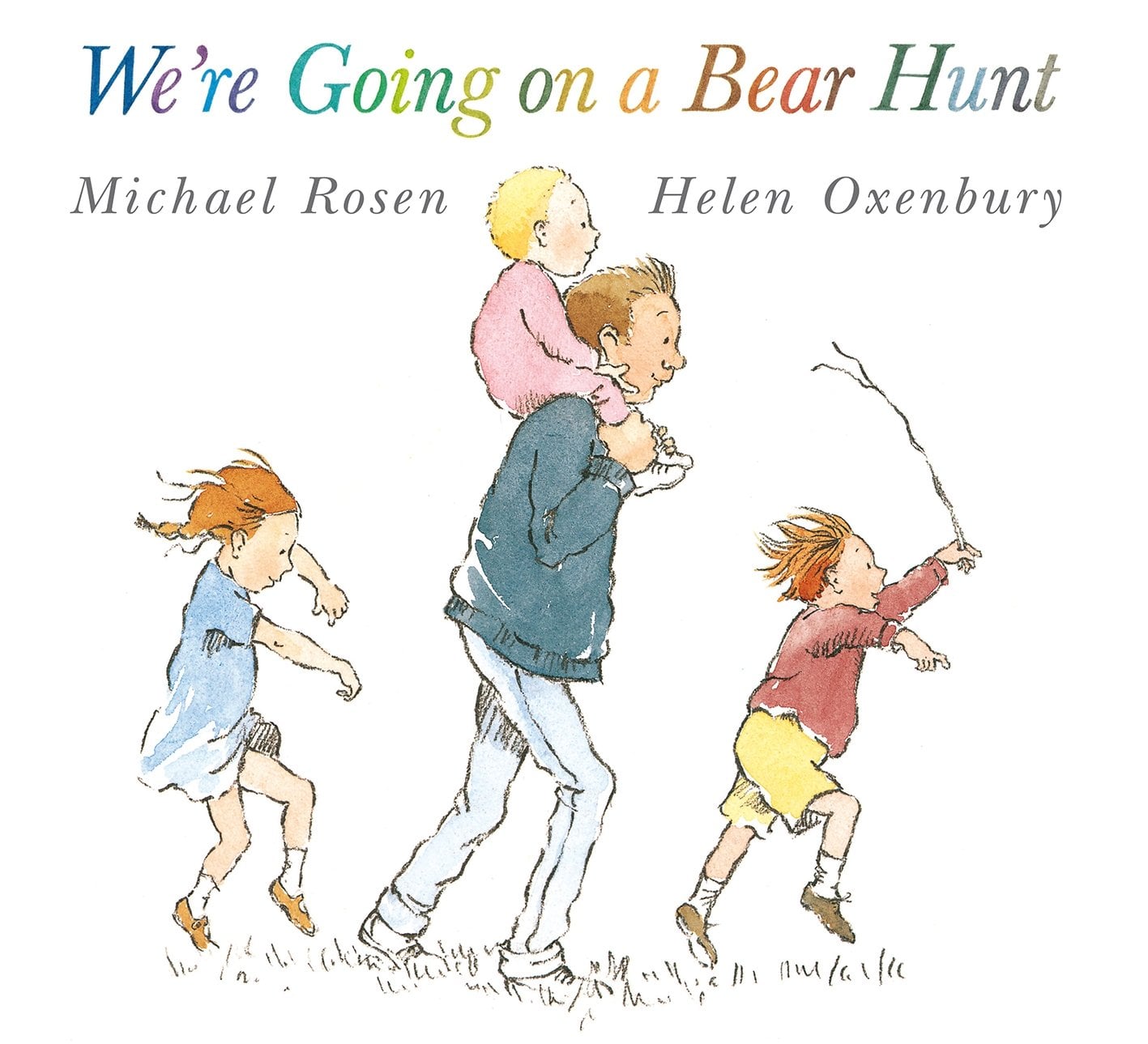
We’re Going on a Bear Hunt, written by Michael Rosen and illustrated by Helen Oxenbury, is a 36-page picture book about a family who sets out to catch a bear — wading through swishy swashy grass, splash sploshing through a cold river, squelch squerching through thick mud, stumble tripping through a dark forest, and hooo woooing through a snowstorm, until they find a bear in a cave and run all the way home in reverse. Published in 1989 and winner of the Nestlé Smarties Book Prize, it has never gone out of print, has sold over nine million copies, was inducted into the Picture Book Hall of Fame in 2018, and has been performed by Rosen himself in living rooms and auditoriums around the world for thirty-five years. Based on a traditional children’s chant, the book’s cumulative repetition, onomatopoeia, and forward-and-back symmetry make it one of the most read-aloud-able picture books ever published — a book that children memorize without trying and recite without being asked, simply because the words feel so good in the mouth. This guide covers We’re Going on a Bear Hunt‘s reading level, whether it’s a read-aloud or independent read, what it’s about, its themes, how long it takes to read, and similar books — designed for parents and teachers of K–2 readers.
For Parents
A British classic beloved in American classrooms for over thirty years — a cumulative adventure story built on repetition, onomatopoeia, and the irresistible rhythm of a family who can’t go over it, can’t go under it, and has to go through it. Best for ages 2–7. No content concerns. The book your child will have memorized by the third reading.
For Teachers
A PreK–K classroom staple for phonological awareness, sequencing, and oral language development — the repetitive refrain and onomatopoeia make it ideal for choral reading, movement activities, and prediction exercises. The forward-and-back structure is one of the clearest examples of narrative symmetry available at this age level. Pairs naturally with other adventure and sequencing picture books.
We’re Going on a Bear Hunt at a Glance
Find on Amazon →| Author | Michael Rosen |
| Illustrator | Helen Oxenbury |
| Published | 1989 (Margaret K. McElderry Books / Walker Books) |
| Grade Level | PreK–K (our assessment) |
| Recommended Age | 2–7 |
| Lexile | 280L |
| ATOS Level | 1.3 |
| Word Count | 410 |
| Pages | 36 |
| Genre | Picture book / adventure / cumulative tale |
| Awards | Nestlé Smarties Book Prize (1989); Boston Globe–Horn Book Honor (1989); Picture Book Hall of Fame (2018) |
For official Lexile and AR levels, visit Lexile.com or AR BookFinder. ReadingVine provides independent editorial assessments.
What Reading Level Is We’re Going on a Bear Hunt?
We’re Going on a Bear Hunt has a Lexile of 280L and an ATOS level of 1.3 — placing it among the most accessible texts in this catalog, alongside One Fish Two Fish Red Fish Blue Fish (270L) and Leo the Late Bloomer (120L). At 410 words across 36 pages, the text is brief and highly repetitive: the same refrain (“We’re going on a bear hunt / We’re going to catch a big one / What a beautiful day / We’re not scared”) returns before each obstacle, and each obstacle’s onomatopoeic sounds (“swishy swashy,” “splash splosh,” “squelch squerch”) repeat twice. This structure makes the book decodable far earlier than its Lexile might suggest — children who cannot yet read independently can join in the refrain after a single hearing.
The Lexile and ATOS scores are appropriate for the text’s vocabulary and sentence structure. What they cannot capture is how the book is actually experienced: as something closer to song than prose, a text whose predictable repetition is a scaffold that allows very young children to participate fully in the reading before they can decode a single word. For official Lexile and AR scores, visit Lexile.com or AR BookFinder. ReadingVine’s assessments are independent editorial judgments.
Is We’re Going on a Bear Hunt a Read-Aloud or Independent Read?
This is first and most powerfully a read-aloud for ages 2–7 — one of the great participatory read-aloud experiences in children’s literature. The repetitive refrain is designed for children to join in; the onomatopoeia is designed to be performed with the whole body; and the building momentum of the adventure — each obstacle harder than the last, each one gone through rather than over or under — creates a genuine sense of mounting excitement that peaks at the bear’s cave and releases in the helter-skelter run home. No other picture book in this catalog offers quite this combination of physical engagement and narrative suspense for the youngest readers.
For independent reading, a confident K–1 reader who knows the book well can work through the text easily — the repetitive structure provides enormous support for early decoders. Many children who love the book will want to “read” it independently long before they can actually decode the words, because they have memorized the text from repeated read-alouds. This pre-reading behavior — reciting a memorized text while tracking the words — is one of the most productive early literacy practices available, and We’re Going on a Bear Hunt generates it almost automatically.
Start the actions on the first obstacle and keep them going: rub your hands together for the swishy swashy grass, splash your hands for the river, squelch your fists for the mud. By the time you hit the snowstorm, your child will be leading the actions with you. Then, when the family runs back through everything in reverse, do it all again — faster. The speed of the retreat is the book’s biggest physical joke, and children who are moving with the text feel it in their bodies.
What Is We’re Going on a Bear Hunt About?
A family — a father and four children, with a dog — set out to catch a bear. They are cheerful and unafraid: “What a beautiful day! We’re not scared.” They encounter five obstacles on their way, and at each one the same realization: they can’t go over it, they can’t go under it, they’ve got to go through it. Through the long wavy grass (swishy swashy), through the deep cold river (splash splosh), through the thick oozy mud (squelch squerch), through the big dark forest (stumble trip), through the swirling whirling snowstorm (hooo wooo) — until finally they reach a narrow gloomy cave.
Inside the cave they feel something. Something cold. Something wet. One shiny wet nose. Two big furry ears. Two big goggly eyes. It’s a bear. The family turns and runs — back through the snowstorm, back through the forest, back through the mud, back through the river, back through the grass, all the way to the house, up the stairs, into bed, under the covers. “We’re not going on a bear hunt again!” The last illustration shows the bear alone on a beach at night — the same beach shown sunny and bright at the book’s opening — trudging back alone.
The ending is the book’s most quietly significant moment: the bear was not dangerous. The family ran from something that was simply a bear, that was perhaps curious and is now alone. Many children notice this and ask about it; it is worth pausing on rather than hurrying past.
We’re Going on a Bear Hunt Characters
The family — a father and four children ranging from a toddler in arms to older siblings, with a small dog — are depicted by Oxenbury with warm, realistic watercolors that give each child a distinct personality visible in their expressions and body language across the book’s adventure. The oldest children’s confidence at the start is gradually replaced by real fear as the obstacles mount; the baby in the father’s arms is blissfully unaware throughout; the dog is the last one into the house and the last one under the covers. The bear is the book’s other character: seen only at the end, in the cave, and then alone on the beach. Rosen and Oxenbury do not make the bear menacing — the children’s panic is disproportionate to any actual threat, and the bear’s final solitary image invites a different reading of the whole adventure.
We’re Going on a Bear Hunt Themes and Lessons
The book’s central wisdom — “we can’t go over it, we can’t go under it, oh no! we’ve got to go through it!” — has become one of the most quoted lines in picture book literature, used by teachers, therapists, and parents to name the experience of facing something unavoidable. The phrase resonates because it is true in a way that goes well beyond a bear hunt: some obstacles cannot be avoided or circumvented; they can only be gone through. This is a concept that serves children well when they encounter their own versions of the long wavy grass and the deep cold river.
The forward-and-back structure is one of the most elegant in picture book history. The family goes through each obstacle on the way to the bear; they go back through each one on the way home, in reverse order, at speed. This symmetry is deeply satisfying to children who have been tracking the sequence — they know what is coming in the retreat before it arrives, and they feel the pleasure of the pattern completing itself. This predictability is not a limitation; it is the book’s central pleasure, the thing that makes re-reading even more satisfying than the first reading.
The ending deserves specific attention. The bear, seen only briefly in the cave, is shown on the final page walking alone on the beach — the same sunny beach where the family began their adventure, now dark and empty. Rosen has said this image was Oxenbury’s contribution and that it changes the book’s meaning in ways he finds moving: the bear was not a monster. The family was afraid of something that was simply itself. Children who notice the bear’s solitude often want to talk about it, and those conversations — about fear, about what we run from and why, about what might happen if the family went back — are among the most productive a picture book can generate.
Talking with your child: What do the children say when they can’t go over or under each obstacle? Can you remember all five things they went through? Which one would you least want to go through? Why do you think they ran away from the bear — was the bear really dangerous? What do you think the bear felt when it got back to the beach alone?
How Long Is We’re Going on a Bear Hunt?
We’re Going on a Bear Hunt is 36 pages with 410 words. Most adults can read it aloud in about six to eight minutes — though sessions with young children who are doing the actions, joining the refrain, and demanding the sounds be performed properly typically run longer and are more raucous. The book is available in multiple formats: standard picture book, board book for the youngest readers, and a 25th anniversary edition. Rosen performs the book himself on YouTube in a widely watched video that is worth showing children who love the text. The 2016 Channel 4 animated special features Olivia Colman and adds significant new story material; it is available for streaming and is appropriate for the same age range as the book.
Books Similar to We’re Going on a Bear Hunt
About Michael Rosen and Helen Oxenbury
Michael Rosen was born in 1946 in Harrow, Middlesex, England. He studied at Oxford University and has been writing poetry and books for children since 1970. He served as the UK Children’s Laureate from 2007 to 2009, a role in which he advocated widely for reading for pleasure in schools. He has written more than 140 books and is one of the most popular children’s poets in the English-speaking world. He adapted We’re Going on a Bear Hunt from a traditional children’s chant he encountered in his work as a performer of poetry for children — hearing the song in various forms and eventually shaping it into a book. He has performed the book himself on television, online, and in live events around the world for thirty-five years; his YouTube video of the performance has been watched millions of times. In 2020 he contracted COVID-19 and spent forty-seven days in intensive care; he wrote about his experience in Many Different Kinds of Love (2021). He lives in London.
Helen Oxenbury was born in 1938 in Ipswich, England, and studied at the Ipswich School of Art and the Central School of Art and Design in London. She is one of the most celebrated illustrators in British children’s book history, winner of two Kate Greenaway Medals (the British equivalent of the Caldecott) and a Kate Greenaway Medal nominee for We’re Going on a Bear Hunt. Her watercolor illustrations for the book alternate between full-color spreads of the family in the natural world and black-and-white charcoal drawings of the family confronting each obstacle — a visual contrast that builds the book’s sense of real adventure within a warm, family-centered world. She was married to illustrator John Burningham until his death in 2019. The final image of the bear alone on the beach was Oxenbury’s contribution to the book’s ending and the detail that most consistently moves adult readers.
We’re Going on a Bear Hunt: Frequently Asked Questions
What reading level is We’re Going on a Bear Hunt?
We’re Going on a Bear Hunt has a Lexile of 280L and an ATOS of 1.3 — among the most accessible texts in this catalog. At 410 words with a highly repetitive structure, it is accessible to the earliest readers. Our assessment: PreK–K, ages 2–7. For official Lexile and AR scores, visit Lexile.com or AR BookFinder.
What is We’re Going on a Bear Hunt about?
A family sets out to catch a bear and travels through five obstacles — long grass, a river, mud, a forest, and a snowstorm — each one gone through rather than over or under. They find a bear in a cave, panic, and run all the way home in reverse. The last page shows the bear alone on a beach at night. The children hide under the covers and declare: “We’re not going on a bear hunt again!”
What are the five obstacles in We’re Going on a Bear Hunt?
Long wavy grass (“swishy swashy”), a deep cold river (“splash splosh”), thick oozy mud (“squelch squerch”), a big dark forest (“stumble trip”), and a swirling whirling snowstorm (“hooo wooo”) — followed by the narrow gloomy cave where the bear is found. The family goes through all five obstacles on the way to the bear, and back through all five in reverse when they run home.
Is We’re Going on a Bear Hunt based on a true story?
It is based on a traditional children’s chant — a song that existed in various forms before Rosen encountered it in his work as a children’s poet and performer. He shaped it into a book, and Oxenbury’s illustrations gave it its specific visual world. It is in the tradition of cumulative folk tales and chants that have been passed down through oral culture, with Rosen and Oxenbury’s version becoming definitive.
What does the ending of We’re Going on a Bear Hunt mean?
The final illustration shows the bear alone on a beach at night — the same beach shown sunny and full of adventure at the book’s opening. Oxenbury added this image to suggest that the bear was not dangerous but simply itself, and is now alone after being frightened away. Many readers find it quietly sad: the children ran from something that was never truly threatening, and the bear returns to its solitude. Rosen has said this ending moves him deeply. It is a productive moment to pause on with children who notice it.
How long does it take to read We’re Going on a Bear Hunt aloud?
About six to eight minutes as a read-aloud — though sessions with young children doing the actions and joining the refrain typically run longer and louder. Michael Rosen’s own performance of the book is available on YouTube and runs approximately four and a half minutes at his characteristic energetic pace.