
 = Partner Site
Linking Verbs Worksheets, Definition, Examples
Welcome to our linking verbs worksheets! Linking verbs are verbs that connect a subject to its complement, providing more information about the subject without describing an action. They often describe a state or condition. The most common linking verb is the verb “to be” in its various forms. Other linking verbs include words like “seem,” “become,” “appear,” “feel,” and “look.”
For example in the sentence, “he seems tired”, the subject is “he,” and the complement is “tired.” The linking verb “seems” connects the subject to the complement, providing more information about the subject’s state. Other examples include “She is a teacher” and “the ice cream tastes delicious”.
Students usually start learning about linking verbs early in their language education, often in elementary school, as they are an essential part of understanding basic sentence structure.
Linking Verbs

Comparing Types of Verbs Worksheet
Practice comparing linking verbs, helping verbs, and being verbs using a Venn diagram to analyze their similarities and differences.

Match the Subject and Tense Linking Verbs Worksheet
Use the chart to match subjects with correctly conjugated linking verbs in different tenses like am, is, are, was, and were.
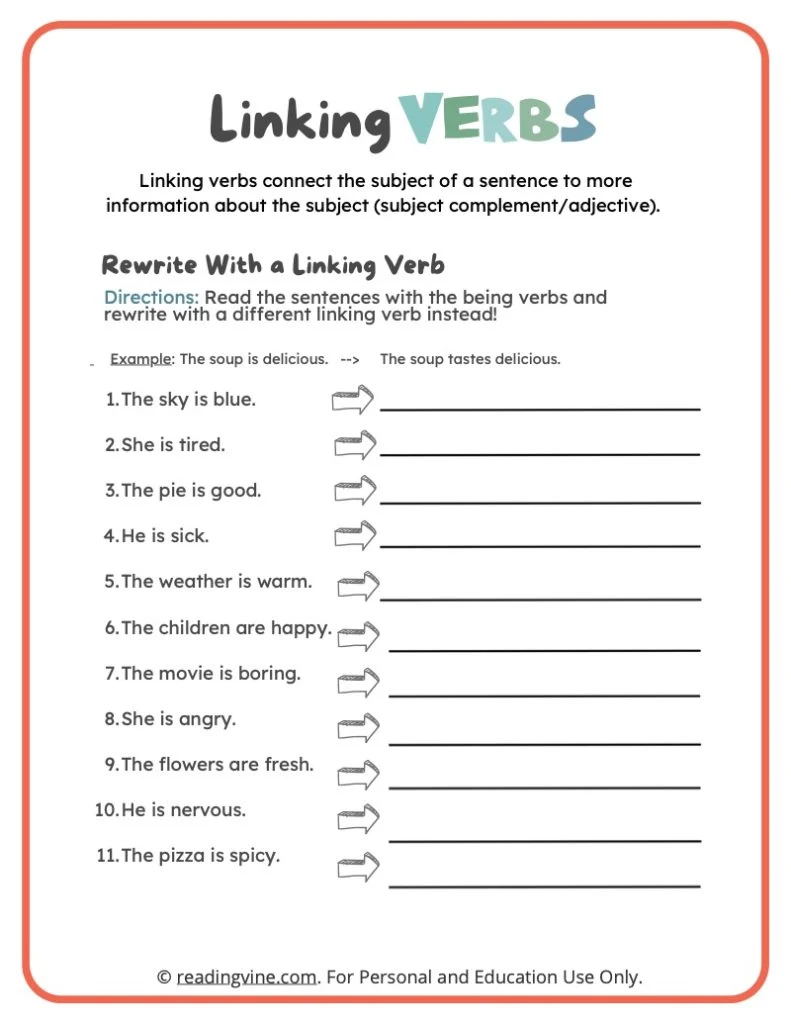
Rewriting Sentences With Linking Verbs Worksheet
Rewrite sentences by changing linking verbs to create new sentences with different meanings while maintaining grammatical structure.

Underline the Linking Verbs Sentence Search Activity
Locate and underline linking verbs in twelve sentences, identifying words that connect subjects to descriptive complements.

Underline the Linking Verbs Worksheet
Read sentences and underline linking verbs, then determine whether each verb is truly a linking verb or not.