
 = Partner Site
Acrostic Poem Examples and Activities
What is Acrostic Poetry? What are some acrostic poem examples and activities?
Acrostic Poems are created when a word or name is chosen and written vertically, with the poem following each letter in that word or name. They are amazing and eye-catching!
Acrostic poems can serve as an excellent complement to “I Am” and “I Am from” poems, as they can be a great way for students to introduce themselves and their likes and dislikes. Imagine a nook in your classroom or learning space where you can see each student’s name and details about them in each poem. There is so much potential for ownership and building connection.
However, acrostics can be used for a number of tasks and across subjects, they do not have to be personal.
Examples
Let’s take a look at a few themed acrostics. (By the way, writing themed acrostic poems can be wonderful for any season. Use words like “FALL,” “SNOW,” and “FLOWER” for your younger learners!)
We love this acrostic:
“Together we accomplished so much.
Having your help has been wonderful.
And I can’t wait to work together again!
No one has as much knowledge as you!
Keeping our connection is important to me.
So let’s work together again soon! Thank you!”
And we can’t get enough of ones like this:
“Dogs are the best! They are so fluffy!
Oh how I love them! They can be funny!
Good dogs are not hard to find!
So search for one to call ‘mine!’”
As you can see, you can integrate acrostics in many ways and encourage students to write them with or without rhyme schemes. There is so much flexibility and potential!
Instructional Uses and Strategies
- Learning Vocabulary: Acrostics can be a wonderful way to showcase a student’s knowledge about a particular subject. For your next vocabulary list or unit vocabulary, ask students to create acrostics that they can share with their peers. Their acrostic poems will help others understand the term they’re learning! This will be a great critical and creative thinking exercise. Moreover, students may choose vocabulary terms to create acrostics for based on students needs, interests, and preferences, which honors student choice. Make vocabulary fun and creative with acrostics!
- Biography Acrostics: A common experience for many students is to learn about famous figures in history. Ask students to create an acrostic using a famous figure’s name so they can share what they’ve learned. This is a great alternative for slideshows, posters, and more traditional assignments.
- Goal Setting Acrostics: In order to connect with goal-setting, ask students to create an acrostic using the word “GOAL.” From there, learners can share their plans and desires to achieve this goal. Have students share their goals to build classroom community; they can plan to cheer each other on!
Acrostics are a staple in early elementary poetry education. They are fun, encourage creative thinking and writing, and can be adapted for a wide variety of age ranges and needs. We love ‘em!
We have sample acrostic poems and a template to help you and your learners get started. Remember: poetry requires fun, flexibility, and time!
Encourage your learners to plan, revise, and enjoy the experience of writing poetry!
Printable Acrostic Poem Worksheets

Acrostic Poem Drawing Activity
Read the acrostic poem with accompanying illustration, then use the provided space to draw your own picture representing the poem's subject or theme.

Acrostic Poem Worksheet: SUNNY
Read the acrostic poem using the word SUNNY and then answer the comprehension question about what the poem describes or means to the author.

Acrostic Poem Template
Students will use this printable template to write their own acrostic poem using the word HOME with blank lines for creative expression.

Acrostic Poem Writing Activity
Explore emotions with an acrostic poem by writing descriptive phrases for each letter in a feeling word of your choice using the creative template provided.

Acrostic Poems Anchor Chart
A classroom poster explaining acrostic poetry—where each letter of a word begins a new line—featuring "READ" as an example with tips for creating your own.

Write Your Name as an Acrostic Poem!
Write an acrostic poem using your first name, with each letter starting a line that describes your personality, interests, or characteristics in the space provided.

New Year’s Acrostic Poem Writing Activity
In this creative writing activity, students create a New Year's acrostic poem by writing one word for each letter in 'NEW YEAR' using words connected to goals, hopes, or new beginnings.
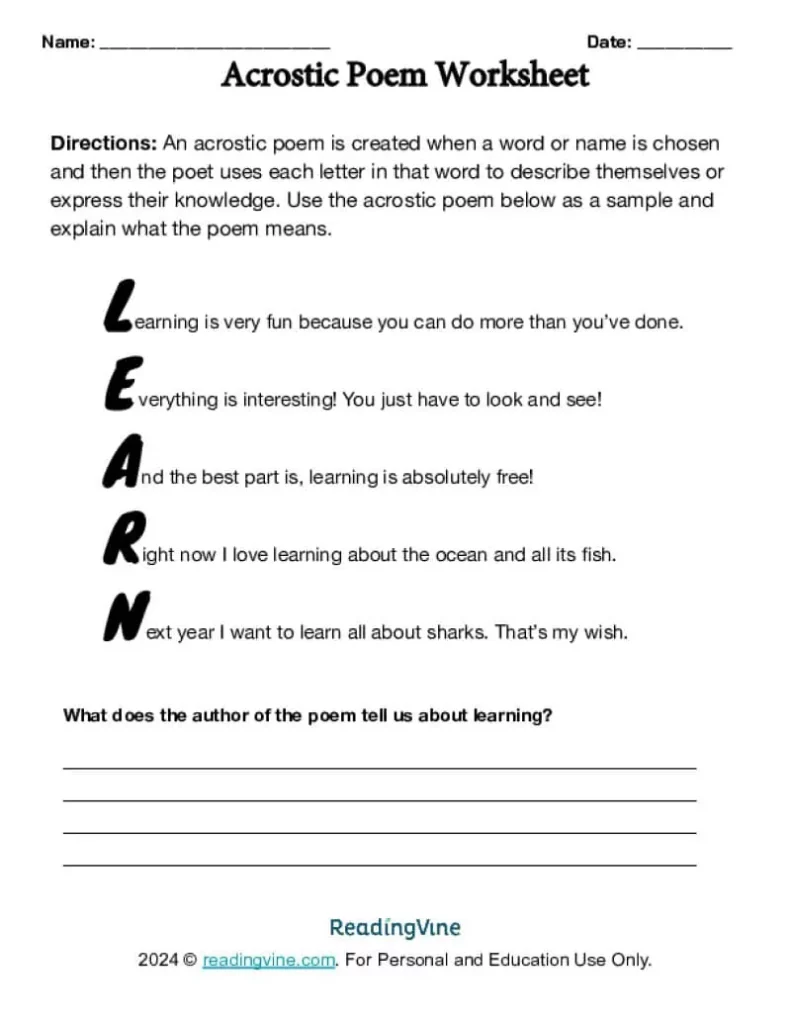
LEARN Acrostic Poem Activity
Students read the acrostic poem LEARN with each line explaining what learning means, then respond to the comprehension question about the poem's message.

Write an Acrostic Poem Activity
Read the example acrostic poem about sunshine, then follow the model to create an original acrostic poem on the lined writing space below.