
 = Partner Site
Amos Fortune, Free Man Reading Level: A Complete Guide
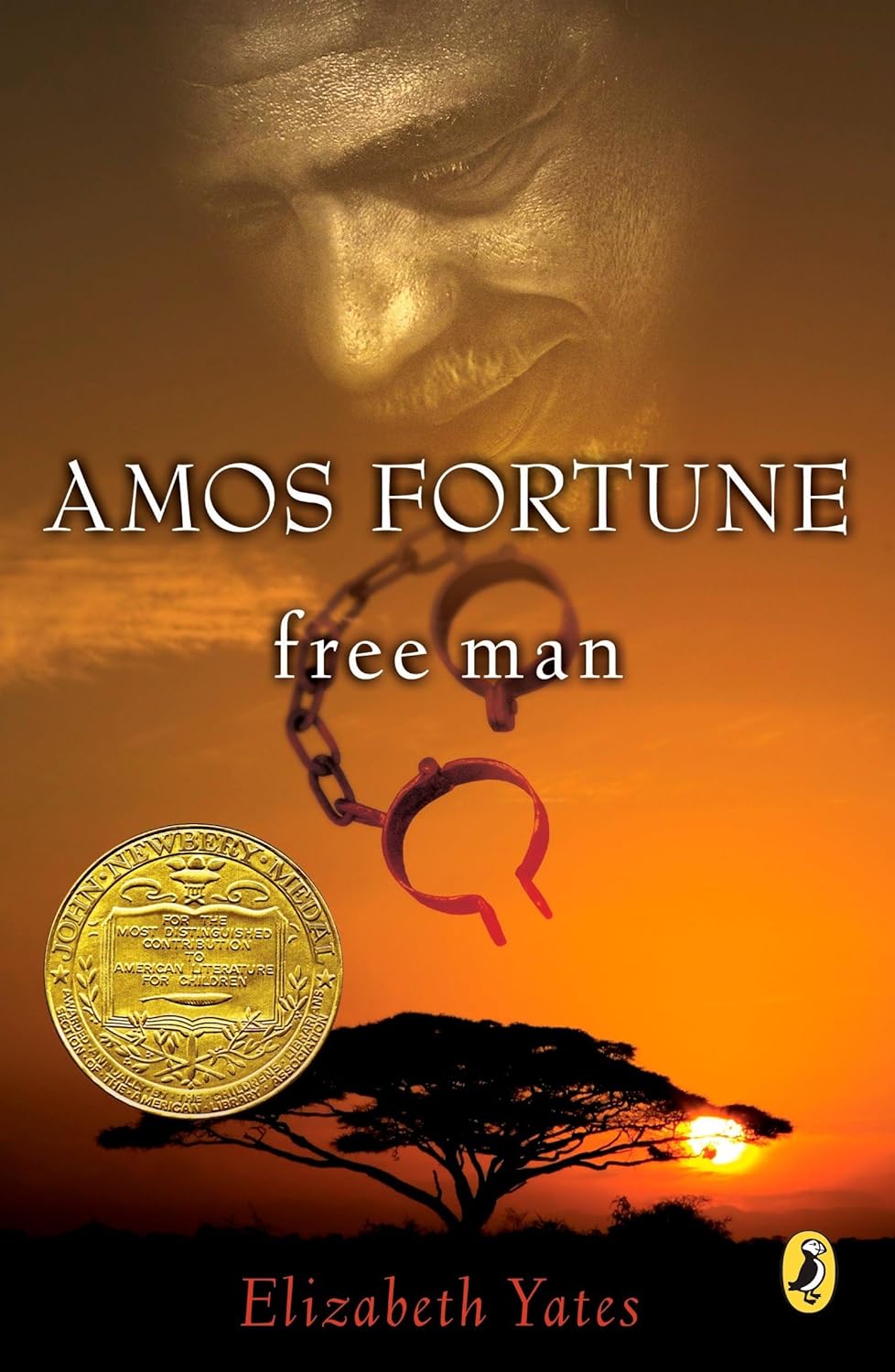
Amos Fortune, Free Man, written by Elizabeth Yates and illustrated by Nora Unwin, is a 192-page biographical novel about Amos Fortune — born into African royalty around 1709 or 1710, captured by slave traders as a teenager, enslaved in Massachusetts for forty-five years, and finally able to begin buying his freedom at age sixty. Amos Fortune was a real man: a tanner in Jaffrey, New Hampshire, who lived to approximately ninety years old and whose grave, along with that of his wife Violet, still stands in the Old Burying Ground in Jaffrey. He left money in his will to the local school and church. Published in 1950 and winner of the 1951 Newbery Medal, the book has been assigned in American classrooms for more than seventy years. It is also a book whose Newbery Medal, whose author’s perspective, and whose portrayal of Amos Fortune have been meaningfully criticized by contemporary scholars, educators, and readers — criticism that any teacher or parent using the book in 2026 should engage with rather than ignore. This complete guide covers Amos Fortune, Free Man‘s reading level, recommended age, content, key figures, themes, the critical conversation about the book, and similar books — designed for parents, teachers, and students.
For Parents
A 1951 Newbery Medal-winning biographical novel about a real man who was enslaved for forty-five years and eventually won his freedom. Ages 10–14, grades 5–8. Content includes the realities of enslavement depicted with period-appropriate directness. The book’s portrayal of Amos’s patience and forbearance reflects assumptions of its era and has been widely criticized by contemporary educators; see the Critical Perspective section below.
For Teachers
A grades 5–8 classroom text with a complex legacy: historically significant as a Newbery winner, valuable for its documentation of a real man’s life, and also the subject of substantive contemporary criticism about its perspective, its portrayal of Black contentment and patience under enslavement, and the implications of a white author’s narrative choices. Assigning it without engaging the criticism does a disservice to students; assigning it alongside the criticism is a genuine teaching opportunity. See the Critical Perspective section.
Amos Fortune, Free Man at a Glance
Find on Amazon →| Author | Elizabeth Yates (1905–2001) |
| Illustrator | Nora Unwin |
| Published | 1950 (Aladdin / Puffin; Penguin current publisher) |
| Grade Level | 5–8 (our assessment) |
| Recommended Age | 10–14 |
| Lexile | 1090L |
| ATOS Level | 6.5 |
| Fountas & Pinnell | V |
| Pages | 192 |
| Genre | Biographical fiction / historical fiction |
| Setting | Massachusetts and New Hampshire; 1725–1801 |
| Awards | Newbery Medal (1951) |
For official Lexile and AR levels, visit Lexile.com or AR BookFinder. ReadingVine provides independent editorial assessments.
What Reading Level Is Amos Fortune, Free Man?
Amos Fortune, Free Man has a Lexile of 1090L and an ATOS level of 6.5, with a Fountas & Pinnell Level V. These scores place it at approximately a sixth- to seventh-grade independent reading level — higher than the publisher’s interest level (grades 3–7, ages 8–12) might suggest, reflecting Yates’s formal, literary prose style, which is considerably more complex than most contemporary children’s novels at this interest level. The 1090L Lexile is among the highest in this catalog, comparable to the Frederick Douglass Narrative (1040–1120L) — though the books are otherwise very different in tone, form, and perspective.
Our editorial assessment places it at grades 5–8, ages 10–14. The prose demands mature, attentive reading; the historical content requires substantial contextual knowledge or classroom scaffolding to process fully; and the critical conversation about the book’s perspective is most productive with readers who are developmentally ready to engage with questions of narrative voice and historical representation. For official Lexile and AR scores, visit Lexile.com or AR BookFinder. ReadingVine’s assessments are independent editorial judgments.
What Age Is Amos Fortune, Free Man Appropriate For?
We recommend Amos Fortune, Free Man for readers ages 10–14, grades 5–8. The primary content considerations are historical:
The book depicts the realities of the transatlantic slave trade and American enslavement in 18th-century Massachusetts — including the capture and sale of enslaved people, the conditions of slavery, and the legal and economic machinery of the slave system. These are depicted with a directness appropriate to serious historical fiction and with more restraint than a contemporary author would likely apply. Parents and teachers should also be aware of the critical conversation about the book’s perspective (see the Critical Perspective section below), which is relevant to how the book is presented to children of any background.
What Is Amos Fortune, Free Man About?
Amos Fortune was born around 1709 or 1710 in Africa, the son of a king. In approximately 1725, when he was about fifteen years old, he was captured by slave traders and transported across the Atlantic to Massachusetts, where he was sold at auction to a Quaker farmer named Caleb Copeland. He was enslaved for approximately forty-five years, working for several masters in Massachusetts. He converted to Christianity. He learned to read. He learned the craft of tanning leather. He saved money over years and decades. At age sixty, he purchased his own freedom. He then purchased and freed two other enslaved women, one of whom became his wife.
Amos settled in Jaffrey, New Hampshire, where he established himself as a tanner — his leather goods were considered some of the finest in the region. He became a respected member of the Jaffrey community, attended church, and was known for his generosity and his equanimity. He died in 1801, aged approximately ninety, and his grave in the Old Burying Ground in Jaffrey reads: “Sacred to the memory of Amos Fortune who was born free in Africa a slave in America he purchased liberty, professed Christianity, lived reputably, and died hopefully.” He left money in his will to the Jaffrey church and school.
Yates’s book follows this arc — capture, enslavement, freedom, resettlement — drawing on historical records, Amos’s gravestone, his surviving legal documents, and her own imagination where the record is silent. The book fills in the lived experience that the historical record cannot provide, imagining Amos’s inner life, his relationships with his enslavers, his faith, and his vision of freedom across forty-five years of waiting.
A Critical Perspective — What Contemporary Scholars and Educators Say
Amos Fortune, Free Man has been the subject of substantive criticism from contemporary scholars, educators, and readers — criticism that is not peripheral to the book’s use in classrooms but central to it. Any teacher or parent using this book in 2026 should engage with this conversation directly.
The most significant criticism concerns the perspective Yates brings to Amos’s story and the portrait of Amos that results. Yates was a white woman writing in 1950, and her portrayal of Amos reflects assumptions common in that era and that context. Specifically:
Patience and contentment as virtue: Yates presents Amos’s extraordinary patience under enslavement — his lack of anger, his forgiveness of his enslavers, his quiet faith — as evidence of exceptional character and spiritual strength. Contemporary critics argue that this framing functions, however unintentionally, as a narrative that sanitizes the violence of enslavement by depicting a Black man’s endurance of it as his defining quality. The book does not examine the system of enslavement with the same attention it gives to Amos’s spiritual equanimity.
White authority as benevolent: Several of Amos’s enslavers are depicted as kind, fair, and fundamentally well-meaning — decent people operating within an unjust system. This framing, critics note, is both historically selective and morally incomplete: it asks readers to distinguish between “good” enslavers and the institution of slavery in a way that deflects attention from the system itself.
A white author’s gaze: Yates did not have access to Amos Fortune’s own words or perspective beyond the legal documents and the inscription on his grave. The interior life she imagines for him — his thoughts, his feelings, his relationship with his faith — is necessarily an act of imagining across a racial and historical distance. Contemporary readers and critics have noted that this imagining reflects Yates’s own cultural perspective and the assumptions of her era, not necessarily what Amos Fortune actually thought or felt.
These criticisms do not make the book without value — its documentation of a real man’s life, its historical context, and its place in the history of American children’s literature are all genuine. But they do make it a book that should not be assigned without being engaged critically, particularly in diverse classrooms. The most productive use of the book in contemporary classrooms is alongside primary sources (Amos Fortune’s own legal documents and will, his gravestone inscription), other accounts of 18th-century New England slavery, and the critical conversation about narrative perspective in historical fiction. The question “who is telling this story, and what do they choose to emphasize?” is the most important question any class reading this book can ask.
The Historical Amos Fortune
Amos Fortune was a real person, and the historical record, while sparse, tells a remarkable story that is in many ways more extraordinary than any fictionalized account. His surviving legal documents — bills of sale, freedom papers, property records — are held in the Jaffrey Public Library and have been digitized. His will, which left money to the Jaffrey school and church, is one of the most moving documents in the historical record of 18th-century New England. The Amos Fortune Forum, an annual lecture series in Jaffrey, New Hampshire, has been held since 1949 in his honor.
Amos Fortune’s grave in the Old Burying Ground in Jaffrey is still there. The inscription — “he purchased liberty, professed Christianity, lived reputably, and died hopefully” — was written in the early 19th century and reflects the language of its time. A visit to Jaffrey and the Old Burying Ground, or a look at photographs of the gravestone, is the most direct available connection to the man Yates wrote about.
Amos Fortune, Free Man Themes and Lessons
The book’s most productive classroom use is as a text that raises as many questions as it answers — particularly the question of how we tell the stories of people whose own words we do not have. Amos Fortune left almost no written record of his interior life. What Yates imagines for him is her best attempt at historical reconstruction; what she could not avoid was bringing her own perspective to that reconstruction. This is worth naming directly for students who are reading the book: all historical fiction does this, and reading historical fiction well requires asking what the author chose to emphasize and why.
The historical facts of Amos Fortune’s life — his capture at fifteen, his forty-five years of enslavement, his patient accumulation of the means to buy his own freedom and the freedom of others, his establishment of a tanning business, and his death at approximately ninety having left money for education in the community where he had been a slave — are genuinely extraordinary and worth knowing. Those facts belong to Amos Fortune. The narrative framing of those facts belongs to Elizabeth Yates, and the two are worth distinguishing.
Discussion questions for classrooms and families: How much of this book is based on real historical records, and how much did Elizabeth Yates imagine? What documents about Amos Fortune’s actual life still exist — and what do they tell us? What does Amos’s will tell us about who he was and what he valued? How might the book be different if it had been written by a Black author in 1950, or if it were written today? What does it mean to tell someone else’s story?
How Long Is Amos Fortune, Free Man?
Amos Fortune, Free Man is 192 pages. At ATOS 6.5 and 1090L, with Yates’s formal literary prose, most assigned readers in grades 5–8 complete it in one to two weeks of classroom reading. It can be read in three to four hours by a motivated independent reader at the upper end of the grade range.
Books Similar to Amos Fortune, Free Man
About Elizabeth Yates
Elizabeth Yates was born in 1905 in Buffalo, New York, and grew up in New Hampshire. She studied at a boarding school before pursuing a writing career in New York City, then moved to England with her husband, where she lived for several years and published several books. She returned to New Hampshire, settling in Peterborough, where she spent most of her adult life and wrote more than fifty books. She received a Newbery Honor in 1944 for Mountain Born and the Newbery Medal in 1951 for Amos Fortune, Free Man. She was active in environmental and humanitarian causes throughout her life. She died in 2001 at age ninety-five.
Yates discovered Amos Fortune’s story through his grave in the Jaffrey Old Burying Ground. She researched the book using historical records available in New Hampshire archives in the late 1940s, supplemented by her own imaginative reconstruction. The Amos Fortune Forum in Jaffrey, which she helped establish, has honored Fortune’s legacy since 1949 with an annual lecture series. Yates’s intentions — to honor Amos Fortune and to bring his story to children — are not in question. The critical conversation about the book concerns what those intentions, filtered through her specific historical and cultural perspective, produced.
Amos Fortune, Free Man: Frequently Asked Questions
What reading level is Amos Fortune, Free Man?
Lexile 1090L, ATOS 6.5, Fountas & Pinnell V. Our assessment: grades 5–8, ages 10–14. The prose is formal and literary; the historical content requires contextual scaffolding. For official Lexile and AR scores, visit Lexile.com or AR BookFinder.
What is Amos Fortune, Free Man about?
The biographical novel follows the life of Amos Fortune — born into African royalty around 1710, captured by slave traders at age fifteen, enslaved in Massachusetts for forty-five years, who bought his own freedom at age sixty and went on to establish a tanning business in Jaffrey, New Hampshire, purchase the freedom of others, and die at approximately ninety leaving money to the local school and church.
Was Amos Fortune a real person?
Yes — Amos Fortune was a real historical person whose grave still stands in the Old Burying Ground in Jaffrey, New Hampshire. His legal documents — freedom papers, bills of sale, property records, and will — are held in the Jaffrey Public Library. Yates drew on these records and used her imagination to fill in what the historical record could not tell her.
Why is Amos Fortune, Free Man controversial?
Contemporary scholars and educators have criticized the book’s portrayal of Amos Fortune — specifically its depiction of his patience and forbearance under enslavement as his defining virtues, its relatively sympathetic treatment of some of his enslavers, and the limitations of a white author imagining the interior life of an enslaved Black man in 1950. These criticisms do not erase the book’s historical value but they do mean it should be read with critical awareness rather than assigned uncritically. See the Critical Perspective section of this guide for a fuller account.
How does Amos Fortune, Free Man compare to the Narrative of Frederick Douglass?
The most direct comparison available: Douglass’s Narrative is an account of American slavery written in the first person by an enslaved man, with his own anger, his own analysis of the system, and his own perspective on his enslavers. Amos Fortune’s story is told by a white woman imagining what an enslaved man’s experience was like. Reading both together — which is the most productive classroom use of Amos Fortune, Free Man for older students — makes the difference in perspective concrete rather than theoretical.