
 = Partner Site
Because of Mr. Terupt Reading Level: A Complete Guide
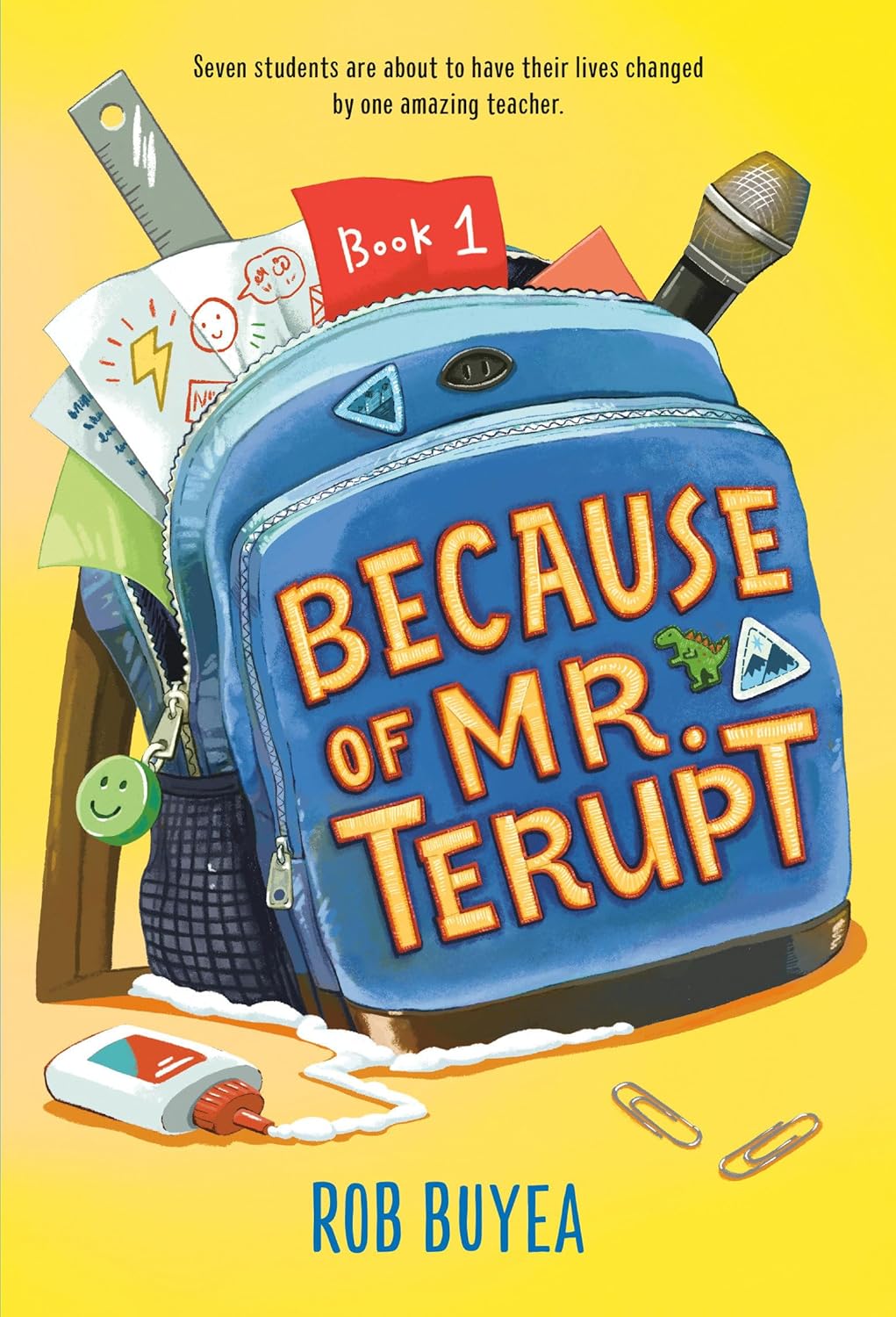
Because of Mr. Terupt, written by Rob Buyea, is a 288-page school novel told through seven alternating narrators — all fifth-graders at Snow Hill School in Connecticut — whose lives are changed by their first-year teacher Mr. Terupt. Peter is the class cut-up who is surprised when Mr. Terupt handles his disruptions with warmth instead of punishment. Jessica is the new girl and a voracious reader. Luke is the math genius who finally has a teacher who challenges him. Alexia is the social queen who manipulates everyone around her. Anna, Danielle, and Jeffrey each carry something private and heavy that Mr. Terupt, over the course of the year, helps them begin to carry differently. Then Peter throws a snowball. It hits Mr. Terupt in the head. Mr. Terupt falls into a coma, and Peter’s guilt may be the thing that unravels everything. Published in 2010 as Rob Buyea’s debut novel — he had taught elementary school in Connecticut for six years before writing it — it received starred reviews from School Library Journal and Publishers Weekly, won the E.B. White Read Aloud Award, and launched a four-book series. This guide covers reading level, age appropriateness, themes, and similar books.
For Parents
A warm, multi-narrator school novel about seven very different fifth-graders and the first-year teacher who changes each of them — followed by an accident that puts the teacher in a coma and tests everything his students have learned. Ages 8–12, grades 4–6. Content: the accident and its aftermath involve a child’s guilt and a teacher’s serious injury. No other content concerns. An excellent classroom read-aloud and a natural companion to Wonder.
For Teachers
A grades 4–6 classroom staple — seven narrators with seven distinct voices, each revealing a different perspective on the same school year, makes it one of the most teachable multiple-perspective novels available. Buyea taught elementary school; the classroom scenes are specific and recognizable. An E.B. White Read Aloud Award winner. Natural companion to Wonder and The Wednesday Wars for school-year novels.
Because of Mr. Terupt at a Glance
Find on Amazon →| Author | Rob Buyea |
| Published | 2010 (Delacorte Press / Random House) |
| Grade Level | 4–6 (our assessment) |
| Recommended Age | 8–12 |
| Lexile | 560L |
| ATOS Level | 3.7 |
| Fountas & Pinnell | Y |
| Word Count | 37,164 |
| Pages | 288 |
| Genre | Realistic fiction / school story |
| Setting | Snow Hill School, Connecticut; one fifth-grade year |
| Awards | E.B. White Read Aloud Award (2011); starred reviews SLJ, PW |
| Series | Mr. Terupt (4 books) |
For official Lexile and AR levels, visit Lexile.com or AR BookFinder. ReadingVine provides independent editorial assessments.
What Reading Level Is Because of Mr. Terupt?
Lexile 560L, ATOS 3.7, Fountas & Pinnell Y — grades 3–7, interest level 4–8. Our assessment: grades 4–6, ages 8–12. The Lexile and ATOS are low relative to the interest level because the seven-narrator structure uses short, accessible chapters in each character’s individual voice — the prose complexity of any single narrator is modest, which pulls the formula scores down. The reading challenge is comprehension across perspectives rather than linguistic complexity. The F&P Level Y — which is significantly higher — is the more reliable indicator of the book’s actual demands. For official scores, visit Lexile.com or AR BookFinder.
What Age Is Because of Mr. Terupt Appropriate For?
Ages 8–12, grades 4–6. The primary content consideration is the accident and its aftermath: Peter throws a snowball that strikes Mr. Terupt and causes a traumatic brain injury, leaving him in a coma. Peter’s guilt — and the uncertainty about whether Mr. Terupt will recover — drives the second half of the novel. This is handled with appropriate gravity rather than graphic detail. Several of the seven narrators also carry difficult home situations (absent parent, teenage pregnancy in the family, bullying) that are handled with sensitivity. No other content concerns.
What Is Because of Mr. Terupt About?
Seven fifth-graders take turns telling the story of the same school year at Snow Hill School in Connecticut. Peter is the cut-up; he expects to get in trouble constantly and is surprised when Mr. Terupt’s discipline feels more like respect than punishment. Jessica is new and loves books; she finds a teacher who values her reading in a way her previous school never did. Luke is the math kid; Mr. Terupt challenges him with real mathematics instead of worksheet repetition. Alexia manipulates everyone around her through friendship; Mr. Terupt sees it and finds ways to redirect her. Anna, Danielle, and Jeffrey each carry private struggles — family difficulty, a secret, something that has made school a complicated place — and Mr. Terupt, over the months, makes their classroom feel safer than it has been.
Then, on a January day, the class is outside in the snow. Peter throws a snowball at another kid. It misses. It hits Mr. Terupt in the head. He collapses. He is rushed to the hospital. He is in a coma. Peter knows — even if no one else does yet — that it was his snowball. The second half of the novel follows the seven narrators through Mr. Terupt’s hospitalization, their vigil, their guilt (Peter’s especially), and what happens when they finally go back to school without him. The ending is the book’s most carefully earned moment.
The Seven Narrators — Why the Structure Works
The novel’s seven-narrator structure is both its most distinctive feature and its best teaching tool. Each narrator sees Mr. Terupt differently because each narrator is different — and each narrator sees the other students differently too. Alexia’s chapter reveals something about Jessica that Jessica’s chapter wouldn’t; Peter’s chapter reveals something about himself that none of the others would admit. The same classroom looks different from inside seven heads.
School Library Journal’s starred review called the characters “authentic” and the short chapters “skillfully arranged to keep readers moving headlong toward the satisfying conclusion” — both of which are accurate. The chapters are short, the voices are distinct, and the accumulation of seven perspectives creates a picture of one school year that is more complete and more honest than any single perspective could provide. This is one of the best available texts for teaching point of view as a genuine literary technique rather than an abstract concept.
Because of Mr. Terupt Themes and Lessons
The book’s warmest argument is that a teacher who sees students as individuals — rather than as the roles they’ve been assigned (troublemaker, new girl, math kid, mean girl) — changes what those students are able to become. Mr. Terupt does not fix anyone; he creates the conditions in which each of the seven can begin to do something different. This is both a celebration of good teaching and a genuine description of what it actually looks like: not dramatic interventions but specific, attentive responses to specific, individual students.
Peter’s guilt is the novel’s most honest emotional thread — and the most useful for classroom discussion. He did not intend what happened. The accident was an accident. He is still responsible for it. The distinction between intent and consequence, and what accountability looks like when the two diverge, is one of the most important conversations the book generates.
Discussion questions: Which of the seven narrators is most like you — and which is most unlike you? What does Mr. Terupt do differently from other teachers the students have had? Is Peter responsible for what happened — and what should responsibility look like here? What does each narrator understand about the classroom that the others don’t see?
Books Similar to Because of Mr. Terupt
About Rob Buyea
Rob Buyea taught third- and fourth-graders in Bethany, Connecticut, for six years before moving to Massachusetts, where he taught high school biology and coached wrestling at Northfield Mount Hermon School. Because of Mr. Terupt was his debut novel, published when he was still teaching. He has said that Mr. Terupt is a composite of the best qualities he observed in teachers during his years in the classroom — not a single person but an ideal assembled from real individuals. The seven student narrators are also composites, each drawn from students he taught or observed. He has continued the series with Mr. Terupt Falls Again (2013), Saving Mr. Terupt (2015), and Goodbye, Mr. Terupt.
Because of Mr. Terupt: Frequently Asked Questions
What reading level is Because of Mr. Terupt?
Lexile 560L, ATOS 3.7, Fountas & Pinnell Y. Our assessment: grades 4–6, ages 8–12. The Lexile and ATOS are low because the seven-narrator structure uses short, accessible chapters; the F&P Level Y is a more reliable indicator of the book’s actual reading demands. For official scores, visit Lexile.com or AR BookFinder.
What is Because of Mr. Terupt about?
Seven fifth-graders take turns narrating the same school year — each seeing their new teacher Mr. Terupt and each other differently. When Peter accidentally injures Mr. Terupt with a snowball and the teacher is left in a coma, Peter’s guilt and the class’s response tests everything their year together has built.
Why does the book have seven narrators?
Because the same classroom looks different from inside seven different heads. Each narrator sees Mr. Terupt differently, sees the other students differently, and reveals something that none of the others would or could. Buyea uses the structure to argue that a classroom is a community — that understanding it requires more than one perspective.
Is Because of Mr. Terupt part of a series?
Yes — four books: Because of Mr. Terupt (2010), Mr. Terupt Falls Again (2013), Saving Mr. Terupt (2015), and Goodbye, Mr. Terupt. The same seven student narrators continue through sixth and seventh grade. Each book stands alone reasonably well; reading in order gives the fullest picture of the characters’ development.