
 = Partner Site
Best Friends Reading Level: A Complete Guide
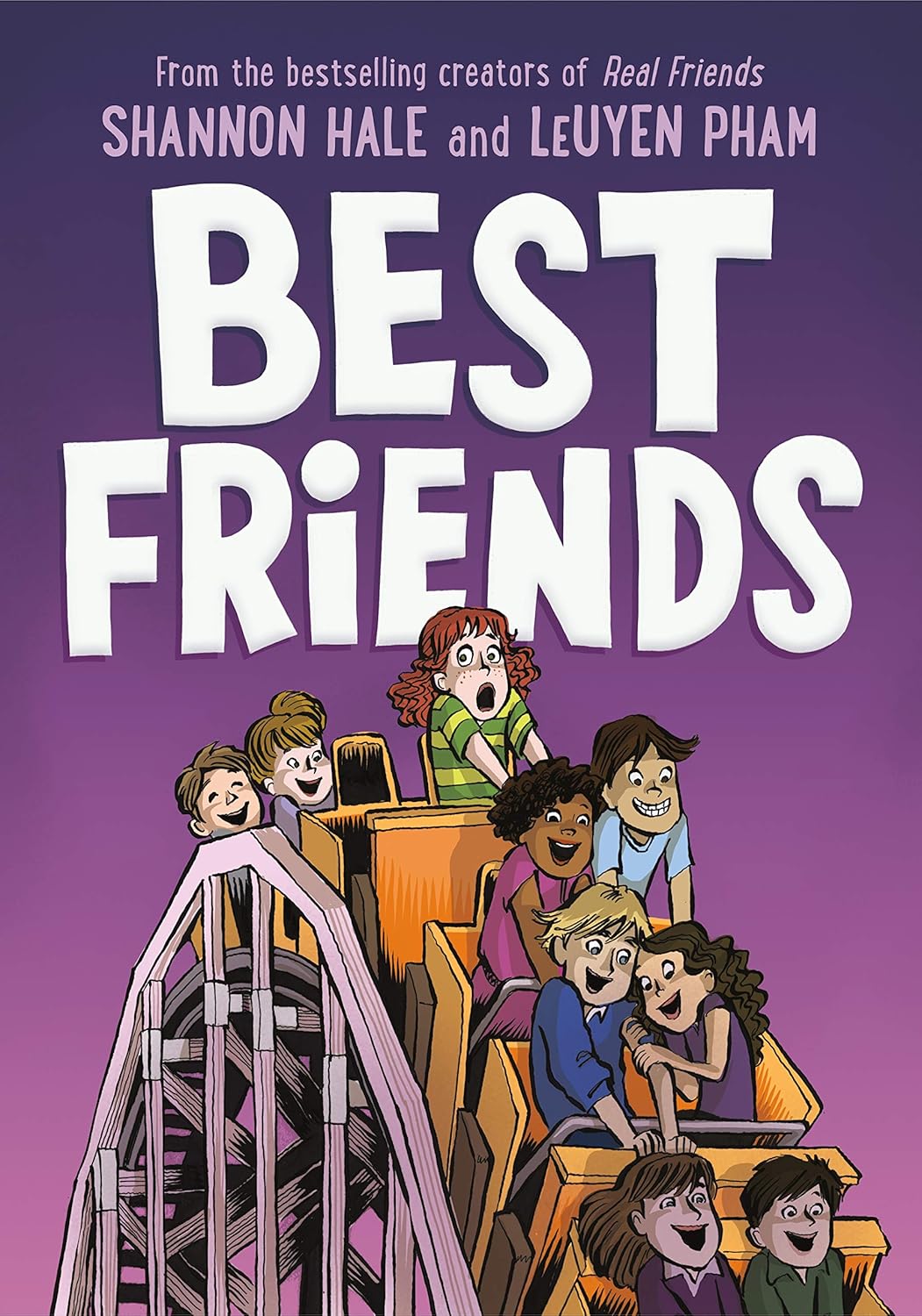
Best Friends, written by Shannon Hale and illustrated by LeUyen Pham, is a 250-page autobiographical graphic novel and the second book in the Friends trilogy. Sixth grade is starting and Shannon has, finally, a secure spot in The Group — the social circle led by Jen, the most popular girl in school. But the rules keep shifting: which TV shows are acceptable, which songs, who you’re allowed to talk to. Shannon scrambles to keep up while also navigating her first crush, her ongoing anxiety, and the question of whether the security of The Group is worth what it costs to maintain. A National and New York Times bestseller, an SLJ Best Book of 2019, an NPR Best Book of 2019, and a Chicago Public Library Best of the Best selection, it continues the story begun in Real Friends with the same honesty and the same Pham visual style — including her practice of depicting Shannon’s anxiety as a physical presence in the panels. This guide covers reading level, age appropriateness, content, and what’s new in this installment. Readers who have not read Real Friends first should start there.
For Parents
The second book in the Friends trilogy — Shannon is now in sixth grade, navigating the continued social dynamics of The Group, first crushes, and her anxiety, depicted by Pham as a visual presence in the panels. Ages 8–12, grades 4–7. No content concerns beyond the social and emotional complexity of sixth grade. Read Real Friends first.
For Teachers
A grades 4–7 sequel that moves the series into middle school territory — first crushes, shifting social rules, and the continuing anxiety thread. Pham’s visual depiction of Shannon’s anxiety as a physical presence in the panels is frequently cited by educators and counselors as a particularly effective way of representing internal emotional states in a graphic format. SLJ Best Book of 2019.
Best Friends at a Glance
Find on Amazon →| Author | Shannon Hale |
| Illustrator | LeUyen Pham |
| Published | 2019 (First Second / Macmillan) |
| Grade Level | 4–7 (our assessment) |
| Recommended Age | 8–12 |
| Lexile | GN380L (Graphic Novel Lexile — see below) |
| ATOS Level | 2.9 |
| Pages | 250–256 (editions vary) |
| Format | Autobiographical graphic novel (full color) |
| Genre | Graphic memoir / autobiography |
| Setting | Salt Lake City, Utah; sixth grade, late 1980s |
| Series | Friends (Book 2 of 3) |
For official Lexile and AR levels, visit Lexile.com or AR BookFinder. ReadingVine provides independent editorial assessments.
What Reading Level Is Best Friends?
Lexile GN380L (Graphic Novel Lexile — a separate scale from prose scores, not directly comparable), ATOS 2.9, grades 5–8. The formula scores reflect only dialogue and captions across 11,464 words; the full visual narrative demands are not captured. Slightly higher than Real Friends (GN340L, ACR 2.6) and lower than Friends Forever (GN420L, ATOS 3.2), consistent with a gradual increase in complexity across the trilogy. Our assessment: grades 4–7, ages 8–12. For official scores, visit Lexile.com or AR BookFinder.
Read Real Friends First
Best Friends picks up directly from the events of Real Friends — the same characters, the same social dynamics, the same ongoing threads. Readers who begin here will be missing the context that gives the sixth-grade story its weight. The Friends trilogy is designed to be read in order: Real Friends (elementary school), Best Friends (sixth grade), Friends Forever (seventh grade). See our Real Friends guide for a full introduction to the series and its characters.
What Is Best Friends About?
Shannon begins sixth grade with a secure spot in The Group and her best friend Adrienne as The Group’s leader. The rules of The Group — what is cool, what is acceptable, who you’re allowed to speak to — keep shifting, and Shannon works to keep up. She also has a first crush, which adds a new layer of social complexity to navigating a world already governed by Jen’s approval. Her anxiety, a constant presence in her inner life, becomes more visible in this volume — Pham depicts it as a black cloud that hovers around Shannon and sometimes swirls to overwhelm her, a visual representation of what Shannon can’t always put into words.
The book asks the same question as Real Friends but from the position of someone who is nominally inside the social circle she wanted: is this actually what friendship is supposed to feel like? The rules, the performance, the never quite knowing if you’re doing it right — Shannon has what she wanted and it doesn’t feel the way she imagined. A reviewer from Pages Unbound noted that Pham’s illustrations add nuance in a key scene where Shannon feels included in a human chain — “but the faces of the other children, angry and upset, suggest that Shannon’s feelings of inclusion mean that others are excluded.” The visual layer carries meaning the text doesn’t state directly.
Pham’s Visual Depiction of Anxiety
One of the most noted features of Best Friends is LeUyen Pham’s visual representation of Shannon’s anxiety as a physical presence — a dark cloud that appears in the panels when Shannon’s anxiety escalates, sometimes hovering, sometimes swirling to overwhelm her. This is an expansion of the visual anxiety language from Real Friends into something more formally developed in this volume. Educators and school counselors who use the book frequently cite this visual approach as effective for helping children who have anxiety see their own experience reflected in a form that doesn’t require them to articulate it verbally first.
Best Friends Themes and Lessons
Where Real Friends asks what real friendship looks like from the outside of a conditional social circle, Best Friends asks the same question from the inside. Shannon has what she wanted — a secure place in The Group — and the book follows her discovery that security purchased through performance is not the same as belonging. The visual moment in which Shannon feels included in a human chain while the excluded children’s faces register distress — captured by Pham’s illustration without being stated in the text — is the book’s sharpest moment of self-awareness.
Talking with your child: Now that Shannon is in The Group, does it feel the way she imagined? What’s the difference between being included and belonging? What do you think Shannon’s anxiety is telling her? What does the black cloud mean when it appears?
Books Similar to Best Friends
About Shannon Hale and LeUyen Pham
See our Real Friends guide for full biographies. Best Friends was published in 2019, two years after Real Friends. Pham’s development of the black-cloud visual language for Shannon’s anxiety in this volume is frequently discussed as an example of how graphic novels can represent internal states that prose struggles to convey directly. The third volume, Friends Forever (2021), concludes the trilogy through seventh grade.
Best Friends: Frequently Asked Questions
What reading level is Best Friends?
Lexile GN380L (Graphic Novel Lexile, separate scale), ATOS 2.9, grades 5–8. Our assessment: grades 4–7, ages 8–12. Slightly higher than Real Friends (GN340L). Formula scores reflect only dialogue and captions; the full visual narrative is more demanding. For official scores, visit Lexile.com or AR BookFinder.
Do I need to read Real Friends before Best Friends?
Yes — Best Friends picks up directly from Real Friends with the same characters and social dynamics. Starting with Book 2 loses the context that gives the sixth-grade story its weight. Read in order: Real Friends, Best Friends, Friends Forever.
What is Best Friends about?
Shannon begins sixth grade with a secure place in The Group — and discovers that the social circle she wanted requires constant performance to maintain. While navigating shifting Group rules, a first crush, and her ongoing anxiety (depicted by Pham as a visual dark cloud), she continues asking what real friendship actually looks like.
How many books are in the Friends series?
Three: Real Friends (2017), Best Friends (2019), and Friends Forever (2021). All by Shannon Hale and LeUyen Pham. The trilogy covers Shannon’s experience from elementary school through seventh grade and should be read in order.