
 = Partner Site
Guts Reading Level: A Complete Guide
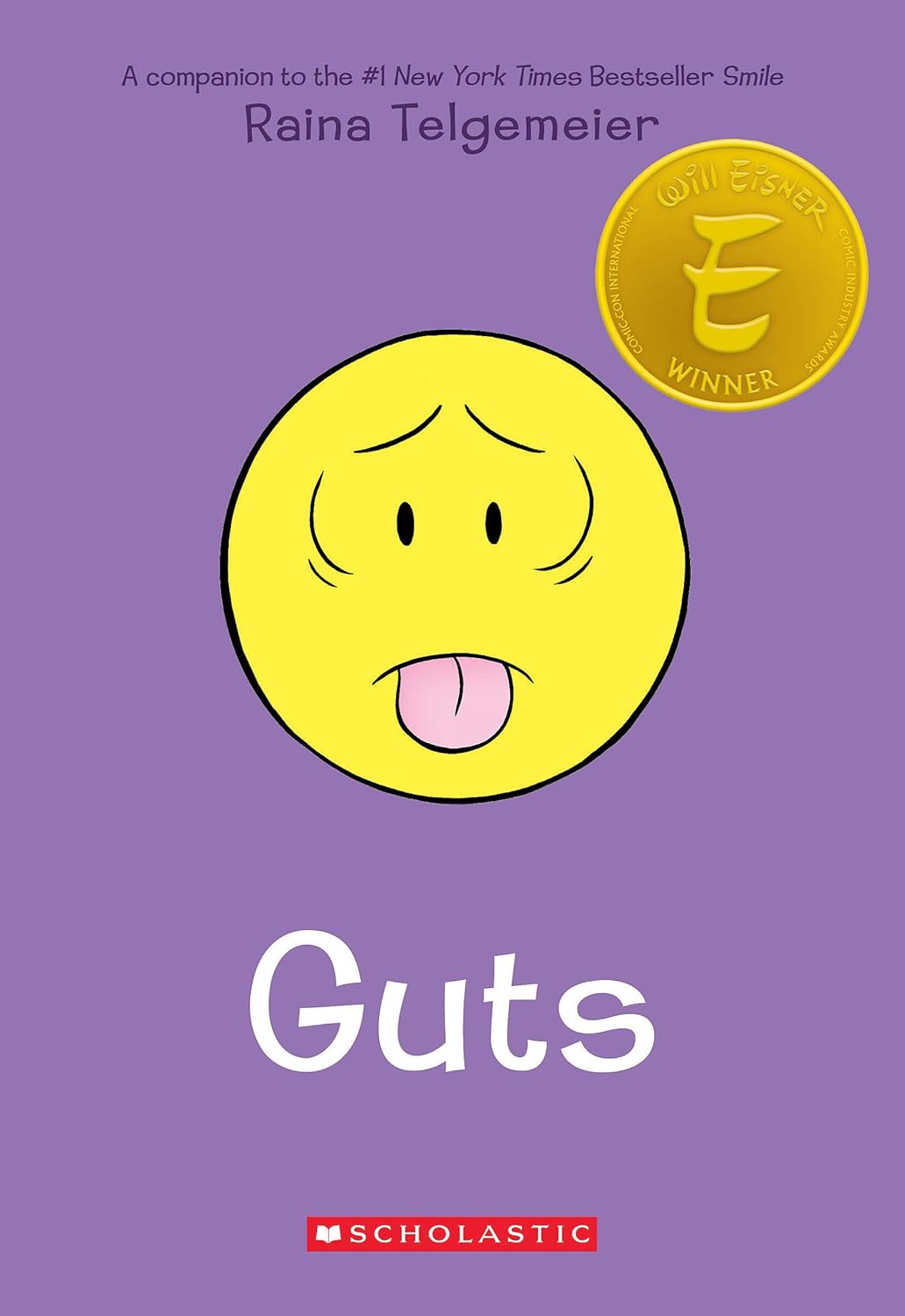
Guts, written and illustrated by Raina Telgemeier and colored by Braden Lamb, is a 224-page autobiographical graphic novel about Raina in fourth and fifth grade — specifically the years when she started waking up in the middle of the night feeling sick to her stomach and couldn’t stop. What begins as what seems like a bug turns out to be something more complicated: anxiety, expressing itself as gastrointestinal distress, creating a cycle that gets harder and harder to manage. School becomes frightening. Food becomes frightening. Eventually Raina starts seeing a therapist, and slowly, carefully, she begins to understand what is happening and how to live with it. A #1 New York Times bestseller, winner of two Eisner Awards (Best Publication for Kids and Best Writer/Artist), and the recipient of starred reviews from Booklist, Kirkus, Publishers Weekly, and School Library Journal, Guts is the most direct and most emotionally honest book Telgemeier has written about her own childhood — and the one most frequently recommended by therapists, counselors, and school psychologists for children dealing with anxiety. This guide covers reading level, age appropriateness, themes, and similar books.
For Parents
Raina Telgemeier’s autobiographical graphic novel about fourth and fifth grade, stomach-based anxiety, and finding her way to therapy — the most gently and honestly presented depiction of childhood anxiety available in the middle-grade graphic novel space. Ages 8–13, grades 3–6. No content concerns. Frequently recommended by therapists and school counselors for children dealing with anxiety or stomach-related symptoms of stress.
For Teachers
A grades 3–6 library and classroom staple — the most accessible available text for normalizing therapy, anxiety, and the physical symptoms of stress for children in the elementary and middle school range. Publishers Weekly’s starred review: “The story both normalizes therapy and shows a child developing useful coping mechanisms for anxiety in a way that will reassure, even inspire, readers.” School Library Journal called it “a must.”
Guts at a Glance
Find on Amazon →| Author & Illustrator | Raina Telgemeier (author & illustrator); Braden Lamb (colors) |
| Published | 2019 (Scholastic/Graphix) |
| Grade Level | 3–6 (our assessment) |
| Recommended Age | 8–13 |
| Lexile | GN480L (Graphic Novel Lexile — see below) |
| ATOS Level | 2.6 |
| Pages | 224 |
| Format | Autobiographical graphic novel (full color) |
| Genre | Graphic memoir / autobiography |
| Setting | San Francisco Bay Area; fourth and fifth grade |
| Awards | Eisner Award – Best Publication for Kids (2020); Eisner Award – Best Writer/Artist (2020); starred reviews from Booklist, Kirkus, PW, SLJ |
For official Lexile and AR levels, visit Lexile.com or AR BookFinder. ReadingVine provides independent editorial assessments.
What Reading Level Is Guts?
Lexile GN480L (Graphic Novel Lexile — a separate scale from prose Lexile scores, not directly comparable), ATOS 2.6, interest level grades 3–8. As with all Telgemeier books in this catalog, the formula scores reflect only the simple dialogue and captions; the visual literacy demands of following a graphic memoir across 224 pages are not captured. Our assessment: grades 3–6, ages 8–13. The emotional content — anxiety, therapy, stomach symptoms as physical expressions of fear — is resonant across a wide age range; some children will encounter it in third grade, others not until middle school. For official scores, visit Lexile.com or AR BookFinder.
What Is Guts About?
Raina is nine years old when she wakes up one night feeling terribly sick to her stomach. Her mom has something similar, so it’s probably just a bug. But it doesn’t go away. Raina starts feeling sick in the mornings before school. Then during lunch. Then at the thought of certain foods. The stomach symptoms come with waves of fear that she can’t quite name or locate — fear about being sick in public, fear about food, fear about school, fear about things that don’t obviously seem frightening. The fear and the stomach symptoms cycle into each other, making both worse.
Over the course of fourth and fifth grade, Raina tries to manage: she avoids certain foods, she worries about the cafeteria, she has panic attacks she doesn’t have words for. Her parents eventually connect her with a therapist — someone who, for the first time, gives Raina a framework for understanding what’s happening and tools for managing it. The therapy is not a cure; it is a beginning. By the end of the book, Raina is still a child who deals with anxiety and stomach symptoms, but she has more language for it and more ways to cope. The comic strips she draws to manage her feelings become, the epilogue reveals, the beginning of her life’s work.
Guts and Childhood Anxiety — Why This Book Matters
Guts is the most widely recommended middle-grade graphic novel for children dealing with anxiety, and the reasons are specific. Telgemeier does three things that most anxiety-focused books for children don’t do simultaneously: she depicts anxiety as a physical experience (the stomach symptoms are the book’s opening premise and its central metaphor), she normalizes therapy without framing it as something only severely broken people need, and she shows the process of developing coping tools as gradual, imperfect, and real rather than as a transformation. Raina doesn’t stop having anxiety by the end of the book. She learns to live with it differently.
Publishers Weekly’s starred review named “the story both normalizes therapy and shows a child developing useful coping mechanisms for anxiety in a way that will reassure, even inspire, readers” — which is the most useful description of what the book does for anxious children who read it. The specific detail of the stomach symptoms is the most important element: many children who experience anxiety as a physical sensation rather than as obvious “worrying” do not have a framework for understanding what they are experiencing, and seeing Raina’s experience depicted honestly is often the first time they feel seen.
Guts Themes and Lessons
The title’s double meaning is the book’s central argument: “guts” is the stomach, and the anxiety that lives there; “guts” is also courage. Raina’s journey across the book is from a child whose guts are simply a source of suffering toward a child who has the guts — the courage — to face what is frightening. The comic strips she draws throughout the book as a way of processing her feelings are both a coping tool and, as the epilogue shows, the beginning of her identity as an artist. Making things is, for Raina, a form of courage — a way of facing and processing what is difficult.
The therapy portrayal is the book’s most valuable element for parents and educators. Telgemeier’s therapist is kind, competent, and immediately reassuring — she does not diagnose Raina with anything alarming, she explains what anxiety is in terms a child can understand, and she gives Raina specific tools. This is an accurate and useful depiction of what good child therapy actually looks like, and it serves to make the idea of seeking help feel accessible rather than frightening for children who are reading the book because they recognize themselves in Raina.
Talking with your child: Have you ever felt scared in your stomach — where your body felt frightened even when you weren’t sure what you were afraid of? What did Raina’s therapist do that helped her? Why do you think Raina draws comics when she’s worried — does making things ever help you feel better? What does “having guts” mean — and how did Raina show it?
Books Similar to Guts
About Raina Telgemeier
See our Smile guide for a full biography. Guts was published in 2019, the ninth year after Smile and the last autobiographical graphic novel Telgemeier has published to date. The colors are by Braden Lamb, a collaborator she has worked with across her recent work. Telgemeier has said that Guts was the hardest book she has written — harder even than Smile, which required her to revisit dental trauma — because anxiety is more difficult to depict visually than a physical injury. The solution she found — showing anxiety as color, texture, and physical sensation in the panels — is widely cited by visual communication educators as an example of how graphic novels can represent inner states that prose struggles to capture.
Guts: Frequently Asked Questions
What reading level is Guts?
Lexile GN480L (Graphic Novel Lexile, separate scale from prose scores), ATOS 2.6. Our assessment: grades 3–6, ages 8–13. Formula scores reflect only simple dialogue and captions; the full visual reading experience is more demanding. For official scores, visit Lexile.com or AR BookFinder.
What is Guts about?
Raina Telgemeier’s autobiographical account of fourth and fifth grade, when anxiety began expressing itself as stomach symptoms — waking up sick, fearing certain foods, panic attacks she didn’t have words for. Over the course of the book, she starts seeing a therapist, begins to understand what’s happening, and develops tools for managing it. The comic strips she draws to cope become the beginning of her life as an artist.
Is Guts good for children with anxiety?
Yes — it is the most widely recommended middle-grade graphic novel for children dealing with anxiety, specifically recommended by therapists and school counselors. It normalizes therapy, depicts anxiety as a physical experience many children recognize in themselves, and shows the process of developing coping tools as gradual and real. Publishers Weekly’s starred review called it a book that “will reassure, even inspire, readers.”
How does Guts relate to Smile?
Both are autobiographical graphic novels by Raina Telgemeier. Guts covers fourth and fifth grade; Smile covers sixth grade through high school. Guts came first chronologically (in Raina’s life) but was published last. Either can be read first; readers who love one almost universally want the other.
Does Guts include therapy, and how is it depicted?
Yes — Raina starts seeing a therapist, who is depicted as kind, competent, and reassuring. The therapy is not presented as something only severely ill children need; it is presented as a resource that helps Raina understand her anxiety and develop tools for managing it. The portrayal is accurate to what good child therapy looks like and is specifically praised by mental health professionals for normalizing help-seeking.