
 = Partner Site
Smile Reading Level: A Complete Guide
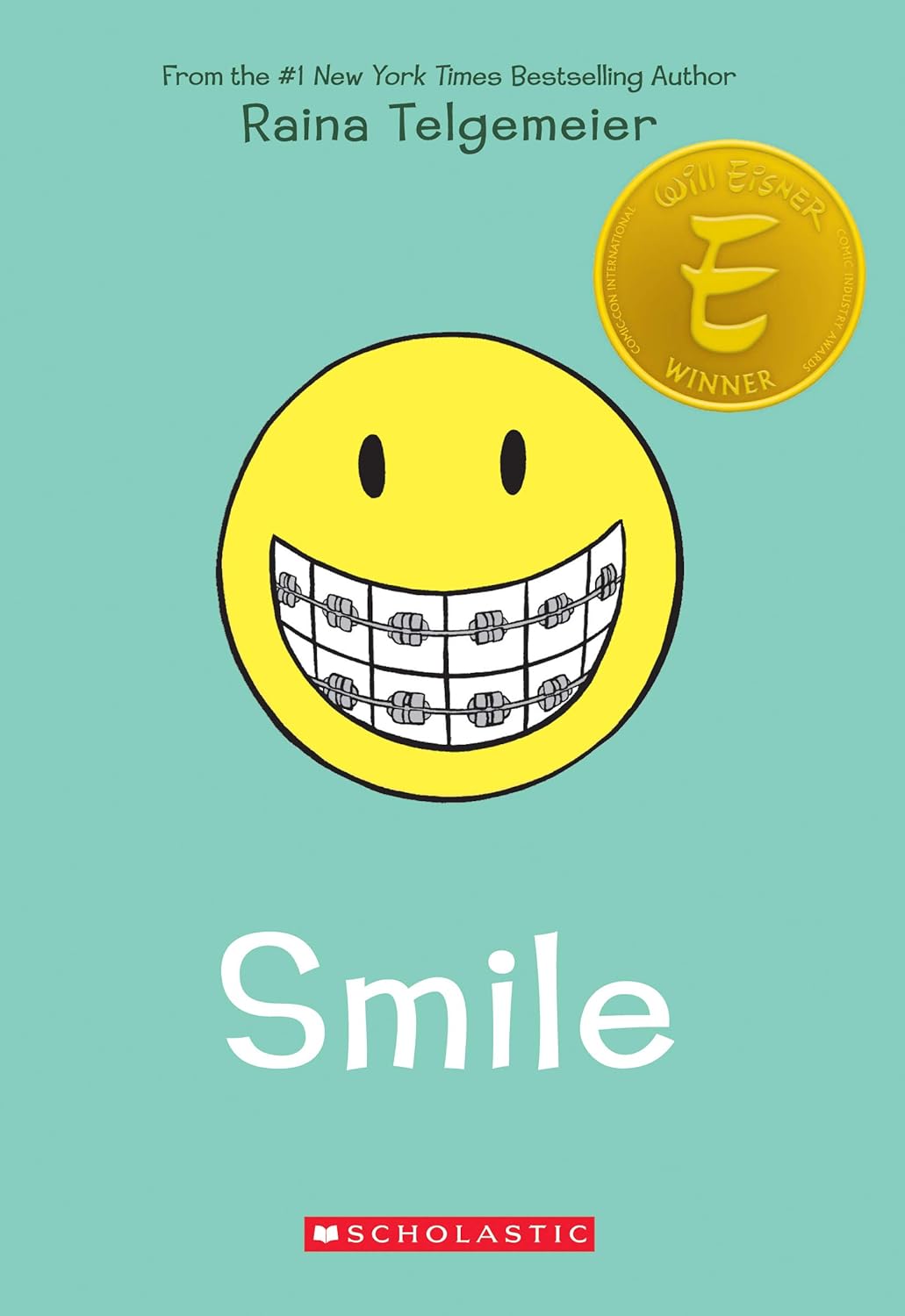
Smile, written and illustrated by Raina Telgemeier, is a 213-page autobiographical graphic novel about the years in Raina’s life from sixth grade through high school — specifically the years dominated by what happened one night after Girl Scouts, when she tripped and severely injured her two front teeth. What followed was years of braces, surgeries, emergency dental procedures, headgear, and a retainer with fake teeth attached. And alongside all the dental drama: a major earthquake (the 1989 Loma Prieta earthquake, which rattled San Francisco while Raina was in middle school), boy confusion, and a group of friends who turned out to be something other than friends. The most successful graphic novel for middle-grade readers of the past two decades, a #1 New York Times bestseller that spent years on the list, and the winner of the Eisner Award — the most prestigious award in comics — Telgemeier’s memoir is the book that proved the modern middle-grade graphic memoir market existed. This guide covers reading level, age appropriateness, themes, and similar books.
For Parents
A warm, honest, and extremely relatable autobiographical graphic novel about the middle school and early high school years — told through the lens of a dental accident that took years to repair. Ages 8–13, grades 3–6. No content concerns. One of the most reliably beloved books for girls in this age range in recent children’s publishing — and for plenty of boys, too.
For Teachers
A grades 3–6 library staple and one of the most effective available texts for introducing the graphic memoir as a genre — Telgemeier’s honest, unguarded voice and her clear panel storytelling make the book excellent for visual literacy and for discussions of memoir, perspective, and how we tell the stories of our own lives. Pairs naturally with Guts for a Telgemeier unit.
Smile at a Glance
Find on Amazon →| Author & Illustrator | Raina Telgemeier (author & illustrator) |
| Published | 2010 (Scholastic/Graphix) |
| Grade Level | 3–6 (our assessment) |
| Recommended Age | 8–13 |
| Lexile | GN410L (Graphic Novel Lexile — see below) |
| Fountas & Pinnell | S |
| Pages | 213–224 (editions vary) |
| Format | Autobiographical graphic novel (full color) |
| Genre | Graphic memoir / autobiography |
| Setting | San Francisco Bay Area; 1989–1993 |
| Awards | Eisner Award (2011); #1 New York Times bestseller |
For official Lexile and AR levels, visit Lexile.com or AR BookFinder. ReadingVine provides independent editorial assessments.
What Reading Level Is Smile?
Smile has a Lexile of GN410L — a Graphic Novel Lexile score, which is a separate scale from standard prose Lexile scores and not directly comparable. As with Hilo and Zita the Spacegirl in this catalog, GN Lexile scores reflect the prose complexity of the text within the panels but do not account for the visual literacy demands of following a graphic narrative. The Fountas & Pinnell Level S is a more useful reference for classroom placement. Our assessment: grades 3–6, ages 8–13. Strong third-graders can read it independently; the interest level and emotional content are most resonant for fourth through seventh grade. For official scores, visit Lexile.com or AR BookFinder.
What Is Smile About?
In sixth grade, after a Girl Scouts meeting, Raina trips and falls on the sidewalk. Her two front teeth are badly damaged — one pushed up into her gum, one knocked out entirely. This begins a years-long process of dental work: emergency procedures, braces, surgery, headgear, a retainer with fake teeth glued to it, and the general experience of navigating middle school with hardware attached to her face and her mouth a constant source of anxiety and embarrassment.
Alongside the dental story: Raina’s friend group turns out to be a mean-girls situation she doesn’t fully recognize until it’s been going on for years; a boy she likes doesn’t like her back in any of the ways she hoped; and in 1989 the Loma Prieta earthquake shakes San Francisco, interrupting the World Series and cracking the Bay Bridge, while Raina is in middle school trying to figure out who she is. The book covers roughly four years, ending when Raina finds a real friend group and — eventually — a smile she can actually wear comfortably.
Why Smile Matters — The Book That Changed Middle-Grade Publishing
Before Smile, the conventional wisdom in children’s publishing was that graphic novels were a niche format — popular with reluctant readers, not taken seriously as literary work, not the kind of thing schools would embrace. Smile changed all of this. It spent years on the New York Times bestseller list. It won the Eisner Award. School librarians and classroom teachers began assigning it. Children who said they hated reading read it in one sitting and asked for more. Raina Telgemeier’s catalog — Drama (2012), Sisters (2014), Ghosts (2016), Guts (2019) — subsequently dominated the middle-grade graphic novel market for a decade. She is the most successful children’s graphic novelist in American publishing history by sales, and Smile is where it started.
The book matters not just commercially but genuinely: it told the story of middle school from the inside of a specific, imperfect, honest experience that readers recognized immediately as real. The dental trauma is the vehicle; the loneliness, the bad friends, the boy stuff, the earthquake of being a body that is changing — that is the content. Children who read it feel seen.
Smile Themes and Lessons
The dental trauma is the book’s framing device but not its subject. The subject is the middle school experience of inhabiting a body that is conspicuous — that draws attention you didn’t ask for, that makes you feel separate from everyone else — and finding your way through it. Every reader who has felt self-conscious about anything finds something of themselves in Raina. The specificity of the braces and the headgear makes the universal experience of self-consciousness more rather than less recognizable: it is exactly the specific details that allow readers to project their own different specific details onto the same feeling.
The friend group revelation — that the girls Raina has been friends with since elementary school are, when she finally looks honestly at how they treat her, not actually friends — is the book’s most painful and most important emotional arc. Recognizing a bad friendship from inside it is one of the hardest things middle schoolers do, and Telgemeier depicts both the difficulty and the relief of finally seeing it clearly.
Discussion questions: How do you know when friends aren’t actually treating you well — what are the signs in the book? Why does it take Raina so long to recognize what her friend group is doing? What is the difference between the early friend group and the friends she makes at the end? When Raina says she finally feels comfortable in her own skin — what changed?
The Raina Telgemeier Catalog
Telgemeier has published five original graphic novels and four graphic novel adaptations of Ann M. Martin’s Baby-Sitters Club books. Her original work: Smile (2010), Drama (2012, fiction about a middle school theater production), Sisters (2014, also autobiographical, about her relationship with her sister Amara on a cross-country road trip), Ghosts (2016, fiction about a girl who moves to a small California town and discovers it is full of ghosts), and Guts (2019, also autobiographical, about the anxiety and stomach issues she experienced in fourth grade). Smile and Guts are autobiographical companions — readers who love one invariably want the other. Sisters continues Raina’s autobiographical story. All five are appropriate for the same age range; Guts is perhaps the most emotionally resonant for children who struggle with anxiety.
Books Similar to Smile
About Raina Telgemeier
Raina Telgemeier was born on May 26, 1977, in San Francisco, California, and grew up there with her two younger siblings, Amara and Will — both of whom appear in her autobiographical work. She studied cartooning at the School of Visual Arts in New York. Smile began as a webcomic in the early 2000s before Scholastic’s Graphix imprint approached her about publishing it as a graphic novel. The published version, with full color by Stephanie Yue, appeared in February 2010 and immediately reached the bestseller list. She has won four Eisner Awards — for Smile, Sisters, and Ghosts — and is the most commercially successful children’s graphic novelist in American publishing history. She is also the illustrator of four Baby-Sitters Club graphic novel adaptations. She lives in the San Francisco Bay Area.
Smile: Frequently Asked Questions
What reading level is Smile?
Lexile GN410L (Graphic Novel Lexile — a separate scale not directly comparable to prose Lexile scores); Fountas & Pinnell S. Our assessment: grades 3–6, ages 8–13. Strong third-graders can read it independently; the emotional content is most resonant for grades 4–7. For official scores, visit Lexile.com or AR BookFinder.
What is Smile about?
Raina Telgemeier’s autobiographical account of sixth grade through high school — specifically the years defined by a dental accident that required years of braces, surgery, and dental hardware, alongside the middle school experience of bad friends, a boy she liked who didn’t like her back, the 1989 San Francisco earthquake, and eventually finding real friends and a real sense of herself.
Is Smile appropriate for boys?
Yes — while the book centers on a girl’s experience and is most frequently read by girls, it has a substantial male readership. The middle school social dynamics, the self-consciousness, and the search for real friends are universal experiences. Many boys who say they hate reading have discovered reading through Smile, Diary of a Wimpy Kid, or both.
What other books has Raina Telgemeier written?
Drama (2012), Sisters (2014, autobiographical companion to Smile), Ghosts (2016), and Guts (2019, autobiographical companion about childhood anxiety). She also illustrated four Baby-Sitters Club graphic novel adaptations. Smile and Guts are the autobiographical companions; readers who love one invariably want the other.
Is there a sequel to Smile?
Sisters (2014) continues Raina’s autobiographical story, focusing on her relationship with her sister Amara during a cross-country road trip. Guts (2019) goes back earlier, covering fourth grade and the anxiety and stomach issues Raina experienced then. Both are full companions to Smile rather than sequential sequels — they can be read in any order.