
 = Partner Site
Zita the Spacegirl Reading Level: A Complete Guide
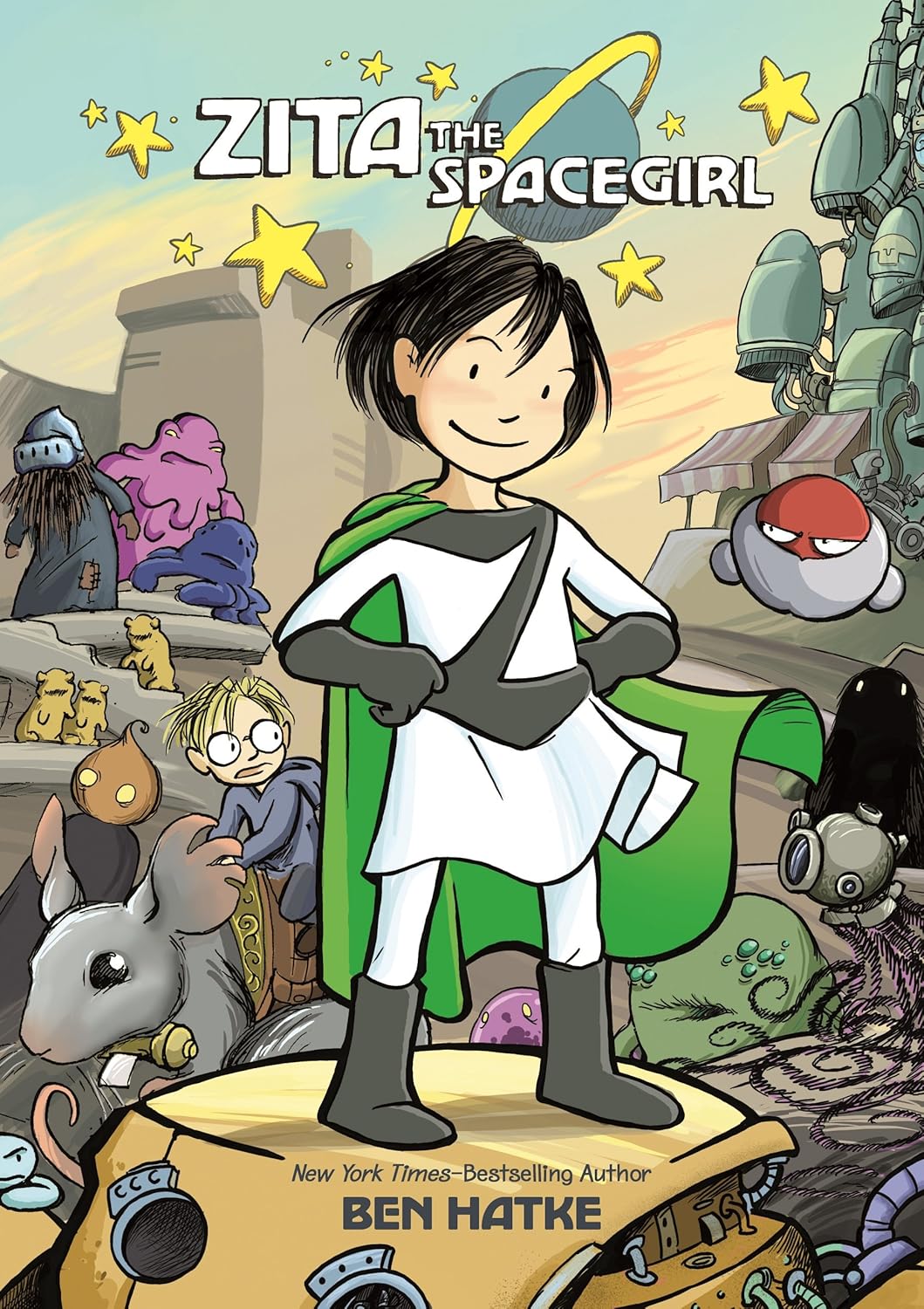
Zita the Spacegirl, written and illustrated by Ben Hatke, is a 192-page graphic novel about a girl named Zita who presses a mysterious button she finds in a crater and accidentally catapults her best friend Joseph into another dimension. Without hesitating for a moment, she follows him. She lands on a strange planet full of alien creatures — humanoid chickens, neurotic robots, tentacled beings, a friendly con man, and a doomsday cult preparing to end the world — and discovers she is, apparently, the hero of an ancient prophecy. She also has no idea how to get home. Published in 2010 by First Second and a New York Times bestseller, it launched a beloved trilogy and established Hatke as one of the preeminent creators in children’s graphic novels. The Goodreads reviewers compare his alien designs to Miyazaki; the school librarians describe it as one of the best gateway graphic novels for children who are new to the format; and the children who find it tend to read all three volumes immediately and then look for everything else Hatke has made. This complete guide covers Zita the Spacegirl‘s reading level, recommended age, content considerations, key characters, themes, and similar books — designed for parents, teachers, and students.
For Parents
A warm, funny, visually inventive graphic novel about a girl who charges into an alien world to rescue her best friend — with a cast of creature designs that reviewers consistently compare to Studio Ghibli. Ages 7–12, grades 2–6. No content concerns. One of the best graphic novels available for girls who are new to the format — and for any child who has ever acted first and thought second.
For Teachers
A grades 2–6 classroom and library staple for graphic novel units — a natural companion to Hilo for a graphic novel introduction unit, or as a standalone choice for students who want a female protagonist in the science fiction/adventure space. The trilogy is a complete, satisfying arc; once students find Book 1, they finish the trilogy without prompting. Hatke’s creature designs reward close visual attention.
Zita the Spacegirl at a Glance
Find on Amazon →| Author & Illustrator | Ben Hatke (author & illustrator) |
| Published | 2010/2011 (First Second / Roaring Brook Press) |
| Grade Level | 2–6 (our assessment) |
| Recommended Age | 7–12 |
| Lexile | GN310L (Graphic Novel Lexile — see below) |
| ATOS Level | 2.5 |
| Word Count | 4,042 (text only) |
| Pages | 192 |
| Format | Graphic novel (full color) |
| Genre | Graphic novel / science fiction / fantasy / adventure |
| Series | Zita the Spacegirl (3 volumes) |
For official Lexile and AR levels, visit Lexile.com or AR BookFinder. ReadingVine provides independent editorial assessments.
What Reading Level Is Zita the Spacegirl?
Zita the Spacegirl has a Lexile of GN310L and an ATOS level of 2.5. As with Hilo in this catalog, the GN prefix designates a Graphic Novel Lexile — a separate scale developed specifically for graphic novels that is not directly comparable to prose Lexile scores. The text word count of 4,042 reflects only the dialogue and captions and significantly understates the full reading experience, which includes Hatke’s detailed alien landscapes, creature designs, and visual storytelling. The ATOS 2.5 is a reasonable proxy for the prose complexity, which is clear and accessible for early independent readers.
Our editorial assessment places it at grades 2–6, ages 7–12 — slightly broader than Hilo’s grades 2–5 because the storyline and emotional stakes are marginally more complex across the trilogy. Children as young as first grade with adult support can enjoy it; middle schoolers who love graphic novels will find it completely satisfying. For official Lexile and AR scores, visit Lexile.com or AR BookFinder. ReadingVine’s assessments are independent editorial judgments.
What Age Is Zita the Spacegirl Appropriate For?
We recommend Zita the Spacegirl for readers ages 7–12, grades 2–6. There are no content concerns: the alien threats and doomsday plot are handled with the same light, adventure-forward tone as the rest of the book, nothing frightening or graphic. A doomsday cult’s plan to destroy the planet provides the plot’s stakes without being genuinely dark or disturbing. The book is explicitly appropriate for the youngest graphic novel readers and for those who are new to the format.
What Is Zita the Spacegirl About?
Zita and her best friend Joseph discover a mysterious device in a crater. Zita, impulsive and curious, presses the red button. A portal opens and Joseph is sucked through it. Without pausing to think, Zita follows. She lands on a strange planet she does not recognize, among creatures she has never seen, and Joseph is nowhere in sight. A doomsday cult has captured him as part of a plan to sacrifice the planet’s inhabitants to prevent the arrival of an enormous asteroid.
Zita has no powers, no map, and no plan. What she has is stubbornness, warmth, and an instinctive willingness to trust people who seem trustworthy even when they look alarming. She gathers a crew of unlikely allies: One, a large gentle robot programmed only to fight but who wants desperately to be something else; Piper, a friendly con man with a magic flute who has mysterious reasons for helping her; a small mouse creature who acts as her guide; and an assortment of alien characters who recognize in Zita something worth following. Together they work toward freeing Joseph and stopping the asteroid before time runs out.
The book’s ending is satisfying but not complete — Zita gets Joseph back, but she is not yet home, and the second volume picks up her continuing journey. The trilogy is structured as a complete arc: each book has its own plot, and the three books together tell Zita’s full story from leaving Earth to returning to it.
Zita as a Female Protagonist in Science Fiction
When Zita the Spacegirl was published in 2010, female protagonists in science fiction and adventure graphic novels for children were rarer than they should have been. Reviewers and librarians noted this consistently — not as a criticism of the book’s competitors but as recognition of what Hatke had done. Zita is the hero in the fullest sense: she makes the decisions, she carries the emotional weight, she drives the plot forward through her own choices rather than being rescued or guided. She is also not defined by her gender — her being a girl is simply who she is, not a theme to be explored or a limitation to be overcome.
This has made the book particularly valuable in library and classroom contexts where teachers and librarians are looking for graphic novels with strong female protagonists for students who haven’t found themselves reflected in the format. Zita is now one of several strong options, but she was among the first in the modern children’s graphic novel revival, and she remains one of the best: fully rounded, warmly drawn, consistently funny, and completely capable.
Zita the Spacegirl Characters
Ben Hatke’s Visual World
Reviewers consistently compare Hatke’s alien creature designs to Studio Ghibli — specifically to Hayao Miyazaki’s approach to designing fantastical creatures that are utterly strange but immediately emotionally legible. The humanoid chickens who appear in the opening pages, the various robot designs, the tentacled and multi-limbed aliens in the background of crowd scenes — all are visually inventive in the way that rewards readers who slow down to look at the panels rather than rushing through the plot. The backgrounds of market scenes and alien cityscapes are populated with creatures Hatke invented and never named, which gives the world a quality of genuine depth: this is a planet with its own history, and most of it is not explained.
The color palette shifts across the book in ways that track Zita’s emotional experience: the warm golds and browns of the alien market, the cooler blues of danger, the vivid reds and oranges of the climactic confrontation. For readers who have worked through the color-as-emotion technique in When Sophie Gets Angry, Hatke’s palette offers a more sophisticated version of the same approach: color as atmosphere rather than explicit emotion, mood rather than state.
Zita the Spacegirl Themes and Lessons
The book’s central question — what makes someone a hero? — is answered in the most practical possible way: Zita is a hero because she acts when acting is needed, because she cares about the specific individuals in front of her, and because she does not wait to be invited or qualified. She does not have special powers at the start of the book; she has a particular quality of attention and commitment that turns out to be exactly what the situation requires. This is a different argument from the “ordinary kid discovers they have powers” narrative that drives Hilo; Zita does not need powers to be extraordinary. She needs only herself.
One’s arc — a robot programmed only to fight who finds another way to be — is the book’s secondary emotional argument and the one that most rewards close reading. One cannot escape his programming by ignoring it; he can only exceed it. His choices throughout the book are made in full awareness of what he was built for and in defiance of that purpose in favor of what he has chosen to be. This is a quietly sophisticated argument about identity and free will, delivered through an enormous gentle robot who is very easy to love.
Talking with your child: Why do you think Zita pressed the button before she thought about what would happen? Was it brave or reckless — or both? What made One want to be something other than what he was programmed to be? Do you think Piper was good or bad — and what made you think so? If you were dropped on a strange planet and had to build a crew, who would you look for?
The Zita the Spacegirl Trilogy
The Zita the Spacegirl series is a complete trilogy of three volumes, all by Ben Hatke and all published by First Second: Zita the Spacegirl (2010), Legends of Zita the Spacegirl (2012), and The Return of Zita the Spacegirl (2014). The three books should be read in order; each builds directly on the previous one, and the trilogy as a whole tells a complete story that ends with a genuinely satisfying resolution. Hatke has also written a crossover volume, Mighty Jack and Zita the Spacegirl (2019), which brings Zita together with characters from his Mighty Jack series in a shared-universe adventure. The Mighty Jack series is a natural next read for readers who finish the Zita trilogy and want more Hatke.
Books Similar to Zita the Spacegirl
About Ben Hatke
Ben Hatke lives and works in the Shenandoah Valley of Virginia with his wife and their daughters — a biographical detail that shows up implicitly in his work’s characteristic warmth and in the quality of attention he brings to his female characters. He has said that he created Zita because he wanted to make something for the girls in his household, and that the character grew from the specific question of what kind of girl hero he would most want to read about: one who acts, who cares, who is funny, and who does not need rescue. He began publishing comics and illustrations online before First Second picked up the Zita trilogy, and he maintains an active web presence at benhatke.com.
Hatke has produced a substantial body of work beyond the Zita trilogy: the picture books Julia’s House for Lost Creatures (2014) and Nobody Likes a Goblin (2016); the graphic novel Little Robot (2015), a wordless graphic novel for very young readers; and the Mighty Jack duology (Mighty Jack, 2016, and Mighty Jack and the Goblin King, 2017), which was followed by the crossover Mighty Jack and Zita the Spacegirl (2019). His work across all formats shares a visual warmth and an emotional generosity that make it immediately recognizable.
Zita the Spacegirl: Frequently Asked Questions
What reading level is Zita the Spacegirl?
Lexile GN310L (Graphic Novel Lexile — a separate scale not directly comparable to prose Lexile scores) and ATOS 2.5. Our assessment: grades 2–6, ages 7–12. The 4,042-word text count understates the full reading experience, which includes substantial visual storytelling. For official Lexile and AR scores, visit Lexile.com or AR BookFinder.
What is Zita the Spacegirl about?
Zita presses a mysterious button and accidentally catapults her best friend Joseph into another dimension. She immediately follows him and lands on a strange alien planet. With no powers and no map, she gathers a crew of unlikely allies — including a large gentle robot, a mysterious con man, and various alien creatures — to find Joseph and stop a doomsday cult from destroying the planet.
How many Zita the Spacegirl books are there?
Three volumes: Zita the Spacegirl (2010), Legends of Zita the Spacegirl (2012), and The Return of Zita the Spacegirl (2014). Read in order — the trilogy is a complete story with a satisfying ending. A crossover volume, Mighty Jack and Zita the Spacegirl (2019), connects the Zita universe with Hatke’s Mighty Jack series.
Is Zita the Spacegirl good for reluctant readers?
Yes — as with Hilo and Diary of a Wimpy Kid, the graphic novel format makes it far more accessible than its page count suggests. Children who resist prose books often find graphic novels immediately engaging, and Zita’s combination of funny alien creatures, fast-paced adventure, and a warm emotional core makes it one of the best graphic novel recommendations for children ages 7–12 who are new to reading independently or new to the graphic novel format.
What makes Zita the Spacegirl different from other graphic novels?
The combination of a strong, proactive female protagonist in a science fiction adventure setting (relatively rare when published in 2010), Hatke’s Miyazaki-influenced creature and world design, and the warm emotional core of the story — particularly One’s arc and Zita’s relationship with her assembled crew — make it stand apart from the superhero and humor graphic novels that dominate the format. It is also a complete trilogy with a beginning, middle, and end, which is less common in graphic novel series than ongoing serialization.