
 = Partner Site
Real Friends Reading Level: A Complete Guide
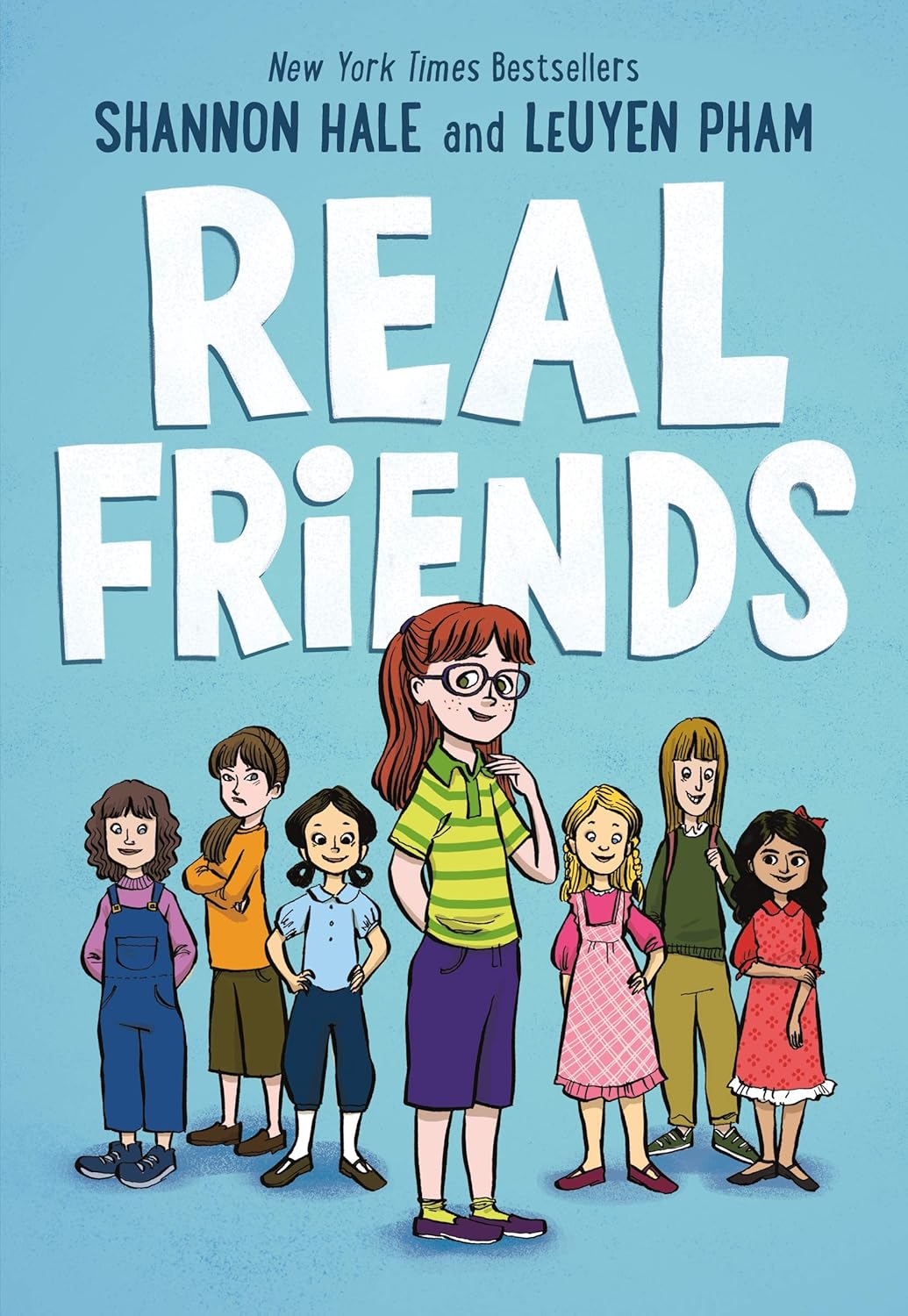
Real Friends, written by Shannon Hale and illustrated by LeUyen Pham, is a 224-page autobiographical graphic novel about Shannon’s elementary school years in the 1980s — specifically the years dominated by the social dynamics of The Group, a circle of friends led by the most popular girl in class, Jen, where loyalty is conditional and every day is a performance. Shannon has been best friends with Adrienne since they were small, but Adrienne has started spending time with Jen, and now Shannon is never quite sure where she stands — whether she’s in or out, whether Adrienne is still really her friend, whether being part of The Group is worth what it costs. A New York Times bestseller, winner of starred reviews from School Library Journal and Publishers Weekly, and the first in a three-book Friends series with over two million copies sold, Real Friends is the most directly relatable graphic memoir about elementary-school social dynamics available for children in this age range. The New York Times Book Review called it “fresh and funny,” and SLJ’s reviewer compared it to El Deafo as a memoir that takes the specific pain of not-quite-friendship seriously. This guide covers reading level, age appropriateness, themes, and similar books.
For Parents
A warm, honest graphic memoir about elementary-school friendship politics, bully dynamics, and finding out who your real friends actually are. Ages 8–12, grades 3–6. No content concerns. One of the most reliably relatable books for girls in this age range — and the one most likely to prompt a “that’s exactly what happened to me” conversation. Boys who feel excluded by friend groups will also recognize Shannon’s experience.
For Teachers
A grades 3–6 library staple and SEL classroom companion — one of the most effective available texts for discussing friendship, cliques, social pressure, and how to recognize the difference between real friends and conditional ones. Pham’s illustrations are especially rich for visual literacy work. Pairs naturally with Smile and Drama for a graphic memoir unit on friendship.
Real Friends at a Glance
Find on Amazon →| Author | Shannon Hale |
| Illustrator | LeUyen Pham |
| Published | 2017 (First Second / Macmillan) |
| Grade Level | 3–6 (our assessment) |
| Recommended Age | 8–12 |
| Lexile | GN340L (Graphic Novel Lexile — see below) |
| ACR Level | 2.6 |
| Guided Reading Level | S |
| Pages | 224 |
| Format | Autobiographical graphic novel (full color) |
| Genre | Graphic memoir / autobiography |
| Setting | Salt Lake City, Utah; 1980s elementary school |
| Series | Real Friends (3 books) |
For official Lexile and AR levels, visit Lexile.com or AR BookFinder. ReadingVine provides independent editorial assessments.
What Reading Level Is Real Friends?
Lexile GN340L (Graphic Novel Lexile — a separate scale from prose scores, not directly comparable), ACR 2.6, Guided Reading Level S, grades 4–7. As with all graphic memoir titles in this catalog, the formula scores reflect only the dialogue and captions; the full visual narrative experience across 224 pages is more demanding. Our assessment: grades 3–6, ages 8–12. The Guided Reading Level S and the interest level grades 4–7 are the most useful references for classroom placement. For official scores, visit Lexile.com or AR BookFinder.
What Is Real Friends About?
Shannon and Adrienne have been best friends since they were little. Then Adrienne starts hanging out with Jen, the most popular girl in class and the leader of a social group called simply The Group. The Group operates on an informal hierarchy — everyone wants to be Jen’s number one, and the way to stay in is to do what Jen wants, which includes what Jen wants regarding who is in and who is out. Shannon is sometimes in. She is sometimes out. She is never quite sure which one she is today.
The book follows Shannon through the elementary school years in which she navigates this: the days when Jen likes her, the days when Jen doesn’t; the specific loneliness of watching your best friend choose someone else; the compromises Shannon makes to try to stay in The Group; and the moment when she realizes that the friendships in The Group are not what real friendship looks like. Alongside this social story, Shannon also struggles with a fear and a habit she can’t quite name — a tendency to imagine terrible things happening to her family, which she develops rituals around to try to prevent. She doesn’t know what it is; the book doesn’t diagnose it; but it is present throughout and gives the social anxiety a deeper emotional root.
LeUyen Pham’s Illustrations
LeUyen Pham brings Shannon Hale’s 1980s Salt Lake City to life with period-accurate detail — the clothes, the computers, the furniture, the aesthetic of a specific decade in a specific place. School Library Journal’s reviewer noted that “just looking at the setting you really feel you’re in the 1980s,” and praised Pham’s ability to stretch from realistic period recreation into the fantasy sequences Shannon uses to process her social anxiety (spy sequences, fantastical journeys, imagination play). The visual contrast between Shannon’s internal fantasy life and the external social pressure of The Group is one of the book’s most distinctive qualities and is entirely dependent on Pham’s visual storytelling.
Pham has illustrated more than one hundred books for children, including the Caldecott Honor book Bear Came Along. Her collaboration with Hale is ongoing across the Friends trilogy and the Princess in Black chapter book series. The Friends trilogy is the most visually complex work of her career.
Real Friends Themes and Lessons
The book’s central question — what makes a friend real rather than conditional? — is asked and answered through Shannon’s experience of The Group, where friendship is contingent on Jen’s approval, and through the quieter friendship with Jen’s opposite that Shannon eventually finds. The answer is both simple and hard to see from inside a social situation: real friends don’t require you to perform for them. The performance is what Shannon has been doing for years, and recognizing it as performance is the book’s most important moment.
The OCD-adjacent anxiety thread — Shannon’s private rituals around preventing imagined disasters from happening to her family — is handled without diagnosis or labeling. It is simply present, depicted with the specific texture of a child who has this experience but no framework for understanding it. Many readers who have similar experiences will recognize themselves in this thread without it ever being named.
Talking with your child: What is the difference between being in The Group and having a real friend? Why does Shannon keep trying to stay in The Group even when it doesn’t feel good? Have you ever been in a friendship where you had to perform to stay in? What did Shannon learn about what real friendship feels like?
The Real Friends Series
The Friends trilogy by Shannon Hale and LeUyen Pham includes Real Friends (2017), Best Friends (2019), and Friends Forever (2021). Each continues Shannon’s autobiographical story through middle school, following the same characters and social dynamics as they evolve. The three books should be read in order; together they trace Shannon’s friendship experiences from elementary school through middle school and give a complete picture of her social development. All three have sold over two million copies combined and maintain the same GN Lexile range and age recommendation.
Books Similar to Real Friends
About Shannon Hale and LeUyen Pham
Shannon Hale is the author of more than fifty books for children and young adults, including the Newbery Honor-winning Princess Academy and the bestselling Princess in Black chapter book series (co-written with her husband Dean Hale, illustrated by LeUyen Pham). She lives near Salt Lake City, Utah — the city in which Real Friends is set. She has said that the social dynamics depicted in the book are closely based on her own elementary school experience and that making the book was both cathartic and clarifying. The friendship that eventually resolves Shannon’s social situation in the book is based on a real friendship that has lasted into adulthood.
LeUyen Pham has illustrated more than one hundred books for children, including the Caldecott Honor book Bear Came Along (with Richard T. Morris). Her collaboration with Shannon Hale spans the Princess in Black series, the Friends trilogy, and the Itty-Bitty Kitty-Corn picture books. She lives in Los Angeles.
Real Friends: Frequently Asked Questions
What reading level is Real Friends?
Lexile GN340L (Graphic Novel Lexile, separate scale), ACR 2.6, Guided Reading Level S. Our assessment: grades 3–6, ages 8–12. Formula scores reflect only dialogue and captions; the full visual narrative is more demanding. For official scores, visit Lexile.com or AR BookFinder.
What is Real Friends about?
Shannon Hale’s autobiographical account of elementary school in 1980s Salt Lake City — specifically the years navigating The Group, a clique led by the most popular girl in class, where Shannon’s best friend Adrienne has started spending time. Shannon’s search for real friendship versus conditional friendship, told with honesty, humor, and Pham’s vivid period-accurate illustrations.
Is Real Friends just for girls?
No — while the social dynamics are centered on a girl’s experience, the feelings of exclusion, the performance required by conditional friendship, and the search for belonging are universal. Boys who have felt excluded by friend groups or peer hierarchies will recognize Shannon’s experience. That said, the book is most frequently read by girls in the recommended age range.
Are there sequels to Real Friends?
Yes — Best Friends (2019) and Friends Forever (2021) continue Shannon’s story through middle school, with the same illustrator and the same characters. The three books form a complete trilogy and should be read in order.
How does Real Friends compare to Smile?
Both are autobiographical graphic novels about girls navigating elementary and middle school social dynamics, both feature friend groups that turn out to be conditional rather than real, and both are among the most beloved graphic memoirs in the age range. Smile covers more years and includes the dental accident that drives its structure; Real Friends is more focused on the friendship dynamics specifically. Reading both together gives the fullest picture of what this format can do for this age range.