
 = Partner Site
Bob Books Set 1 Reading Level: A Complete Guide
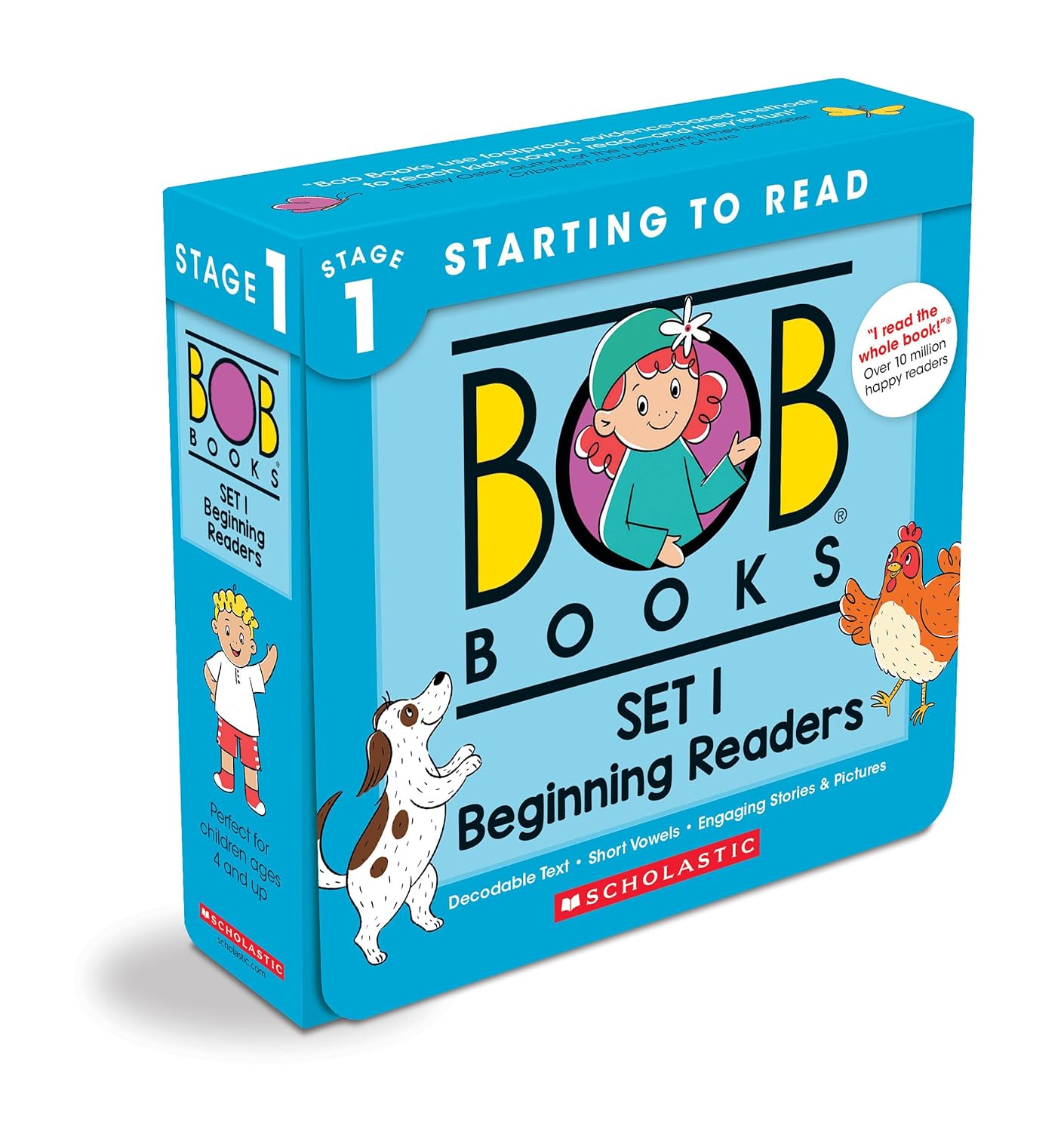
Bob Books Set 1: Beginning Readers by Bobby Lynn Maslen, illustrated by John R. Maslen, is not a single book but a boxed set of 12 decodable mini-books — the tool that has taught millions of children to read their very first words. Created in the 1970s by a Portland kindergarten teacher who couldn’t find materials simple enough for children just learning letter sounds, Bob Books have been in print since 1980 and are now sold at a rate of more than a million sets per year through Scholastic. The first book in the set, Mat, uses only four letter sounds and one sight word. By the last book, The Vet, a child has encountered all the letters of the alphabet. Along the way, twelve children have each read a whole book — often for the very first time. This guide covers the reading level, recommended age, how to use Bob Books effectively, and everything parents and teachers need to know about this essential early literacy tool.
For Parents
Find out what Bob Books Set 1 is, who it’s for, and exactly how to use it with your child — including how each book works, what phonics skills are introduced and when, and why these tiny, deliberately simple books are one of the most effective beginning reading tools available for children ages 3–6 who are ready to decode their first words.
For Teachers
Reading level data, phonics scope and sequence, and guidance on using Bob Books Set 1 in a classroom or small-group setting. Widely used in Montessori, phonics-based, and homeschool programs; aligned with Science of Reading research; and one of the most trusted decodable book sets in early literacy education for more than forty years.
Bob Books Set 1: Beginning Readers at a Glance
Find on Amazon →| Author | Bobby Lynn Maslen |
| Illustrator | John R. Maslen |
| Published | 1976 (original); 2006 (Scholastic edition); updated illustrations 2022 |
| Grade Level | PreK–K (our assessment) |
| Recommended Age | 3–6 |
| Best For | Independent reading ages 3–6; read-aloud support for ages 3–5 |
| Reading Level | Guided Reading A–C; Lexile BR–180L |
| Format | Boxed set of 12 mini-books, 12 pages each |
| Words Per Book | 4–27 unique words (progressing across the set) |
| Genre | Decodable readers / phonics program |
| Phonics Approach | Systematic phonics; CVC words; short vowels only |
| Awards | 16.5+ million copies in print; 1M+ sets sold annually; Children’s Book of the Month Club selection |
Bob Books use a phonics-based approach rather than Lexile or AR leveling systems. For more on reading level frameworks, visit Lexile.com or AR BookFinder.
What Reading Level Is Bob Books Set 1: Beginning Readers?
Bob Books Set 1: Beginning Readers spans Guided Reading Levels A through C, with Lexile measures ranging from BR (Below Reader baseline) to approximately 180L across the twelve books. These are the earliest reading levels available in any standard framework — below the entry point of most early reader series, including Biscuit, Brown Bear, and Pete the Cat: I Love My White Shoes. This is intentional and correct: Bob Books Set 1 is designed for children who are just learning to decode, before they are ready for any conventional picture book text.
The set uses a systematic phonics approach: Book 1 (Mat) introduces only the sounds m, a, t, and s, and uses just four unique words. Each subsequent book adds a small number of new letter sounds while reinforcing those already learned, so by Book 12 (The Vet) a child has encountered all letters of the alphabet except Q. All words in the set are decodable — meaning they can be sounded out using the phonics rules already introduced — with a very small number of high-frequency sight words (a, the). There are no irregular spellings, no vocabulary challenges beyond the phonics scope, and no sentences longer than four or five words.
This radical simplicity is the point. The Flesch-Kincaid formula, designed for longer continuous text, does not apply meaningfully to books of this length and structure. Bob Books are better understood as a phonics tool than as a reading level assessment target — they exist at the moment before a child enters the reading level systems, and their purpose is to get that child to a place where those systems are relevant. For guidance on next steps once your child has completed Set 1, the Bob Books website at bobbooks.com provides a full progression chart.
Are Bob Books Set 1 Read-Alouds or Independent Reads?
Bob Books Set 1: Beginning Readers are designed primarily as independent reading tools for ages 3–6 — specifically, for children who know their letter sounds and are ready to begin decoding. This is the inverse of most books on the K–2 list: where a picture book like Where the Wild Things Are is primarily a read-aloud that a child may eventually read independently, Bob Books are primarily independent readers that a parent or teacher sits alongside, rather than reading aloud. The goal is for the child to read; the adult’s role is to encourage and support, not to perform the text.
That said, the early books in the set work well as scaffolded read-alouds for children ages 3–5 who are not yet decoding independently. Each mini-book takes an adult about 1–2 minutes to read aloud, and a child new to the phonics concepts can follow along, tracking the text with their finger while hearing it. Many parents read the first two or three books aloud once before asking their child to try independently, which gives the child a model of how the decoding process sounds before they attempt it themselves.
For independent reading, the standard approach is to sit with the child while they read aloud to you. When a child gets stuck on a word, the recommended strategy is to say “sound it out” — encourage them to say each letter sound slowly, then blend them together. Bob Books are designed so that this strategy always works: every word in the set is decodable with the phonics knowledge the child has already encountered in that book or earlier in the set. There are no words that require guessing from context or picture cues, which is intentional: the books build the specific skill of phonetic decoding, distinct from the broader skill of reading comprehension.
Each mini-book is sized for little hands — approximately 5½ × 4¼ inches — and at 12 pages can be completed in a single sitting. Most beginning readers finish Book 1 (Mat) in under five minutes. The experience of finishing a whole book — small as it is — is the emotional core of the Bob Books design: children are supposed to close the back cover, look up, and say “I read the whole book.” That moment of pride is what the entire set is engineered to produce, repeatedly and reliably, as the books become gradually more complex.
Introduce one book at a time, and don’t move to the next book until your child can read the current one smoothly from start to finish. It is completely normal for a child to need to read the same book three or four times before it feels effortless — that repetition is part of how phonics skills become automatic rather than effortful. When they’re ready to move on, let them: the confidence from mastering each book is what makes the next book feel achievable rather than daunting.
What Are the Books in Bob Books Set 1: Beginning Readers?
Bob Books Set 1 contains 12 mini-books, each 12 pages, progressing in complexity across the set. The titles are Mat, Sam, Dot, Mac, Dot and Mit, Dot and the Dog, Jig and Mag, Muff and Ruff, 10 Cut-Ups, Peg and Ted, Lad and the Fat Cat, and The Vet. Each book tells a simple story involving characters whose names are themselves decodable CVC (consonant-vowel-consonant) words — Mat, Sam, Dot, Jig, Mag, Muff, Ruff, Peg, Ted, Lad. The stories are deliberately minimal but not humorless: Maslen’s ear for the small pleasures of child-friendly absurdity means that a book about a dog hiding a bag that turns out to contain a hot dog (Dot and the Dog) has genuine comic structure, and The Vet — in which a vet chases a big cat at the zoo in a zig-zag pattern — ends with a satisfying “ZAM!” that children find delightful.
The phonics scope and sequence is precise: Book 1 (Mat) introduces m, a, t, s. Book 2 (Sam) reinforces these and introduces c. Book 3 (Dot) adds d, o, g. Each subsequent book adds a small number of new sounds while reinforcing all previous ones. Short vowels a, i, o, u, and e are all introduced across the set. By Book 12, the child has encountered the full alphabet (minus Q) in decodable contexts. The parent guide included in the boxed set explains the phonics scope of each book explicitly and provides tips for parents who are working through the set at home.
Bob Books Set 1 Characters
The characters in Bob Books Set 1 are mostly recurring across multiple books: Mat and Sam appear in the first books and become familiar friends; Dot appears in three separate titles; Mac, Muff, Ruff, Jig, Mag, Peg, Ted, and Lad each star in their own stories. All character names are decodable CVC words, which is both a pedagogical choice (the child can read the character’s name using the phonics rules they already know) and a quietly amusing one — these are names that sound like names but sit at a slight angle to ordinary naming conventions, which gives the books a gentle, low-key charm that children respond to. John Maslen’s simple line drawings keep the illustrations clear and uncluttered, supporting rather than competing with the text, and the characters’ expressions and body language carry the modest emotional arcs of each story without requiring any words the child can’t yet decode.
Bob Books Set 1 Themes and Learning Goals
The primary purpose of Bob Books Set 1: Beginning Readers is building the specific skill of phonetic decoding — the ability to look at a sequence of letters, produce the sound each letter represents, and blend those sounds into a recognizable word. This is a foundational literacy skill, distinct from reading comprehension, vocabulary, or fluency, and it is the skill that Maslen identified as undersupported by the materials available to her kindergarten students in the 1970s. Most early readers at the time — the Dick and Jane series and its successors — were built on a “look-say” approach that asked children to memorize whole words by sight. Maslen’s phonics-first approach, which asks children to decode by sounding out rather than by recognizing, is now well-supported by what researchers call the Science of Reading: the body of cognitive science evidence showing that systematic phonics instruction is the most reliable foundation for reading acquisition.
The set is designed equally to build reading confidence. Maslen understood that a child who cannot finish a book does not feel like a reader, and a child who does not feel like a reader is less motivated to read. The twelve books of Set 1 are each short enough to finish in a single sitting, simple enough to decode successfully on the first or second attempt, and structured so that each new book is only slightly harder than the last — no child should feel defeated moving from one book to the next. The phrase “I read the whole book!” is the registered trademark of Bob Books for a reason: it is the emotional outcome the entire system is designed to produce. A child who has read twelve whole books knows they are a reader, because the evidence is right there in the box.
For teachers and parents interested in literacy research, Bob Books Set 1 is a useful example of decodable readers — books in which all words are decodable using the phonics knowledge already taught, as opposed to leveled readers, which may include high-frequency words and context cues alongside phonics. The Science of Reading research base broadly supports the use of decodable readers in early instruction, and Bob Books’ longevity (now in print for more than forty years) reflects their alignment with what actually works for most beginning readers.
Discussion starters for families: Which book is your favorite? What funny thing happened in The Vet? Can you sound out the names of all twelve books? Which character would you most want to meet? Can you make up a Bob Books story of your own, using only the letters you’ve learned?
How Long Are the Books in Bob Books Set 1: Beginning Readers?
Each book in Bob Books Set 1: Beginning Readers has 12 pages and between 4 and 27 unique words, increasing across the set. Book 1 (Mat) can be read aloud by an adult in under a minute; Book 12 (The Vet) takes two to three minutes. A beginning reader working through a book independently for the first time will typically take 5–15 minutes per book, depending on their current decoding speed and how many times they need to work through a tricky word. Subsequent readings of the same book are faster.
The set is designed to be worked through gradually — one book mastered before moving to the next — rather than read all at once. At a pace of roughly one new book per week (with multiple re-readings to build fluency), a child typically completes Set 1 over two to three months. Some children move faster; some slower. The pace should be set by the child’s comfort and confidence, not by a schedule.
What to Read After Bob Books Set 1: Beginning Readers
Children who have completed Bob Books Set 1: Beginning Readers are ready to move to books that build on their new decoding skills while introducing more story and vocabulary. These are the natural next steps:
About the Author and Illustrator
Bobby Lynn Maslen taught preschool and kindergarten at the Catlin Gabel School in Portland, Oregon from 1968 to 1980. During those years she searched repeatedly for beginning reading materials simple enough for children who were just learning letter sounds and found nothing that met her standard. The materials available were either too difficult — early readers that required sight word recognition before children had phonics — or too dull to engage young children. Her solution was to make the books herself. The first Bob Books were written on typing paper cut into postcard-sized pages, using only the letter sounds her youngest students had learned that week. The stories were minimal but not humorless — she understood that a book a child finds funny is a book a child will want to read again, and repetition is how phonics skills become fluent.
The origin story of the characters Mat and Sam is characteristic of the whole enterprise: Maslen bought two small dolls at a craft fair, named them Mat and Sam, and spun stories about them illustrated with line drawings the children could copy and color. Word spread from the Catlin Gabel community to parents and then to home-schoolers and Montessori teachers; Portland State University published early editions; the family self-published from their home in West Linn, with Maslen’s children helping to collate and staple. In 1993 a USA Today story about Bob Books generated an overnight deluge of phone calls, and in 1994 Scholastic licensed the series for national distribution. As of 2018, over 16.5 million Bob Books had been printed, and Scholastic sells more than a million sets per year. Bobby Maslen is retired and lives in Portland with her husband John. Bob Books has continued with new sets written by their daughter Lynn Maslen Kertell, who hand-lettered the original books as a teenager.
John R. Maslen, Bobby’s husband, is a watercolor artist and former architect who drew the original illustrations for Bob Books and continues to be credited as the illustrator of Set 1. His simple line drawings — clear, uncluttered, expressive enough to carry the small emotional moments of each story — were designed explicitly not to distract from the text. In a decodable reader, the illustrations should support decoding rather than provide a shortcut around it, and Maslen’s drawings do exactly that: they confirm what the words say rather than replacing the need to read them.
Bob Books Set 1: Beginning Readers: Frequently Asked Questions
What reading level is Bob Books Set 1: Beginning Readers?
Bob Books Set 1: Beginning Readers spans Guided Reading Levels A through C, with Lexile measures ranging from Below Reader baseline to approximately 180L across the twelve books. These are the earliest reading levels in any standard framework — below the entry point of conventional picture books and early readers. They are designed for children who are just beginning to decode, before they are ready for standard early reader levels. The set uses a systematic phonics approach aligned with Science of Reading research, and is appropriate for children ages 3–6 who know their letter sounds.
What age is Bob Books Set 1: Beginning Readers for?
Bob Books Set 1: Beginning Readers is appropriate for ages 3–6. The readiness indicator is not age but phonics knowledge: a child who knows the sounds of the letters of the alphabet is ready to begin. Some children are ready at 3 or 4; others not until 5 or 6; both are completely normal. Children who are not yet ready will find Book 1 frustrating rather than exciting, which is the clearest sign to wait. Children who are ready will pick it up quickly and feel proud of themselves by the end of the first book, which is the sign to continue.
How many books are in Bob Books Set 1, and what are they?
Bob Books Set 1: Beginning Readers contains 12 mini-books, each 12 pages. The titles in order are: Mat, Sam, Dot, Mac, Dot and Mit, Dot and the Dog, Jig and Mag, Muff and Ruff, 10 Cut-Ups, Peg and Ted, Lad and the Fat Cat, and The Vet. Each book should be mastered — read smoothly from beginning to end — before moving to the next. The set also includes a parent guide with tips for helping your child through the books.
How long does it take to read a Bob Book aloud?
Each book in Bob Books Set 1: Beginning Readers takes about 1–3 minutes to read aloud as an adult. A beginning reader working through a book independently for the first time will typically take 5–15 minutes. The goal is not speed but accuracy and confidence: a child who can read a book smoothly from beginning to end, decoding each word correctly, has mastered that book and is ready for the next one. Subsequent readings of the same book are faster, and children often enjoy reading familiar books to younger siblings, stuffed animals, or anyone who will listen.
What comes after Bob Books Set 1: Beginning Readers?
Children who have completed Bob Books Set 1: Beginning Readers are ready for Bob Books Set 2: Advancing Beginners, which introduces consonant blends and longer words using the same decodable approach. Beyond the Bob Books series, children who have mastered Set 1 are generally ready for I Can Read Level 1 books such as Little Bear, simple picture book early readers like Biscuit, and Mo Willems’ Elephant & Piggie series. The Bob Books website at bobbooks.com provides a full progression chart for children moving through all five stages of the program.
Are Bob Books based on phonics or sight words?
Bob Books Set 1: Beginning Readers are based primarily on systematic phonics — specifically, the ability to decode words by sounding out each letter and blending the sounds together. All words in the set are decodable using the phonics rules already introduced in that book or earlier in the set, with a very small number of high-frequency sight words (a, the). This approach is aligned with what reading researchers call the Science of Reading, which supports systematic phonics as the most reliable foundation for early reading acquisition. The set does not use a look-say or whole-language approach.