
 = Partner Site
Pete the Cat: I Love My White Shoes Reading Level: A Complete Guide
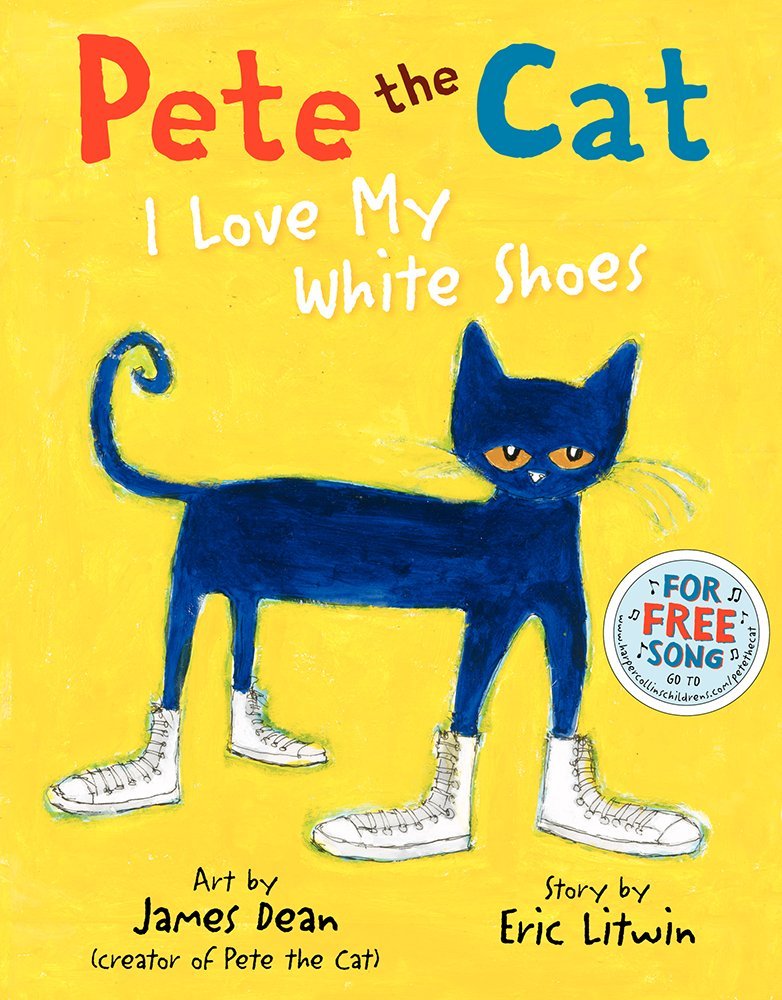
Pete the Cat: I Love My White Shoes by Eric Litwin, illustrated by James Dean, is one of the most joyful and infectiously rhythmic picture books of the past twenty years — a story about a groovy blue cat who steps in one colorful mess after another and never, not once, loses his cool. Originally self-published in 2008 and picked up by HarperCollins after a viral YouTube video, Pete the Cat: I Love My White Shoes became a #1 New York Times bestseller and launched one of the most popular series in contemporary children’s publishing. This guide covers the reading level, recommended age, read-aloud vs. independent reading guidance, themes, and everything parents and teachers need to know about sharing Pete the Cat: I Love My White Shoes with young readers.
For Parents
Find out whether Pete the Cat: I Love My White Shoes works best as a read-aloud or independent read for your child, what age range it suits, and why this book — written as a song — is one of the most effective early literacy tools for children who learn best through music and movement.
For Teachers
Grade-level data, read-aloud timing, key themes, and discussion questions for a multiple-award-winning PreK–K classroom favorite. Exceptional for color learning, phonics, emotional regulation, and any lesson that benefits from children who are physically and vocally engaged — which is most of them.
Pete the Cat: I Love My White Shoes at a Glance
Find on Amazon →| Author | Eric Litwin |
| Illustrator | James Dean |
| Published | 2010 (HarperCollins; self-published 2008) |
| Grade Level | PreK–K (our assessment) |
| Recommended Age | 3–6 |
| Best For | Read-aloud ages 2–6; independent reading ages 4–6 |
| Flesch-Kincaid Grade | 1.2 |
| Word Count | ~350 |
| Pages | 36 |
| Genre | Picture book / song / early reader |
| Setting | A street; wherever Pete walks |
| Awards | #1 New York Times Bestseller; E.B. White Read-Aloud Award Honor (2011); Missouri Building Block Picture Book Award (2011) |
For official Lexile and AR levels, visit Lexile.com or AR BookFinder. ReadingVine provides independent editorial assessments.
What Reading Level Is Pete the Cat: I Love My White Shoes?
Pete the Cat: I Love My White Shoes is a PreK–K reading level by our editorial assessment, with a Flesch-Kincaid grade level of approximately 1.2. At around 350 words it is one of the shorter books on this list, with very simple vocabulary and a strongly repetitive structure — Pete steps in something, his shoes change color, he keeps singing his song because it’s all good. The text is designed to be sung as much as read: Litwin, a musician and former teacher, wrote it with a melody, and the call-and-response rhythm is built into every page.
The FK score accurately reflects the decoding demand, but Pete the Cat: I Love My White Shoes is more than a simple text. It is a text that is simultaneously a color lesson, a phonics exercise, an emotional regulation model, and a song — and children who engage with it on all four levels are getting considerably more from it than the word count suggests. The repetition that makes it so accessible to beginning readers also makes it an unusually effective tool for children who learn through music, movement, and oral language: children who can sing a text before they can read it are often able to decode it more quickly once they encounter it on the page, because the rhythm carries them through words that would otherwise be obstacles.
For parents who use specific reading level systems: we recommend checking your child’s level on Lexile.com or AR BookFinder for official scores, or asking your child’s teacher for their Guided Reading or DRA level.
Is Pete the Cat: I Love My White Shoes a Read-Aloud or Independent Read?
Pete the Cat: I Love My White Shoes works magnificently as both a read-aloud for ages 2–6 and an independent read for ages 4–6. As a read-aloud it is, more accurately, a sing-aloud: Litwin wrote the book with a tune, and families who learn the melody find that the book transforms entirely when performed as a song rather than read as text. Most adults can read Pete the Cat: I Love My White Shoes aloud in about 4–6 minutes, though performances — especially musical ones — naturally run longer.
As a read-aloud, Pete the Cat: I Love My White Shoes rewards participation at every stage. The structure is call-and-response from the first page: the book asks what color Pete’s shoes are, and children answer. When Pete steps in the strawberries, the reader can pause and let children predict the color change before turning the page. The refrain — “Did Pete cry? Goodness, no! He just kept walking along and singing his song, because it’s all good” — is designed to be said aloud together, and children who have heard it once will say it with you on every repetition. James Dean’s boldly colored, slightly jangly illustrations — Pete is a long, cool blue cat with an unbothered expression — give the book a visual energy that matches Litwin’s rhythmic text perfectly.
For independent reading, the repetitive structure means that once a child has decoded the first verse, the pattern is established for the rest of the book. Color words — white, red, blue, brown — are the primary vocabulary challenge, and most can be confirmed against both the text and Dean’s vivid illustrations. Pete the Cat: I Love My White Shoes is one of those rare books that children can often partially “read” from memory before they can fully decode it, which is a valuable early literacy milestone: it tells a child that they are a reader before they have technically learned to read.
There is nothing in this book that requires parental preparation. Pete steps in strawberries, blueberries, mud, and a bucket of water. That is the full extent of the peril. The book ends with Pete’s shoes wet but clean, and Pete still singing.
Look up the song before your first read-aloud — Eric Litwin performs it on YouTube and the tune is simple enough to learn in one listen. Reading Pete the Cat: I Love My White Shoes with the melody makes it a completely different (and considerably more joyful) experience than reading it as text. Children who know the tune will sing the refrain before you get to it, which is both the book’s best interactive moment and a genuine early literacy practice: anticipating text from rhythm and context is exactly what fluent readers do.
What Is Pete the Cat: I Love My White Shoes About?
Pete the Cat is walking down the street wearing his brand-new white shoes. He is very happy about these shoes. He sings about them. Then he steps in a pile of strawberries. His shoes are now red. Does Pete cry? Goodness, no. He keeps walking along and singing his song, because it’s all good. He steps in blueberries — shoes go blue. He steps in a pile of mud — shoes go brown. He steps in a bucket of water — shoes are wet. Each time, Pete takes stock of the situation, adjusts his song, and keeps moving. At the end, the book delivers its moral directly: no matter what you step in, keep walking along and singing your song, because it’s all good.
The story is as simple as a folk song — which is, in fact, what it is. Litwin wrote Pete the Cat: I Love My White Shoes with the same structural principles that make folk songs work: simple words, a repeating refrain, a slight variation in each verse, and a clear moral delivered at the end without apology. The book does exactly what it sets out to do, completely and well.
Pete the Cat: I Love My White Shoes Characters
Pete the Cat: I Love My White Shoes Themes and Lessons
The central theme of Pete the Cat: I Love My White Shoes is resilient positivity in the face of minor setbacks — the conviction that when something changes, you adjust and keep going, because it’s all good. This is not a complex philosophical position, and it is not meant to be. It is a simple, clear, memorable model for how to respond to disappointment, delivered through a character who embodies it completely and without irony. Children who read Pete the Cat: I Love My White Shoes enough times — and most read it many times — absorb the refrain (“did Pete cry? Goodness, no!”) as a genuine cognitive tool. Many teachers and parents have observed children invoking it in real situations: they step in something, they don’t cry, it’s all good.
The book is equally effective as a color learning tool. White, red, blue, and brown appear in sequence, each paired with the food or substance that creates the color change: strawberries make red, blueberries make blue, mud makes brown. The pairing of color word with concrete object gives children a semantic anchor for each color that is more memorable than a flash card, and the repetitive structure means each color is encountered multiple times across a single reading. For children who are still building color vocabulary, Pete the Cat: I Love My White Shoes is one of the most engaging and effective available tools.
The book also models something important about music as an emotional regulation strategy. Pete keeps singing his song. That is his coping mechanism. It is simple, portable, and it works. For children — and teachers — who use music as a classroom management and emotional regulation tool, Pete the Cat: I Love My White Shoes offers both a model and a vocabulary. The song is the solution. Keep singing.
Discussion starters for families: Why doesn’t Pete cry when his shoes change color? What colors did Pete’s shoes turn? Which color do you think looked the best? Do you have a song you sing when something goes wrong? What would you do if you stepped in something messy on your way to somewhere important?
How Long Is Pete the Cat: I Love My White Shoes?
Pete the Cat: I Love My White Shoes has 36 pages and approximately 350 words. Most adults can read it aloud in about 4–6 minutes — or sing it in about the same time, if you know the tune. Like most books with strong musical or repetitive structures, Pete the Cat: I Love My White Shoes is routinely read multiple times in a single sitting, and the cumulative time spent with it typically far exceeds the per-reading duration.
A child reading independently at a PreK or early kindergarten level will typically finish in about 5–8 minutes. Children who know the song often read and sing simultaneously, which is both charming and entirely valid as a literacy activity. The rhythm carries them through any words they can’t decode on sight, and the illustrations confirm the color words on every page.
Books Similar to Pete the Cat: I Love My White Shoes
If your child loves Pete the Cat: I Love My White Shoes, these titles share its rhythm, its resilience theme, or its place in the Rhyme and Phonics cluster:
About the Author and Illustrator
Eric Litwin is an American author, musician, and former classroom teacher who spent years performing for children and families before writing Pete the Cat: I Love My White Shoes. His background is explicitly musical — he plays guitar, banjo, and harmonica, performs folk-influenced children’s music, and has recorded multiple award-winning music CDs — and the book reflects that background completely: it was written as a song first and a picture book text second, and it reads most naturally when treated as one. Litwin and James Dean self-published Pete the Cat: I Love My White Shoes in 2008 as a local Atlanta product, and it became a word-of-mouth hit. The viral moment that changed everything came when two young girls were filmed reading and singing the book; the video spread online and reached HarperCollins, which signed the book for national distribution in 2010. It reached the New York Times bestseller list that same year. Litwin wrote the original four Pete the Cat books before the series continued under James and Kimberly Dean. His books have sold over 13 million copies, been translated into 17 languages, and won 26 literacy awards including a Theodor Seuss Geisel Honor Award.
James Dean is a self-taught artist from Fort Payne, Alabama, who had been painting Pete the Cat — a character based on his real-life rescue cat — for years before the book existed. Pete the Cat began as a series of paintings Dean sold at art shows and online, and the character’s look, attitude, and essential coolness were fully formed before Litwin brought the story. Dean illustrated Pete the Cat: I Love My White Shoes in 2008 and has since illustrated dozens of Pete the Cat titles with his wife Kimberly Dean, making the series one of the most extensive in contemporary children’s publishing. His illustration style — bold, simple shapes, saturated colors, Pete’s characteristic long cool body and expressive single-color eyes — is immediately recognizable and has become one of the defining visual identities of 21st-century picture books. Dean lives with his wife and a collection of cats that would be no surprise to anyone who has read the books.
Pete the Cat: I Love My White Shoes: Frequently Asked Questions
What reading level is Pete the Cat: I Love My White Shoes?
Pete the Cat: I Love My White Shoes is a PreK–K reading level by our editorial assessment, with a Flesch-Kincaid grade level of approximately 1.2. At around 350 words with simple vocabulary and a strongly repetitive structure, it is highly accessible to beginning readers and children who are just starting to recognize sight words. It works best as a read-aloud (or sing-aloud) for ages 2–6 and as an independent read for ages 4–6. For official Lexile and AR levels, visit Lexile.com or AR BookFinder.
What age is Pete the Cat: I Love My White Shoes for?
Pete the Cat: I Love My White Shoes is appropriate for ages 2–6. As a read-aloud it works from age 2 — the rhythm and the color changes engage very young toddlers before they can follow the text. As an independent read it suits children ages 4–6 who are building early reading skills. It is one of the most recommended books for children who learn through music and movement, and it works particularly well for children who are reluctant to engage with books presented in a more traditional format.
Is there a song for Pete the Cat: I Love My White Shoes?
Yes — Pete the Cat: I Love My White Shoes was written by Eric Litwin as a song, not just a story. Litwin, a musician and performer, composed a tune for the book that is freely available on YouTube and on the Pete the Cat website. Most families who discover the song find that reading Pete the Cat: I Love My White Shoes with the melody makes it a completely different — and considerably more joyful — experience. Children who learn the tune often sing the refrain before it appears on the page, which is both delightful and a genuine early literacy practice.
How long does it take to read Pete the Cat: I Love My White Shoes aloud?
Most adults can read Pete the Cat: I Love My White Shoes aloud in about 4–6 minutes. A sung performance with full participation from children typically runs longer — and is worth every minute. Like most books with strong repetitive structures, Pete the Cat: I Love My White Shoes is usually read multiple times in a row, making the per-session time considerably longer than a single reading.
What is Pete the Cat: I Love My White Shoes about?
Pete the Cat: I Love My White Shoes is about a blue cat who is very happy about his new white shoes. As he walks down the street, he steps in strawberries, blueberries, mud, and a bucket of water, turning his shoes red, blue, brown, and wet. Each time, Pete takes stock of the situation, adjusts his song, and keeps walking, because it’s all good. The book’s message is delivered directly at the end: no matter what you step in, keep walking along and singing your song. It is a book about resilient positivity, color vocabulary, and the specific grace of a character who never loses his cool.
Are there other Pete the Cat books?
Yes — Pete the Cat: I Love My White Shoes launched one of the most extensive series in contemporary children’s publishing. Eric Litwin wrote the first four books, including Pete the Cat: Rocking in My School Shoes and Pete the Cat and His Four Groovy Buttons. James Dean and his wife Kimberly Dean have since written and illustrated dozens more, covering holidays, school adventures, friendships, and seasonal stories. All are appropriate for the same PreK–K age range and use the same visual style and emotional register. Children who love Pete the Cat: I Love My White Shoes typically work through the series with the same unconcerned enthusiasm Pete brings to his shoes.