
 = Partner Site
Don’t Let the Pigeon Drive the Bus! Reading Level: A Complete Guide
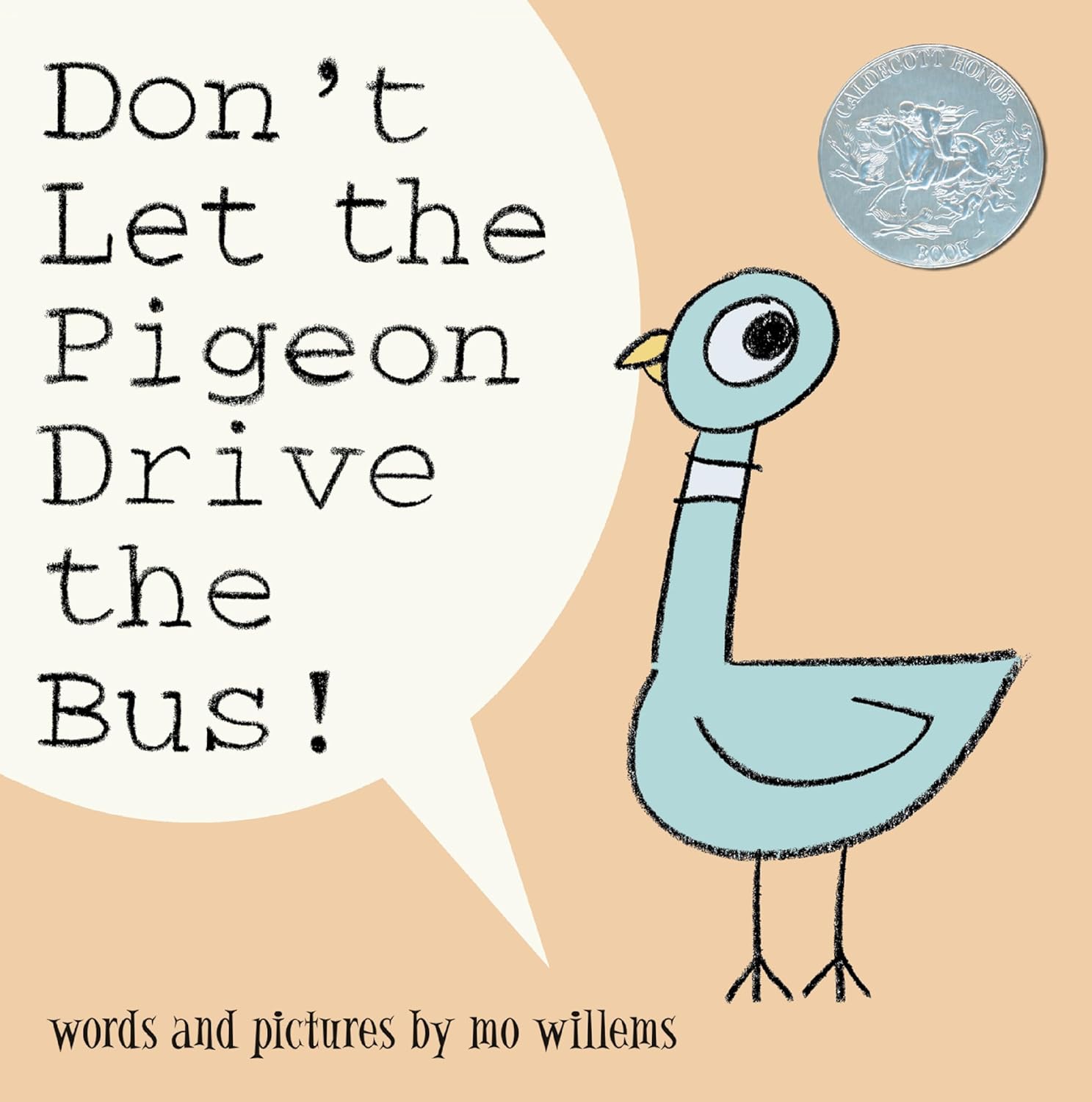
Don’t Let the Pigeon Drive the Bus! by Mo Willems is one of the most inventive and immediately beloved picture books of the past twenty-five years — a deceptively simple story about a bus driver who asks the reader to keep a persistent pigeon away from the wheel, and a pigeon who has absolutely no intention of accepting that answer. A 2004 Caldecott Honor Book and Willems’s picture book debut, it turned the reader into a participant and the pigeon into one of the great comic characters in children’s literature. This guide covers the reading level, recommended age, read-aloud vs. independent reading guidance, themes, and everything parents and teachers need to know about sharing this book with young readers.
For Parents
Find out whether Don’t Let the Pigeon Drive the Bus! works best as a read-aloud or independent read for your child, what age range it suits, and why this Caldecott Honor winner is one of the most participatory and rereadable picture books available for the PreK–K age range.
For Teachers
Grade-level data, read-aloud timing, key themes, and discussion questions for one of the most widely used PreK–K classroom books in American education. Exceptional for discussions of rules, persuasion, emotional regulation, and what it feels like to want something you can’t have — delivered with some of the funniest illustrations at this level.
Don’t Let the Pigeon Drive the Bus! at a Glance
Find on Amazon →| Author & Illustrator | Mo Willems |
| Published | 2003 |
| Grade Level | PreK–K (our assessment) |
| Recommended Age | 3–6 |
| Best For | Read-aloud ages 2–6; independent reading ages 4–6 |
| Flesch-Kincaid Grade | 0.5 |
| Word Count | ~300 |
| Pages | 40 |
| Genre | Picture book / interactive / humor |
| Setting | A city street; next to a bus |
| Awards | Caldecott Honor Book (2004); ALA Notable Children’s Book; NEA Teachers’ Top 100 Books for Children; Indie Choice Picture Book Hall of Fame |
For official Lexile and AR levels, visit Lexile.com or AR BookFinder. ReadingVine provides independent editorial assessments.
What Reading Level Is Don’t Let the Pigeon Drive the Bus!?
Don’t Let the Pigeon Drive the Bus! is a PreK–K reading level by our editorial assessment, with a Flesch-Kincaid grade level of approximately 0.5 — near the very bottom of the scale, reflecting the book’s extremely simple vocabulary and short sentences. At around 300 words it is one of the shortest picture books on this list, and the text consists almost entirely of the Pigeon’s increasingly desperate arguments: simple sentences, exclamations, questions, and the occasional full-page tantrum rendered in enormous block letters.
The FK score accurately captures the decoding demand — this is one of the most accessible texts in the K–2 library — but it does not capture the book’s considerable sophistication as a read-aloud experience. The Pigeon is a masterclass in rhetorical escalation: he begins with a polite request, moves to flattery, then bargaining, then emotional manipulation, then an outright meltdown, then a sulk, and finally a new dream. Children who follow this progression are learning something important about persuasion, persistence, and emotional regulation, delivered entirely through comedy. This is not a simple book; it is a simple-looking book, which is not the same thing at all.
For parents who use specific reading level systems: we recommend checking your child’s level on Lexile.com or AR BookFinder for official scores, or asking your child’s teacher for their Guided Reading or DRA level.
Is Don’t Let the Pigeon Drive the Bus! a Read-Aloud or Independent Read?
Don’t Let the Pigeon Drive the Bus! is first and foremost a read-aloud for ages 2–6 — one of the most participatory read-alouds in the entire K–2 library — and also a strong independent read for ages 4–6 who are beginning to decode text. The book places the reader inside the story as a character from the very first page, and most children respond to this responsibility with immediate and vocal commitment. Most adults can read it aloud in about 4–7 minutes, though most first readings run longer because children participate so enthusiastically.
As a read-aloud, the book’s genius is that it gives children something almost no other picture book gives them: permission — even instruction — to say no to someone who really wants something. The bus driver asks you to keep the Pigeon away from the wheel. The Pigeon pleads with you directly. You have to refuse him. Children who have spent their whole lives being on the Pigeon’s side of these conversations — wanting something and being told no — find enormous pleasure in being the one who holds the line. The role reversal is funny and genuinely empowering, and children play the reader with conviction.
As a read-aloud, Willems’s illustrations are essential and cannot be separated from the text. The Pigeon is drawn with extraordinary minimalism — a circle, a beak, a wing, a single expressive eye — and yet communicates an enormous range of emotion through tiny shifts in posture and eye position. The full-spread tantrum, where the Pigeon finally explodes in frustration, is one of the funniest single images in picture book history, and children who see it for the first time consistently respond with the same delighted recognition: they have felt exactly that way. Many of them have looked exactly like that.
For independent reading, the very short sentences and simple vocabulary make this one of the most accessible beginning reader texts available. A child who can read “No,” and “Please?” and “Let me drive the bus!” has the core of the book. The speech bubble format — though not as consistently structured as in Elephant & Piggie — helps early readers navigate dialogue without tags.
There is nothing in this book that requires parental preparation. The Pigeon is frustrated and doesn’t get what he wants, and the book treats both of those facts with complete comedic honesty.
Before you begin, tell your child: “The bus driver is going to ask us to keep the Pigeon away from the bus. It’s our job.” Then read the bus driver’s instructions and, when the Pigeon appears, let your child be the one who tells him no. Try to play the Pigeon yourself — a little pleadingly, a little desperately — and let your child experience the full authority of being the person who gets to say “No!” After the book, ask: “Was it hard to say no to the Pigeon? Why?” Most children have something genuine to say.
What Is Don’t Let the Pigeon Drive the Bus! About?
A bus driver has to leave his route for a little while. Before he goes, he addresses the reader directly with one request: don’t let the pigeon drive the bus. The moment he’s gone, a pigeon appears and asks if he can drive the bus. He just wants to drive. He’d be careful. His cousin Herb drives a bus almost every day — true story. He’ll be your best friend. How about five bucks? He never gets to do anything. Fine. He’ll just steer. He’s never even had a chance to— LET HIM DRIVE THE BUS. The bus driver returns. The Pigeon trudges off, dejected. Then he notices a large tractor-trailer parked nearby and begins to dream again.
That is the whole story. It is funny, precise, and exactly the right length. The Pigeon’s escalation — from polite request to shameless bribery to full meltdown to sulk to renewed optimism — is a complete arc, and the book’s final beat, where the Pigeon spots the truck, is one of the most perfect endings in picture book literature: it doesn’t moralize, it doesn’t resolve, it simply acknowledges that the Pigeon is exactly who he always was, and always will be.
Don’t Let the Pigeon Drive the Bus! Characters
Don’t Let the Pigeon Drive the Bus! Themes and Lessons
The central theme of Don’t Let the Pigeon Drive the Bus! is the experience of wanting something very much and not getting it — and the full emotional range of strategies a determined creature deploys in pursuit of that thing before finally accepting defeat. The Pigeon’s escalation — polite request, flattery, false logic, bribery, emotional manipulation, outright tantrum, sulk — is a precise and hilarious map of how preschoolers actually negotiate, and young children recognize every step of it with the particular delight of seeing their own behavior reflected back at them through comedy. This is the book’s most profound achievement: it makes the experience of not getting your way funny rather than shameful, which is considerably more useful than most books on the subject.
The book is also, from the child-reader’s perspective, a study in the experience of holding a rule. The bus driver’s instruction is clear; the Pigeon’s arguments are creative and persistent; the reader has to maintain the boundary. For young children who are usually on the other side of these situations — wanting something, being told no — the experience of being the one who says no is both unusual and empowering. The book models boundary-holding not as meanness but as responsible authority, which is a concept children are building at exactly this age.
The Pigeon’s final optimism — spotting the truck and beginning to dream again — is the book’s most generous moment. He is not defeated; he is simply redirected. The dream persists. Children who love the Pigeon often love him most here, in his undimmed enthusiasm for the next impossible thing, which is a form of resilience the book endorses without moralizing about it.
Discussion starters for families: Was the Pigeon being naughty, or did he just really want something? Which of the Pigeon’s arguments was the hardest to say no to? Have you ever wanted something so much that you tried everything to get it? How did it feel to be the one who said no? Do you think the Pigeon will get to drive the truck?
How Long Is Don’t Let the Pigeon Drive the Bus!?
Don’t Let the Pigeon Drive the Bus! has 40 pages and approximately 300 words — one of the shortest books on the K–2 list by word count. Most adults can read it aloud in about 4–7 minutes, though participatory readings that allow for children’s responses to the Pigeon’s arguments, children’s imitation of his expressions, and the inevitable requests to read it again typically run considerably longer.
A child reading independently at a PreK or early kindergarten level will typically finish in about 5–8 minutes. It is one of those books that children read multiple times in a row, which is entirely appropriate — the Pigeon’s escalation is funny on repeated readings, and children who have it memorized often perform it rather than read it, which is its own valuable literacy activity.
Books Similar to Don’t Let the Pigeon Drive the Bus!
If your child loves Don’t Let the Pigeon Drive the Bus!, these titles share its interactive energy, its humor, or its portrait of a character who wants something very badly:
About the Author and Illustrator
Mo Willems is an American author, illustrator, and animator whose career before children’s books included six Emmy Awards for writing on Sesame Street and the creation of the animated series Sheep in the Big City for Cartoon Network. The Pigeon first appeared not in a picture book but in the margins of a notebook in 1997 — Willems has described him as appearing and complaining that his ideas were better than Willems’s own — and made his first public appearance in a small cartoon sketchbook in 1998. Don’t Let the Pigeon Drive the Bus! was published in 2003 as Willems’s first children’s picture book and was named a Caldecott Honor Book the following year: immediate recognition for a debut that was, by any measure, unlike anything else in picture book publishing at the time.
The book’s visual approach — minimal line drawing, earth-toned backgrounds, the Pigeon’s single expressive eye doing essentially all of the book’s emotional work — reflects Willems’s animation background. Each page reads like a perfectly frozen frame of cartoon footage: action, expression, and humor captured with the fewest possible marks. Willems has said that he wanted to make books that children could read to their parents rather than always the other way around, and Don’t Let the Pigeon Drive the Bus! achieves this more completely than almost any other picture book: young children who have heard it twice know it well enough to perform it, and they do.
Willems has since written and illustrated more than 50 books, including the Elephant & Piggie early reader series (which won two Theodor Seuss Geisel Medals and five Geisel Honors), the Knuffle Bunny trilogy (two more Caldecott Honors), and numerous additional Pigeon books. The Pigeon series includes Don’t Let the Pigeon Stay Up Late!, The Pigeon Finds a Hot Dog!, The Pigeon Wants a Puppy!, and several others, all featuring the same bird with the same unmistakable combination of outsized desire and limited self-control. Willems served as the Education Artist in Residence at the Kennedy Center from 2019 to 2021.
Don’t Let the Pigeon Drive the Bus!: Frequently Asked Questions
What reading level is Don’t Let the Pigeon Drive the Bus!?
Don’t Let the Pigeon Drive the Bus! is a PreK–K reading level by our editorial assessment, with a Flesch-Kincaid grade level of approximately 0.5 — one of the lowest on the K–2 list. At around 300 words with very short sentences and simple vocabulary, it is highly accessible to beginning readers. It works best as a read-aloud for ages 2–6 and as an independent read for ages 4–6. For official Lexile and AR levels, visit Lexile.com or AR BookFinder.
What age is Don’t Let the Pigeon Drive the Bus! for?
Don’t Let the Pigeon Drive the Bus! is appropriate for ages 2–6. As a read-aloud it works from age 2 — the Pigeon’s expressions and energy engage very young toddlers before they can follow the text. As an independent read it suits children ages 4–6 building early reading skills. It is one of the most reliably successful read-alouds in the PreK–K classroom library, with an essentially unlimited replay value for children in this age range.
Why does the Pigeon want to drive the bus so badly?
Willems never explains, and doesn’t need to. The Pigeon’s desire to drive the bus is simply what it is — complete, specific, and non-negotiable, in the way that children’s strongest wants always are. His reasons shift with each argument — he’d be careful, his cousin Herb does it, he’ll just steer — but the want itself never changes. Children understand this immediately because they have the same relationship to their own strongest wants: the reasons are retrofitted, but the desire is bedrock. The Pigeon wants what he wants because he wants it.
How long does it take to read Don’t Let the Pigeon Drive the Bus! aloud?
Most adults can read Don’t Let the Pigeon Drive the Bus! aloud in about 4–7 minutes. In practice, participatory readings that allow for children’s responses, reactions to the Pigeon’s tantrum, and the inevitable requests to read it again typically run considerably longer. It is a book that generates its own extensions — performance, imitation, commentary — in a way that makes the clock largely irrelevant.
What is Don’t Let the Pigeon Drive the Bus! about?
Don’t Let the Pigeon Drive the Bus! is about a pigeon who really, really wants to drive the bus. A bus driver asks the reader to prevent this. The Pigeon then deploys every argument available — polite request, flattery, false logic, bribery, emotional manipulation, and finally a spectacular full-spread tantrum — before accepting defeat and spotting a truck to dream about instead. It is a story about wanting something you cannot have, told entirely from the wanting creature’s perspective, with the reader cast in the role of the one who has to say no.
Are there other Pigeon books?
Yes — Mo Willems has written more than a dozen Pigeon books, all featuring the same persistent, expressive bird: The Pigeon Finds a Hot Dog!, Don’t Let the Pigeon Stay Up Late!, The Pigeon Wants a Puppy!, The Pigeon HAS to Go to School!, The Pigeon Will Ride the Rollercoaster!, and several others. All are appropriate for the same PreK–K age range and use the same minimalist illustration style. Children who love Don’t Let the Pigeon Drive the Bus! typically work through the series with the same enthusiasm the Pigeon brings to every new ambition.