
 = Partner Site
Crispin: The Cross of Lead Reading Level: A Complete Guide
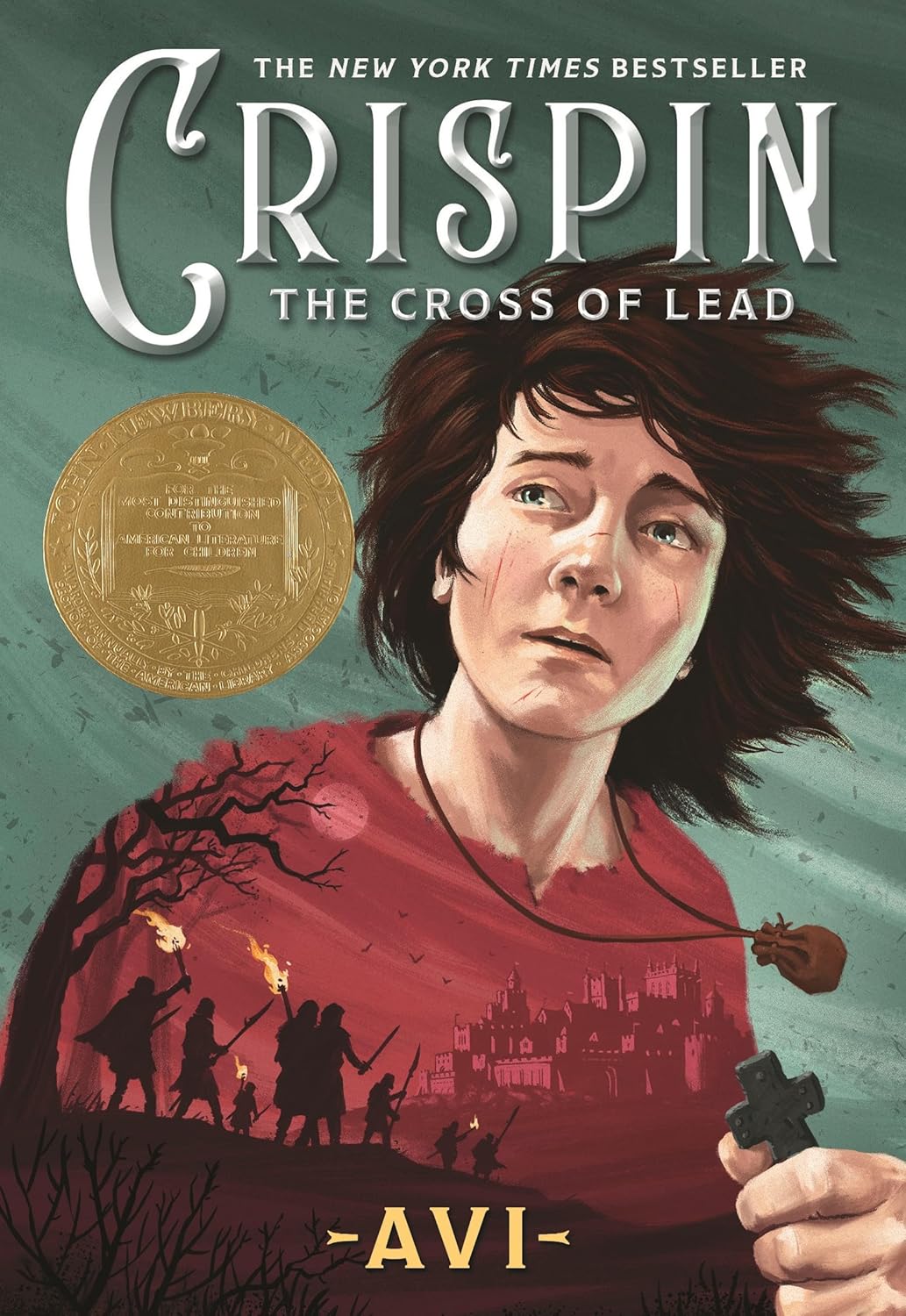
Crispin: The Cross of Lead by Avi is a Newbery Medal-winning adventure novel set in 14th-century England — a taut, fast-moving story about a peasant boy who is falsely declared a “wolf’s head” and must flee for his life through a dangerous medieval world. Part thriller, part coming-of-age story, and part historical portrait of feudal England at its most oppressive, it is one of the most gripping and accessible Newbery winners in the catalog. This complete guide covers the reading level, age appropriateness, themes, characters, and everything parents and teachers need to know about this acclaimed historical adventure.
For Parents
Crispin: The Cross of Lead is a propulsive adventure novel that moves quickly and keeps readers turning pages from the first chapter. It deals honestly with the cruelty and inequality of medieval feudal society, and there is real danger and violence in the plot, but nothing gratuitous. Best suited for readers ages 10-13, it is one of the more plot-driven Newbery winners and an excellent choice for readers who want historical fiction that actually feels like an adventure.
For Teachers
A Newbery Medal winner widely assigned in grades 5-7, Crispin: The Cross of Lead is an outstanding text for teaching historical fiction, character development under pressure, and how authors build and sustain narrative tension. The novel’s portrait of feudal England — serfdom, the church, political intrigue, the Black Death’s aftermath — provides rich historical context for medieval studies units. It pairs naturally with Good Masters! Sweet Ladies! for a comprehensive medieval England unit.
Crispin: The Cross of Lead at a Glance
Find on Amazon →| Author | Avi |
| Published | 2002 |
| Grade Level | 5-7 (our assessment) |
| Recommended Age | 10-13 |
| Flesch-Kincaid Grade | 5.4 |
| Word Count | ~53,000 |
| Pages | 262 (standard hardcover) |
| Chapters | 48 |
| Genre | Historical fiction / adventure |
| Setting | Rural and urban England, 1377 |
| Awards | Newbery Medal (2003) |
For official Lexile and AR levels, visit Lexile.com or AR BookFinder. ReadingVine provides independent editorial assessments.
What Reading Level Is Crispin: The Cross of Lead?
Crispin: The Cross of Lead reads at approximately a 5th-7th grade level by our editorial assessment, with a Flesch-Kincaid grade level of around 5.4. The prose is clear and direct — Avi writes in a spare, declarative style that suits the urgency of the story — and the short chapters (forty-eight of them in 262 pages) create a fast, propulsive reading experience that makes the book feel shorter than it is.
What elevates the book beyond its word-level score is the historical context it assumes and the moral and philosophical questions it raises. Crispin’s world is one that modern readers need to understand to fully appreciate — serfdom, the feudal obligation of lord to peasant and peasant to lord, the role of the church, the political turmoil of 14th-century England. Avi weaves this context in naturally through Bear’s teaching and the situations Crispin encounters, but readers who have some familiarity with medieval history will get considerably more from the book. The novel also raises genuine questions about identity, freedom, and justice that reward more than surface-level reading.
The book is most commonly assigned in grades 5-7 and is one of the more accessible Newbery winners for readers who prefer plot-driven fiction. For official Lexile and Accelerated Reader scores, visit Lexile.com or AR BookFinder.
What Age Is Crispin: The Cross of Lead Appropriate For?
We recommend Crispin: The Cross of Lead for readers ages 10-13. The novel contains violence and danger appropriate to a medieval adventure thriller — characters are killed, Crispin is in genuine physical peril, and the world he moves through is depicted as brutal and unjust. None of this is gratuitous, but parents should know this is not a sanitized version of the Middle Ages.
The novel includes the deaths of multiple characters, including Crispin’s mother and, later, characters he has come to care about. There are scenes of pursuit, capture, and physical threat. The feudal system and its treatment of serfs — as property, with no legal rights — is depicted honestly and with moral weight. A character is tortured, described briefly but without graphic detail. The political conspiracy at the center of the plot involves real danger and real casualties. There is no sexual content and no strong language. The violence is in keeping with historical adventure fiction and is handled with narrative purpose rather than gratuitousness.
For readers who have enjoyed other adventure-driven historical fiction — Johnny Tremain, My Brother Sam Is Dead, or The Witch of Blackbird Pond — the content level will feel familiar and appropriate. The novel never glorifies its violence; it uses it to make the stakes of Crispin’s situation viscerally real.
What Is Crispin: The Cross of Lead About?
It is 1377 in rural England, and a thirteen-year-old serf boy known only as “Asta’s son” has just lost his mother to illness. He has no name of his own, no rights, and no knowledge of who his father was. Before she died, his mother whispered something to the village priest — something she had kept secret for years — and now the boy finds himself suddenly and inexplicably declared a “wolf’s head” by the manor’s steward, John Aycliffe: a fugitive who can be killed on sight by anyone, for any reason, with no legal consequence.
Fleeing into the countryside with nothing but a lead cross his mother left him — inscribed with words he cannot read, since he has never been taught — the boy is taken in by a large, boisterous, surprisingly principled juggler and entertainer named Bear. Bear gives him a name: Crispin. He also gives him something he has never had before: an education, a sense of his own worth, and a growing understanding that the world does not have to be the way it is.
As Crispin and Bear travel toward the city of Great Wexly, the mystery of why Crispin was declared a wolf’s head deepens. The answer is connected to the words on the cross, to the secret his mother kept, and to the political conspiracies of 14th-century England — a world in turmoil after the Black Death, on the eve of the Peasants’ Revolt of 1381. What Crispin discovers about his identity will change everything, and what he chooses to do with that knowledge will define who he is.
Avi — who writes under a single name and is one of the most prolific and versatile authors in American children’s literature — spent years researching the novel’s historical setting. The aftermath of the Black Death, the political climate of England under Richard II, and the conditions of serfdom in the late 14th century are all rendered with accuracy and care. The novel is the first book in a trilogy; the sequels are Crispin: At the Edge of the World (2006) and Crispin: The End of Time (2010).
Crispin: The Cross of Lead Characters
Is Crispin: The Cross of Lead Banned?
Crispin: The Cross of Lead has not been banned or widely challenged and does not appear on lists of frequently challenged books. Its depictions of medieval violence and social injustice are handled with historical seriousness and narrative purpose, and the book has been widely embraced by educators, librarians, and critics as a distinguished work of historical adventure fiction. It is commonly assigned in schools across the country and is considered one of the more accessible and engaging Newbery Medal winners for middle grade readers.
Crispin: The Cross of Lead Themes and Lessons
The central theme of Crispin: The Cross of Lead is the discovery of one’s own worth in a world that insists you have none. Crispin begins the novel as someone who has been taught, since birth, that he is property — that his life belongs to his lord, that he has no name worth using, that his thoughts and feelings are irrelevant to the world around him. Bear’s great gift to Crispin is not the name he gives him or the skills he teaches him, but the radical idea that Crispin’s life belongs to himself. This is not a small thing in 14th-century England, and the novel makes clear that it is not a small thing in any era.
Running alongside this is an exploration of freedom — what it means, what it costs, and whether it is worth dying for. Bear belongs to a secret brotherhood that preaches equality before God in a time when such ideas are considered seditious. His political beliefs put both of them in danger, but they also give Crispin a framework for understanding why his situation is unjust rather than simply inevitable. The novel is set on the eve of the Peasants’ Revolt of 1381, and that historical context gives Bear’s ideas a specific gravity — these were not abstract philosophies but the beginnings of a real historical movement.
The novel is also, at its most immediate, a thriller about survival — and the tension between survival and principle is one of its most interesting threads. Crispin must choose, more than once, between the safe path and the right path. Those moments are where the coming-of-age story lives.
Discussion starters for classrooms: What does it mean that Crispin starts the novel without a name? Why is Bear’s belief that all men are equal so dangerous in 14th-century England? At what point does Crispin begin to feel like his life is his own? What does the cross of lead represent? What would you have done in Crispin’s position at the novel’s climax?
How Many Pages and Chapters Are in Crispin: The Cross of Lead?
The standard hardcover edition of Crispin: The Cross of Lead is 262 pages, divided into 48 short chapters averaging just over five pages each. The word count is approximately 53,000 words. The very short chapters are one of the book’s most effective structural features — they create a relentless forward momentum and make the novel feel impossible to put down, since there is always another brief chapter just ahead.
For readers in the target age range of 10-13, expect a reading time of roughly 5-8 hours, or about a week of steady reading at 30 minutes per session. The pacing is fast enough that many readers finish it in two or three extended sittings. As a classroom text, it works well in a two-to-three week unit, with the historical content requiring additional time for discussion and contextualization.
Books Similar to Crispin: The Cross of Lead
About Avi
Avi (born Edward Irving Wortis in 1937) is one of the most prolific and versatile authors in the history of American children’s literature, with more than seventy books across nearly every genre — historical fiction, contemporary realism, fantasy, mystery, humor, and picture books. He writes under the single name Avi, a nickname given to him by his twin sister when they were children. Crispin: The Cross of Lead won the Newbery Medal in 2003; he had previously received Newbery Honors for The True Confessions of Charlotte Doyle and Nothing But the Truth. Avi has spoken about the years of historical research that went into Crispin and his particular interest in the lives of ordinary people — serfs, peasants, wandering entertainers — in medieval England, the people who are most absent from traditional historical accounts. He wrote two sequels: Crispin: At the Edge of the World (2006) and Crispin: The End of Time (2010). He lives in Colorado.
Crispin: The Cross of Lead Frequently Asked Questions
What reading level is Crispin: The Cross of Lead?
Crispin: The Cross of Lead has a Flesch-Kincaid grade level of approximately 5.4. Our editorial assessment places it at grades 5-7 (ages 10-13). The prose is clear and direct, and the short chapters make it one of the more propulsive Newbery winners. The medieval historical context adds depth that rewards readers who engage with it carefully. For official Lexile and AR scores, visit Lexile.com or AR BookFinder.
What is a “wolf’s head” in Crispin: The Cross of Lead?
A “wolf’s head” was a medieval legal status — an outlaw declared outside the protection of the law. Anyone declared a wolf’s head could be killed on sight by any person, with no legal consequence, much as a wolf could be killed freely. The term reflected the idea that an outlaw had forfeited their place in human society and had no more legal standing than a wild animal. When John Aycliffe declares Crispin a wolf’s head, he is effectively placing a death sentence on a thirteen-year-old boy with no due process and no recourse. Understanding this status is essential to grasping the urgency of Crispin’s situation from the novel’s opening pages.
What is the significance of the cross of lead?
The lead cross Crispin’s mother left him is inscribed with words he cannot read — he has never been taught to read, as serfs generally were not. When Bear finally reads the inscription aloud, it reveals information about Crispin’s true identity that explains why powerful people want him dead. The cross is the novel’s central symbol: a secret carried by a boy who does not yet know what he is carrying, the key to a mystery that has been waiting for him to be old enough to understand it. It also represents his mother’s love and her long-held hope that Crispin would one day claim what was rightfully his.
Is Crispin: The Cross of Lead part of a series?
Yes. It is the first book in a trilogy. The sequels are Crispin: At the Edge of the World (2006), which continues Crispin’s journey following the events of the first book, and Crispin: The End of Time (2010), which brings the trilogy to a close. The first novel ends at a clear stopping point and stands entirely on its own — readers do not need to read the sequels to feel satisfied, though those who love Crispin and Bear will want to continue.
What grade is Crispin: The Cross of Lead typically assigned in?
Crispin: The Cross of Lead is most commonly assigned in grades 5, 6, and 7, often as part of a medieval history unit or a historical fiction curriculum. Its propulsive pacing and accessible prose make it one of the more student-friendly Newbery winners, and its historical content gives it strong value in social studies and history classes studying the Middle Ages. It pairs well with Good Masters! Sweet Ladies! for a comprehensive medieval England unit.
What historical period is Crispin: The Cross of Lead set in?
The novel is set in England in 1377, during the reign of Richard II — a period of significant political and social turmoil. The Black Death had swept England between 1348 and 1350, killing roughly a third of the population and fundamentally destabilizing the feudal system by creating a labor shortage that gave peasants more leverage than they had ever had. The Peasants’ Revolt of 1381 — a major uprising against feudal oppression — is just a few years away from the events of the novel. Bear’s radical ideas about equality and freedom are not invented by Avi; they reflect real currents of thought that were circulating in late 14th-century England and that would eventually fuel that revolt.
Why did Crispin: The Cross of Lead win the Newbery Medal?
Crispin: The Cross of Lead won the Newbery Medal in 2003 for the quality and craft of its storytelling — specifically for the precision of Avi’s prose, the vividness and depth of his characters, the historical authenticity of the medieval setting, and the novel’s ability to sustain urgent narrative tension while exploring genuinely important themes about identity, freedom, and human worth. The Medal committee recognized a historical adventure that met the highest literary standards while remaining gripping and accessible to its intended audience.
Who is Bear, and what does he believe?
Bear is a juggler, entertainer, and wandering performer who takes Crispin in when he is fleeing for his life. He is large, loud, and apparently simple — but he is also educated, thoughtful, and a member of a secret brotherhood of men who believe in the radical idea that all human beings are equal before God, regardless of birth, station, or wealth. In 14th-century England, this belief is not just unconventional but actively dangerous — it challenges the entire social order on which the feudal system depends. Bear’s willingness to act on his beliefs, and to teach them to Crispin, is what makes him the novel’s moral center and one of the most memorable mentor figures in recent children’s historical fiction.