
 = Partner Site
Good Masters! Sweet Ladies! Reading Level: A Complete Guide
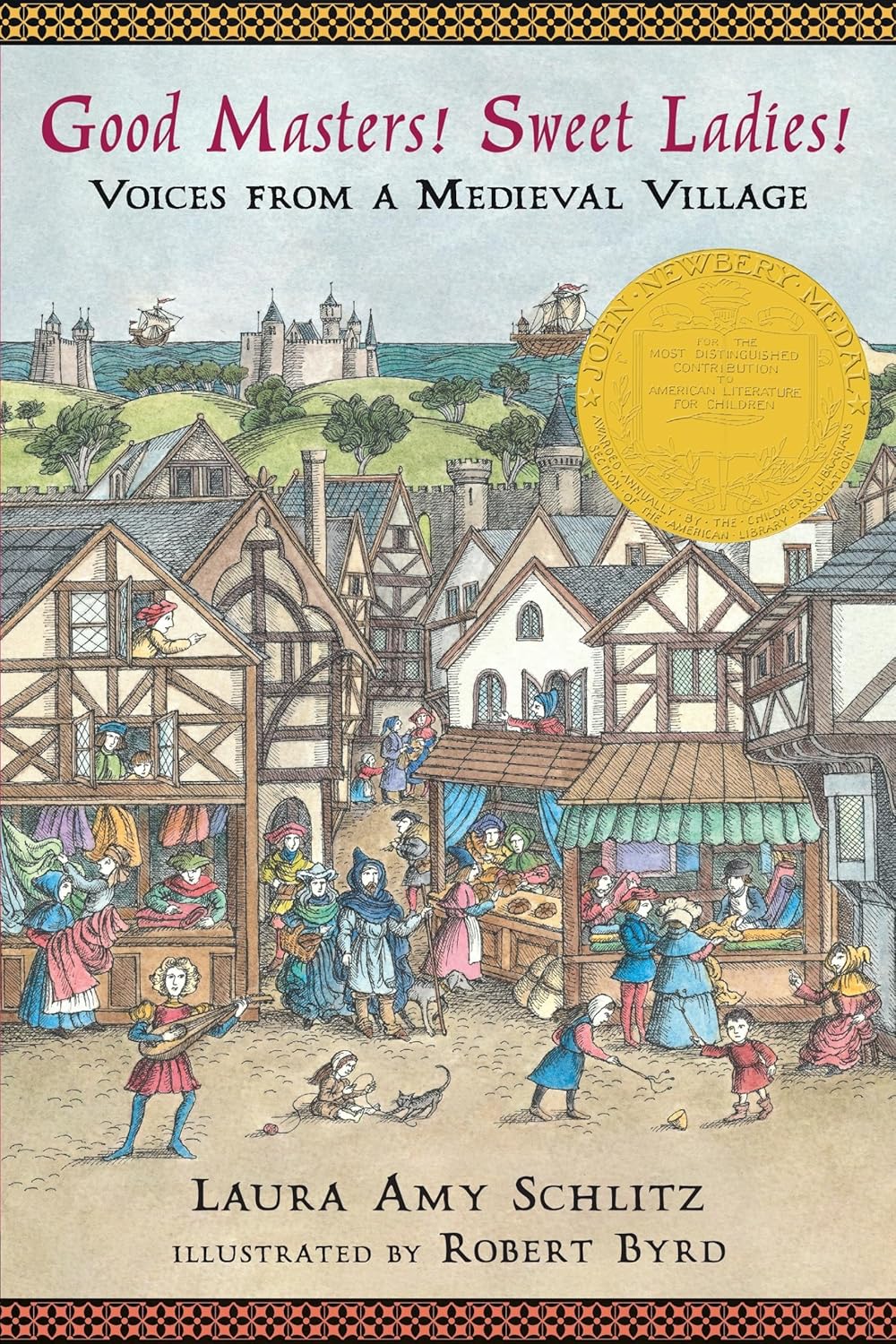
Good Masters! Sweet Ladies! Voices from a Medieval Village by Laura Amy Schlitz is a Newbery Medal-winning collection of monologues and dialogues written to be performed aloud — each piece giving voice to a different young person living in and around an English manor in the year 1255. This complete guide covers the reading level, age appropriateness, themes, and everything parents and teachers need to know about this inventive and richly researched work of historical fiction in dramatic form.
For Parents
Good Masters! Sweet Ladies! is an unusual and genuinely exciting book — part play collection, part historical portrait, part poetry anthology. Each short monologue gives a voice to a different medieval child: a lord’s son, a blacksmith’s daughter, a pilgrim, an educated girl who can read when almost no women could. It’s accessible, lively, and illuminating about a world very different from our own. Best suited for readers ages 10-13, it is especially wonderful read aloud or performed.
For Teachers
A Newbery Medal winner purpose-built for classroom performance, Good Masters! Sweet Ladies! was originally written by Schlitz for her school library’s drama program. Each monologue is short enough to assign individually, and the cast of characters is large enough that every student in a class can have a speaking part. It is an outstanding text for teaching medieval history, dramatic monologue, point of view, and how social class shapes experience. The author’s notes and historical sidebars make it an excellent research scaffold as well.
Good Masters! Sweet Ladies! at a Glance
Find on Amazon →| Author | Laura Amy Schlitz |
| Illustrator | Robert Byrd |
| Published | 2007 |
| Grade Level | 5-7 (our assessment) |
| Recommended Age | 10-13 |
| Flesch-Kincaid Grade | 4.5-7.0 (varies by monologue) |
| Word Count | ~14,000 |
| Pages | 85 (standard hardcover) |
| Monologues & Dialogues | 23 |
| Genre | Historical fiction / drama / poetry |
| Setting | An English manor village, 1255 |
| Awards | Newbery Medal (2008) |
For official Lexile and AR levels, visit Lexile.com or AR BookFinder. ReadingVine provides independent editorial assessments.
What Reading Level Is Good Masters! Sweet Ladies!
Good Masters! Sweet Ladies! is a collection of dramatic monologues and dialogues, which makes standard reading level measures difficult to apply uniformly. The Flesch-Kincaid grade level varies considerably across the twenty-three pieces — from around 4.5 for the simpler, more conversational monologues to 7.0 for the more formally structured ones. Our overall editorial assessment places the collection at grades 5-7, though individual pieces can be used successfully with students as young as 4th grade.
What makes the book more demanding than its lower word-level scores suggest is the historical content. Schlitz writes each monologue from within a specific medieval social position — a serf, a falconer’s apprentice, a toll-keeper’s daughter, a half-blood boy who is neither noble nor common — and understanding what each character is saying fully requires understanding the world they inhabit. Schlitz addresses this through informational sidebars woven throughout the book, which provide historical context for the social structures, occupations, and conditions referenced in the monologues. These sidebars are essential reading, not supplementary.
As a performance text, reading level functions differently than it does for a novel read silently. A student who finds the vocabulary challenging may shine in performance, and the social dynamic of preparing and presenting a monologue can motivate engagement with the text in ways that independent reading does not. For official Lexile and Accelerated Reader scores, visit Lexile.com or AR BookFinder.
What Age Is Good Masters! Sweet Ladies! Appropriate For?
We recommend Good Masters! Sweet Ladies! for readers ages 10-13. The book deals honestly with the realities of medieval life — poverty, disease, social inequality, religious prejudice — but does so in a way that is illuminating rather than graphic. The voices are those of children and young people, which keeps the perspective accessible even when the subject matter is serious.
Several monologues address difficult historical realities with honesty. One piece voices a half-blood child (the son of a Jewish father and Christian mother) and deals directly with anti-Semitic persecution in medieval England, including the expulsion of Jews. Another monologue is spoken by a child with a visible skin condition who faces social exclusion. There are references to poverty, illness, hard physical labor, and the limited rights of serfs and women. A dialogue between two young monks references a plague. None of this is graphic, but parents should know the book does not soften the hardships of medieval life. There is no violence beyond historical reference, no strong language, and no sexual content.
What Is Good Masters! Sweet Ladies! About?
Good Masters! Sweet Ladies! is a collection of twenty-three dramatic monologues and two-person dialogues, each one spoken by a different young person living in or around a fictional English manor in the year 1255. The characters range across the full social spectrum of medieval life: there is the lord’s son, who is learning to be a knight; the blacksmith’s daughter, who loves her father’s trade but cannot follow it because she is a girl; the shepherd’s daughter, who is fiercely proud despite her low station; the villager’s son with a gift for healing; the educated girl who can read Latin; the half-blood boy caught between two worlds; the pilgrim, the falconer’s apprentice, the toll-keeper, the mudlark who scavenges the riverbed for objects of value.
The pieces are connected not by a single plot but by place and time — all of these young people inhabit the same small world, and the collection works as a kind of mosaic portrait of a community. Characters from one monologue appear briefly in others; the village feels, by the end, like a real place populated by people who know each other. The effect is cumulative: individually each piece is a snapshot, but together they build into something that feels whole.
Schlitz wrote the book originally for the students at the school library where she worked as a librarian, wanting to create a text that could be performed by a whole class with every child having a role. The genesis in classroom performance is visible in the structure — the pieces are short enough to rehearse quickly, varied enough in tone and register to suit different performers, and rich enough in historical detail to anchor an entire unit of study.
Robert Byrd’s detailed pen-and-ink and watercolor illustrations throughout the book deserve mention on their own terms. They are meticulously researched and deeply atmospheric, and they make the medieval world tangible in a way that complements and extends the text. The book won the Newbery Medal in 2008 — one of the very few non-novel works to win the Newbery Medal in the modern era.
Who Are the Characters in Good Masters! Sweet Ladies!
The remaining seventeen voices include a miller’s daughter, a falconer’s apprentice, a villain’s son who wants to be a physician, a young pilgrim, a mudlark, two young monks, a swineherd, a demoiselle, a glassblower’s son, and others. Each is introduced with a brief character note and a historical sidebar explaining the social role or condition the character represents.
Is Good Masters! Sweet Ladies! Banned?
Good Masters! Sweet Ladies! has not been banned or widely challenged. It does not appear on lists of frequently challenged books. The piece dealing with anti-Semitism and the persecution of Jews in medieval England (Nod’s monologue) has occasionally prompted questions from parents, but the treatment is historical, empathetic, and explicitly critical of persecution rather than endorsing it. The book is widely used in schools and libraries and is considered a distinguished and appropriate text for grades 5-7.
Good Masters! Sweet Ladies! Themes and Lessons
The collection’s dominant theme is the relationship between social position and identity — how the accident of birth determines almost everything about a medieval person’s life, and how the young people in these monologues negotiate, resist, or accept that determination. Every character is defined first by their social role: lord’s son, blacksmith’s daughter, serf, half-blood. But within those roles, each voice is distinct and individual, pushing against the limits of what their world allows them to be. The tension between social category and individual selfhood is what gives the collection its emotional energy.
A related theme is the particular position of girls and women in the medieval world. Several of the female voices — Otoline who wants to work the forge, Isobel who has been educated beyond what her world knows how to do with, Taggot who is proud and able and constrained by her sex as much as by her class — give students a vivid, personal experience of what gender limitation looked like from the inside. This is history felt rather than simply described.
The collection also models, through its form, the idea that every person has a story worth telling — that the lord’s son and the mudlark and the outcast half-blood are all equally entitled to a voice and equally interesting when given one. That is itself a theme, enacted by the book’s structure.
Discussion starters for classrooms: Which character’s life would you most want to live, and which least — and why? How does your character’s social position shape what they can and cannot do? Which monologue surprised you most? What do the historical sidebars add that the monologues alone don’t? How would these characters’ lives be different if they lived today?
How Long Is Good Masters! Sweet Ladies!
The standard hardcover edition of Good Masters! Sweet Ladies! is 85 pages, containing 23 dramatic pieces (monologues and dialogues) plus historical sidebars and Robert Byrd’s illustrations. The total word count is approximately 14,000 words, making it one of the shortest Newbery Medal winners. Individual monologues range from about half a page to three pages in length.
In classroom use, the collection is typically not read straight through but distributed across multiple sessions, with one to three monologues per class period. Each piece can be rehearsed and performed in a single class period, leaving time for discussion of the historical content. The full collection, with all twenty-three pieces rehearsed and performed by a class, works well as a two-to-three week unit. Individual monologues can also be used as standalone performance or analysis assignments without reading the whole book.
Books Similar to Good Masters! Sweet Ladies!
About Laura Amy Schlitz
Laura Amy Schlitz is an American author and school librarian who spent many years working at the Park School in Baltimore, Maryland — where she wrote Good Masters! Sweet Ladies! specifically for her students, who needed a performance text that could give every child in the class a role. The book grew out of that practical need and became something far larger: a work of genuine literary distinction that won the Newbery Medal in 2008. Schlitz is also the author of A Drowned Maiden’s Hair and Splendors and Glooms, both Gothic historical novels that share Good Masters! Sweet Ladies!’ meticulous research and atmospheric period detail. She received the Newbery Medal at a point in her career when she was still working full time as a librarian — a fact she has spoken about with characteristic humor and grace.
Good Masters! Sweet Ladies!: Frequently Asked Questions
What reading level is Good Masters! Sweet Ladies!
Because Good Masters! Sweet Ladies! is a collection of dramatic monologues rather than a novel, reading level varies by piece. Flesch-Kincaid grade levels across the twenty-three monologues range from approximately 4.5 to 7.0. Our overall editorial assessment places the collection at grades 5-7 (ages 10-13), though individual pieces work well with 4th graders and through middle school. For official Lexile and AR scores, visit Lexile.com or AR BookFinder.
Is Good Masters! Sweet Ladies! a play or a book?
It is both — or rather, it is a collection of dramatic monologues and dialogues published as a book. Each piece is written in the form of a dramatic monologue (one character speaking) or a dialogue (two characters speaking to each other), meant to be performed aloud. It is not a single unified play with a continuous narrative, but a collection of twenty-three standalone performance pieces set in the same time and place. It can be read silently, but it was written to be spoken.
How many characters are in Good Masters! Sweet Ladies!
There are twenty-three speaking parts total — twenty-one monologues and two dialogues, which means two of the pieces require pairs of performers. The cast of characters spans the full social spectrum of a medieval English manor: lord’s children, craftspeople’s children, serfs, a pilgrim, a half-blood, monks, a mudlark, and others. The large cast makes the book ideal for whole-class performance, with every student having a role.
What grade is Good Masters! Sweet Ladies! typically assigned in?
Good Masters! Sweet Ladies! is most commonly used in grades 5-7, typically as part of a medieval history unit or a drama and performance unit. Individual monologues are sometimes used as standalone assignments in grades 4-8. Because the book was written specifically for classroom performance, it integrates naturally into any curriculum that includes history, drama, or social studies.
Why did Good Masters! Sweet Ladies! win the Newbery Medal?
Good Masters! Sweet Ladies! won the Newbery Medal in 2008, and its selection was notable because it is not a novel — it is the only dramatic collection to win the Medal since the award’s early decades. The committee recognized it for the originality of its form, the depth of its historical research, the vividness and individuality of each voice, and Schlitz’s ability to make a distant historical world feel immediate and human. It is a book that does something genuinely new with children’s literature.
What are the historical sidebars in Good Masters! Sweet Ladies!
Scattered throughout the book, between and alongside the monologues, are informational sidebars that explain the historical context for what each character is describing. These cover topics like the feudal system and serfdom, the role of the church in medieval life, the status of Jews in medieval England, the trades and occupations represented in the collection, and the daily realities of medieval childhood. Schlitz treats these as essential reading — the monologues are richer and more comprehensible with the sidebars, and the sidebars come alive through the monologues. They should not be skipped.
Can individual monologues be used without reading the whole book?
Yes, and this is one of the book’s great practical virtues. Each monologue is self-contained, with its own character note and relevant historical sidebar, so individual pieces can be assigned, rehearsed, and performed without reading the full collection. Teachers frequently assign a single monologue per student for a performance unit, or use two or three pieces as close-reading exercises in a history class. The book works as a whole and as a collection of parts.
What is the setting and time period of Good Masters! Sweet Ladies!
The collection is set in and around a fictional English manor village in the year 1255 — the height of the medieval period in England, roughly sixty years after the Magna Carta and forty years before the expulsion of Jews from England in 1290 (an event Nod’s monologue anticipates). The year 1255 places the action in the reign of Henry III. Schlitz chose the period carefully for its social complexity and its documentary record, and the book’s historical notes reflect deep research into the specifics of 13th-century English life.