
 = Partner Site
Brown Girl Dreaming Reading Level: A Complete Guide
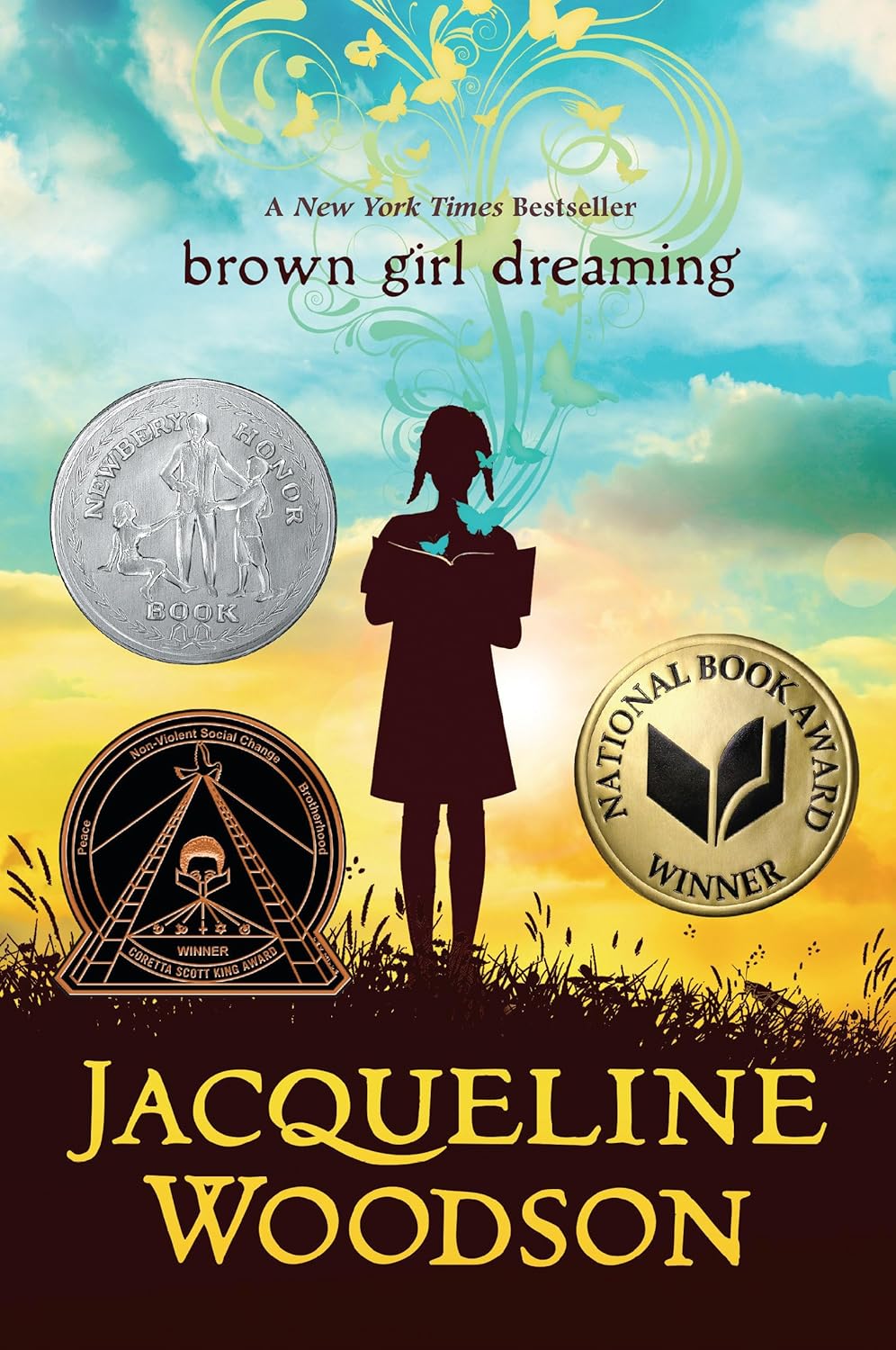
Brown Girl Dreaming by Jacqueline Woodson is a Newbery Honor-winning memoir in verse — a collection of poems that tells the story of Woodson’s own childhood, moving between South Carolina and New York City in the 1960s and 1970s, shaped by the Civil Rights Movement, family love, the joy and difficulty of being different, and the slow discovery of a writer’s identity. Luminous, precise, and deeply moving, it is one of the most celebrated books in contemporary children’s literature and one of the most beautiful memoirs written for any age. This complete guide covers the reading level, age appropriateness, themes, characters, and everything parents and teachers need to know about this extraordinary book.
For Parents
Brown Girl Dreaming is a memoir in verse about a Black girl growing up in two Americas — the Jim Crow South and the changing North — and finding, slowly and surely, that she is a writer. It is lyrical, intimate, and honest about race, family, and what it feels like to be different. Best suited for readers ages 10-13, it is one of those rare books that reads beautifully aloud and that parents and children can share across a wide age range. It is not a difficult or frightening book — it is, at its heart, a love letter to language and to the people who shaped a writer.
For Teachers
A Newbery Honor and National Book Award winner that belongs in every classroom, Brown Girl Dreaming is an outstanding text for teaching memoir, poetry, the verse novel form, and the Civil Rights era. Woodson’s poems are individually teachable — each one is a complete piece — while also building cumulatively into a fully realized life story. The book is exceptional for teaching how poets use white space, repetition, image, and line breaks to create meaning. It pairs naturally with any Civil Rights unit and is an essential text for discussions of Black American history and identity. Best suited to grades 5-7, with individual poems accessible much earlier.
Brown Girl Dreaming at a Glance
Find on Amazon →| Author | Jacqueline Woodson |
| Published | 2014 |
| Grade Level | 5-7 (our assessment) |
| Recommended Age | 10-13 |
| Flesch-Kincaid Grade | 3.5-5.5 (varies by poem) |
| Word Count | ~17,000 |
| Pages | 336 (standard hardcover) |
| Poems | ~330 |
| Genre | Memoir in verse / narrative poetry |
| Setting | Greenville, South Carolina and Brooklyn, New York, 1963-1970s |
| Awards | Newbery Honor (2015); National Book Award for Young People’s Literature (2014); Coretta Scott King Award (2015) |
For official Lexile and AR levels, visit Lexile.com or AR BookFinder. ReadingVine provides independent editorial assessments.
What Reading Level Is Brown Girl Dreaming?
Brown Girl Dreaming is a memoir told entirely in free verse poems, which makes standard reading level measures less useful than they are for prose fiction. The Flesch-Kincaid grade level varies considerably across the roughly 330 poems — from around 3.5 for the simplest, most image-based pieces to 5.5 for the more reflective, complex ones. Our overall editorial assessment places the book at grades 5-7, though individual poems are accessible to readers as young as 2nd or 3rd grade, and the book rewards rereading well into adulthood.
The reading challenge in Brown Girl Dreaming is not primarily linguistic but interpretive. Woodson’s poems are spare and image-driven — she says a great deal in very few words, and much of the meaning lives in what is not said, in the white space on the page, in the way one poem responds to another across dozens of pages. Readers who have experience with poetry and are comfortable sitting with ambiguity and implication will find the book deeply rewarding from the first page. Readers who are newer to poetry may need guidance in how to read it — understanding that a poem is not a failed paragraph, that the line breaks are meaningful, that the white space is doing work.
As a classroom text, individual poems can be taught starting in 3rd or 4th grade. The full book is most commonly assigned in grades 5-7. As a family read-aloud, it works beautifully across a wide age range — Woodson’s voice is so warm and immediate that even very young children respond to the poems read aloud, while adults find layers of meaning they did not expect. For official Lexile and Accelerated Reader scores, visit Lexile.com or AR BookFinder.
What Age Is Brown Girl Dreaming Appropriate For?
We recommend Brown Girl Dreaming for readers ages 10-13, though individual poems are suitable for much younger readers and the book as a whole rewards adult reading. The memoir deals honestly with race and racism in America — the Jim Crow South, segregation, the Civil Rights Movement — as well as with family disruption, the absence of a father, and the particular loneliness of a child who feels different from everyone around her.
The book depicts the Jim Crow South with historical honesty — segregated water fountains, the fear that Black people lived with, the specific indignities of second-class citizenship. The Civil Rights Movement is a presence throughout, including references to protests, danger, and the fear that activism carries. Woodson’s parents separate and her father is largely absent from her life, which she addresses with honesty and without self-pity. There are references to the deaths of Civil Rights figures. A family member struggles with addiction in the later sections. None of this is graphic or gratuitous — it is the honest record of a childhood lived in a specific historical moment. There is no sexual content and no strong language.
The book’s tone is not one of suffering or complaint — it is, remarkably, a tone of gratitude and wonder, even when the subject matter is painful. Woodson writes about racism and family difficulty with the same luminous attention she brings to the smell of her grandmother’s kitchen or the feeling of words falling into place for the first time. This tonal balance is one of the book’s great achievements, and it makes it accessible and even joyful in ways that its subject matter alone would not suggest.
What Is Brown Girl Dreaming About?
Jacqueline Woodson was born in Columbus, Ohio, in 1963 and spent her childhood moving between her maternal grandparents’ home in Greenville, South Carolina — the deeply segregated Jim Crow South — and her mother’s home in Brooklyn, New York. Brown Girl Dreaming tells the story of that childhood in poems: the smell and sound and texture of Greenville, the strict religious household of her Jehovah’s Witness grandparents, the complicated love between her mother and the grandmother who raised her, the absence of her father, the arrival of the Civil Rights Movement into the world of her childhood.
The book is organized into five sections that move roughly chronologically through Woodson’s early life. The opening section, “i am born,” situates her birth in the specific historical moment of 1963 — the year of the March on Washington, the year the world was changing. Subsequent sections follow her through early childhood in South Carolina, the move to Brooklyn, her growing awareness of race and difference, her years in elementary school, and finally the discovery that would define her life: that she is a writer, that words are the thing she has been looking for all along.
Threading through all of this is the richly rendered world of Woodson’s family: her grandfather’s quiet authority, her grandmother’s fierce love and Jehovah’s Witness faith, her older sister Odella’s gift for school, her brother Dell’s ease in the world, her uncle Robert’s passionate involvement in the Civil Rights Movement. The people around Woodson are as fully realized as she is, and the book is as much a portrait of a family and a community as it is an autobiography.
Woodson has spoken about writing the book over many years, beginning with fragments of memory and gradually finding the poems that could hold them. She has described the verse form as essential — prose, she felt, could not capture the way memory actually works, in images and fragments and sudden illuminations rather than in continuous narrative. The result is a book that reads like memory feels: immediate, vivid, and shot through with beauty.
People in Brown Girl Dreaming
Is Brown Girl Dreaming Banned?
Brown Girl Dreaming has appeared on some lists of challenged books in recent years, primarily due to its honest depictions of racism and segregation in American history and its portrayal of the Civil Rights Movement. Challenges have generally come from parents or community members who object to the book’s treatment of race as a subject for children. The American Library Association, educators, and children’s literature scholars have defended the book as age-appropriate, historically important, and essential reading. It is widely assigned in schools and libraries across the country and is considered one of the most significant children’s books of the 21st century. Jacqueline Woodson has been a vocal advocate for the freedom to read and has spoken extensively about the importance of honest books about Black American history for young readers of all backgrounds.
Brown Girl Dreaming Themes and Lessons
The central theme of Brown Girl Dreaming is the discovery of a writer’s identity — the slow, uneven realization that the thing that makes Jackie different from her siblings, the thing that makes her a dreamer rather than a doer, is actually her gift. She is not slow; she is noticing. She is not behind; she is storing. The book is, at its deepest level, about how a person finds what they are for, and how the qualities that isolate a child can become the source of their power as an adult.
Race and history run through every section of the book, never as abstract concepts but as lived experience. The Jim Crow South is not a historical unit or a chapter in a textbook — it is the water fountain Jackie cannot drink from, the church her grandmother attends because it is theirs, the fear that her uncle carries when he goes to march. Woodson renders race and racism the way a child experiences them: not with analytical distance but with the direct, sensory impact of something you live inside. This is one of the book’s most important contributions to children’s literature — it makes history personal and immediate in ways that straightforward historical accounts cannot.
Family is a third major theme — the specific texture of this family, these relationships, this love. The grandparents’ household in Greenville is rendered with such specificity that it becomes a place readers feel they have visited: the smell of the garden, the sound of hymns, the particular quality of the grandmother’s attention. The Brooklyn household is different — louder, more uncertain, more open — and the contrast between the two places shapes Jackie’s sense of who she is and where she belongs.
Discussion starters for classrooms: How does Woodson use line breaks and white space to create meaning? What is the effect of telling a memoir in poems rather than in prose? How does Jackie’s experience in the South differ from her experience in Brooklyn? What does writing mean to Jackie, and how does she discover it? How does the Civil Rights Movement enter Jackie’s personal world? Which poem affected you most, and why?
How Many Pages and Poems Are in Brown Girl Dreaming?
The standard hardcover edition of Brown Girl Dreaming is 336 pages, containing approximately 330 individual poems organized into five thematic sections. The word count is approximately 17,000 words — short for a book of this length, because each page holds relatively few words surrounded by significant white space. Individual poems range from a single stanza to several pages, with most falling between half a page and a full page in length.
As a classroom text, the book is typically not read straight through in a single unit but approached in sections, with individual poems selected for close reading and discussion. The full book can be assigned for independent reading over several weeks while class time focuses on selected poems. For readers ages 10-13 reading independently, expect a reading time of roughly 4-6 hours for the complete book, though the experience of reading it slowly — letting each poem settle before moving to the next — is considerably longer and more rewarding. The book works extraordinarily well as a family or classroom read-aloud, since Woodson’s poems are written to be heard.
Books Similar to Brown Girl Dreaming
About Jacqueline Woodson
Jacqueline Woodson was born in Columbus, Ohio, in 1963 and is one of the most celebrated and prolific authors in American children’s and young adult literature. She is the author of more than thirty books for young readers, including the young adult novels Miracle’s Boys and If You Come Softly, the middle grade novel Feathers, and the picture book Each Kindness. Brown Girl Dreaming won the National Book Award for Young People’s Literature in 2014, the Coretta Scott King Award, and a Newbery Honor in 2015. She was named the Young People’s Poet Laureate by the Poetry Foundation from 2015 to 2017, and the National Ambassador for Young People’s Literature from 2018 to 2019. Woodson has spoken and written extensively about the importance of seeing yourself in books — about what it meant to her, as a Black girl growing up in the 1960s and 1970s, to rarely find anyone who looked like her or lived like her in the books she loved. Brown Girl Dreaming is the book she wrote to give that recognition to the children who came after her. She lives in Brooklyn, New York — the city that shaped the second half of her childhood — with her family.
Brown Girl Dreaming: Frequently Asked Questions
What reading level is Brown Girl Dreaming?
Brown Girl Dreaming is a memoir in verse, and reading level varies considerably across its roughly 330 poems. Flesch-Kincaid grade levels range from approximately 3.5 to 5.5. Our overall editorial assessment places the book at grades 5-7 (ages 10-13), though individual poems are accessible to much younger readers and the book rewards adult reading. For official Lexile and AR scores, visit Lexile.com or AR BookFinder.
Is Brown Girl Dreaming fiction or nonfiction?
Brown Girl Dreaming is a memoir — it is nonfiction, based on Jacqueline Woodson’s own life and childhood. The events, people, and places in the book are real, though memoir by its nature involves selective memory and artistic shaping. Woodson presents it as her genuine recollection of her childhood, told in the form of poems. This makes it one of the rare Newbery Honor books that is both nonfiction and poetry — a combination that makes it unusually rich for classroom use.
Why is Brown Girl Dreaming written in poems instead of prose?
Woodson has explained that she chose the verse form because it reflects the way memory actually works — in fragments, images, and sudden illuminations rather than in continuous narrative. A childhood is not experienced as a smooth story with clear cause and effect; it is experienced as a series of vivid moments, some connected and some not, with gaps and silences between them. The poems capture that quality of memory: each one is a complete experience, self-contained, and the spaces between them are part of the meaning. Woodson has also spoken about poetry as the form that taught her to love language, and writing her childhood memoir in poems was a way of honoring that first love.
What is the Civil Rights Movement’s role in Brown Girl Dreaming?
The Civil Rights Movement is not background in Brown Girl Dreaming — it enters Woodson’s childhood world directly and personally. Her uncle Robert is an activist involved in the movement. She grows up in Greenville, South Carolina, during the years when the Jim Crow South was being challenged and slowly dismantled. The fear, hope, and upheaval of that historical moment are part of the texture of her daily life. Woodson renders the Civil Rights era the way a child experiences history: not as events in a textbook but as the specific quality of a particular summer, the way her uncle comes home from a march, the things adults say and don’t say in her presence. It is one of the most effective treatments of this history in children’s literature precisely because it is personal rather than explanatory.
What grade is Brown Girl Dreaming typically assigned in?
Brown Girl Dreaming is most commonly assigned in grades 5, 6, and 7, either as a full text or with individual poems selected for close reading. It appears frequently on Newbery lists, Civil Rights history reading lists, and poetry curriculum guides. Individual poems are used in grades 3-8 for teaching poetic craft. The book’s combination of memoir, poetry, and Civil Rights history gives it exceptional cross-curricular value in English language arts, social studies, and history.
What awards did Brown Girl Dreaming win?
Brown Girl Dreaming won the National Book Award for Young People’s Literature in 2014, the Coretta Scott King Award in 2015, and a Newbery Honor in 2015. It also received a Sibert Honor for its informational content. It is one of a handful of children’s books to have won or been honored by multiple major awards in the same year, reflecting the breadth of its achievement — it is simultaneously an exceptional memoir, an exceptional poetry collection, and an exceptional work of historical record.
Why did Brown Girl Dreaming receive a Newbery Honor rather than the Medal?
The Newbery Medal in 2015 was awarded to The Crossover by Kwame Alexander — another novel in verse, which made for an unusual year in which both the Medal and one of its Honors went to verse narratives. The decision to award the Medal to The Crossover rather than Brown Girl Dreaming was made by the committee on the basis of the specific Newbery criteria, and reasonable people can and do disagree with it. What is not in dispute is that Brown Girl Dreaming is one of the most significant American children’s books of the 21st century, honored by every major award in children’s literature and beloved by readers, teachers, and critics alike.
Is Brown Girl Dreaming appropriate for children who struggle with reading?
Potentially, yes — with the right framing. The verse format, with its short lines, white space, and accessible vocabulary, can actually be less intimidating than dense prose for reluctant readers. The poems are short enough that a reader who struggles with long texts can feel genuine accomplishment finishing one, and then another. The book works especially well as a read-aloud for struggling readers, since hearing Woodson’s voice — warm, immediate, musical — can unlock the text in ways that silent reading alone may not. That said, readers who resist poetry in any form may need support and encouragement before they can find their way into the book’s rhythms.