
 = Partner Site
Joyful Noise: Poems for Two Voices Reading Level: A Complete Guide
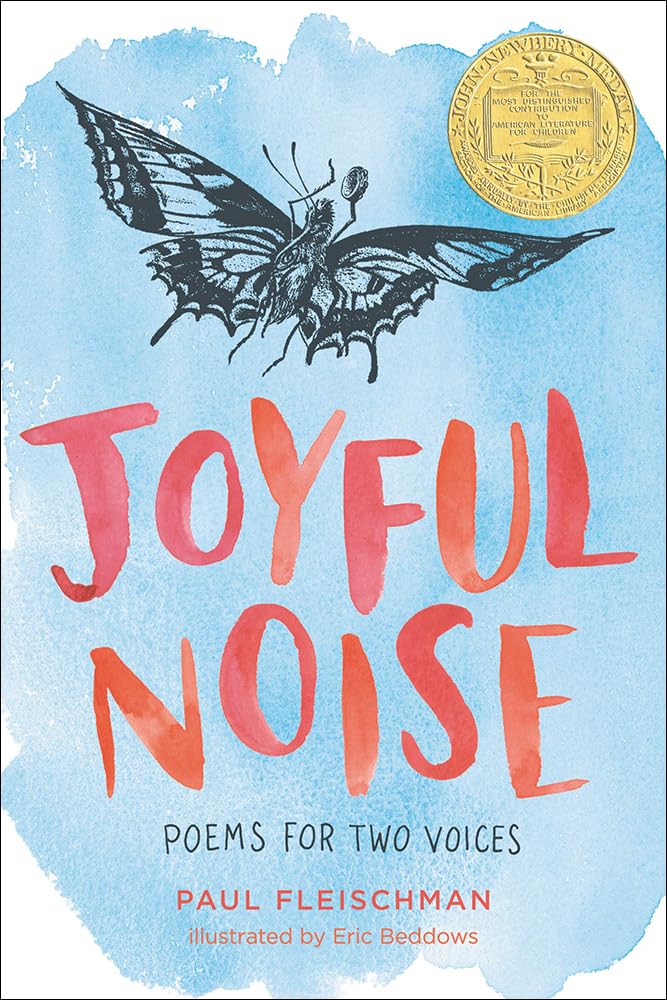
Joyful Noise: Poems for Two Voices by Paul Fleischman is a Newbery Medal-winning collection of fourteen poems written to be read aloud by two readers simultaneously — each poem a portrait of a different insect, structured so the two voices sometimes speak alone, sometimes in unison, and sometimes in counterpoint. This complete guide covers the reading level, age appropriateness, themes, and everything parents and teachers need to know about this inventive and joyful book.
For Parents
Joyful Noise is one of the most unique books in children’s literature — a poetry collection designed to be performed rather than simply read. It’s accessible, playful, and completely free of mature content. Best enjoyed read aloud with a partner, it’s a wonderful book to share between a parent and child, or between siblings. Ages 9-12 is the sweet spot, though younger children who enjoy reading aloud will love it too.
For Teachers
A Newbery Medal winner and a classroom favorite, Joyful Noise is ideal for teaching poetry, performance, and the music of language. Each two-voice poem is written on a split page — the left column for Reader 1, the right for Reader 2 — making it perfect for paired reading activities. It’s also an excellent entry point for students who say they don’t like poetry, since the performance element makes the experience active and collaborative. Works well across grades 4-7.
Joyful Noise at a Glance
Find on Amazon →| Author | Paul Fleischman |
| Illustrator | Eric Beddows |
| Published | 1988 |
| Grade Level | 4-6 (our assessment) |
| Recommended Age | 9-12 |
| Flesch-Kincaid Grade | 3.5-5.5 (varies by poem) |
| Word Count | ~2,500 |
| Pages | 44 (standard hardcover) |
| Poems | 14 |
| Genre | Poetry / nature |
| Subject | Insects |
| Awards | Newbery Medal (1989) |
For official Lexile and AR levels, visit Lexile.com or AR BookFinder. ReadingVine provides independent editorial assessments.
What Reading Level Is Joyful Noise?
Joyful Noise is a poetry collection, which makes traditional reading level measures less straightforward to apply than they are for novels. The vocabulary within individual poems ranges from simple to quite rich, and Flesch-Kincaid grade levels across the fourteen poems range from roughly 3.5 to 5.5. Our editorial assessment places the collection at grades 4-6 overall, though the book can be enjoyed by strong readers as young as third grade and is regularly taught through middle school.
What makes Joyful Noise unique as a reading experience is that it is explicitly designed to be read aloud by two people at once. Each poem is formatted on a split page: Reader 1 reads the left column, Reader 2 reads the right. Some lines are spoken by one voice alone; others are shared; some overlap. This means the “reading level” of the book is partly a performance challenge — the skill isn’t just decoding the words but coordinating with a partner and finding the rhythm of the poem. That makes it valuable for readers at a wide range of levels, since a struggling reader can take the simpler voice in a given poem while a stronger reader handles the more complex lines.
For official Lexile and Accelerated Reader scores, visit Lexile.com or AR BookFinder.
What Age Is Joyful Noise Appropriate For?
We recommend Joyful Noise for readers ages 9-12, though the book has no content concerns whatsoever — it is entirely appropriate for younger readers as well. The subject matter is insects, the tone is celebratory and playful, and there is nothing in the collection that would give any parent pause. The age range reflects when readers will get the most out of the poems’ sophistication and layered meanings, not any content restriction.
There are no content concerns in Joyful Noise. The book contains no violence, no strong language, no mature themes, and no disturbing content of any kind. A small number of poems touch on the natural cycles of life and death among insects (a mayfly’s brief life, a digger wasp preparing for her young), but these are handled with lightness and wonder. This is one of the most universally appropriate books in the Newbery catalog.
What Is Joyful Noise About?
Joyful Noise is a collection of fourteen poems, each one written from the perspective of a different insect and structured for two voices to read simultaneously. The insects include the water strider, the book lice, the mayfly, the digger wasp, the firefly, the moth, the grasshopper, and others. Each poem is a small portrait — of the insect’s life, its habits, its particular way of moving through the world — and each uses the two-voice format to reflect something essential about that creature.
The two-voice structure is not merely a gimmick. Fleischman uses it purposefully: poems about solitary insects tend to have the two voices speak separately, while poems about social or paired insects — like the book lice, who live together in a library — have voices that speak in unison or finish each other’s thoughts. The form mirrors the content, which is one of the things that makes the collection so artistically distinguished.
Paul Fleischman, who is the son of Newbery-winning author Sid Fleischman (The Whipping Boy), has described the two-voice format as inspired by polyphonic music — the way two melodic lines can weave together to create something neither could produce alone. The collection grew from his interest in both entomology and musical structure, and that dual influence gives the poems their unusual texture: scientific precision combined with lyrical delight.
What Poems Are in Joyful Noise?
The fourteen poems in Joyful Noise are, in order: “Grasshoppers,” “Water Striders,” “Mayflies,” “Fireflies,” “Book Lice,” “The Moth’s Serenade,” “Whirligig Beetles,” “Honeybees,” “Cicadas,” “Digger Wasp,” “Ground Beetles,” “Requiem,” “Chrysalis Diary,” and “Finale.” Each is a complete, standalone piece, though together they form a loose arc from spring through the seasons and into winter. Teachers frequently assign individual poems as standalone reading activities rather than the full collection at once — “Book Lice,” “Fireflies,” and “Chrysalis Diary” are among the most commonly taught.
Is Joyful Noise Banned?
Joyful Noise has never been banned or challenged and does not appear on any lists of frequently challenged books. It is considered one of the most universally appropriate Newbery Medal winners — a book that teachers, librarians, and parents recommend without reservation across a wide age range. It has been continuously in print since 1988 and remains a staple of elementary and middle school classrooms.
Joyful Noise Themes and Lessons
The most immediate theme of Joyful Noise is celebration — of the natural world, of insects in all their strangeness and specificity, and of language itself as a source of pleasure. Fleischman approaches each insect not as a subject to be described but as a perspective to inhabit, and that imaginative generosity is one of the book’s lasting gifts to young readers. The collection models a way of looking at the world: with attention, with curiosity, and with delight.
The two-voice structure carries its own thematic weight. By requiring two readers to coordinate, the poems make collaboration a physical experience — you cannot perform them well without listening to your partner. Poems like “Book Lice,” in which two insects living in the same library have read entirely different books and grown into entirely different beings, use the format to explore how two voices can coexist, differ, and still find moments of harmony. That’s a subtle but powerful lesson about difference and connection.
Discussion starters for families: Which insect would you most want to be, based on its poem? How does having two voices change the way the poem sounds compared to reading it alone? Why do you think Fleischman chose insects as his subjects? Can you find places in a poem where the two voices agreeing or disagreeing tells you something about the insect?
How Long Is Joyful Noise?
The standard hardcover edition of Joyful Noise is 44 pages and contains 14 poems with a total word count of approximately 2,500 words. It is one of the shortest Newbery Medal winners in the catalog — the entire collection can be read in under an hour, and most individual poems take only two to three minutes to perform.
In classroom use, teachers typically spread the collection across multiple sessions, performing one to three poems per class period with discussion and sometimes re-reading between performances. Because the poems work best read aloud with a partner, plan for pairs or small groups and allow time for rehearsal. A single poem rehearsed and performed well is a more valuable experience than rushing through the whole collection silently.
Books Similar to Joyful Noise
About Paul Fleischman
Paul Fleischman (born 1952) is an American author known for formally inventive, musically structured books for young readers. The son of Newbery Medal-winning author Sid Fleischman (The Whipping Boy), he grew up in a household steeped in literature and developed an early interest in both music and writing. Joyful Noise won the Newbery Medal in 1989; he had previously received a Newbery Honor for Graven Images. His novel Seedfolks — also a multi-voice work — is widely taught in middle schools. Fleischman has cited polyphonic music as a primary influence on his two-voice poems, and that musical sensibility runs through much of his work. He lives in California and continues to write for young audiences.
Joyful Noise: Frequently Asked Questions
What reading level is Joyful Noise: Poems for Two Voices?
Because Joyful Noise is a poetry collection, reading level measures vary by poem. Individual poems have Flesch-Kincaid grade levels ranging from approximately 3.5 to 5.5. Our overall editorial assessment places the collection at grades 4-6 (ages 9-12), though it is regularly taught from 3rd grade through middle school. For official Lexile and AR scores, visit Lexile.com or AR BookFinder.
How do you read Joyful Noise: Poems for Two Voices?
Each poem is formatted on a split page with two columns: Reader 1 reads the left column, Reader 2 reads the right. Some lines appear in only one column (spoken by one voice alone), some lines appear in both columns (spoken in unison), and some overlap so that both voices are speaking simultaneously but saying different things. The poems are meant to be performed aloud — reading them silently misses most of what makes them work. The best approach is to rehearse a poem at least once before performing it, so both readers can find the rhythm and coordinate the unison moments.
What insects are featured in Joyful Noise?
The fourteen poems feature grasshoppers, water striders, mayflies, fireflies, book lice, a moth, whirligig beetles, honeybees, cicadas, a digger wasp, ground beetles, and a chrysalis (a caterpillar transforming into a butterfly or moth). The final poem, “Finale,” brings the collection to a close. Each insect is treated as a distinct perspective with its own voice, habits, and way of experiencing the world.
Is Joyful Noise a good book for kids who don’t like poetry?
Genuinely yes — and teachers have been using it for exactly this purpose for decades. The two-voice format turns poetry into a performance and a game, which removes the pressure that many children feel when asked to interpret a poem on the page. The subject matter is engaging and concrete. And the poems are short enough that no child has to sustain attention for long before switching partners and trying a different one. It’s one of the best gateway books to poetry for reluctant readers.
Why did Joyful Noise win the Newbery Medal?
Joyful Noise won the Newbery Medal in 1989 for its originality, technical artistry, and demonstration that poetry for children can be formally ambitious without sacrificing accessibility or joy. It used the two-voice structure not as a trick but as an integral part of the meaning of each poem, and remains one of the very few poetry collections ever to win the Newbery Medal.
Is there a sequel to Joyful Noise?
Paul Fleischman wrote I Am Phoenix: Poems for Two Voices in 1985, before Joyful Noise — it uses the same two-voice format but focuses on birds rather than insects. For readers who loved Joyful Noise, I Am Phoenix is the natural companion. Fleischman also wrote Big Talk: Poems for Four Voices (2000), which expands the format to four simultaneous readers.
Which poems from Joyful Noise are best for classroom use?
“Book Lice” is perhaps the most beloved classroom poem in the collection — two insects living in the same library who have read completely different books and become completely different beings, yet find moments of connection. “Fireflies” and “Chrysalis Diary” are also frequently taught for their imagery and emotional resonance. “Honeybees” works well for introducing the concept of perspective, since one voice speaks as a worker bee and the other as the queen. Any poem in the collection works well, but these four tend to generate the richest discussion.
How is Joyful Noise different from a regular poetry collection?
Most poetry collections are written to be read by one person, either silently or aloud. Joyful Noise is written specifically for two people to read simultaneously — the poems only fully exist in performance, with two voices weaving together. This means the experience of the book is inherently social and collaborative. You can read it alone, but you only get half of what Fleischman intended. That’s what makes it unlike almost any other book in children’s literature.