
 = Partner Site
Seedfolks Reading Level: A Complete Guide
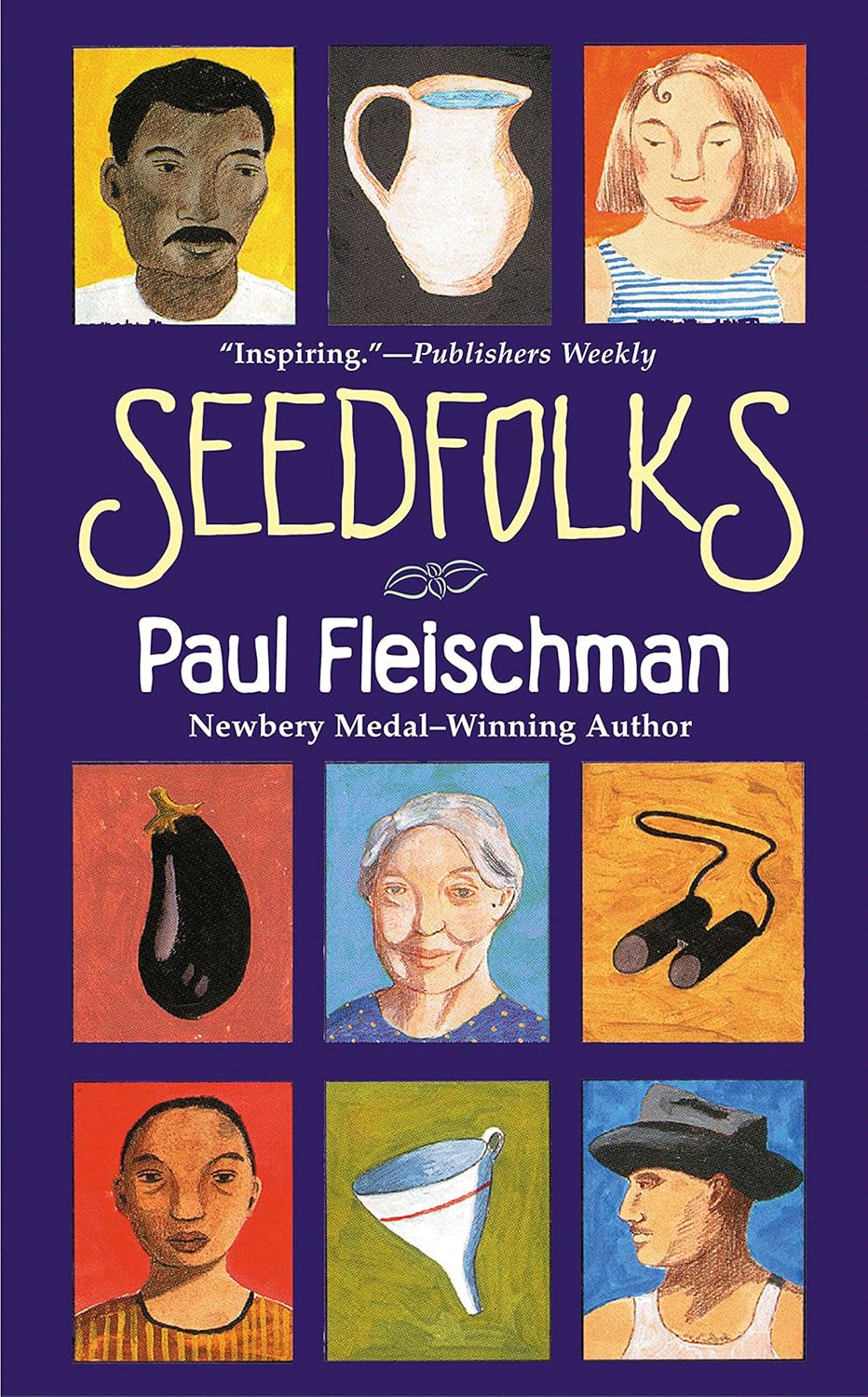
Seedfolks by Paul Fleischman is a slim, innovative novel told in thirteen short chapters, each narrated by a different voice — a Korean girl, an elderly Romanian woman, a Haitian man, a teenage African American boy, a pregnant woman, a retired teacher — all of them residents of a run-down Cleveland neighborhood who are transformed, one by one, by a vacant lot that becomes a community garden. Quiet, humane, and quietly radical in its structure, it is one of the most distinctive novels in middle grade literature: a book about community that is itself built the way communities are, one person and one voice at a time. This complete guide covers the reading level, age appropriateness, themes, characters, and everything parents and teachers need to know about this beloved and widely taught novel.
For Parents
Seedfolks is a short, accessible, and deeply warm novel about what happens when strangers begin to care for something — a garden, a neighborhood, each other — together. Each chapter is written in a different voice, making it ideal for reading aloud or for readers who find longer narratives daunting. Best suited for readers ages 9-12, it is gentle in tone, honest about the difficulties of urban poverty and immigration without being heavy, and genuinely moving in the way that only very simple, very true things can be.
For Teachers
One of the most widely taught novels in American middle schools, Seedfolks is an outstanding text for teaching multi-perspective narrative, character voice, community and immigration, and how authors build a cumulative story from individual pieces. The novel’s thirteen distinct voices — spanning age, ethnicity, national origin, and circumstance — make it exceptional for discussions of diversity, empathy, and the complexity of urban community. Each chapter works as a standalone piece, making it ideal for close reading exercises focused on voice and characterization. It pairs naturally with nonfiction on urban gardening, immigration, and community organizing.
Seedfolks at a Glance
Find on Amazon →| Author | Paul Fleischman |
| Published | 1997 |
| Grade Level | 4-6 (our assessment) |
| Recommended Age | 9-12 |
| Flesch-Kincaid Grade | 4.2-6.8 (varies by narrator) |
| Word Count | ~14,000 |
| Pages | 64-80 (standard hardcover) |
| Chapters / Narrators | 13 |
| Genre | Realistic fiction / multi-voice novel |
| Setting | Cleveland, Ohio, present day |
| Awards | Scott O’Dell Award for Historical Fiction (1998) |
For official Lexile and AR levels, visit Lexile.com or AR BookFinder. ReadingVine provides independent editorial assessments.
What Reading Level Is Seedfolks?
Seedfolks is a multi-voice novel, and reading level varies considerably across its thirteen narrators. Flesch-Kincaid grade levels range from around 4.2 for the simplest, most direct voices to around 6.8 for the more complex adult perspectives. Our overall editorial assessment places the book at grades 4-6, though individual chapters are accessible to readers as young as 2nd or 3rd grade, and the cumulative effect of the whole novel rewards readers through middle school and beyond.
At just 64-80 pages and roughly 14,000 words, Seedfolks is one of the shortest novels regularly assigned in middle school — shorter than many picture books and far shorter than a typical chapter book. But brevity does not mean simplicity. Each chapter is a complete character study, and Fleischman’s gift for rendering distinct voices — the specific rhythms, assumptions, and preoccupations of a Korean girl, a Romanian grandmother, a Haitian refugee, a skeptical teenager — means that the novel rewards close, attentive reading even as it moves quickly.
The novel’s primary demand is empathic rather than linguistic: readers are asked to inhabit thirteen different perspectives, many of them culturally and experientially far from their own, and to understand each one from the inside. This is the skill the novel most powerfully teaches, and it is one that deepens with each rereading. For official Lexile and Accelerated Reader scores, visit Lexile.com or AR BookFinder.
What Age Is Seedfolks Appropriate For?
We recommend Seedfolks for readers ages 9-12, though individual chapters work beautifully for younger readers and the novel as a whole is regularly enjoyed by adults. The content is gentle by any standard — there is no violence, no strong language, and no sexual content.
The novel deals honestly with the circumstances of its characters: urban poverty, immigration and the difficulty of adjusting to a new country, racial distrust and prejudice between neighbors, the loneliness of the elderly, and the challenges facing teenagers in under-resourced neighborhoods. None of this is graphic or frightening — it is the texture of ordinary difficult lives, rendered with compassion and without melodrama. One narrator, Virgil’s father, has come from Haiti hoping for a better life and is struggling. One narrator, Wendell, is dealing with grief. One narrator, Sae Young, is recovering from a traumatic experience referenced but not detailed. Parents should know the novel deals with real urban life, not an idealized version of it — but it does so with warmth and genuine humanity throughout.
Seedfolks is one of the most widely used novels in American classrooms precisely because its content is accessible across a wide age range while its themes are deep enough to sustain serious discussion. It is an unusually safe choice for parents and teachers looking for a book that opens important conversations without requiring significant content management.
What Is Seedfolks About?
In a run-down Cleveland neighborhood, on a block where neighbors don’t know each other’s names and a vacant lot has become a dumping ground, a nine-year-old Korean American girl named Kim plants six lima bean seeds in the frozen March ground. She does it alone, before dawn, to honor her father who died before she was born — a farmer in Korea whose photograph she has grown up studying, trying to feel a connection to someone she never knew.
No one sees her do it. But one person notices the seedlings. Then another. Then someone plants their own seeds nearby. Then someone else brings water. Then a fence goes up, then a tool shed, then a community. By the end of the summer, the vacant lot has become a garden tended by people from a dozen countries, most of whom would never have spoken to each other otherwise — a Romanian woman and an African American teenager, a Haitian immigrant and a retired teacher from Ohio, a pregnant woman named Leona who started things moving by complaining to City Hall, a Mexican family and a Vietnamese family planting side by side.
Each chapter is told by a different person in the neighborhood, and each person explains, in their own voice, how they came to the garden and what it gave them. No narrator tells the whole story. Each one sees only their own piece of it. The novel’s form is its argument: community is not a single story but the accumulation of many partial stories, each person contributing what they see from where they stand, none of them able to see the whole thing alone.
Paul Fleischman has spoken about his interest in multi-voice narrative — he explored it earlier in Joyful Noise: Poems for Two Voices — and his conviction that a community garden was the ideal subject for this form. A garden, like a community, is built by many people over time, with each person’s contribution both individual and dependent on all the others. The form and the content mirror each other perfectly.
Seedfolks Narrators
Each of the novel’s thirteen chapters is narrated by a different resident of the Cleveland neighborhood. Rather than a traditional cast of characters with sustained arcs, Seedfolks offers a succession of voices, each a complete portrait in itself. Here are the thirteen narrators in order of appearance:
Is Seedfolks Banned?
Seedfolks has not been banned or challenged and does not appear on lists of frequently challenged books. It is one of the most universally embraced novels in middle grade literature — warm, gentle, and focused on the capacity of diverse people to come together around something they share. It is widely shelved and assigned in schools and libraries across the country and is considered an ideal classroom text for readers across a wide age range.
Seedfolks Themes and Lessons
The central theme of Seedfolks is community — specifically, how community forms, which is not through grand gestures or organized programs but through small acts of attention and care that accumulate over time. Kim does not set out to build a community. She sets out to honor her dead father. What happens afterward is the result of other people noticing, being curious, following an impulse, taking a small risk on something they don’t understand yet. The novel is a theory of community formation rendered in narrative: this is how it actually works, person by person, act by act, without anyone being in charge.
Empathy is the skill the novel most directly teaches and most directly requires. Each chapter asks readers to inhabit a perspective very different from the one before it — different in age, nationality, life experience, and relationship to the neighborhood. Fleischman is asking readers to do exactly what the garden asks its tenders to do: to be curious about what someone else is growing, to understand that other people’s plots are as important to them as yours is to you, to find in shared effort a form of connection that does not require shared history or shared language.
The garden is also a metaphor for America, and particularly for the immigrant experience. Many of the novel’s narrators are immigrants or the children of immigrants, and for them the garden is a place where knowledge from another country — farming techniques, relationship to the soil, understanding of seasons — suddenly becomes valuable rather than irrelevant. The novel quietly argues that what immigrants bring is not a problem to be overcome but a resource to be cultivated.
Discussion starters for classrooms: Why does Kim plant seeds in a vacant lot? What does each narrator see that the others can’t? How does the garden change each person who comes to it? What does the novel suggest about how communities form? Why does Fleischman tell this story through many voices instead of one? What does the garden represent beyond itself?
How Many Pages and Chapters Are in Seedfolks?
The standard hardcover edition of Seedfolks is just 64-80 pages, divided into 13 chapters — one per narrator — averaging around five pages each. The word count is approximately 14,000 words, making it one of the shortest novels regularly taught in American middle schools and shorter than many picture books. Despite its brevity, it is complete, fully realized, and emotionally substantial.
For readers in the target age range of 9-12, the full novel can be read in a single sitting of 60-90 minutes, or across several short sessions. As a classroom text, its short length is one of its great practical strengths: the whole novel can be read aloud in class over the course of a week, with each chapter sparking its own discussion. Individual chapters can be assigned as standalone reading for close reading exercises, character voice analysis, or creative writing models. The novel also works beautifully as a drama: each chapter can be performed by a different student, and the cumulative effect of thirteen voices speaking their own stories in a single space is precisely the experience the novel is trying to create.
Books Similar to Seedfolks
About Paul Fleischman
Paul Fleischman is an American author whose work is distinguished by its formal inventiveness and its consistent interest in multiple voices, collective experience, and the relationship between sound and meaning. He won the Newbery Medal in 1989 for Joyful Noise: Poems for Two Voices — a collection of poems written for two readers to perform simultaneously — and the Scott O’Dell Award for Historical Fiction in 1998 for Seedfolks. His other novels include Bull Run, a multi-voice account of the first battle of the Civil War told from sixteen different perspectives, and Whirligig, in which a single act of careless driving ripples outward to affect four different families across the country. The multi-voice, multi-perspective form that defines these books reflects Fleischman’s deep interest in community: how individual stories combine to form a larger story that no one person can tell alone. He is the son of Newbery Medal-winning author Sid Fleischman (The Whipping Boy), making them one of the rare father-son pairs in Newbery history. He lives in California.
Seedfolks: Frequently Asked Questions
What reading level is Seedfolks?
Seedfolks is a multi-voice novel, and reading level varies across its thirteen narrators. Flesch-Kincaid grade levels range from approximately 4.2 to 6.8 depending on the chapter. Our overall editorial assessment places it at grades 4-6 (ages 9-12), though individual chapters work with readers as young as 2nd or 3rd grade. For official Lexile and AR scores, visit Lexile.com or AR BookFinder.
Why does Seedfolks have so many narrators instead of one main character?
The multi-narrator structure is the novel’s central artistic and thematic choice: a community cannot be told from a single perspective, because a community is by definition the sum of many different perspectives. Each narrator in Seedfolks sees only their own piece of the garden and the neighborhood — Kim doesn’t know what Wendell sees when he finds her seedlings, Gonzalo doesn’t know what Sam remembers when he watches the garden grow. The form enacts the novel’s argument: understanding a community requires listening to many voices, because no single voice can hold it all. Fleischman made this same structural choice in Joyful Noise and Bull Run, and it is the defining feature of his work.
What is the significance of the garden in Seedfolks?
The garden works on multiple levels simultaneously. Literally, it is a community garden that transforms a vacant lot in Cleveland. Symbolically, it is a metaphor for community itself: something that grows from small acts of individual care, that requires tending and attention from many different hands, and that produces something no single person could have created alone. It is also an image of America — particularly of the immigrant experience — because it is a place where knowledge brought from other countries (farming traditions, relationship to the land, understanding of growing things) is suddenly valuable rather than irrelevant. The garden asks nothing about where you came from; it only asks what you will plant and whether you will tend it.
What grade is Seedfolks typically assigned in?
Seedfolks is most commonly assigned in grades 4, 5, and 6, though it is regularly used in grades 3 and 7-8 as well. Its short length and accessible individual chapters make it unusually flexible for classroom use: it can be read as a whole text in a week, or individual chapters can be used for shorter reading and writing exercises throughout a unit. It is particularly popular for units on community, immigration, diversity, and multi-perspective narrative.
Why did Kim plant seeds to honor her father?
Kim’s father was a farmer in Korea who died before she was born. She has grown up looking at his photograph — a formal portrait in which he is wearing his best clothes, standing stiffly, giving her no real sense of who he was in life. She plants seeds because her father was a farmer; it is her way of doing something he did, of making a connection to him across the impossible distance of his absence and her ignorance of him. She wants him to see her and recognize her as his daughter. The act is private, almost secret, and she has no idea it will change anything for anyone else. This is the novel’s most important structural point: the thing that changes everything begins as a small, private act of love that was never meant for an audience.
Is Seedfolks fiction or nonfiction?
Seedfolks is a work of fiction. The neighborhood, the characters, and the garden are all invented. However, the novel is grounded in the real phenomenon of urban community gardens, which have transformed vacant lots in cities across the United States, and in the real social dynamics of diverse urban neighborhoods. Community gardens have been documented as having real effects on neighborhood cohesion, safety, and the integration of immigrant communities — effects very similar to what Fleischman depicts in the novel. The fiction is realistic and the social dynamics it portrays are well supported by research on urban communities and community gardening.
What is the Scott O’Dell Award?
The Scott O’Dell Award for Historical Fiction is given annually to a distinguished work of historical fiction for children or young adults set in the New World — North America, South America, or the Caribbean. It is named for Scott O’Dell, author of Island of the Blue Dolphins, who established the award to encourage the writing of high-quality historical fiction for young readers. Seedfolks won the award in 1998. Interestingly, Seedfolks is set in the present day rather than the historical past — the award committee recognized it as engaging with the historical experience of immigration and urban community in America in ways that qualified it for the distinction.
Can Seedfolks be used as a drama or performance piece?
Yes — and it works exceptionally well this way. Because each chapter is a distinct first-person monologue with its own voice, the novel is naturally suited to performance: each chapter can be assigned to a different student or group, performed in sequence, with the cumulative effect of thirteen voices speaking their individual stories in turn creating exactly the experience of community the novel describes. Many teachers who use Seedfolks in class do some version of this, from informal read-alouds to full theatrical performances. Paul Fleischman, whose Joyful Noise was explicitly designed for two-voice performance, has a deep interest in literature as spoken art, and Seedfolks reflects that interest throughout.