
 = Partner Site
Bud, Not Buddy Reading Level: A Complete Guide
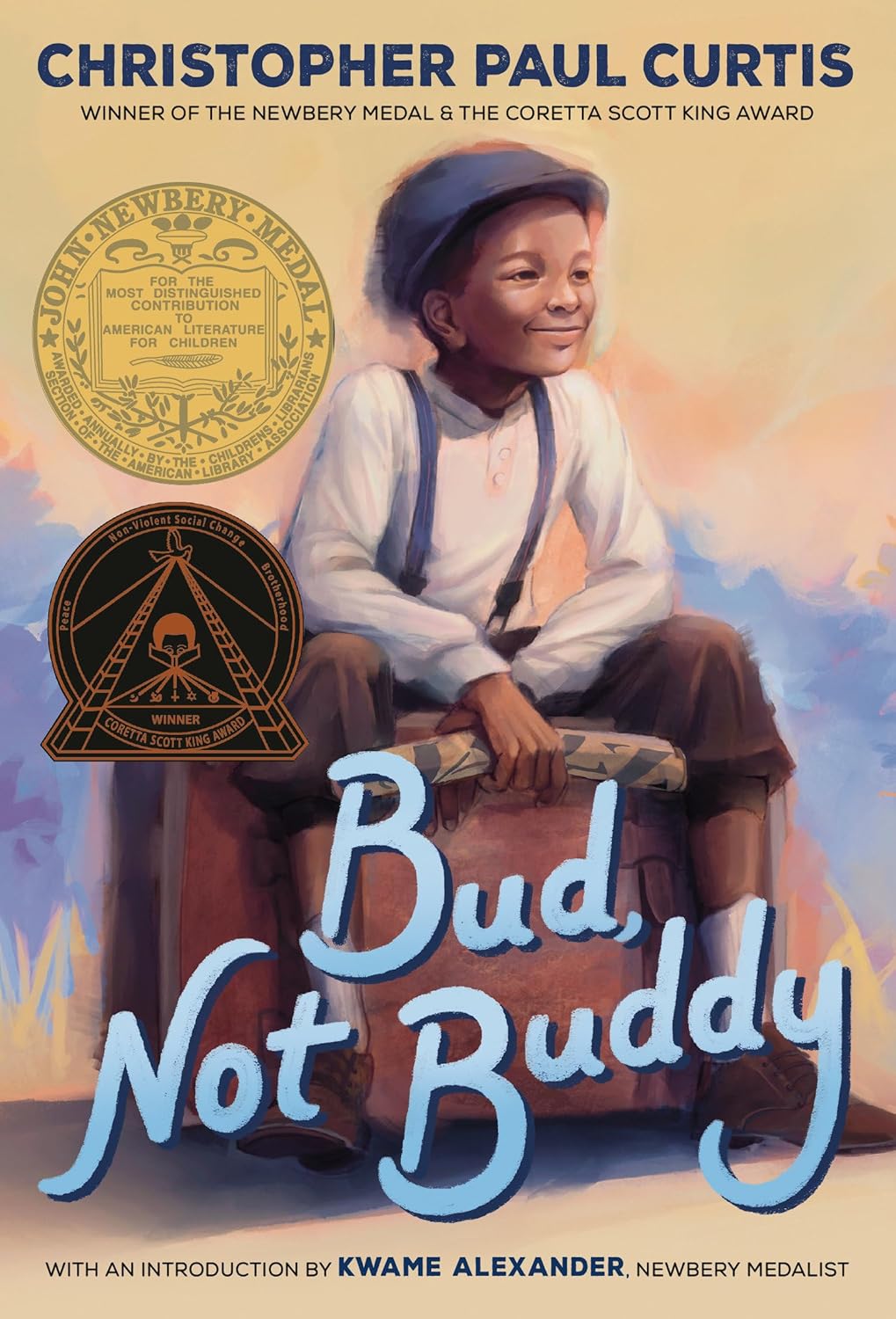
Bud, Not Buddy by Christopher Paul Curtis tells the heartwarming story of a ten-year-old orphan during the Great Depression searching for his father and finding family in unexpected places. This guide provides parents and teachers with reading level information, age recommendations, content insights, and discussion questions for this Newbery Medal-winning novel about resilience, hope, and the meaning of home.
For Parents
Find the right reading level for your child, understand the book’s honest portrayal of orphan life and Depression-era hardships, and get conversation starters to help your child explore themes of perseverance, family, and maintaining hope during difficult times.
For Teachers
Access grade-level guidance, reading metrics, character analysis support, and thematic discussion questions perfect for classroom use. This Newbery Medal winner offers rich opportunities for exploring Great Depression history, African American culture, and character resilience.
Bud, Not Buddy at a Glance
Find on Amazon →| Author | Christopher Paul Curtis |
| Published | 1999 |
| Grade Level | 4–6 (our assessment) |
| Recommended Age | 9–12 |
| Flesch-Kincaid Grade | 5.0 |
| Word Count | ~50,000 |
| Pages | 245 (standard paperback) |
| Chapters | 19 |
| Genre | Historical fiction / children’s literature |
| Setting | Flint, Michigan and Grand Rapids, 1936 (Great Depression) |
| Awards | Newbery Medal (2000), Coretta Scott King Award |
For official Lexile and AR levels, visit Lexile.com or AR BookFinder. ReadingVine provides independent editorial assessments.
What Reading Level Is Bud, Not Buddy?
Bud, Not Buddy is appropriate for grades 4–6, with a Flesch-Kincaid grade level of 5.0. The vocabulary is accessible with period-appropriate slang and Depression-era terms that add authenticity. The sentence structure is straightforward, and the first-person narration from Bud’s perspective makes the story feel immediate and personal. Curtis writes in a voice that captures how a smart, resourceful ten-year-old thinks and speaks.
Christopher Paul Curtis’s writing style is warm, humorous, and deeply human. He balances the serious realities of orphan life and Depression-era poverty with Bud’s optimism, humor, and resilience. The book includes “Bud Caldwell’s Rules and Things for Having a Funner Life and Making a Better Liar Out of Yourself”—Bud’s survival wisdom presented as numbered rules throughout the story. These rules add humor and insight while showing how Bud has learned to navigate a difficult world.
While strong fourth graders can handle the reading mechanics, the story resonates most deeply with readers ages 9–12 who can understand the historical context of the Great Depression, appreciate Bud’s resourcefulness and determination, and grasp themes about belonging, family (both biological and chosen), and maintaining hope despite hardship. The book rewards readers who enjoy character-driven stories with heart, historical settings, and protagonists who face real challenges with courage and humor.
What Age Is Bud, Not Buddy Appropriate For?
Bud, Not Buddy is most appropriate for readers ages 9–12. The story deals with orphan life, poverty, hunger, and the hardships of the Great Depression in honest ways. However, Curtis balances these serious elements with warmth, humor, and ultimate hope. The tone is never despairing—Bud is resourceful and optimistic, and the story emphasizes resilience and community support rather than dwelling on suffering.
Orphan life and foster care: Bud lives in an orphanage and experiences foster care placements. One foster family locks him in a shed overnight with wasps, which is frightening and cruel. The system’s failures are portrayed realistically.
Poverty and hunger: Bud often doesn’t have enough food and must be resourceful to survive. Breadlines and Hoovervilles (homeless encampments) appear. The Depression’s hardships are shown but not graphically.
Mother’s death: Bud’s mother died when he was six. While not described in detail, this loss shapes everything about Bud’s journey. He carries grief but also loving memories.
Racism and discrimination: The book portrays 1930s racism, including segregation and limited opportunities for Black Americans. This is handled matter-of-factly as part of the historical context.
Violence (mild): Bud gets into a brief fight with a foster brother (Todd Amos) and is locked in a shed. There’s no graphic violence, but the treatment is cruel and frightening.
What’s NOT in the book: No graphic violence, no prolonged suffering, no despair. The book’s tone is ultimately hopeful and warm. Bud experiences hardships but isn’t traumatized or broken. He’s resourceful, funny, and maintains his dignity. The ending is happy—Bud finds family, belonging, and home. Curtis treats difficult topics with sensitivity while keeping the story appropriate and uplifting for middle-grade readers.
What Is Bud, Not Buddy About?
Ten-year-old Bud Caldwell (not Buddy—he insists people get his name right) has been living in an orphanage in Flint, Michigan since his mother died four years ago. It’s 1936, the middle of the Great Depression, and times are hard for everyone—especially orphans. Bud has learned to survive through resourcefulness, humor, and following his own rules for life, which he keeps in his head and shares with readers.
Bud’s most precious possession is a small suitcase containing a few items from his mother: flyers advertising Herman E. Calloway and his famous band, a photograph of his mother as a child, and some rocks with writing on them. Bud believes Herman E. Calloway is his father—his mother never told him about his father, but she kept these flyers, so Bud figures Herman must be related to him somehow.
Bud is placed with the Amos family as a foster child, but it goes badly immediately. The Amos’s son Todd is a bully who provokes Bud, then lies when Bud fights back. As punishment, Mr. Amos locks Bud in a shed overnight. The shed is dark, full of wasps, and terrifying. Bud escapes the shed and runs away, deciding to find Herman E. Calloway in Grand Rapids and claim his place as Herman’s son.
Before leaving Flint, Bud seeks revenge on Todd (getting him wet in his own bed) and tries to reunite with his friend Bugs, who’s also run away from the orphanage. They meet up and plan to “ride the rails”—hopping trains to go west where there are supposedly jobs picking fruit. At the train yard, Bud misses the train while Bugs makes it, leaving Bud alone.
Bud starts walking toward Grand Rapids, over 100 miles away. On the road, he encounters Lefty Lewis, a kind older man who gives him a ride. Lefty is suspicious of Bud’s story but helps him anyway, feeding him and eventually driving him all the way to Grand Rapids. Lefty represents the kindness and community support that helped people survive the Depression.
In Grand Rapids, Bud finds Herman E. Calloway at a club called the Log Cabin. Herman is an elderly, grumpy bandleader who initially wants nothing to do with Bud. When Bud insists he’s Herman’s son, Herman is insulted and angry—there’s no way this random child is his son. The band members are more sympathetic, especially Miss Thomas (the band’s vocalist) and Steady Eddie (a musician). They can see Bud is alone and needs help.
The band takes Bud in temporarily while they try to figure out the truth. Bud shows them the rocks his mother left him—they have writing that turns out to be dates and locations of the band’s performances. This proves Bud’s mother knew Herman, but it doesn’t prove Bud is Herman’s son. Herman remains cold and dismissive.
As Bud stays with the band, living with Miss Thomas, he begins to feel at home. The band members treat him kindly, teach him about music, and give him small jobs. He starts to feel like he belongs somewhere for the first time since his mother died. Miss Thomas, in particular, becomes a mother figure, caring for him and making him feel valued.
The truth finally comes out: Herman E. Calloway is not Bud’s father—he’s Bud’s grandfather. Herman had a daughter who ran away years ago when she was young. He never knew what happened to her, and he’s been bitter and grieving ever since. Bud’s mother was Herman’s daughter, Angela Janet. She died at age twenty-six, never having reconciled with her father. The rocks were her way of keeping track of her father’s performances, even though they were estranged.
This revelation is devastating for Herman—he learns his daughter is dead and that he missed her entire adult life, including the birth of his grandson. But it also means Bud has found his family. Bud isn’t Herman’s son, but he’s Herman’s grandson, and that’s just as important. The band becomes Bud’s family—they’re musicians who perform together, but they’re also a tight-knit community that looks out for each other.
Bud moves in with Herman and Miss Thomas permanently. He joins the band, learning to play and becoming part of their musical family. Herman starts to soften, though he’s still gruff and grieving his daughter. The book ends with Bud finally having a home, a family, and a place where he belongs. He learns his mother’s full name and story, connecting to his past while building his future.
Most importantly, Bud discovers that family isn’t just about biology—it’s about people who care for you, make room for you, and help you become who you’re meant to be. The band members, Miss Thomas, and even Herman (eventually) become Bud’s family not because they have to, but because they choose to. Bud’s journey teaches him—and readers—that home is where people love you, not just where you come from.
Bud, Not Buddy Characters
Bud, Not Buddy Themes and Lessons
At its heart, Bud, Not Buddy explores the meaning of family and belonging. Bud begins searching for his biological father, believing blood connection will give him a home. What he discovers is that family is about more than biology—it’s about people who choose to care for you, make room for you in their lives, and help you grow. The band members become Bud’s family not because they’re related but because they see his need, open their hearts, and include him. Miss Thomas mothers him, Steady Eddie mentors him, and even grumpy Herman eventually accepts him. The book teaches that family is created through love and choice, not just birth.
The book also celebrates resilience and maintaining hope during difficult times. Bud faces poverty, hunger, cruel treatment, and the pain of being unwanted, but he never becomes bitter or gives up. His “Rules and Things for Having a Funner Life” show how he’s learned to survive with humor and intelligence. He doesn’t just endure hardship—he actively works to make his situation better, whether by running away from the Amos family, seeking Herman, or making himself useful to the band. The book teaches that hope and resourcefulness can carry you through hard times, and that it’s important to keep trying even when things seem impossible.
Discussion questions for families:
- What are some of Bud’s “Rules and Things”? Which ones do you think are most important for his survival?
- How do the band members become Bud’s family even though they’re not related to him? What makes someone family?
- Why is Herman so cold to Bud at first? How does learning about his daughter change him?
- How does music bring people together in this story? What role does it play in the band’s life and in Bud finding his place?
How Many Pages and Chapters in Bud, Not Buddy?
Bud, Not Buddy has 245 pages in the standard paperback edition and is divided into 19 chapters. The word count is approximately 50,000 words, making it a substantial middle-grade novel. The chapters average about 13 pages each and are structured around key events in Bud’s journey—from the orphanage to the Amos house to his travels to Grand Rapids to his gradual acceptance into the band.
For independent readers in the target age range (9–12), the book typically takes 6–7 hours to complete, or about two weeks of reading 30 minutes per day. Bud’s engaging voice and the adventure of his journey keep readers interested. The humor in Bud’s Rules and Things, combined with the warmth of the characters and the ultimate happiness of the ending, make it a page-turner despite the serious historical context.
As a read-aloud, Bud, Not Buddy takes approximately 5–6 hours total. The chapter structure works well for reading sessions, and Bud’s distinctive voice is fun to read aloud. The historical content provides excellent opportunities to discuss the Great Depression, Hoovervilles, breadlines, jazz music, and African American culture in the 1930s. Many families and classrooms enjoy it because it combines important history with a heartwarming story about family, belonging, and hope. Teachers often use it to teach both Depression-era history and literary themes about resilience and chosen family.
Books Similar to Bud, Not Buddy
If your child enjoyed Bud, Not Buddy, here are six similar books that explore themes of resilience, family, and finding where you belong:
About Christopher Paul Curtis
Christopher Paul Curtis (born 1953) is an acclaimed African American author known for his warm, humorous historical novels featuring Black protagonists. Bud, Not Buddy, published in 1999, won both the Newbery Medal and the Coretta Scott King Award in 2000. Curtis grew up in Flint, Michigan, the setting for much of Bud’s story, and worked on an automobile assembly line for thirteen years before becoming a full-time writer. His experiences in Flint and stories from his family about the Depression era informed Bud, Not Buddy. Curtis’s own grandfather was a big band musician, which inspired the band elements in the book. The character of Herman E. Calloway and his band are loosely based on real 1930s jazz musicians Curtis learned about through research and family stories. Curtis wanted to write about the Great Depression from a Black perspective, showing both the hardships and the resilience, community support, and joy that existed despite difficult circumstances. He was particularly interested in showing that Black children in the 1930s had childhoods—they played, had adventures, and found happiness even in hard times. The “Rules and Things” were Curtis’s way of showing how resourceful and intelligent Bud is, giving him agency and humor rather than just portraying him as a victim. Curtis conducted extensive research into Depression-era Hoovervilles, breadlines, orphanages, and the lives of traveling musicians to ensure historical accuracy. The book balances serious topics (poverty, orphan life, racism) with warmth and hope, showing that difficult historical periods included both suffering and humanity. Curtis’s other acclaimed novels include The Watsons Go to Birmingham—1963 (a Newbery Honor book) and Elijah of Buxton (which won the Coretta Scott King Award and Newbery Honor). His books are celebrated for their historical accuracy, authentic Black voices and experiences, humor, warmth, and ultimately hopeful messages. Bud, Not Buddy remains his most beloved work, teaching generations of readers about the Depression, the power of music and community, and the truth that family is found not just in blood but in people who choose to love and support you.
Bud, Not Buddy: Frequently Asked Questions
Is Herman E. Calloway Bud’s father or grandfather?
Herman E. Calloway is Bud’s grandfather, not his father. Bud initially believes Herman is his father because his mother kept flyers advertising Herman’s band. However, the truth is that Herman had a daughter, Angela Janet, who ran away when she was young. Angela was Bud’s mother. She and Herman never reconciled—Herman didn’t know she had a son, and she died without ever telling him about Bud. When the band members figure out the connection by matching the dates on Bud’s rocks to the band’s performance schedule, they realize Bud’s mother was Herman’s estranged daughter. This makes Herman Bud’s grandfather. The revelation is devastating for Herman (learning his daughter is dead) but also gives both Herman and Bud the family connection they’ve been missing.
What happened to Bud’s mother in Bud, Not Buddy?
Bud’s mother, Angela Janet Calloway, died when Bud was six years old. The book doesn’t provide extensive details about her death, but it’s clear she was young (twenty-six) and that Bud loved her deeply. Before she died, she left Bud a small suitcase containing precious items: flyers from her father Herman’s band, rocks with dates and cities written on them (marking her father’s performances—her way of keeping track of him despite being estranged), and a photograph. She never told Bud about his father or grandfather, likely because she had run away from Herman years earlier and they weren’t in contact. Her death left Bud completely alone in the world, which is why he ended up in the orphanage. The rocks she left him ultimately lead Bud to Herman and help prove Bud’s connection to the Calloway family.
What are Bud’s rules in Bud, Not Buddy?
Throughout Bud, Not Buddy, Bud shares his “Rules and Things for Having a Funner Life and Making a Better Liar Out of Yourself”—survival wisdom he’s developed through experience. Examples include: Rule Number 3 (if you’ve got to tell a lie, make sure it’s simple and easy to remember), Rule Number 29 (when you make up your mind to do something, hurry up and do it), Rule Number 63 (never, ever say something bad about someone you don’t know—especially when you’re around a bunch of strangers), and Rule Number 83 (if a adult tells you not to worry, start worrying immediately). These rules show Bud’s intelligence, resourcefulness, and the hard lessons he’s learned about survival as an orphan. They add humor to the story while showing how Bud has developed street smarts and wisdom beyond his years. The rules help him navigate a difficult world with both cleverness and hope.
Is Bud, Not Buddy appropriate for 4th grade?
Yes, Bud, Not Buddy is appropriate for fourth graders. The reading level (5.0 Flesch-Kincaid) is accessible to fourth-grade readers, and the first-person narrative from ten-year-old Bud makes the story relatable. The content deals with serious topics—orphan life, poverty, hunger, the Depression—but Christopher Paul Curtis balances these with warmth, humor, and hope. Bud is resourceful and optimistic, never giving in to despair, and the story ultimately has a happy ending with Bud finding family and belonging. The book works well in fourth grade as either independent or class reading. Teachers should provide some historical context about the Great Depression, but the story itself is age-appropriate and engaging for fourth graders. Fifth and sixth graders will appreciate the historical depth more fully, but fourth graders can absolutely enjoy and understand Bud’s story.
What is the main conflict in Bud, Not Buddy?
The main external conflict is Bud’s search for his father and a place to belong. After his mother’s death, Bud is alone in the world, moving between orphanages and bad foster placements. He believes Herman E. Calloway is his father and sets out on a dangerous journey to find him, hoping to finally have a family and home. The deeper internal conflict is Bud’s struggle to maintain hope and dignity despite being unwanted and alone. He must balance survival (following his Rules) with keeping his heart open to connection and love. The resolution comes when Bud discovers Herman is his grandfather, not his father, and that family isn’t just about finding your biological relatives—it’s about finding people who choose to love and care for you. The band becomes Bud’s chosen family, and he learns that home is where people make room for you in their hearts and lives.
Does Bud, Not Buddy have a happy ending?
Yes, Bud, Not Buddy has a happy ending. Bud finds his family—discovering that Herman E. Calloway is his grandfather and that the band members have become his chosen family. He moves in permanently with Herman and Miss Thomas, joins the band, learns to play music, and finally has a stable home where he’s loved and valued. Herman begins to soften and accept Bud, though he’s still grieving his daughter. The book ends with Bud feeling like he belongs somewhere for the first time since his mother died. He learns his mother’s full name and story, connecting to his past while building his future. The ending is warm and hopeful—Bud has found not just one family member but an entire community of people who care about him. It’s a satisfying conclusion that rewards Bud’s resilience and teaches that family can be found in unexpected places.
What is the setting of Bud, Not Buddy?
Bud, Not Buddy is set in Michigan during the Great Depression, specifically in 1936. The story begins in Flint, Michigan, where Bud lives in an orphanage and is briefly placed with the Amos foster family. Most of the book follows Bud’s journey from Flint to Grand Rapids, Michigan—about 120 miles—which he accomplishes partly on foot and partly with help from Lefty Lewis. In Grand Rapids, Bud finds Herman E. Calloway and his band at a club called the Log Cabin. The setting is crucial to the story: the Depression era means widespread poverty, breadlines, Hoovervilles (homeless encampments), and children riding the rails seeking better opportunities. The Michigan setting reflects Christopher Paul Curtis’s own background—he grew up in Flint—and the story includes authentic details about Depression-era Michigan, including the automobile industry, traveling jazz bands, and the specific challenges Black families faced during this period.
What is the message of Bud, Not Buddy?
The main message is that family is defined by love and choice, not just biology, and that maintaining hope and resilience can carry you through even the hardest times. Bud searches for his biological father seeking belonging, but what he finds is that family is created when people choose to care for you, make space in their lives, and help you become who you’re meant to be. The band members, Miss Thomas, and eventually Herman become Bud’s family through love and choice. The book also teaches that resourcefulness, humor, and refusing to give up on yourself are crucial for survival during difficult times. Bud’s Rules show how intelligence and adaptability help you navigate hardship. Finally, the book celebrates the power of music and community to bring people together and create joy even during poverty and struggle. It’s ultimately a hopeful message: no matter how alone you feel or how hard life is, there are people who will care for you, and finding your place in the world is possible if you keep trying and stay open to connection.