
 = Partner Site
The Watsons Go to Birmingham-1963 Reading Level: A Complete Guide
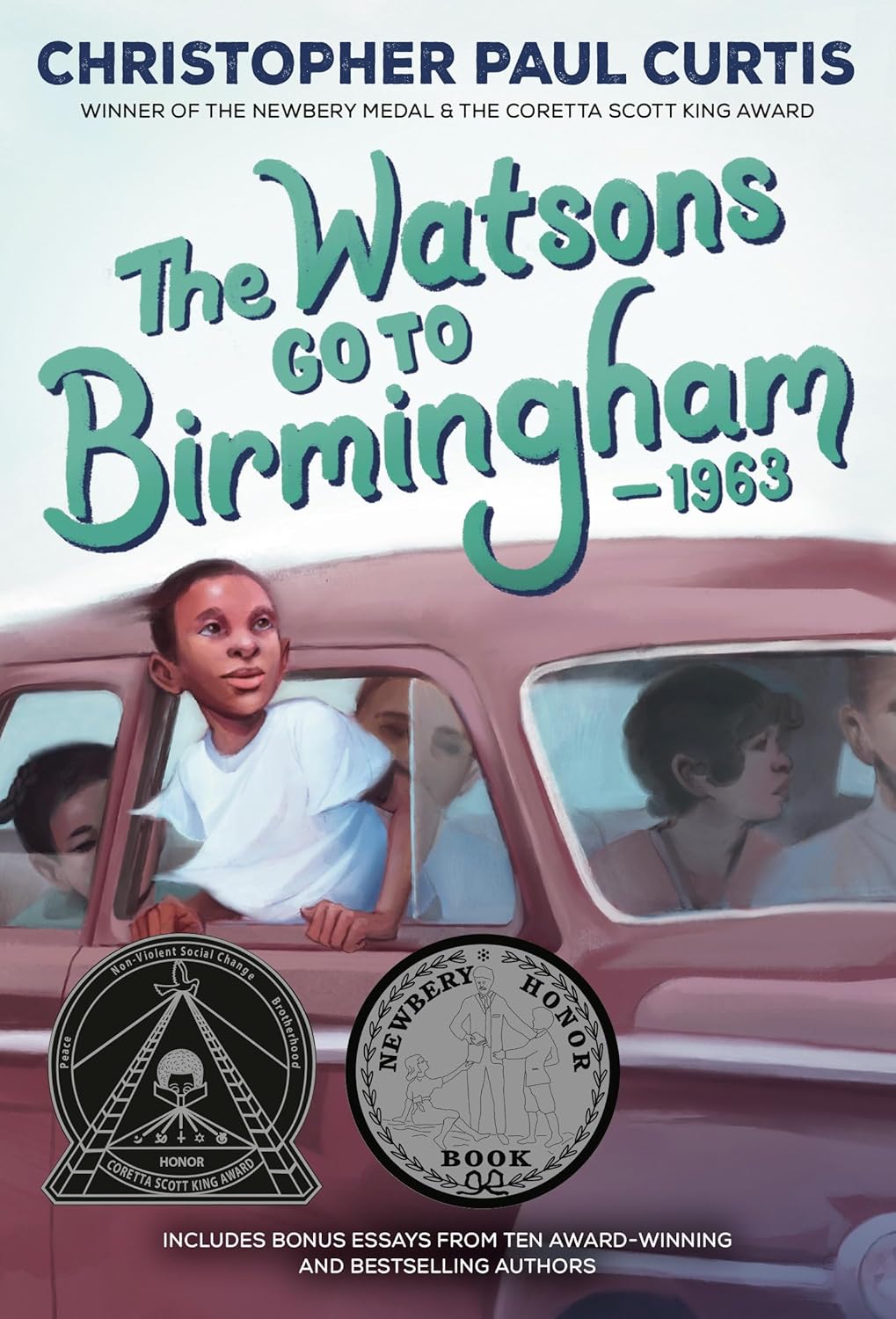
The Watsons Go to Birmingham—1963 by Christopher Paul Curtis tells the powerful story of a loving African American family whose summer road trip becomes a witness to one of the Civil Rights Movement’s darkest moments. This guide provides parents and teachers with reading level information, age recommendations, content insights, and discussion questions for this Newbery Honor classic about family, resilience, and confronting racial violence.
For Parents
Find the right reading level for your child, understand the book’s portrayal of the 16th Street Baptist Church bombing, and get conversation starters to help your child explore themes of racism, family strength, and historical tragedy.
For Teachers
Access grade-level guidance, reading metrics, character analysis support, and thematic discussion questions perfect for classroom use. This Newbery Honor book offers rich opportunities for exploring Civil Rights history and family resilience in the face of tragedy.
The Watsons Go to Birmingham—1963 at a Glance
Find on Amazon →| Author | Christopher Paul Curtis |
| Published | 1995 |
| Grade Level | 4–6 (our assessment) |
| Recommended Age | 9–12 |
| Flesch-Kincaid Grade | 5.0 |
| Word Count | ~55,000 |
| Pages | 210 (standard paperback) |
| Chapters | 15 |
| Genre | Historical fiction / children’s literature |
| Setting | Flint, Michigan and Birmingham, Alabama, 1963 |
| Awards | Newbery Honor (1996), Coretta Scott King Honor |
For official Lexile and AR levels, visit Lexile.com or AR BookFinder. ReadingVine provides independent editorial assessments.
What Reading Level Is The Watsons Go to Birmingham—1963?
The Watsons Go to Birmingham—1963 is appropriate for grades 4–6, with a Flesch-Kincaid grade level of 5.0. The vocabulary is accessible with period-appropriate slang and 1960s cultural references that add authenticity. The sentence structure is straightforward, and the first-person narration from nine-year-old Kenny’s perspective makes the story feel immediate and relatable. Curtis writes in a voice that captures how a smart, observant child thinks and speaks.
Christopher Paul Curtis’s writing style balances humor and warmth with serious historical events. The first two-thirds of the book focus on the Watson family’s everyday life in Flint—sibling dynamics, parental discipline, car trouble, and the preparations for a road trip south. The tone is often funny and loving, showing a tight-knit family with typical problems. This makes the final third—when Kenny experiences the Birmingham church bombing—even more powerful and heartbreaking. Curtis doesn’t shield readers from historical tragedy, but he approaches it through a child’s perspective, making it accessible while still honest.
While strong fourth graders can handle the reading mechanics, the story resonates most deeply with readers ages 9–12 who can understand the historical context of segregation and the Civil Rights Movement, process the trauma of the church bombing, and appreciate how Curtis shows a family helping each other heal from witnessing violence. The book rewards readers who are ready for honest discussions about racism and historical violence while still receiving the comfort of a loving family story.
What Age Is The Watsons Go to Birmingham—1963 Appropriate For?
The Watsons Go to Birmingham—1963 is most appropriate for readers ages 9–12. The story deals with the real historical event of the 16th Street Baptist Church bombing, which killed four young Black girls in Birmingham, Alabama. Curtis handles this tragedy honestly but through a child’s perspective, making it accessible without being gratuitously graphic. The bombing is frightening and sad, but the focus is on the family’s love and resilience, not on violence.
Church bombing and death: The 16th Street Baptist Church bombing is central to the story’s climax. Kenny experiences the bombing and its aftermath in a fragmented, traumatic way, believing his sister Joetta was killed. While the violence isn’t graphically depicted, the event is traumatic and frightening.
Racism and segregation: The Watson family experiences segregation in the South, including “Colored” restrooms, restaurants that won’t serve them, and the constant threat of racial violence. This historical reality is portrayed honestly.
Trauma and withdrawal: After the bombing, Kenny experiences trauma symptoms—nightmares, withdrawal, and inability to process what happened. The family helps him heal.
Physical discipline: Byron gets “whuppings” (spankings) from his parents for misbehavior. This reflects historical parenting practices and is presented as the parents trying to protect Byron from worse consequences outside the family.
Bullying and violence: Kenny is bullied at school. Byron gets in fights. These incidents are realistic but not graphic.
What’s important to know: While the church bombing is tragic and scary, no Watson family member dies. Joetta escapes, and the family survives intact. The book emphasizes healing, family love, and resilience. Curtis balances the historical tragedy with warmth, humor, and hope. The Watsons are a loving, stable family who support each other through trauma. The book teaches that even when terrible things happen, family and community can help you survive and heal.
What Is The Watsons Go to Birmingham—1963 About?
The Watson family—Dad, Momma, Byron (thirteen), Kenny (nine), and Joetta (five)—live in Flint, Michigan in 1963. They’re a loving, close-knit African American family, though not without their challenges. Byron, the oldest, is becoming increasingly rebellious—playing with matches, getting his hair straightened against his parents’ wishes, and generally causing trouble. Kenny is sensitive and smart but gets bullied at school for having a lazy eye. Joetta, called Joey, is the sweet youngest child everyone loves.
The story begins in winter, with the family dealing with Michigan’s brutal cold. The Watsons have an old brown car they call the “Brown Bomber,” which Dad has outfitted with special features, including a record player that only plays Yakety Yak. The family dynamics are warm and funny—Momma and Dad tease each other, the kids bicker and bond, and despite Byron’s rebelliousness, there’s deep love holding them together.
When Byron gets his hair straightened into a “conk” (a straightening process popular in the 1960s) against his parents’ explicit orders, Dad and Momma decide Byron needs stronger discipline than they can provide. They plan a trip to Birmingham, Alabama, where Momma grew up, to leave Byron with Grandma Sands for the summer. Grandma Sands is strict and old-fashioned, and they hope she can straighten Byron out before he gets in serious trouble.
The road trip south is an adventure. The family drives straight through from Flint to Birmingham in the Brown Bomber, with Dad pushing to make good time. They experience small moments of joy—singing together, playing games—but also encounter segregation firsthand. When they stop at rest areas, they see “Colored” restrooms and water fountains. They can’t eat at most restaurants. The reality of the segregated South becomes clear, even to the children.
In Birmingham, they stay with Grandma Sands. The heat is oppressive compared to Michigan. Grandma Sands is indeed strict, and Byron quickly realizes he’s in for a tough summer. But there are good parts too—Kenny makes friends, Joey enjoys playing, and the family relaxes together. Momma warns the children about certain dangers in Birmingham, including a whirlpool at a nearby swimming area called Collier’s Landing that she says is dangerous.
One Sunday, Grandma Sands insists the family attend church at the 16th Street Baptist Church. Joey wants to go, and most of the family attends, but Kenny and Byron stay behind. While they’re at home, Kenny decides to go to Collier’s Landing to cool off despite the warnings about the whirlpool. He gets caught in what he believes is the dangerous whirlpool and nearly drowns. Byron saves him, pulling him out and, for the first time, showing genuine care and fear for his younger brother. This near-death experience bonds them in a new way.
The following Sunday, September 15, 1963, Joey goes to church again. Kenny, feeling guilty about not going the previous week, decides to follow her to church. As he’s walking there, he hears a tremendous explosion. The 16th Street Baptist Church has been bombed by white supremacists. In shock and confusion, Kenny goes toward the church. His experience is disorienting and fragmented—he sees a shoe that looks like Joey’s and believes his little sister was killed in the bombing.
In shock and grief, Kenny returns home without telling anyone what he saw. When Joey walks in the door alive—she had left church early and wasn’t inside during the explosion—Kenny can’t process it. He’s traumatized by what he witnessed and can’t reconcile Joey being alive with the horror he saw. He retreats emotionally, hiding behind the couch in what the family calls his “secret hiding place” (the World-Famous Watson Pet Hospital, where they used to hide injured animals).
Kenny withdraws from his family, experiencing severe trauma symptoms. He has nightmares, can’t talk about what happened, and isolates himself. The family is worried but doesn’t know how to reach him. Finally, Byron—the rebellious older brother who’s been the source of family stress—becomes Kenny’s savior. Byron sits with Kenny, lets him cry, and helps him talk about what he saw. Byron explains that Joey is alive, that Kenny isn’t crazy, and that it’s okay to be sad and scared about what happened.
Byron’s tenderness and understanding help Kenny begin to heal. The bombing killed four young girls—Addie Mae Collins, Cynthia Wesley, Carole Robertson, and Carol Denise McNair—children close to Joey’s age. Kenny realizes how close his family came to losing Joey, and how lucky they are while also grieving for the families who lost their daughters. The Watson family helps each other process the trauma, supporting Kenny and each other through an impossible tragedy.
The family returns to Flint, and life gradually returns to normal. Byron’s behavior has changed—the near-drowning and the bombing have matured him, making him more protective and responsible. Kenny slowly heals with his family’s support. The book ends with Kenny understanding that terrible things happen in the world, but family and love help you survive and keep going. The Watsons remain a strong, loving unit, changed by their experience but not broken.
The Watsons Go to Birmingham—1963 Characters
The Watsons Go to Birmingham—1963 Themes and Lessons
At its heart, The Watsons Go to Birmingham—1963 is about family love as protection and healing. The Watson family is tight-knit and loving, using humor and affection to navigate everyday challenges. When they face real tragedy—the church bombing—this family bond becomes their salvation. Byron, previously the family’s problem child, becomes the healer who helps Kenny process trauma. The parents provide stability and safety. The family’s love doesn’t erase the horror of what happened, but it gives Kenny and Joey the foundation to survive and eventually heal. The book teaches that family support is crucial for processing trauma and that love can help you endure even the worst experiences.
The book also serves as a witness to historical tragedy, introducing young readers to the Birmingham church bombing and the Civil Rights Movement through a child’s eyes. By making the Watsons a relatable, loving family, Curtis helps readers connect emotionally to history. Kenny’s trauma represents the collective trauma of Black children who grew up during the Civil Rights era, knowing that violence could strike at any moment. The book teaches that historical events affected real families like the Watsons, and that the fight for civil rights came at tremendous human cost, particularly to children and families who just wanted to live in peace.
Discussion questions for families:
- How does Byron change throughout the story? What events cause him to mature and become more responsible?
- Why do Kenny’s parents want to protect him from knowing too much about racism and violence? Is this the right approach?
- How does the Watson family help Kenny heal after witnessing the church bombing? What does this teach about processing trauma?
- Why is it important to learn about historical events like the Birmingham church bombing? How does experiencing it through Kenny’s eyes affect your understanding?
How Many Pages and Chapters in The Watsons Go to Birmingham—1963?
The Watsons Go to Birmingham—1963 has 210 pages in the standard paperback edition and is divided into 15 chapters. The word count is approximately 55,000 words, making it a substantial middle-grade novel. The chapters average about 14 pages each and follow the family’s journey chronologically—from winter in Flint through the road trip south to the Birmingham summer and the church bombing, ending with the return home and healing.
For independent readers in the target age range (9–12), the book typically takes 6–7 hours to complete, or about two weeks of reading 30 minutes per day. The engaging family dynamics and Kenny’s relatable voice keep readers interested through the lighter first two-thirds. The church bombing sequence is emotionally intense and may require readers to slow down and process. Many readers find themselves deeply invested in the Watson family and eager to see how Kenny heals.
As a read-aloud, The Watsons Go to Birmingham—1963 takes approximately 5–6 hours total. The chapter structure works well for reading sessions. Teachers and parents should prepare children for the church bombing section, providing historical context and creating space for processing difficult emotions. The book works excellently for teaching Civil Rights history because it makes the era personal and immediate rather than distant and abstract. Many classrooms use it alongside primary sources about the Birmingham campaign and the 16th Street Baptist Church to deepen understanding of this crucial period in American history.
Books Similar to The Watsons Go to Birmingham—1963
If your child enjoyed The Watsons Go to Birmingham—1963, here are six similar books that explore themes of family, Civil Rights history, and resilience:
About Christopher Paul Curtis
Christopher Paul Curtis (born 1953) wrote The Watsons Go to Birmingham—1963 as his first novel, published in 1995. It immediately became a critical and commercial success, winning a Newbery Honor and Coretta Scott King Honor. Curtis drew on his own experiences growing up in Flint, Michigan in the 1960s—he was ten years old in 1963 when the Birmingham church bombing occurred, close to Kenny’s age. While the Watson family is fictional, Curtis based the family dynamics on his own close-knit family and the African American community in Flint. The Brown Bomber was inspired by Curtis’s family car, and many of the humorous family interactions reflect his own childhood experiences. The Birmingham bombing was a defining moment of Curtis’s childhood—he remembered the shock and fear Black families across the country felt when children were murdered for being Black and going to church. The story is told through a child’s perspective, making the Civil Rights Movement accessible to young readers by showing how it affected real children their age with families like theirs. Curtis balances the tragedy with humor and family warmth, portraying Black families during the Civil Rights era as loving, funny, resilient people who supported each other through incredible hardships, not just as victims. The character of Byron reflects Curtis’s interest in showing a “problem child” who rises to the occasion when his family needs him. Curtis’s own brother inspired aspects of Byron’s character. The book is meticulously researched in its historical details about 1963—from the music and cars to the specifics of the church bombing—while remaining accessible and emotionally resonant for young readers. Curtis went on to write other acclaimed novels including Bud, Not Buddy (which won both the Newbery Medal and Coretta Scott King Award) and Elijah of Buxton. However, The Watsons Go to Birmingham—1963 remains his most widely read work, taught in schools across America as both a powerful family story and an essential introduction to Civil Rights history. The book’s combination of warmth, humor, historical accuracy, and honest portrayal of racial violence has made it a lasting classic that helps young readers understand a crucial period in American history through the eyes of a relatable, loving family.
The Watsons Go to Birmingham—1963: Frequently Asked Questions
What happened at the church in The Watsons Go to Birmingham—1963?
On September 15, 1963, white supremacists bombed the 16th Street Baptist Church in Birmingham, Alabama, killing four young Black girls: Addie Mae Collins (14), Cynthia Wesley (14), Carole Robertson (14), and Carol Denise McNair (11). This was a real historical event. In the book, Kenny is walking toward the church when the bomb explodes. His experience is disorienting and fragmented—in shock, he sees a shoe he believes belongs to his sister Joey, making him think she died in the blast. Joey had actually left church early and survived, but Kenny is traumatized by what he experienced. The bombing was one of the most horrific events of the Civil Rights era, intended to terrorize the Black community and stop the movement for equality. It had the opposite effect, galvanizing support for civil rights and leading to important legislation.
Does Joey die in The Watsons Go to Birmingham—1963?
No, Joey does not die in The Watsons Go to Birmingham—1963. Joey survives the church bombing because she left the church early before the bomb exploded. Kenny believes she died because he saw shoes and clothing that looked like hers in the rubble, but when he returns home in shock, Joey is alive and safe. Her survival is both a relief and difficult for Kenny to process—he’s traumatized by what he witnessed and can’t immediately reconcile Joey being alive with the horror he saw. The Watsons are grateful Joey is alive while also deeply affected by the deaths of the four young girls who didn’t escape. This reflects the reality that many Black families during the Civil Rights era experienced both personal survival and communal trauma.
Is The Watsons Go to Birmingham—1963 appropriate for 4th grade?
The Watsons Go to Birmingham—1963 can be appropriate for fourth graders, especially in a classroom setting with teacher guidance, though fifth and sixth graders typically handle the emotional content with more maturity. The reading level (5.0 Flesch-Kincaid) is accessible to fourth graders, and the family humor and Kenny’s relatable voice engage younger readers. However, the church bombing sequence is emotionally intense and may upset some fourth graders. The key is preparation and support: teachers should provide historical context about the Civil Rights Movement and the Birmingham bombing before reading, create space for students to process difficult emotions, and emphasize the book’s ultimately hopeful message about family healing. As a class read-aloud with guided discussion, it works well for fourth grade. For independent reading, fifth grade and up is typically more appropriate for handling the emotional complexity.
What is the main conflict in The Watsons Go to Birmingham—1963?
The main external conflict shifts throughout the book. Initially, it’s Byron’s rebellious behavior prompting the family trip to Birmingham to straighten him out. During the trip, the conflict becomes navigating segregation and the dangers of the South. The climactic conflict is the church bombing and its aftermath—Kenny’s trauma from witnessing the explosion and believing Joey died. The deeper internal conflict is Kenny’s loss of innocence and struggle to process violence and tragedy. He must reconcile the loving, safe world his family created with the reality of racial hatred and violence. The resolution comes through family support, particularly Byron’s tenderness, which helps Kenny heal. The book shows that while you can’t prevent trauma or erase violence, family love and support can help you survive and gradually heal from terrible experiences.
Why do the Watsons go to Birmingham?
The Watsons go to Birmingham because Byron’s rebellious behavior has escalated and his parents want Grandma Sands to provide stricter discipline than they can. Byron has been getting in trouble repeatedly—playing with fire, getting his hair conked against orders, and generally becoming more defiant. Dad and Momma worry that if Byron continues down this path in Flint, he’ll end up in serious trouble with real consequences. They believe that sending him to spend the summer with Grandma Sands in Birmingham—where she can watch him closely and where he’ll be away from bad influences—will help him mature and understand the importance of following rules. The irony is that they’re sending him to Birmingham for his safety, but Birmingham in 1963 is actually far more dangerous due to racial violence. The trip that’s supposed to protect Byron becomes the experience that traumatizes Kenny and changes the whole family.
How does Byron change in The Watsons Go to Birmingham—1963?
Byron transforms from a rebellious, self-centered teenager to a mature, caring protector. At the beginning, Byron is the family’s problem child—playing with fire, defying his parents, concerned only with looking cool. The change begins when he saves Kenny from drowning at Collier’s Landing, showing genuine fear and care for his brother. The church bombing completes Byron’s transformation. When Kenny withdraws from trauma, Byron becomes his healer—sitting with him, letting him cry, helping him process what he saw, and reassuring him that Joey is alive and that Kenny’s feelings are valid. Byron’s tenderness and emotional maturity surprise everyone, showing that the “tough” exterior hid a caring heart. By the end, Byron is protective, responsible, and emotionally available—the experience of nearly losing Kenny and witnessing the bombing’s impact has matured him in ways punishment never could.
Is The Watsons Go to Birmingham—1963 based on a true story?
The Watson family is fictional, but the book is grounded in real history. The 16th Street Baptist Church bombing on September 15, 1963, really happened, killing four young Black girls: Addie Mae Collins, Cynthia Wesley, Carole Robertson, and Carol Denise McNair. Christopher Paul Curtis was ten years old in 1963 and remembered the impact of this tragedy on Black communities nationwide. While the Watsons themselves aren’t a real family, they represent countless Black families who lived through the Civil Rights era, experiencing both everyday joys and the constant threat of racial violence. Curtis based the family dynamics on his own close-knit family in Flint, Michigan, and the historical details about 1963—the cars, music, segregation, and the Birmingham bombing—are meticulously researched and accurate. The book blends fictional characters with real historical events to help readers understand what the Civil Rights era felt like for ordinary families.
What is the message of The Watsons Go to Birmingham—1963?
The main message is that family love and support can help you survive and heal from even the worst trauma, and that historical violence affected real families just like yours. The book teaches that the Civil Rights Movement wasn’t abstract—it involved real children who experienced fear, violence, and loss. Kenny’s trauma and healing process show that witnessing violence has lasting effects, but family support, honesty about feelings, and time can help you recover. The book also teaches that maintaining family bonds, humor, and love is an act of resistance during oppressive times—the Watsons refuse to be broken by hatred. Byron’s transformation shows that people can rise to the occasion and become heroes when family needs them. Finally, the book argues that learning about historical tragedies like the Birmingham bombing is crucial—not to dwell on violence but to honor those who suffered, understand how far we’ve come, and recognize work that remains to achieve true equality and justice.