
 = Partner Site
Lincoln: A Photobiography Reading Level: A Complete Guide
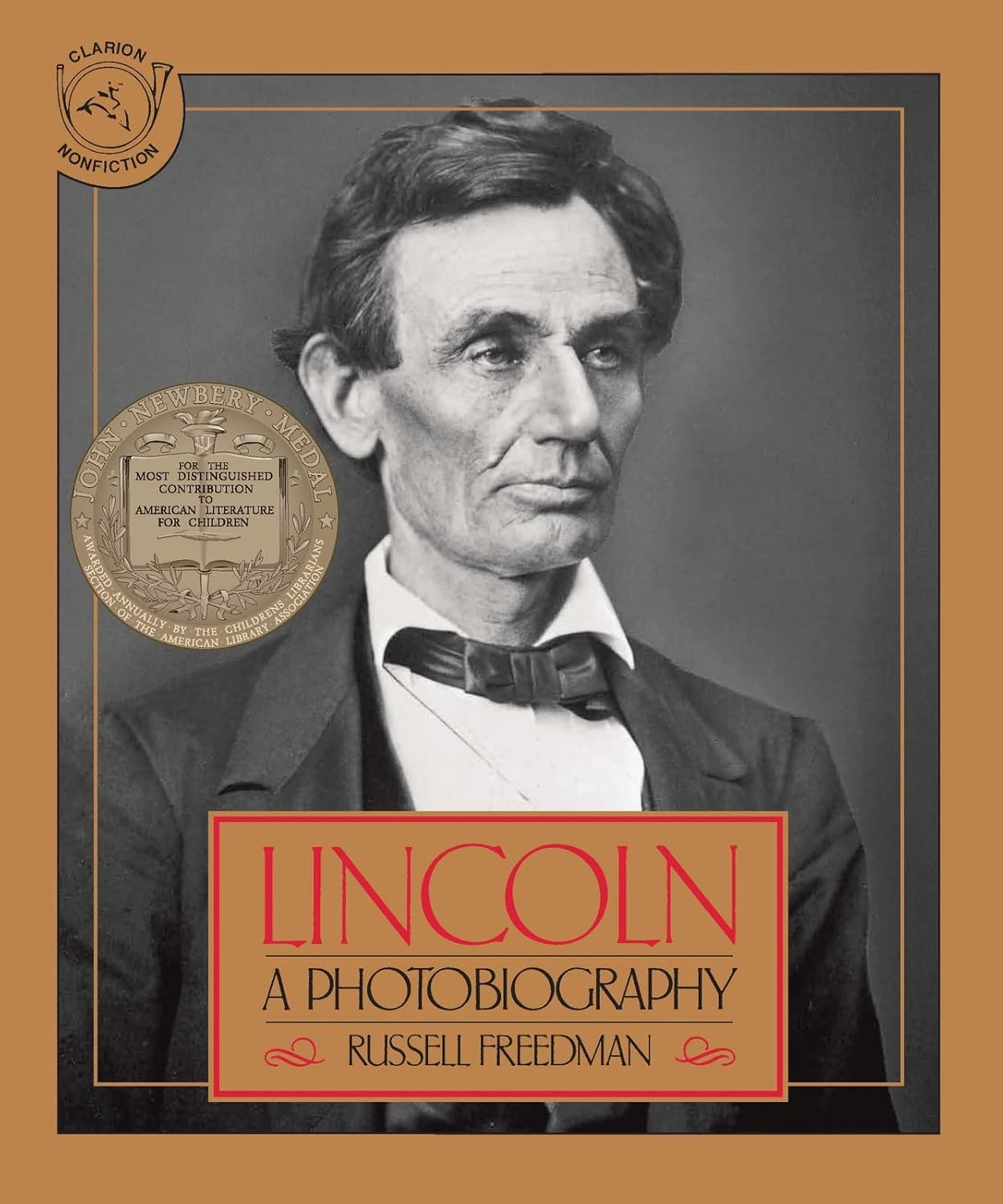
Lincoln: A Photobiography by Russell Freedman is the Newbery Medal-winning nonfiction biography that brought Abraham Lincoln to life for a new generation of young readers — combining Freedman’s clear, engaging prose with more than eighty historical photographs and illustrations gathered from archives across the country. This complete guide covers the reading level, age appropriateness, content, and everything parents and teachers need to know about this landmark work of nonfiction for children.
For Parents
Lincoln: A Photobiography is a thorough, beautifully assembled biography that reads more like narrative nonfiction than a textbook. It covers Lincoln’s full life — from his Kentucky frontier childhood through his presidency and assassination — with honesty, nuance, and warmth. Appropriate for readers ages 10-14, it’s an excellent choice for children studying the Civil War era or American history, and it holds up as a reading experience well beyond its educational value.
For Teachers
The first nonfiction book to win the Newbery Medal in more than thirty years when it was awarded in 1988, Lincoln: A Photobiography is widely assigned in grades 5-8 as part of Civil War, American history, and biography units. Freedman’s model of narrative nonfiction — grounded in primary sources, illustrated with archival photographs, and written with literary care — makes it an ideal text for teaching research, historical thinking, and nonfiction craft. The photographs alone are a teaching resource.
Lincoln: A Photobiography at a Glance
Find on Amazon →| Author | Russell Freedman |
| Published | 1987 |
| Grade Level | 5-8 (our assessment) |
| Recommended Age | 10-14 |
| Flesch-Kincaid Grade | 7.2 |
| Word Count | ~30,000 |
| Pages | 150 (standard hardcover) |
| Chapters | 9 |
| Genre | Nonfiction / biography / photobiography |
| Subject | Abraham Lincoln; American Civil War era |
| Awards | Newbery Medal (1988) |
For official Lexile and AR levels, visit Lexile.com or AR BookFinder. ReadingVine provides independent editorial assessments.
What Reading Level Is Lincoln: A Photobiography?
Lincoln: A Photobiography reads at approximately a 5th-8th grade level by our editorial assessment, with a Flesch-Kincaid grade level of around 7.2. The prose is clear and accessible, but Freedman writes with the precision and vocabulary of serious narrative nonfiction — complex sentences, historical terminology, and multi-clause constructions that reward careful readers. The book is notably more demanding than the average novel assigned at the same grade levels.
One thing that offsets the text difficulty is the format. The more than eighty photographs and illustrations throughout the book break up the reading experience and give context for the prose — a struggling reader who gets lost in a paragraph about the Lincoln-Douglas debates can ground themselves in the photographs of Lincoln’s face at different points in his life, watching him age under the weight of the presidency. For visual learners especially, the photobiography format makes the text significantly more approachable.
The book is most commonly assigned in grades 5-7, and readers in that range who are comfortable with nonfiction will find it manageable and engaging. For official Lexile and Accelerated Reader scores, visit Lexile.com or AR BookFinder.
What Age Is Lincoln: A Photobiography Appropriate For?
We recommend Lincoln: A Photobiography for readers ages 10-14. The book deals with the realities of the Civil War era honestly — including slavery, battlefield death, and Lincoln’s assassination — but does so with historical gravity rather than sensationalism. There is no graphic content, but parents should know the book does not sanitize the history it covers.
The book covers slavery and its role in the Civil War in direct, honest terms. It discusses the deaths of soldiers in the Civil War and includes a chapter on Lincoln’s assassination. Several of the archival photographs depict the realities of 19th-century life, including images of the aftermath of battles. All of this is handled with historical seriousness and appropriate weight. There is no graphic gore, no language, and no sexual content.
For students studying American history in grades 5-8, the honest treatment of slavery and the war is a feature rather than a concern — Freedman’s refusal to soften the history is part of what makes this biography distinguished. Younger readers (ages 10-11) may benefit from reading it alongside a parent or teacher who can provide context for the more difficult historical material.
What Is Lincoln: A Photobiography About?
Lincoln: A Photobiography tells the full story of Abraham Lincoln’s life, from his birth in a one-room log cabin in Kentucky in 1809 through his frontier childhood in Indiana, his self-education, his early legal and political career in Illinois, his debates with Stephen Douglas, his election to the presidency, and his leadership of the nation through the Civil War. Freedman follows Lincoln to the end: his second inaugural address, the Union’s victory, and his assassination at Ford’s Theatre in April 1865.
What sets this biography apart from standard children’s books about Lincoln is Freedman’s commitment to the full, complicated person. He doesn’t present Lincoln as a marble monument. He writes about Lincoln’s awkwardness and melancholy, his political shrewdness and ambition, his evolving views on race and slavery, and the profound toll the war took on him. The Lincoln that emerges is deeply human — funny, sad, driven, uncertain — and far more interesting than the simplified legend.
The photographs are central to the experience. Freedman gathered images from the Library of Congress, the National Archives, the Illinois State Historical Library, and many other sources — portraits of Lincoln at various ages, images of his family and colleagues, photographs of Civil War battlefields and soldiers, and pictures of the places Lincoln lived and worked. The visual record reinforces that this was a real man living in a real and violent time, not a myth.
Russell Freedman spent years researching the book and drew on primary sources including Lincoln’s own letters and speeches throughout the text. His approach — treating young readers as capable of handling complexity and nuance — was part of what made the book groundbreaking when it was published in 1987.
What Topics Does Lincoln: A Photobiography Cover?
The book’s nine chapters move chronologically through Lincoln’s life. The opening chapter covers his frontier childhood in Kentucky and Indiana, including the death of his mother when he was nine. Subsequent chapters follow his self-education and early reading life, his work as a surveyor, postmaster, and store clerk before becoming a lawyer, his marriage to Mary Todd and their family life in Springfield, his years in the Illinois state legislature and the U.S. Congress, the Lincoln-Douglas debates and his rise to national prominence, his election as president and the secession crisis, his wartime leadership and the Emancipation Proclamation, and finally his second term and assassination. An afterword discusses Lincoln’s legacy and the long shadow he has cast over American history. A bibliographic note at the end lists Freedman’s sources and offers suggestions for further reading.
Is Lincoln: A Photobiography Banned?
Lincoln: A Photobiography has not been banned or challenged and does not appear on lists of frequently challenged books. It is universally regarded as a distinguished and important work of nonfiction for young readers, and it has been recommended by educators, librarians, and historians since its publication. It remains in wide use in schools and libraries across the United States.
Lincoln: A Photobiography Themes and Lessons
One of the book’s central themes is the relationship between character and circumstance — how Lincoln’s particular qualities, shaped by a difficult frontier upbringing and driven by relentless self-education, made him the right person for an almost impossibly difficult historical moment. Freedman doesn’t treat Lincoln’s greatness as inevitable or mythic; he shows it as earned, hard-won, and not without contradiction. Lincoln’s evolving views on slavery — from a man who opposed its expansion but accepted its existence, to the president who issued the Emancipation Proclamation — are presented honestly as a process of moral growth under pressure.
A second major theme is the power of language and self-education. Lincoln taught himself to read by firelight, walked miles to borrow books, and became one of the most eloquent writers ever to hold the presidency. Freedman draws attention to Lincoln’s prose throughout the book, and the speeches and letters quoted in the text make a compelling case that words — chosen carefully, built from wide reading and deep thought — can shape history.
Discussion starters for families and classrooms: How did Lincoln’s childhood shape the kind of leader he became? How did his views on slavery change over his lifetime, and why? What does it mean that Lincoln taught himself — what does the book suggest about education and self-improvement? Why do you think Freedman included so many photographs? What do they add that the words alone couldn’t?
How Many Pages and Chapters Are in Lincoln: A Photobiography?
The standard hardcover edition of Lincoln: A Photobiography is 150 pages, divided into 9 chapters, with an afterword and a bibliographic note. The word count is approximately 30,000 words — substantial for a nonfiction children’s biography but considerably shorter than a full middle grade novel.
For readers in the target age range of 10-14, expect a reading time of roughly 4-6 hours, or 4-6 days at around 30 minutes of reading per session. The photobiography format means pages turn somewhat faster than word count alone would suggest — readers frequently pause to study the photographs. As a classroom read-aloud or shared text, the book works well in a two-to-three week unit with time for discussion of both the history and the photographs.
Books Similar to Lincoln: A Photobiography
About Russell Freedman
Russell Freedman (1929-2018) was one of the most celebrated nonfiction writers in the history of American children’s literature. Over a career spanning more than five decades, he wrote more than fifty books, most of them narrative biographies and histories for young readers. Lincoln: A Photobiography won the Newbery Medal in 1988 — the first nonfiction book to win the award since 1956 — and opened a new era for nonfiction in children’s publishing, demonstrating that rigorously researched, literary narrative nonfiction could reach and move young readers as powerfully as fiction. He went on to receive Newbery Honors for The Wright Brothers, Eleanor Roosevelt: A Life of Discovery, and The Voice That Challenged a Nation. Freedman was a passionate advocate for nonfiction’s place in children’s reading lives, and his work transformed what was expected of the genre.
Lincoln: A Photobiography Frequently Asked Questions
What reading level is Lincoln: A Photobiography?
Lincoln: A Photobiography has a Flesch-Kincaid grade level of approximately 7.2. Our editorial assessment places it at grades 5-8 (ages 10-14). The prose is clear but sophisticated, drawing on the vocabulary and sentence structure of serious narrative nonfiction. The extensive photographs throughout the book help ground the text and make it more accessible to visual learners. For official Lexile and AR scores, visit Lexile.com or AR BookFinder.
Is Lincoln: A Photobiography fiction or nonfiction?
Lincoln: A Photobiography is nonfiction — a thoroughly researched biography of Abraham Lincoln. Everything in the book is grounded in historical evidence, including primary sources such as Lincoln’s own letters and speeches. The more than eighty photographs and illustrations are all archival images gathered from historical collections. It is one of the landmark works of nonfiction for young readers ever published.
Why did Lincoln: A Photobiography win the Newbery Medal?
Lincoln: A Photobiography won the Newbery Medal in 1988 for its distinguished contribution to American literature for children — and its win was historically significant because it was the first nonfiction book to receive the Medal since 1956. The award recognized Freedman’s achievement in writing a biography that treated its young readers as intellectually serious, that drew on deep archival research, and that brought Lincoln to life as a full human being rather than a simplified national symbol. The win helped establish narrative nonfiction as a legitimate and valued category within children’s literature.
What grade is Lincoln: A Photobiography typically assigned in?
Lincoln: A Photobiography is most commonly assigned in grades 5, 6, and 7, typically as part of a Civil War unit or an American history curriculum. It also appears on independent reading lists and in biography units through grade 8. Because it is nonfiction, it is sometimes assigned in sections rather than as a full cover-to-cover read — individual chapters work well as standalone assignments alongside other primary and secondary sources.
Does Lincoln: A Photobiography cover slavery?
Yes, directly and seriously. Freedman discusses slavery as the central moral and political crisis of Lincoln’s era, traces Lincoln’s evolving views on the subject from his early career through the Emancipation Proclamation, and does not soften the horror of the institution. This honest treatment is one of the book’s strengths — it gives students a truthful account of why the Civil War was fought and what Lincoln’s legacy actually means. Parents and teachers should be prepared for substantive discussion on this topic.
How many photographs are in Lincoln: A Photobiography?
The book contains more than eighty historical photographs and illustrations, sourced from archives including the Library of Congress, the National Archives, and the Illinois State Historical Library, among others. The images include portraits of Lincoln taken throughout his life (he was one of the most photographed people of the 19th century), photographs of his family and key political figures, images of Civil War battlefields and soldiers, and pictures of the places where Lincoln lived and worked.
Is there a bibliography or source list in Lincoln: A Photobiography?
Yes. The book includes a bibliographic note at the end that lists the primary and secondary sources Freedman consulted, including Lincoln’s collected writings, major biographies, and historical studies. He also provides a list of places associated with Lincoln that readers can visit, and acknowledgments for the archives that provided photographs. This apparatus makes the book a useful model for teaching students how nonfiction research works.
How is Lincoln: A Photobiography different from other Lincoln books for kids?
Most children’s books about Lincoln tend toward simplification — the log cabin origin story, the penny image, a few famous quotes. Lincoln: A Photobiography is different in its completeness and its honesty. Freedman presents Lincoln’s contradictions, his melancholy, his political calculations, and his genuine moral evolution. He draws on Lincoln’s actual words throughout. And the archival photographs give the book a visual immediacy that no illustrated biography can match. It remains, nearly forty years after publication, the standard by which children’s biographies of Lincoln are measured.