
 = Partner Site
Chains Reading Level: A Complete Guide
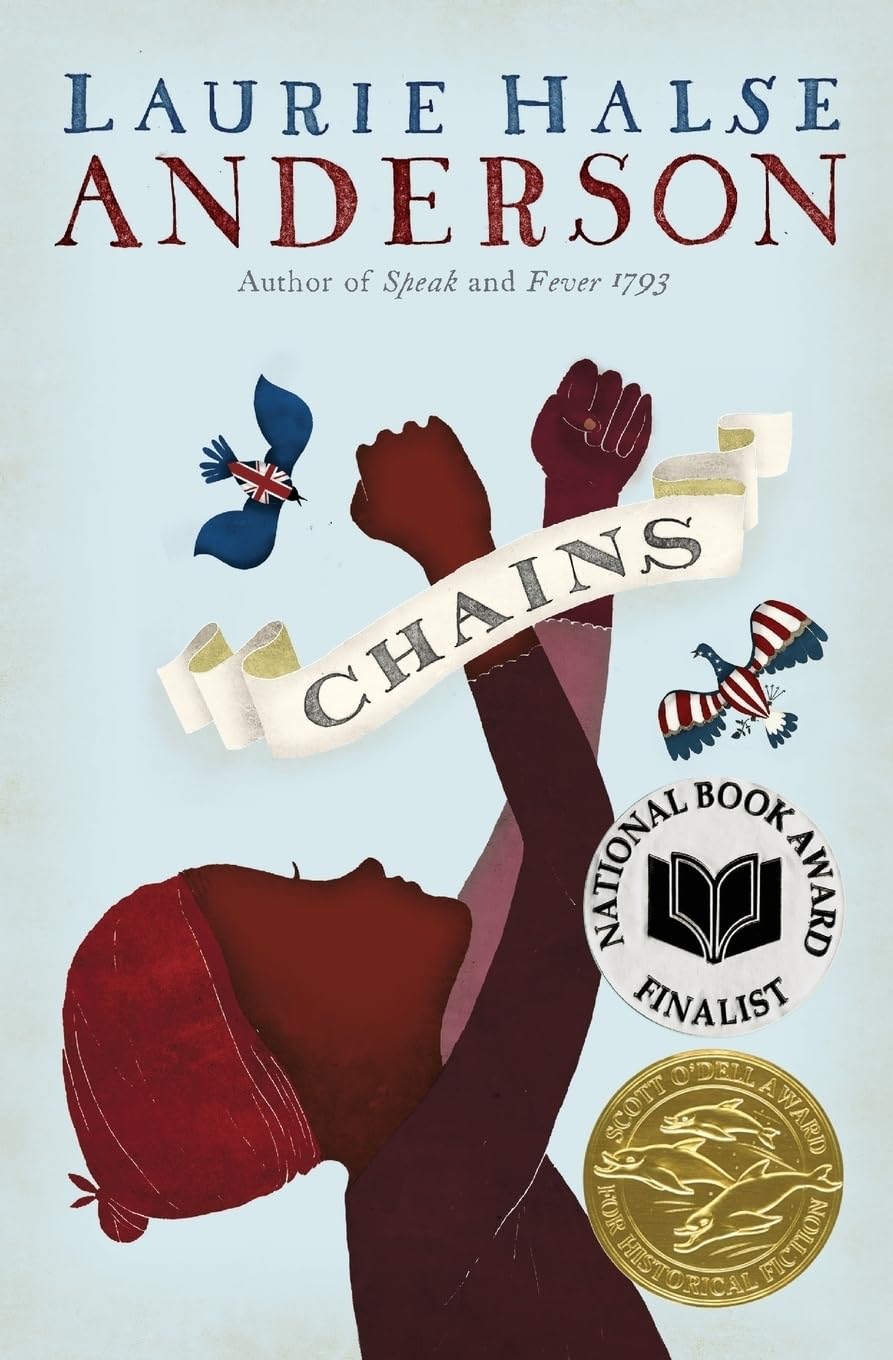
Chains by Laurie Halse Anderson is a fierce, meticulously researched, and deeply affecting novel about a thirteen-year-old enslaved girl named Isabel who finds herself sold into bondage in Revolutionary War New York City after the death of the woman who promised to free her — and who must navigate the competing demands of Patriot and Loyalist factions, neither of which has any interest in her freedom, while protecting her younger sister Ruth and finding a path to liberty entirely on her own terms. The first book in Anderson’s Seeds of America trilogy, it is one of the most important works of historical fiction for young readers published in the past twenty years: a novel that refuses to let the American Revolution be a simple story of freedom, and that insists on telling that story from the perspective of those for whom it changed nothing. This complete guide covers the reading level, age appropriateness, themes, characters, and everything parents and teachers need to know about this essential book.
For Parents
Chains is a novel about American slavery told with complete honesty and without any of the softening that makes some historical fiction about this period feel false. Best suited for readers ages 11-14, it is not a comfortable book and is not meant to be. The institution of slavery is depicted as the systematic dehumanization it was, and Isabel’s experience — her grief, her rage, her determination, and the specific daily indignities of her situation — is rendered with a precision and a moral seriousness that make it one of the most powerful novels about this period available to young readers. Parents who give their children this book are giving them one of the most important American stories ever written for this age range.
For Teachers
A Newbery Honor book well suited to grades 5-8, Chains is an exceptional text for teaching the American Revolution from a perspective that the standard historical narrative systematically excludes. Isabel’s situation — enslaved by Patriots, recruited by Loyalists, betrayed by both, and forced to act entirely on her own judgment — is the most pointed possible illustration of the hypocrisy at the heart of the Revolution’s freedom rhetoric. The novel pairs naturally with primary source documents about slavery, the Loyalist cause, and the specific history of slavery in Revolutionary New York, and its historical notes are among the most useful teaching appendices in the middle grade canon. Anderson’s prose is also a masterclass in first-person historical voice.
Chains at a Glance
Find on Amazon →| Author | Laurie Halse Anderson |
| Published | 2008 |
| Grade Level | 5-8 (our assessment) |
| Recommended Age | 11-14 |
| Flesch-Kincaid Grade | 5.2 |
| Word Count | ~93,000 |
| Pages | 316 (standard paperback) |
| Chapters | 45 |
| Genre | Historical fiction |
| Setting | Rhode Island and New York City, 1776 |
| Awards | Newbery Honor (2009); Scott O’Dell Award for Historical Fiction (2009) |
For official Lexile and AR levels, visit Lexile.com or AR BookFinder. ReadingVine provides independent editorial assessments.
What Reading Level Is Chains?
Chains reads at approximately a 5th-8th grade level by our editorial assessment, with a Flesch-Kincaid grade level of around 5.2. That score runs notably low for a novel most strongly associated with grades 5-8 and ages 11-14. Anderson writes in Isabel’s voice with a spare, controlled intensity that reflects Isabel’s character — a girl who has learned to observe everything and reveal nothing, whose prose has the tight, watchful quality of someone who cannot afford to be careless with words or with trust. The period vocabulary and the density of historical detail require more from readers than the sentence-level score suggests.
What makes the novel considerably more demanding than its F-K score indicates is the moral and emotional weight it asks readers to carry. Isabel’s situation is genuinely terrible, and Anderson does not soften it. Readers who engage fully with the novel’s historical reality — who understand what Isabel’s enslavement means, what the promises made to her were worth, and what the Revolution’s rhetoric of freedom meant to someone it explicitly excluded — will find the novel among the most powerful they have read at any level. It is most rewarding for readers at the upper end of the recommended range, and benefits substantially from classroom or family discussion.
The book is most commonly recommended for grades 5-8. For official Lexile and Accelerated Reader scores, visit Lexile.com or AR BookFinder.
What Age Is Chains Appropriate For?
We recommend Chains for readers ages 11-14. The novel depicts American slavery with historical honesty — the violence, the dehumanization, the specific daily indignities — and parents should be prepared for a book that does not offer comfort where comfort would be false.
Isabel is enslaved, and the novel depicts the reality of that condition with care and accuracy. She is threatened with violence, witnesses violence against other enslaved people, and is herself branded on the cheek as punishment for an act of defiance — the branding scene is one of the novel’s most difficult passages and is depicted with unflinching honesty. Her younger sister Ruth, who has seizures, is sold away from Isabel early in the novel — their separation is the novel’s most sustained source of grief and one of its most devastating illustrations of slavery’s specific cruelties. The historical context includes the Battle of New York and the British occupation of the city, including scenes of military violence. Isabel is subjected to the psychological cruelty of her enslaver, Madam Lockton, throughout the novel. There is no sexual content. The novel’s difficulty is entirely historical and moral, and every difficult element is handled with the seriousness and the craft of a Newbery Honor book. Parents who are concerned about the content should read it alongside their children — it is precisely the kind of book that rewards and deserves that shared attention.
Chains has been challenged in some school districts for its depiction of slavery, which is a remarkable fact worth noting: the challenges have come primarily from those who find its honest portrayal of American history uncomfortable. Most educators and librarians who have reviewed such challenges have found the novel’s historical honesty not only appropriate but essential, and it remains one of the most widely taught and most highly honored novels in the middle grade historical fiction canon.
What Is Chains About?
Isabel and her younger sister Ruth are enslaved in Rhode Island when the novel opens. Their owner, Miss Mary Finch, has promised to free them in her will — a promise that Isabel has held onto with everything she has. When Miss Finch dies, her nephew ignores the will and sells both girls to the Locktons, a wealthy Loyalist couple in New York City. It is the spring of 1776, and the city is a powder keg: Patriots and Loyalists are maneuvering for position, the Continental Army is preparing to defend the city, and the Revolution that promises liberty to all men is about to begin in earnest.
The Locktons are cold, self-interested, and entirely indifferent to Isabel and Ruth as human beings. Madam Lockton in particular is a study in the specific cruelty of people who have never been required to consider whether the people they own have inner lives. Isabel is required to work constantly, is given minimal food and shelter, and must manage her every expression with care — any sign of defiance is dangerous, and any sign of intelligence more dangerous still.
Isabel is approached by Patriot agents who want her to spy on the Locktons, who are indeed passing information to the British. She agrees, hoping that the Patriots — the people fighting for liberty — will help her secure her own. She spies. She delivers intelligence. And when she is caught and the Patriots can no longer use her, they abandon her completely, leaving her to face Madam Lockton’s punishment alone.
The punishment is a brand on her cheek — the letter I for insolence, seared into her face in front of other enslaved people as a warning. It is the novel’s most devastating moment, and it is also its moral turning point: Isabel understands, completely and permanently, that neither side in this war has any interest in her freedom. The Revolution is not her revolution. The only person who will secure her liberty is herself.
What follows is Isabel’s long, careful, entirely self-directed movement toward escape — not a dramatic flight but a patient accumulation of knowledge, resources, and courage, built in the margins of a life that has given her almost nothing to work with. Her friendship with Curzon, an enslaved boy who has been acting as a Patriot spy, gives her an ally and eventually something more complicated than an alliance. And Ruth’s absence — Ruth sold away to an unknown buyer, Ruth’s fate uncertain — is the wound that never closes and the reason every risk is worth taking.
Anderson conducted years of research into slavery in Revolutionary New York for the novel — a history that is largely absent from standard accounts of the Revolution — and the historical notes at the end of the novel are an essential companion to the story. Chains is the first book in the Seeds of America trilogy; Forge (2010) follows Curzon through the winter at Valley Forge, and Ashes (2016) concludes both storylines.
Chains Characters
Is Chains Banned?
Chains has been challenged in some school districts and appears on lists of books that have faced removal attempts, primarily due to its honest depiction of slavery including the branding scene. The challenges are notable precisely because they reveal the ongoing discomfort some communities have with honest historical accounts of American slavery in books assigned to young readers. The American Library Association and most educational organizations that have reviewed these challenges have defended the novel’s inclusion in curricula, noting that a novel about American slavery that softened its reality would be a form of historical dishonesty. The novel’s Newbery Honor and Scott O’Dell Award represent the broad institutional recognition of its historical and literary value, and it remains widely taught across the country.
Chains Themes and Lessons
The central theme of Chains is the hypocrisy at the heart of the American Revolution — the gap between the rhetoric of liberty and the reality of an institution that enslaved hundreds of thousands of people in the American colonies at the time the Declaration of Independence was signed. Anderson does not make this argument through editorializing; she makes it through Isabel’s experience. Isabel is recruited by Patriots who invoke freedom and abandon her the moment she is no longer useful. She is owned by Loyalists who invoke order and treat her as property. Neither side’s ideology has room for her actual humanity, and the novel’s argument — that the Revolution’s promise of liberty was always conditional on race and class in ways the standard narrative obscures — is made through the specificity and the honesty of Isabel’s story.
Agency and self-determination are the novel’s second great themes, rendered through Isabel’s gradual and costly movement toward a plan of her own. She spends much of the novel acting in service of other people’s plans — the Patriots’, the Loyalists’, the Locktons’ — and discovering that every one of them will sacrifice her without hesitation when their interests require it. The novel’s moral arc is Isabel’s recognition that she cannot rely on anyone else’s movement or anyone else’s ideology to secure her freedom, and her patient, determined, entirely self-directed building of a path out. This is not an inspirational arc in the conventional sense; it is a portrait of survival intelligence operating under conditions of genuine oppression.
Sisterhood and family are the novel’s emotional core. Every risk Isabel takes is ultimately for Ruth — to find her, to protect her, to refuse to leave her behind. The novel’s understanding of what slavery does to families — the specific, calculated cruelty of separating siblings, of making love itself a vulnerability — is one of the most important things it teaches, and it teaches it not through argument but through the sustained grief of a girl who cannot stop thinking about where her sister is.
Discussion starters for classrooms: What does it mean that both Patriots and Loyalists enslave people? Why do the Patriots abandon Isabel after she spies for them? What does the brand on Isabel’s cheek represent, and what does Isabel do with that meaning over the course of the novel? How does Ruth’s absence shape every decision Isabel makes? What does the novel suggest about whose history gets included in standard accounts of the Revolution, and whose gets left out?
How Many Pages and Chapters Are in Chains?
The standard paperback edition of Chains is 316 pages, divided into 45 chapters averaging around seven pages each. The word count is approximately 93,000 words — making it one of the longer novels commonly assigned in grades 5-8, and one that rewards the commitment it asks of its readers with a fully realized historical world and an unforgettable narrator. The short chapters move quickly and give the novel a propulsive forward momentum despite its considerable length.
For readers in the target age range of 11-14, expect a reading time of roughly 8-10 hours, or about two weeks of comfortable reading at 30 minutes per session. As a classroom text it works well in a three-to-four week unit, with substantial time reserved for the historical discussion the novel demands. Anderson’s historical notes at the end are essential reading and should be assigned alongside the novel — they provide context about slavery in Revolutionary New York that enriches every chapter. The novel pairs naturally with primary source documents about slavery, the Declaration of Independence, and the Loyalist perspective on the Revolution. Forge (2010) and Ashes (2016) complete the trilogy, with Forge following Curzon through Valley Forge and many teachers teaching both as a unit.
Books Similar to Chains
About Laurie Halse Anderson
Laurie Halse Anderson is one of the most important and most honored American authors writing for young readers today, known for fiction that confronts difficult historical and contemporary realities with unflinching honesty and extraordinary craft. She is the author of Speak (1999), a landmark novel about sexual assault that has helped generations of young readers find language for their own experiences, and of the Seeds of America trilogy — Chains (2008), Forge (2010), and Ashes (2016) — which represents the most sustained and most serious fictional reckoning with slavery in the American Revolution available to young readers. Chains received the Newbery Honor and the Scott O’Dell Award for Historical Fiction in 2009. Anderson conducted years of research into the history of slavery in Revolutionary New York for the trilogy, and the historical notes in all three books are among the most useful and most honest in the middle grade canon. She has spoken extensively about her conviction that young readers deserve access to the full, unvarnished truth of American history — that sanitizing that history is a form of disrespect both to the people who lived it and to the young readers who are inheriting its consequences. She lives in Pennsylvania.
Chains: Frequently Asked Questions
What reading level is Chains?
Chains has a Flesch-Kincaid grade level of approximately 5.2, which runs significantly low for a novel most strongly associated with grades 5-8 and ages 11-14. Our editorial assessment places it at grades 5-8. Isabel’s spare, controlled narrative voice accounts for much of the low score; the moral and emotional weight the novel asks readers to carry, and the density of historical context it requires, make it considerably more demanding than the number suggests. For official Lexile and AR scores, visit Lexile.com or AR BookFinder.
Were there really enslaved people fighting in the American Revolution?
Yes — on both sides. The British offered freedom to enslaved people who escaped from Patriot owners and joined the Loyalist cause, and thousands did so. Enslaved people also served in the Continental Army, sometimes in exchange for promises of freedom that were not always honored. Slavery in the northern colonies — including New York, where Chains is set — is a history that is substantially absent from standard Revolutionary War accounts but that Anderson researched extensively. Her historical notes at the end of the novel provide essential context, and the story of Black Americans in the Revolution is one of the most important and most underrepresented chapters in American history.
Why does Isabel spy for the Patriots if they own slaves too?
Because she is desperate and because the Patriots’ rhetoric — the language of liberty, of freedom from tyranny — gives her a fragile basis for hope that they might extend their principles to people like her. Isabel is not naive; she is calculating a risk. She trades intelligence for the promise of help, and the Patriots’ willingness to take everything she offers and give her nothing in return is the novel’s most pointed demonstration of the limits of their ideology. Her decision to spy is not a mistake on her part — it is a reasonable bet given her options — and the Patriots’ betrayal of her is not a surprise to the reader, though it is devastating. It is exactly what the novel has been building toward: the proof that neither side’s freedom was ever meant to include her.
What is the Scott O’Dell Award for Historical Fiction?
The Scott O’Dell Award for Historical Fiction is given annually to the most distinguished work of historical fiction for young readers set in the New World — North America, Central America, or South America. It was established by Scott O’Dell, the author of Island of the Blue Dolphins and Sing Down the Moon, who wanted to encourage the writing of serious historical fiction for young people. Chains won the award in 2009, the same year it received its Newbery Honor. Past winners include My Brother Sam Is Dead, The Witch of Blackbird Pond, and Lyddie.
Does Isabel find Ruth?
Ruth’s fate — her whereabouts, her welfare, whether Isabel will ever find her — is the emotional through-line of the entire Seeds of America trilogy. Chains ends without resolving this question, which is one of the most powerful things about it: the novel’s conclusion is not an ending but a beginning, Isabel’s escape from New York marking the start of a search rather than its completion. The trilogy’s subsequent volumes — Forge and Ashes — continue both Isabel’s and Curzon’s stories, and the question of Ruth is answered, though readers should be prepared for the answer to cost something.
Is Chains part of a series?
Yes — Chains is the first book in the Seeds of America trilogy. Forge (2010) follows Curzon through the winter at Valley Forge, where enslaved men served in the Continental Army in exchange for promises of freedom, and intersects with Isabel’s continuing story. Ashes (2016) brings both storylines to their conclusion. The three books can be read independently — Chains has a complete narrative arc of its own — but readers who finish Chains will almost universally want to continue with Forge, and many teachers assign both as a unit.
What grade is Chains typically assigned in?
Chains is most commonly assigned in grades 5, 6, 7, and 8, both as independent reading and as a classroom text. It is particularly well suited to units on the American Revolution that aim to present the period from multiple perspectives, including those of enslaved people, women, and Loyalists. Anderson’s historical notes are essential assigned reading alongside the novel. It pairs naturally with primary source documents about slavery, the Declaration of Independence, and the British offer of freedom to enslaved Patriots’ property. It is also widely taught alongside Forge as a two-book unit on the Revolution’s excluded voices.