
 = Partner Site
Lyddie Reading Level: A Complete Guide
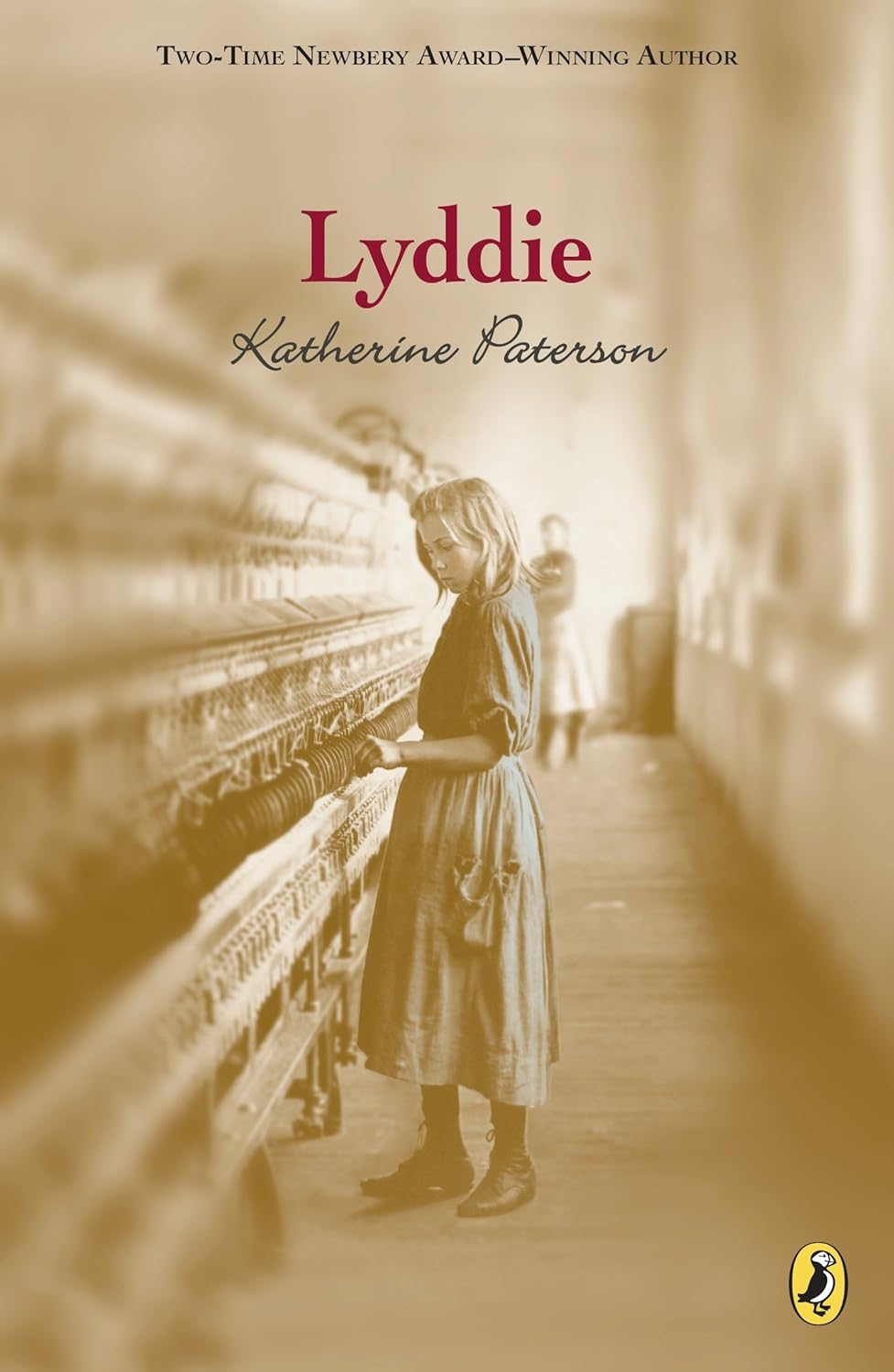
Lyddie by Katherine Paterson is a fierce, unsentimental, and deeply moving novel about a Vermont farm girl named Lyddie Worthen who goes to work in the textile mills of Lowell, Massachusetts in the 1840s, determined to earn enough money to pay off her family’s debts and reclaim her home. One of the most important works of historical fiction in the middle grade canon, it is a novel about economic independence, the early American labor movement, the cost of ambition, and what it means for a young woman in the 19th century to refuse to be defined by her circumstances. This complete guide covers the reading level, age appropriateness, themes, characters, and everything parents and teachers need to know about this essential book.
For Parents
Lyddie is a novel about a girl who wants to be free and who discovers that freedom in the 1840s for a young woman without money or connections is far more complicated than she anticipated. Best suited for readers ages 10-13, it deals honestly with industrial labor conditions, economic exploitation, sexual harassment, and the limited options available to women in 19th-century America. None of this is depicted gratuitously, and the novel’s portrait of Lyddie’s intelligence, determination, and refusal to be diminished is one of the most powerful in middle grade historical fiction. Parents who give their children this book are giving them a story about a girl who fights for herself with everything she has.
For Teachers
A widely taught novel well suited to grades 5-7, Lyddie is an exceptional text for teaching the early American labor movement, the history of women’s work, and the specific social and economic conditions that gave rise to abolitionism and women’s suffrage in the mid-19th century. Lyddie’s arc — from isolated farm girl to mill worker to someone who begins to understand her situation in political terms — mirrors the historical arc of the women who organized the first American labor unions, and discussing that parallel opens some of the richest historical discussions available at this grade level. The novel also raises genuine ethical complexity about the choices Lyddie makes and the choices available to her.
Lyddie at a Glance
Find on Amazon →| Author | Katherine Paterson |
| Published | 1991 |
| Grade Level | 5-7 (our assessment) |
| Recommended Age | 10-13 |
| Flesch-Kincaid Grade | 5.8 |
| Word Count | ~56,000 |
| Pages | 182 (standard paperback) |
| Chapters | 24 |
| Genre | Historical fiction |
| Setting | Vermont; Lowell, Massachusetts, 1843-1846 |
| Awards | ALA Notable Children’s Book; ALA Best Book for Young Adults |
For official Lexile and AR levels, visit Lexile.com or AR BookFinder. ReadingVine provides independent editorial assessments.
What Reading Level Is Lyddie?
Lyddie reads at approximately a 5th-7th grade level by our editorial assessment, with a Flesch-Kincaid grade level of around 5.8. Paterson writes in a voice that reflects Lyddie’s New England plainness and determination — spare, direct, occasionally dry, and possessed of the particular precision of someone who says exactly what she means and means everything she says. The prose is clean and accessible, and Lyddie’s voice is one of the most distinctive in middle grade historical fiction: unmistakably 19th-century in its rhythms without being archaic, grounded in the physical reality of farm and mill work, and shot through with the iron will of a girl who has decided she will not be beaten.
The novel’s historical context — the Lowell textile mills, the early labor movement, the specific economics of women’s work in the 1840s — rewards and benefits from classroom or family discussion. Readers who bring historical knowledge to the novel will feel its stakes more fully; those who don’t will find the context builds naturally through the story. The ethical complexity of the novel’s ending — a deliberate choice by Paterson that has generated genuine classroom debate for thirty years — makes it one of the more demanding texts at this level for discussion, even if the reading itself is accessible.
The book is most commonly recommended for grades 5-7. For official Lexile and Accelerated Reader scores, visit Lexile.com or AR BookFinder.
What Age Is Lyddie Appropriate For?
We recommend Lyddie for readers ages 10-13. The novel deals honestly with industrial labor exploitation, economic desperation, and sexual harassment in the workplace. These are handled with restraint and historical accuracy, but parents should be prepared for a novel that takes the difficulties of a young woman’s life in the 1840s seriously.
The mill conditions depicted in the novel are genuinely harsh: long hours, dangerous machinery, cotton dust that damages workers’ lungs, and supervisors who have significant power over the girls in their charge. An overseer named Mr. Marsden attempts to sexually coerce Lyddie — this is handled with period-appropriate circumspection rather than graphic description, but it is real and Lyddie’s response to it is the novel’s most charged ethical moment. A fellow mill girl is dismissed from her position, and the consequences for women who lose their jobs and their boarding house places in this era are made clear without being sensationalized. Lyddie’s family is dispersed early in the novel — her mother is taken to an asylum, her siblings are sent to work for other families, her brother runs away — and the specific loneliness of a child who has lost her family to poverty is a sustained emotional note throughout. There is no sexual content beyond what is described above and no graphic violence. The novel’s difficulty is historical, emotional, and ethical.
Lyddie has been occasionally challenged in schools over its depiction of sexual harassment and its morally complex ending, and it remains one of the most frequently taught novels in the middle grade canon. The challenges themselves are worth discussing with students: the topics the novel raises — economic exploitation, workplace harassment, the limited options available to women without economic independence — are exactly the topics a novel about this period of American history should raise.
What Is Lyddie About?
Lyddie Worthen is thirteen years old when her mother, overwhelmed by debt and isolation after her father’s disappearance, locks up the Vermont farmhouse and disperses the family. Her mother goes to her brother’s household. Her younger siblings are hired out to neighboring farms. Her brother Charlie goes with one family, her baby sister Rachel with another. Lyddie is left essentially alone, determined to do one thing: earn enough money to pay off the family’s debts, reclaim the farm, and bring the family back together.
She goes first to work at a tavern, where the labor is hard and the pay is minimal. Then she hears about the mills in Lowell, Massachusetts, where a girl can earn real wages — more than she could make in years of tavern work — if she can survive the conditions. She goes to Lowell and becomes a mill girl, one of thousands of young women from New England farms who work the looms in the great textile factories that are making Lowell one of the most productive industrial cities in America.
The work is brutal. The mills run from before dawn to after dark, with thirty-minute breaks for meals. The air is thick with cotton fiber. The machinery is deafening and dangerous. The girls live in company boarding houses under strict rules, supervised by older women called boarding house keepers who report to the mill owners. They are paid better than almost any other work available to women in 1840s America, and they are completely under the control of the companies that employ them.
Lyddie is good at the work. She is fast, strong, and focused, and she takes on more and more looms as her skill increases, earning more money with each addition. She is also reading — teaching herself from a copy of Oliver Twist that a fellow worker lends her — and her growing literacy is one of the novel’s most important threads: the connection between education and the ability to understand and articulate one’s own situation.
Around Lyddie the labor movement is forming. The mill girls are beginning to organize, to petition the legislature for shorter hours, to understand their collective power. Lyddie is aware of this and resistant to it: joining the movement risks her job, and her job is the only path to her goal. Her refusal to sign the petition — her determination to keep her head down and earn her money and leave — is the novel’s central ethical tension, and the consequences of that refusal, and of an act of courage she finally cannot avoid, are where the novel finds its most complex and most honest territory.
Katherine Paterson has spoken about Lyddie as a novel about the price of freedom — about the fact that economic independence, for a woman in the 1840s, required a set of sacrifices and a set of losses that men’s economic independence did not require, and that the novel’s ending honors both Lyddie’s achievement and its cost.
Lyddie Characters
Is Lyddie Banned?
Lyddie has been challenged in some school districts and removed from some libraries and curricula, primarily due to its depiction of sexual harassment and its morally ambiguous ending. The challenges typically cite the sexual harassment scene involving Mr. Marsden as inappropriate for the intended age group. Most educators and librarians who have reviewed these challenges have found the depiction appropriate, historically grounded, and handled with restraint — and have noted that a novel about a young woman’s working life in the 1840s that omitted this element would be significantly less honest. The novel remains widely taught and widely available.
Lyddie Themes and Lessons
The central theme of Lyddie is economic independence — the specific, concrete meaning of money for a young woman in the 1840s, and the specific, concrete price of getting it. Lyddie’s goal is not abstract: she wants the farm, she wants her family back, she wants to be beholden to no one. The mill is the only instrument available to her for achieving this, and she pursues it with a single-mindedness that is both admirable and costly. The novel’s argument is not that Lyddie is wrong to want independence, but that the path to it, for a woman in this period, runs directly through the exploitation of the very system she is trying to use.
Solidarity and self-interest are the novel’s central ethical tension. The mill girls around Lyddie are organizing — petitioning, collecting signatures, risking their jobs for a shorter working day that would benefit everyone including Lyddie. Lyddie refuses to sign because signing risks the job that is her only path to her goal. Her refusal is not cowardice; it is calculation, the calculation of someone who cannot afford to be idealistic. But Diana’s fate — what happens to a woman who organizes and is dismissed — demonstrates the cost of that calculation with complete historical honesty: the movement requires individual sacrifice, and Lyddie’s refusal to contribute to it while benefiting from its eventual gains is the novel’s most uncomfortable ethical question.
Literacy is the novel’s third great theme and its quietest. Lyddie teaches herself to read — haltingly, then fluently — from Oliver Twist, and the novel draws a direct line between her growing literacy and her growing ability to understand and articulate her own situation. Education, in Lyddie, is not an ornament; it is the instrument by which a person begins to see the system they are living inside, and the novel’s ending — in which Lyddie makes a choice that requires seeing her situation clearly — is possible only because she has learned to read.
Discussion starters for classrooms: Why does Lyddie refuse to sign the petition? Is her refusal understandable? Is it right? What does Diana’s fate demonstrate about the limits of individual courage? What does Oliver Twist mean to Lyddie, and why does Paterson choose that particular book? What does Lyddie give up at the novel’s end, and what does she gain? How does the novel’s ending compare to the endings students expected or wanted?
How Many Pages and Chapters Are in Lyddie?
The standard paperback edition of Lyddie is 182 pages, divided into 24 chapters averaging around seven to eight pages each. The word count is approximately 56,000 words. The chapters are compact and forward-moving, and the novel’s two-part structure — Vermont and Lowell — gives it a natural shape: a before and an after, with Lyddie’s arrival at the mills as the hinge between them.
For readers in the target age range of 10-13, expect a reading time of roughly 5-7 hours, or about a week and a half of comfortable reading at 30 minutes per session. As a classroom text, the novel works well in a two-to-three week unit, with substantial time reserved for the discussion the ending generates — Paterson’s choice is deliberate and has been generating productive disagreement in classrooms for thirty years, and teachers who plan for extended discussion of the final chapters will use that time well. The novel pairs naturally with primary source materials about the Lowell mills and the early labor movement, which provide the historical context that makes Lyddie’s individual story legible as part of a larger history.
Books Similar to Lyddie
About Katherine Paterson
Katherine Paterson is one of the most celebrated American children’s authors of the 20th century, winner of two Newbery Medals — for Bridge to Terabithia (1978) and Jacob Have I Loved (1981) — and two National Book Awards. Born in China to missionary parents and raised between China and the American South, she brings to all her work a historical consciousness and a moral seriousness that distinguish it from most children’s fiction of any era. Lyddie, published in 1991, drew on her research into the Lowell mill system and the early American labor movement and is widely considered one of her finest works outside the Newbery Medal books. She has spoken about Lyddie’s ending as the choice she is most frequently asked to defend — and as the choice she is most certain of: a novel about economic independence for women in the 1840s that gave Lyddie an easy ending would have been a lie. Her other notable works include The Great Gilly Hopkins (1978), Rebels of the Heavenly Kingdom (1983), and Jip: His Story (1996). She lives in Vermont.
Lyddie: Frequently Asked Questions
What reading level is Lyddie?
Lyddie has a Flesch-Kincaid grade level of approximately 5.8. Our editorial assessment places it at grades 5-7 (ages 10-13). The prose is spare and accessible, but the historical context — the Lowell mills, the early labor movement, the specific economics of women’s work in the 1840s — rewards and benefits from paired classroom discussion. The ethical complexity of the ending makes it one of the more demanding texts at this level for discussion. For official Lexile and AR scores, visit Lexile.com or AR BookFinder.
What were the Lowell mills?
The Lowell mills were a system of large textile factories established in Lowell, Massachusetts in the 1820s and 1830s that became one of the most significant industrial enterprises in early American history. They employed primarily young women from New England farms — known as “mill girls” — who lived in company-owned boarding houses under strict rules and worked twelve to fourteen hours a day for wages that, while low by later standards, were higher than almost any other employment available to women in this era. By the 1840s, the conditions had deteriorated significantly as the factory owners increased production demands, and the mill girls began organizing — petitioning the Massachusetts legislature for shorter hours and better conditions — in what became one of the first labor organizing efforts in American history. The Lowell mills are now a National Historical Park.
Why does Lyddie refuse to sign the petition?
Because signing the petition risks her job, and her job is the only path to her goal — paying off the farm’s debts and reuniting her family. Lyddie’s refusal is not ignorance or indifference; she understands what the petition is for and she knows it would benefit her. She refuses because she cannot afford the risk. This is the novel’s central ethical tension, and Paterson does not resolve it easily: Lyddie is not wrong that signing is risky, and she is not wrong that her goal requires her job. What the novel demonstrates, through Diana’s fate and the movement’s eventual gains, is the cost of individual calculation in the face of collective need — and the question of whether Lyddie’s refusal is understandable or indefensible is one of the most productive discussions the novel generates.
What happens at the end of Lyddie?
Lyddie reports Mr. Marsden’s harassment of Brigid and is dismissed from the mill as a result — the novel’s honest demonstration that individual courage without institutional protection has a cost. She does not go home to the farm, which has been sold. She does not immediately accept Luke’s offer of marriage. Instead, in the novel’s final pages, she decides to go to Oberlin College — one of the first American colleges to admit women — to get the education that will make her genuinely free rather than merely employed. This ending has generated more classroom debate than almost any other in middle grade fiction: some readers find it triumphant, some find it lonely, some find it incomplete. Paterson has said it is the ending that is truest to Lyddie and truest to history.
Why does Lyddie read Oliver Twist?
A fellow mill worker lends Lyddie a copy of Dickens’s novel, and Lyddie — who is teaching herself to read — works through it slowly and then obsessively. Oliver Twist is a novel about an orphan exploited by the economic system of industrial England, and its presence in Lyddie is not accidental: Paterson is drawing a direct line between the economic exploitation Dickens depicted in 1830s England and the exploitation Lyddie is experiencing in 1840s America. Lyddie’s ability to read Oliver Twist is also a measure of her growing literacy and her growing ability to see her own situation in larger terms. By the end of the novel, she has moved from sounding out individual words to reading fluently — a transformation that mirrors her political and personal transformation.
Is Lyddie based on a true story?
Lyddie is a fictional character, but the world she inhabits is meticulously researched and historically accurate. The Lowell mills existed exactly as described. The labor organizing efforts — the petitions, the turnouts, the dismissals of organizers — are historically documented. The boarding house system, the overseer structure, the specific conditions of mill work in the 1840s are all drawn from historical sources. Katherine Paterson has spoken about her research into the real women who worked in the Lowell mills and organized the first American textile labor unions, and Lyddie is best understood as a fictional character through whom a real and important history is made personal and immediate.
What grade is Lyddie typically assigned in?
Lyddie is most commonly assigned in grades 5, 6, and 7, both as independent reading and as a classroom text. It is particularly well suited to units on the Industrial Revolution, the early American labor movement, women’s history, and 19th-century American social history. Most teachers pair it with primary source materials about the Lowell mills and the labor movement. It is also widely taught in units on historical fiction alongside Chains, Roll of Thunder, Hear My Cry, and other novels that present American history from the perspective of the economically and socially marginalized.