
 = Partner Site
Sing Down the Moon Reading Level: A Complete Guide
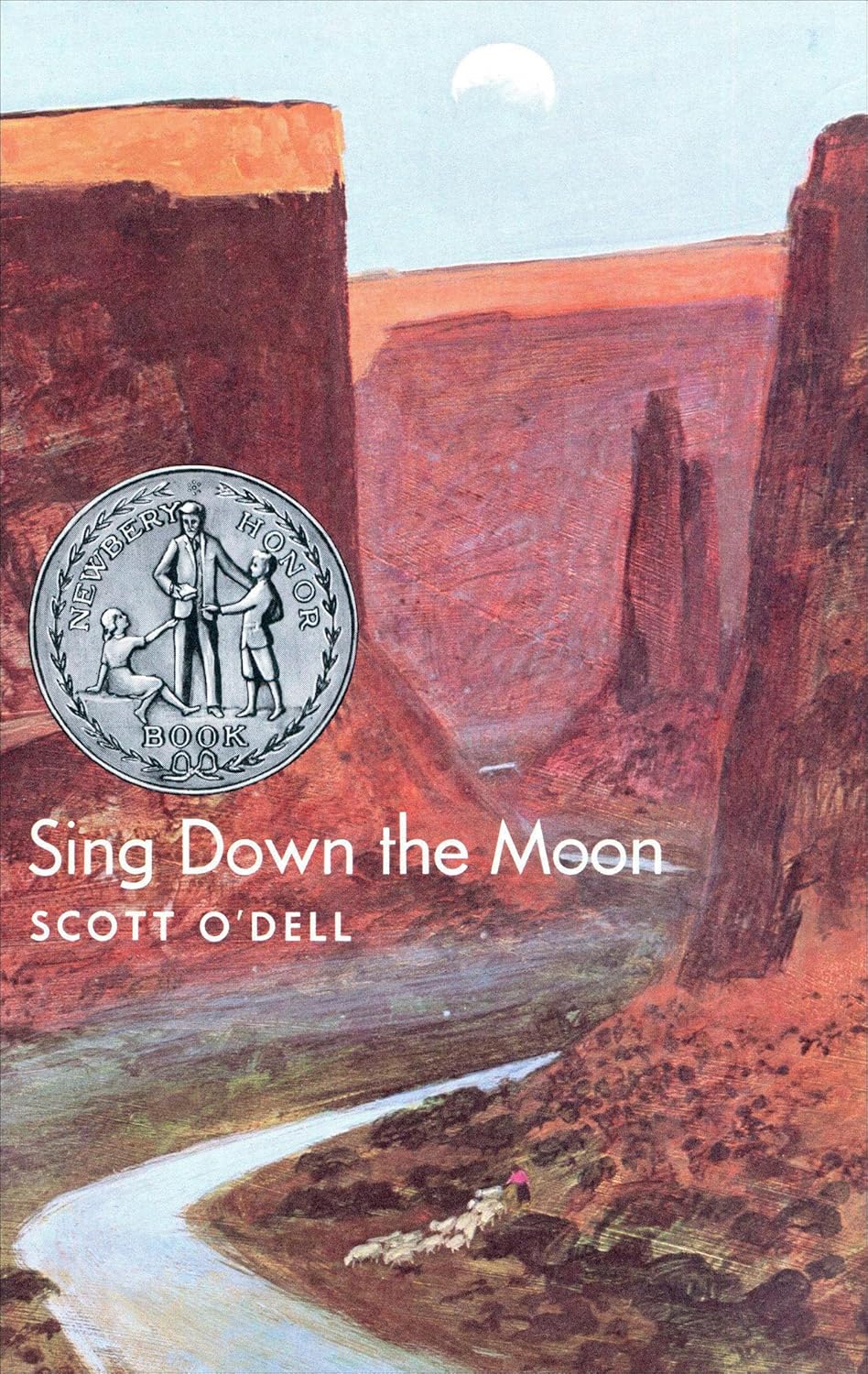
Sing Down the Moon by Scott O’Dell is a spare, devastating, and quietly extraordinary novel told through the eyes of a young Navajo girl named Bright Morning who witnesses the Long Walk of 1864 — the forced removal of the Navajo people from their homeland in Canyon de Chelly by the United States Army under Kit Carson. One of the most important works of historical fiction in the middle grade canon, it tells the story of a historical atrocity from the inside, through the consciousness of a child who survives it, with a restraint and a dignity that make it more powerful than any amount of explicit description could. This complete guide covers the reading level, age appropriateness, themes, characters, and everything parents and teachers need to know about this essential book.
For Parents
Sing Down the Moon is a novel about one of the most painful chapters in American history, told with the restraint and moral clarity of a narrator who does not editorialize because she does not need to — what she witnesses speaks for itself. Best suited for readers ages 10-13, it deals honestly with forced removal, captivity, and the destruction of a way of life. It is not a comfortable book, and it is not meant to be. Parents who want their children to understand American history more fully — to encounter it from the perspective of those who bore its costs rather than those who imposed them — will find it one of the most important books they can give.
For Teachers
A Newbery Honor book well suited to grades 5-7, Sing Down the Moon is an exceptional text for teaching narrative restraint, perspective and whose history gets told, and the specific demands of historical fiction that takes seriously the experience of people who have been marginalized by mainstream accounts. Bright Morning’s refusal to editorialize — her habit of stating what happened without explaining what it means — is itself a craft choice worth extended discussion. The novel pairs naturally with units on Native American history, westward expansion, and the Long Walk, and with nonfiction resources that provide the historical context Bright Morning’s perspective cannot supply.
Sing Down the Moon at a Glance
Find on Amazon →| Author | Scott O’Dell |
| Published | 1970 |
| Grade Level | 5-7 (our assessment) |
| Recommended Age | 10-13 |
| Flesch-Kincaid Grade | 5.0 |
| Word Count | ~28,000 |
| Pages | 137 (standard paperback) |
| Chapters | 22 |
| Genre | Historical fiction |
| Setting | Canyon de Chelly, Arizona; Bosque Redondo, New Mexico, 1863-1865 |
| Awards | Newbery Honor (1971) |
For official Lexile and AR levels, visit Lexile.com or AR BookFinder. ReadingVine provides independent editorial assessments.
What Reading Level Is Sing Down the Moon?
Sing Down the Moon reads at approximately a 5th-7th grade level by our editorial assessment, with a Flesch-Kincaid grade level of around 5.0. O’Dell writes in Bright Morning’s voice with a spare, declarative style that reflects both her character and the oral storytelling tradition from which her world emerges — short sentences, precise observations, no word wasted, no emotion named that is not first earned. The prose is accessible to strong 5th grade readers, but the historical context the novel assumes — and the emotional complexity it withholds from the surface while making fully available to careful readers — rewards the upper end of the recommended age range.
What makes the novel more demanding than its word-level score suggests is its restraint. Bright Morning does not explain what the Long Walk means, does not name the injustice in political terms, does not tell readers how to feel. She states what happened. The weight of what she states is the novel’s primary emotional demand, and readers who bring historical knowledge to it — who understand what the Long Walk was, what Kit Carson did, what Bosque Redondo meant for the Navajo people — will find the novel almost unbearably powerful. Readers who lack that context will benefit enormously from the paired nonfiction resources that most teachers use alongside it.
At just 137 pages, the novel is deceptively brief. It earns every one of them. The book is most commonly recommended for grades 5-7. For official Lexile and Accelerated Reader scores, visit Lexile.com or AR BookFinder.
What Age Is Sing Down the Moon Appropriate For?
We recommend Sing Down the Moon for readers ages 10-13. The novel deals with forced removal from ancestral land, captivity by Mexican slave traders, the destruction of crops and livestock by soldiers, the forced march of an entire people hundreds of miles in winter, and the experience of living in an internment camp. All of this is depicted with restraint rather than graphic detail, but the historical reality it represents is genuinely terrible, and parents should be prepared for children who have serious questions after reading it.
Bright Morning is captured by Mexican slave traders early in the novel — a frightening episode that is resolved, but not without violence and genuine danger. The Long Walk itself — the forced march of approximately 8,000-10,000 Navajo people three hundred miles to Bosque Redondo — is depicted through Bright Morning’s experience of it: the cold, the exhaustion, the deaths of people along the way. These deaths are stated rather than described in detail, but they are present. The conditions at Bosque Redondo are depicted as miserable — bad water, poor food, inadequate shelter. A romantic relationship between Bright Morning and a young man named Tall Boy is central to the novel; it is entirely chaste. There is no sexual content. The novel’s difficulty is entirely historical and emotional, and O’Dell handles it with the care and restraint of a Newbery Honor book.
For students studying westward expansion, Native American history, or the specific history of the Navajo Long Walk, the novel provides an invaluable perspective that no textbook account can replicate: the experience of these events from the inside, through the consciousness of a young woman who lived them. Parents who read it alongside their children will find it opens conversations about American history that are difficult, necessary, and long overdue.
What Is Sing Down the Moon About?
Bright Morning is a young Navajo girl who lives with her family in the Canyon de Chelly in what is now northeastern Arizona — a place her people have called home for generations, a landscape of red stone and sheep and the particular beauty of a life rooted in a specific place. The novel opens in this world and renders it with the precise affection of someone who knows it well: the sheep Bright Morning tends, the corn her family grows, the specific rhythm of a life organized around the seasons and the land.
That world begins to come apart in stages. First, Bright Morning and a friend are captured by Mexican slave traders and taken south to work as servants. She escapes with Tall Boy, a young man who rescues her but is wounded in the attempt — an injury that permanently limits his right arm and that shadows everything that follows. The two return home, and the novel pauses in the Canyon for a chapter or two of restored peace before the larger catastrophe descends.
In 1863 and 1864, the United States Army, under the command of Kit Carson, conducts a campaign to force the Navajo people from their homeland. Carson’s method is systematic destruction: he burns the crops, kills or drives off the livestock, destroys the orchards and the food stores, and makes the Canyon de Chelly uninhabitable. Families who do not surrender are hunted. Bright Morning watches her world dismantled piece by piece until there is nothing left to defend.
The Long Walk begins in the winter of 1864: approximately 8,000 to 10,000 Navajo people marched three hundred miles east to Bosque Redondo, a reservation on the Pecos River in New Mexico, where the Army intends to hold them until they abandon their traditional way of life. People die on the march. People die at Bosque Redondo. The conditions are terrible and the land is wrong — alkaline water, insufficient food, no wood for fires, soil that will not grow the crops the Navajo know how to grow.
Bright Morning survives. She marries Tall Boy. She has a child. And in 1868, when the United States government finally acknowledges the failure of Bosque Redondo and allows the Navajo to return to their homeland, Bright Morning walks back — three hundred miles, in the opposite direction, toward the Canyon that has never stopped being home. The novel’s final pages, in which she approaches the Canyon and finds it beginning, slowly, to recover, are among the most quietly powerful in American children’s literature.
Scott O’Dell won the Newbery Medal for Island of the Blue Dolphins in 1961 and later established the Scott O’Dell Award for Historical Fiction, given annually to the most distinguished work of historical fiction for young readers set in the New World. Sing Down the Moon is widely considered his second-finest work and the one that most directly confronts the American government’s treatment of Native peoples.
Sing Down the Moon Characters
Is Sing Down the Moon Banned?
Sing Down the Moon has not been widely banned or challenged in the conventional sense. It has, however, been the subject of ongoing scholarly and educational discussion about the ethics of a non-Native author representing Navajo interiority — O’Dell was not Navajo, and some Native scholars and educators have raised substantive questions about whether his portrayal of Bright Morning’s voice and inner life is accurate or appropriate. This is a legitimate critical conversation, not a banning effort, and it is worth raising in classrooms that use the novel. Most educators who teach it pair it with perspectives from Navajo and other Native American voices, and treat O’Dell’s novel as an entry point rather than a definitive account. The novel has remained in print and in classrooms for more than fifty years, and its Newbery Honor reflects the educational community’s longstanding recognition of its literary and historical value.
Sing Down the Moon Themes and Lessons
The central theme of Sing Down the Moon is the relationship between a people and their land — the specific, irreplaceable attachment of the Navajo to Canyon de Chelly, and what it means to be removed from that land by force. Bright Morning’s identity is not separable from the Canyon; she is who she is because of the place she comes from, and the novel’s deepest grief is not for the hardships of Bosque Redondo — as real as those are — but for the Canyon itself, emptied of the people who belonged to it. Her determination to return, and her return, is the novel’s answer to that grief: not triumphant, not without cost, but real.
Resilience is the novel’s second great theme, and O’Dell renders it without sentimentality. Bright Morning does not survive the Long Walk because she is exceptional or because she is protected by luck or by narrative convenience. She survives because she is determined — determined to return to the Canyon, determined to keep Tall Boy alive, determined to bring her child home to the land that is his inheritance. That determination is not dramatic. It is quiet, daily, and completely unrelenting, which is exactly what resilience actually looks like.
The novel is also, implicitly, a meditation on whose history gets told and from whose perspective. Bright Morning never names Kit Carson. She does not know, and does not need to know, the name of the officer who ordered her world destroyed. The soldiers are not characters; they are forces, like weather. This narrative choice — staying entirely inside Bright Morning’s perspective and refusing to give the perpetrators of the Long Walk the dignity of characterization — is one of the novel’s most important political and artistic decisions, and one of the most productive things teachers can discuss with students who are reading it.
Discussion starters for classrooms: Why does Bright Morning never name Kit Carson or the soldiers who carry out the Long Walk? What does the Canyon de Chelly mean to Bright Morning beyond being a place she lives? How does Tall Boy’s injury change him, and what does the novel suggest about what that change costs him? What does Bright Morning’s decision to return home — even when return is dangerous and uncertain — tell us about her? What would you want students to know about the real Long Walk that the novel doesn’t directly explain?
How Many Pages and Chapters Are in Sing Down the Moon?
The standard paperback edition of Sing Down the Moon is 137 pages, divided into 22 short chapters averaging around six pages each. The word count is approximately 28,000 words — making it one of the shorter Newbery Honor books and one of the most compressed historical novels in the middle grade canon. The brevity is a feature, not a limitation: O’Dell packs an extraordinary amount of historical and emotional weight into each page, and the novel’s restraint — what it chooses not to say — is as important as what it does say.
For readers in the target age range of 10-13, expect a reading time of roughly 3-4 hours, or about a week of comfortable reading at 20-30 minutes per session. As a classroom text, the novel works extremely well in a two-week unit, with the first week covering the Canyon and captivity sections and the second week covering the Long Walk and Bosque Redondo. The historical context it requires — the Navajo Long Walk, Kit Carson, Bosque Redondo, the Treaty of 1868 — is best provided through paired nonfiction reading, and teachers who supply that context find the novel lands with significantly more force. It pairs naturally with Island of the Blue Dolphins for a unit on O’Dell, or with Chains and Number the Stars for a unit on historical fiction told from the perspective of the displaced and the persecuted.
Books Similar to Sing Down the Moon
About Scott O’Dell
Scott O’Dell (1898-1989) was born in Los Angeles and grew up in various Southern California communities, developing the deep familiarity with the American Southwest and its histories that runs through his best work. He won the Newbery Medal in 1961 for Island of the Blue Dolphins — his first novel for young readers, published when he was sixty-one — and went on to write more than two dozen books for young people, many of them historical fiction set in the Americas and centering on the experiences of those who have been marginalized by mainstream American historical accounts. Sing Down the Moon, published in 1970, received a Newbery Honor in 1971 and is widely considered his second-finest work. In 1982 he established the Scott O’Dell Award for Historical Fiction, given annually to the most distinguished work of historical fiction for young readers set in the Americas — a prize that has recognized books including My Brother Sam Is Dead, The Witch of Blackbird Pond, and Chains. He died in 1989 at the age of ninety-one, leaving a body of work that consistently advocated for the perspectives of Native Americans, women, and other groups whose experiences had been omitted from the historical record available to young readers.
Sing Down the Moon: Frequently Asked Questions
What reading level is Sing Down the Moon?
Sing Down the Moon has a Flesch-Kincaid grade level of approximately 5.0. Our editorial assessment places it at grades 5-7 (ages 10-13). The prose is spare and accessible, but the historical weight the novel carries — and the emotional complexity it withholds from the surface while making fully available to careful readers — exceeds the word-level score significantly. Paired nonfiction context about the Long Walk substantially increases the novel’s impact. For official Lexile and AR scores, visit Lexile.com or AR BookFinder.
What was the Long Walk of the Navajo?
The Long Walk refers to the forced removal of the Navajo people from their homeland in the Four Corners region — primarily the Canyon de Chelly area of what is now northeastern Arizona — to Bosque Redondo, a reservation on the Pecos River in eastern New Mexico, carried out by the United States Army between 1863 and 1866. Approximately 8,000 to 10,000 Navajo people were marched roughly three hundred miles under military guard, primarily in the winter of 1864. Hundreds died on the march from cold, exhaustion, and violence. At Bosque Redondo, the Navajo were held for four years in conditions of severe hardship — insufficient food, alkaline water, inadequate shelter, and soil unsuited to the crops they knew how to grow. In 1868 the United States government signed the Treaty of Bosque Redondo, acknowledging the failure of the internment and allowing the Navajo to return to a portion of their homeland. The Long Walk is a central event in Navajo history and cultural memory.
Why doesn’t Bright Morning name Kit Carson?
Bright Morning stays entirely inside her own perspective and her own knowledge — she is a young Navajo woman living through events she can witness and suffer but whose political and military architecture she has no access to. She does not know Kit Carson’s name. She does not know the name of the officer who ordered her world destroyed. The soldiers are not characters in her story; they are forces, like drought or fire — present, damaging, and not requiring individual identification to be understood. This narrative choice is one of the most important and most discussed in the novel: O’Dell is refusing to give the perpetrators of the Long Walk the dignity of characterization, keeping the reader’s attention entirely on the experience of those who were displaced. Teachers often use this choice as a starting point for discussions about perspective, whose story gets told, and what it means to remain entirely inside a narrator’s limited but morally authoritative point of view.
What is Canyon de Chelly?
Canyon de Chelly (pronounced “d’SHAY,” from the Navajo Tséyi’, meaning “rock canyon”) is a canyon system in northeastern Arizona that has been home to Native peoples for nearly five thousand years, including the Ancestral Puebloans and, most recently, the Navajo. It is now a National Monument administered jointly by the National Park Service and the Navajo Nation — one of the few National Monuments located entirely within a Native American reservation and managed in partnership with the tribe whose land it occupies. The canyon walls contain thousands of archaeological sites and are considered sacred by the Navajo people. Its destruction by Kit Carson’s forces — the burning of the orchards, the killing of livestock, the driving out of families — is one of the Long Walk’s most specific and most mourned losses.
Is Sing Down the Moon historically accurate?
The major historical facts are accurate: the Long Walk occurred, Kit Carson led the campaign, Bosque Redondo was the destination, the conditions there were as described, and the Treaty of 1868 allowed the Navajo to return. O’Dell conducted research and the broad outlines of Bright Morning’s experience are consistent with historical accounts. Some Native scholars have raised questions about whether a non-Native author can accurately represent Navajo interiority and cultural specificity — this is a legitimate scholarly conversation that teachers should be aware of and can productively bring into classroom discussion. O’Dell’s novel is best understood as historical fiction grounded in research rather than as an authoritative account of Navajo experience, and pairing it with perspectives from Navajo writers and historians enriches and complicates the picture it offers.
What grade is Sing Down the Moon typically assigned in?
Sing Down the Moon is most commonly assigned in grades 5, 6, and 7, both as independent reading and as a classroom text. It is particularly well suited to units on Native American history, westward expansion, and the treatment of Indigenous peoples by the United States government. Most teachers who use it provide substantial nonfiction context about the Long Walk and Bosque Redondo alongside the novel. It pairs naturally with Island of the Blue Dolphins for a Scott O’Dell unit, with Chains for a unit on American history told from the perspective of the persecuted, and with primary source materials from Navajo historians and storytellers.
Are there books about the Long Walk written by Navajo authors?
Yes, and teachers who use Sing Down the Moon are strongly encouraged to supplement it with Navajo voices. Luci Tapahonso, a celebrated Navajo poet and the first Poet Laureate of the Navajo Nation, has written poetry and prose that addresses the Long Walk and its continuing presence in Navajo memory. Jennifer Deetline Denetdale’s historical scholarship on the Long Walk provides rigorous academic context. There is a growing body of children’s and young adult literature by Native American authors that offers perspectives on Indigenous history from inside the cultures whose histories are being told, and the best classroom use of O’Dell’s novel includes these voices alongside it.