
 = Partner Site
My Brother Sam Is Dead Reading Level: A Complete Guide
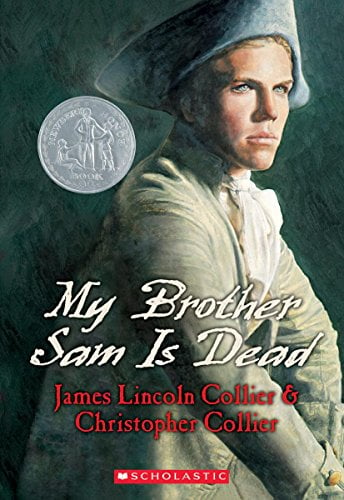
My Brother Sam Is Dead by James Lincoln Collier and Christopher Collier is a Newbery Honor-winning novel set during the American Revolution, told by a boy named Tim Meeker whose older brother Sam comes home from Yale fired with revolutionary fervor — and whose family is then destroyed, piece by piece, by the war that follows. Unflinching, morally serious, and deliberately unromantic about a conflict American culture has spent two centuries romanticizing, it is one of the most honest novels ever written about the Revolution for young readers: a book that asks whether the war was worth what it cost, and refuses to answer. This complete guide covers the reading level, age appropriateness, themes, characters, and everything parents and teachers need to know about this important and challenging novel.
For Parents
My Brother Sam Is Dead is a deliberately unsettling novel about the American Revolution told from the perspective of a family that loses nearly everything to it — a father, a brother, a way of life — and that is never given the comfort of knowing it was worth it. Best suited for readers ages 10-13, it is one of the few books about the Revolution that treats its violence and moral ambiguity with complete honesty. Parents should know this is a genuinely dark novel with a genuinely tragic ending. It is also one of the most important books a young American can read about what the founding of this country actually cost the people who lived through it.
For Teachers
A Newbery Honor book widely used in grades 5-7, My Brother Sam Is Dead is an exceptional text for teaching the American Revolution from a civilian perspective, moral ambiguity in historical fiction, and how authors use an unreliable or limited narrator to complicate received history. The novel’s deliberate refusal to celebrate the Revolution opens essential discussions about the gap between how history is taught and how it was lived. It pairs naturally with primary sources from the Revolutionary period and with other novels about the costs of war. The authors’ note on historical fact versus fiction is itself a valuable teaching document.
My Brother Sam Is Dead at a Glance
Find on Amazon →| Author | James Lincoln Collier and Christopher Collier |
| Published | 1974 |
| Grade Level | 5-7 (our assessment) |
| Recommended Age | 10-13 |
| Flesch-Kincaid Grade | 5.4 |
| Word Count | ~52,000 |
| Pages | 216 (standard paperback) |
| Chapters | 14 |
| Genre | Historical fiction |
| Setting | Redding, Connecticut, 1775–1779 |
| Awards | Newbery Honor (1975) |
For official Lexile and AR levels, visit Lexile.com or AR BookFinder. ReadingVine provides independent editorial assessments.
What Reading Level Is My Brother Sam Is Dead?
My Brother Sam Is Dead reads at approximately a 5th-7th grade level by our editorial assessment, with a Flesch-Kincaid grade level of around 5.4. The prose is clear and accessible — Tim narrates in a plain, direct style that reflects his age and his practical, observant temperament. The historical vocabulary is present but manageable: muskets, Lobsterbacks, Tories, patriots, the Continental Army appear with enough context to be understood without a glossary.
What makes the novel more demanding than its word-level score suggests is its moral complexity. Tim is a boy who genuinely does not know which side is right — his father is a Loyalist, his brother a patriot, and the war destroys both of them. The novel asks readers to sit with this uncertainty throughout, resisting the patriotic framework that most American children bring to anything about the Revolution. Readers who expect a story where the good guys win will be disoriented; readers who can hold moral ambiguity and genuinely conflicting loyalties will find the novel extraordinary.
The novel is most commonly assigned in grades 5-7, often as part of an American history unit on the Revolutionary period. For official Lexile and Accelerated Reader scores, visit Lexile.com or AR BookFinder.
What Age Is My Brother Sam Is Dead Appropriate For?
We recommend My Brother Sam Is Dead for readers ages 10-13. The novel deals with violence, death, moral ambiguity, and the destruction of a family by historical forces larger than any of them. The content is significant and is handled with honesty rather than restraint.
The novel depicts the violence of the Revolutionary War with deliberate realism. Tim’s father dies of cholera on a British prison ship — a slow, undignified death that the novel does not romanticize. Sam is arrested by his own Continental Army on dubious charges, tried in a cursory military court, and executed by firing squad in the novel’s final pages — a scene depicted with full emotional weight and no consolation. Characters are killed by raiders on both sides. A neighbor is shot. Cattle are stolen and civilians are terrorized by soldiers acting outside any legal authority. The novel includes a scene in which Tim witnesses an assault on two young women by soldiers — not depicted graphically but clearly referenced. There is no sexual content beyond this reference and no strong language. The darkness is entirely purposeful: the authors are making an argument about war, and the argument requires readers to see what war actually does.
The novel has been widely used in middle school American history and English classrooms for fifty years and is considered age-appropriate and historically essential for the 10-13 range. Parents who are concerned about the tragic ending should know that the tragedy is the point — it is not gratuitous but an honest accounting of what the Revolution cost ordinary families in the communities where it was fought.
What Is My Brother Sam Is Dead About?
It is the spring of 1775, and Tim Meeker is ten years old, living with his family in Redding, Connecticut — a small farming community where most people are Loyalists or simply trying to stay out of the conflict gathering around them. His father, Life Meeker, keeps the local tavern and is a practical, cautious man who believes the war is a catastrophe and wants no part of it. His older brother Sam comes home from Yale burning with revolutionary conviction and determined to enlist. The argument between Sam and their father — between idealism and pragmatism, between the cause and the family — is the novel’s first great scene, and Tim watches it unable to choose a side.
Sam enlists anyway, takes the family’s only musket over his father’s furious objection, and leaves. What follows is the war as it was actually experienced by the families of Redding: not as battles and heroism but as a sustained disruption of everything ordinary life depends on. Trade collapses. Food becomes scarce. Soldiers from both sides raid farms and take what they need. Tim’s father is captured by British forces while on a trading trip and dies on a prison ship. Tim, still in his early teens, is left to run the family tavern and farm with his mother.
Sam returns periodically — older, more hardened, still certain he is right. Tim loves him and admires him and is also, increasingly, not sure his certainty is warranted by what he sees around him. When Sam is arrested by Continental Army soldiers on a charge of cattle theft — almost certainly a frame-up — Tim and his mother fight to save him. The Continental Army, making an example of a soldier to enforce discipline, executes Sam by firing squad. The novel ends with Tim, years later, still unable to say whether the Revolution was worth what it cost his family.
James Lincoln Collier, who wrote the novel, and his brother Christopher Collier, a professional historian who provided the historical research and authenticity, were making a deliberate argument in 1974: that the celebratory, heroic version of the American Revolution taught in schools was a sanitized myth, and that a truer accounting would have to reckon with what ordinary families — Loyalist, patriot, and in-between — actually lost. The authors’ note at the end of the novel, in which Christopher Collier discusses the historical record behind the fiction, is one of the most valuable appendices in middle grade historical fiction.
My Brother Sam Is Dead Characters
Is My Brother Sam Is Dead Banned?
My Brother Sam Is Dead has a substantial history of challenges and banning attempts, making it one of the more frequently challenged works of American historical fiction for young readers. It appears on the American Library Association’s lists of frequently challenged books. Challenges have been based on its violence — particularly Sam’s execution — its profanity (a small amount of period-appropriate language), and most significantly its refusal to celebrate the American Revolution in the way parents and community members expect a novel about the Revolution to celebrate it. The novel has been banned or challenged in school districts across the country since its publication in 1974. The educational community has consistently and strongly defended it, and it has remained in print and in classrooms for fifty years. The American Library Association cites it as a landmark of intellectual freedom in children’s literature.
My Brother Sam Is Dead Themes and Lessons
The central argument of My Brother Sam Is Dead is that the heroic, celebratory version of the American Revolution — the version taught in schools, commemorated in monuments, and retold in patriotic literature — is incomplete at best and dishonest at worst. The Colliers are not arguing that the Revolution was wrong or that its ideals were false. They are arguing that its costs were real, that the people who paid those costs were not always the people who chose the cause, and that a complete accounting requires looking at those costs honestly rather than sublimating them into myth.
The opposition between Sam and his father — idealism and pragmatism, cause and family, the long view and the immediate — is the novel’s central structural tension, and the tragedy is that both of them are partly right and neither of them survives. Sam is right that the Revolution mattered and that someone had to fight it. Life is right that the war was a catastrophe for ordinary families and that no cause justifies every cost. The novel refuses to adjudicate between them, and that refusal is its moral seriousness.
Tim’s development from a ten-year-old boy watching his father and brother argue to a young man who has seen both of them die is a coming-of-age story in the most unsentimental sense: he grows up not by discovering who he is but by having his illusions stripped away one by one until what remains is only the bare fact of survival and the unanswered question of whether it was worth it. His final reflection — that he still does not know — is one of the most honest endings in American children’s literature.
Discussion starters for classrooms: Who is right in the argument between Sam and his father? Does the novel suggest that the Revolution was worth fighting? What does Tim’s uncertainty at the end tell us about the novel’s moral position? How does the experience of Redding’s civilians differ from the history of the Revolution you’ve learned in school? Is Sam’s execution by his own army just or unjust? What does the novel suggest about the relationship between idealism and its consequences?
How Many Pages and Chapters Are in My Brother Sam Is Dead?
The standard paperback edition of My Brother Sam Is Dead is 216 pages, divided into 14 chapters averaging around fifteen pages each, followed by an authors’ note by Christopher Collier on the historical record behind the fiction. The word count is approximately 52,000 words. The long chapters give the novel a measured, unhurried quality that suits Tim’s voice — patient and observant, taking the full measure of each episode before moving on.
For readers in the target age range of 10-13, expect a reading time of roughly 5-7 hours, or about a week and a half of steady reading at 30 minutes per session. As a classroom text it works well in a two-to-three week unit, particularly when paired with historical context about the Revolutionary War’s civilian experience in Connecticut. The authors’ note is worth assigning as a companion reading — Christopher Collier’s discussion of historical fact versus fictional invention is a model for thinking about how historical fiction works and what it is responsible for getting right.
Books Similar to My Brother Sam Is Dead
About James Lincoln Collier and Christopher Collier
My Brother Sam Is Dead is the product of a collaboration between two brothers: James Lincoln Collier, who wrote the narrative, and Christopher Collier, a professional historian specializing in American colonial and Revolutionary history who provided the historical research, verified the accuracy, and wrote the authors’ note at the end of the novel. This division of labor — a novelist’s craft paired with a historian’s rigor — gives the book its unusual combination of narrative immediacy and historical accuracy. Christopher Collier was at the time of the novel’s publication a professor of history and would later serve as Connecticut’s official state historian. James Lincoln Collier is also known for his writing about jazz and American music. The brothers collaborated on several other historical novels, including Jump Ship to Freedom and War Comes to Willy Freeman, both set in the same Revolutionary period and dealing with the experience of enslaved people during the war. My Brother Sam Is Dead, published in 1974, received the Newbery Honor in 1975 and has remained in print and in classrooms ever since.
My Brother Sam Is Dead: Frequently Asked Questions
What reading level is My Brother Sam Is Dead?
My Brother Sam Is Dead has a Flesch-Kincaid grade level of approximately 5.4. Our editorial assessment places it at grades 5-7 (ages 10-13). The prose is clear and accessible in Tim’s plain, direct voice. The moral complexity and historical demands exceed the word-level score. For official Lexile and AR scores, visit Lexile.com or AR BookFinder.
Does Sam really die at the end?
Yes. Sam is executed by firing squad by the Continental Army in the novel’s final pages — a scene depicted with full emotional weight and no softening. His death is not a battle death or a heroic sacrifice; he is shot by his own side on charges that were almost certainly unjust, made an example to enforce military discipline. The title announces this from the first page, and the novel does not withhold it or soften it. Parents who are concerned about the impact on younger or more sensitive readers should know that the execution is depicted directly and is genuinely devastating.
Why does Sam’s own army execute him?
Sam is arrested by Continental Army soldiers on a charge of cattle theft — accused of stealing cattle from his own family’s farm, which he almost certainly did not do. The evidence is thin and the trial is cursory. General Putnam, commanding in the area, has decided to make an example of someone to enforce discipline among soldiers who have been raiding civilian farms, and Sam — a Continental soldier found near the cattle — is convenient. The execution is a portrait of how military justice works in wartime: not as a careful weighing of evidence but as an exercise of power designed to maintain order. It is one of the novel’s most important arguments about the difference between the ideals of the Revolution and its actual practice.
Is the novel anti-American or anti-Revolution?
No — and the Colliers address this directly in their authors’ note. The novel is not arguing that the Revolution was wrong or that its ideals were false. It is arguing that the celebratory, heroic version of the Revolution taught in schools is incomplete, and that a full accounting requires looking honestly at what ordinary families — particularly Loyalist and neutral families in contested communities — actually experienced. The novel holds the Revolution’s ideals and its costs in tension without resolving that tension into a simple verdict. Tim’s final uncertainty is the novel’s position: not that the Revolution was wrong, but that it is not possible to celebrate it honestly without also accounting for what it destroyed.
What grade is My Brother Sam Is Dead typically assigned in?
My Brother Sam Is Dead is most commonly assigned in grades 5, 6, and 7, both as an English text and as supplementary reading in American history units on the Revolutionary period. It is particularly effective as a paired reading with Johnny Tremain — the traditional patriotic account of the Revolution — for a unit on how different authors construct historical narrative and what they choose to emphasize. The authors’ note by Christopher Collier is often assigned alongside the novel as a model for thinking about the relationship between historical fiction and historical fact.
What is the historical accuracy of the novel?
High. Christopher Collier’s involvement as a professional historian ensured that the novel’s historical framework — the military campaigns in Connecticut, the experience of civilian communities in contested territory, the specific dynamics of Loyalist and patriot conflict in Redding, the treatment of prisoners on British prison ships — is accurate. The Meeker family is fictional, but the events around them are drawn from the historical record. Christopher Collier’s authors’ note distinguishes carefully between what is historical fact and what is fictional invention, and the note is itself a model for how historical novelists should be transparent about their sources and their choices.
Why has My Brother Sam Is Dead been banned or challenged?
The novel has been challenged in school districts across the country since its publication, primarily for three reasons: its violence (particularly Sam’s execution), a small amount of period-appropriate profanity, and most significantly its refusal to celebrate the American Revolution in the way that many parents and community members expect. Challenges based on the last reason reflect the novel’s deepest purpose: it is precisely the book’s insistence on complicating the patriotic narrative that makes it valuable and that makes some communities uncomfortable. The American Library Association has consistently defended it as a landmark work of intellectual honesty in children’s historical fiction.
How does this novel compare to Johnny Tremain as a way to teach the Revolution?
Johnny Tremain (Newbery Medal, 1944) and My Brother Sam Is Dead (Newbery Honor, 1975) are the two most commonly assigned novels about the American Revolution in American middle schools, and they make an ideal paired reading precisely because they tell such different stories. Johnny Tremain is a patriotic novel: it follows a boy who becomes part of the Sons of Liberty, who witnesses the Boston Tea Party and the battles of Lexington and Concord, and who comes to believe in the Revolution’s cause. The Revolution in Johnny Tremain is heroic, purposeful, and ultimately worth its costs. In My Brother Sam Is Dead, the Revolution is chaotic, destructive, morally ambiguous, and paid for by people who had no say in the matter. Reading them together gives students a much more complete picture of how historical fiction works and what it means to tell a story about history from a particular point of view.