
 = Partner Site
Crown: An Ode to the Fresh Cut Reading Level: A Complete Guide
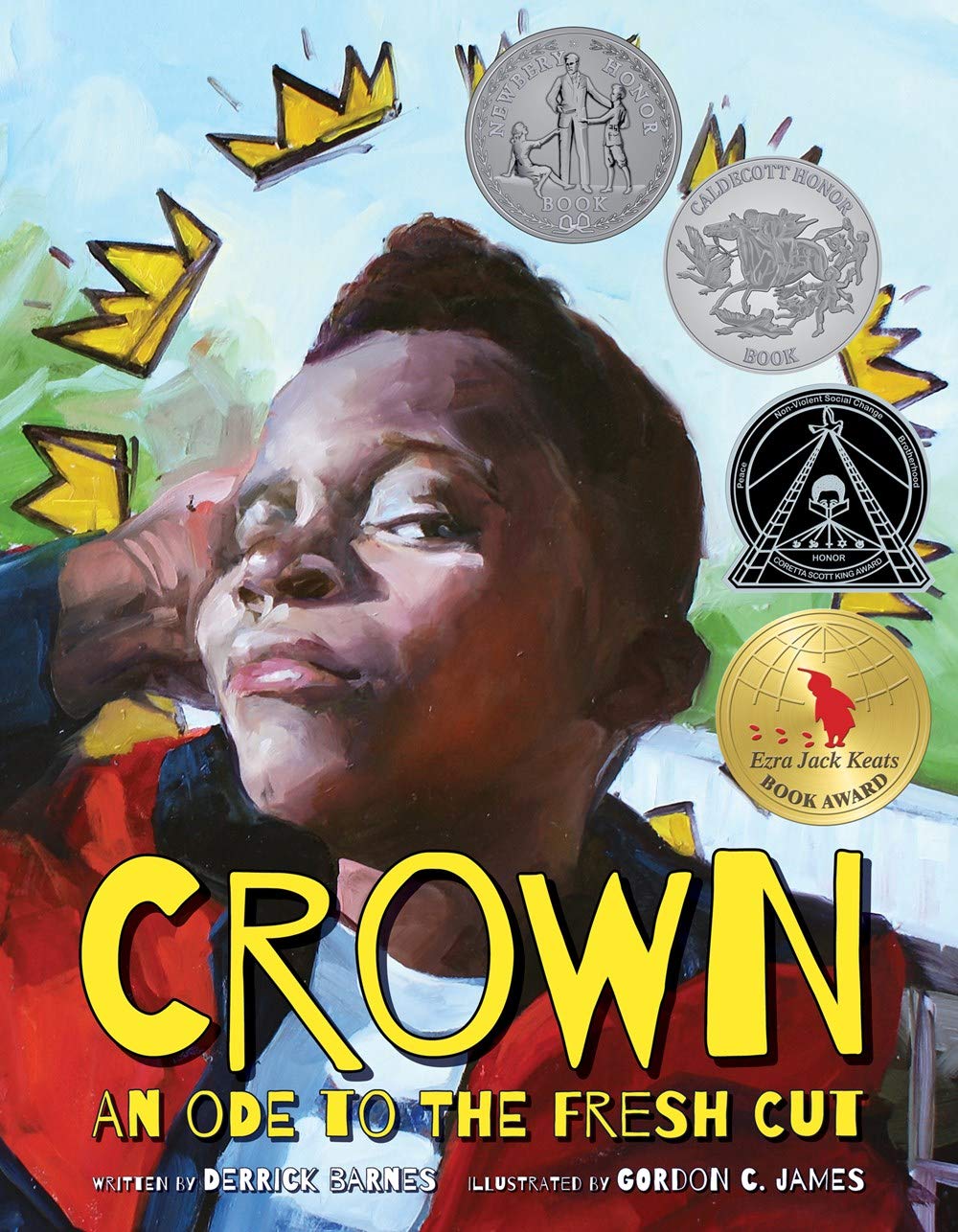
Crown: An Ode to the Fresh Cut, written by Derrick Barnes and illustrated by Gordon C. James, is a picture book poem about what it feels like to be a Black boy in a barbershop getting a fresh cut — the anticipation, the ritual, the moment the barber’s chair becomes a throne, and the walk out the door afterward when the whole world looks different because you do. Published in October 2017 by Agate Bolden and told entirely in the second person (“you”), so that every reader is the boy in the chair, it received starred reviews from Kirkus, Booklist, Publishers Weekly, and School Library Journal, won the Kirkus Prize for Young Readers, and earned both a Newbery Honor and a Caldecott Honor at the 2018 ALA Youth Media Awards — along with Coretta Scott King Author and Illustrator Honors, two Ezra Jack Keats Awards, and a Society of Illustrators Gold Medal. Barnes’s son Silas was the model for the boy in the book; the barber is based on James’s son’s barber. Gordon C. James painted the illustrations in oil on illustration board, aiming deliberately for the feel of fine art — critics compared his work to Basquiat and noted that his portraits of Black men and boys in the barbershop were unlike anything available in American picture books. This guide covers Crown‘s reading level, whether it’s a read-aloud or independent read, what it’s about, its themes, how long it takes to read, and similar books — designed for parents and teachers of K–2 readers.
For Parents
A joyful, rhythmic picture book poem about Black boyhood, confidence, and the transformative power of a fresh cut — one of the most decorated picture book debuts in recent memory. Best as a read-aloud for ages 4–8. No content concerns. A book for every child, and an essential book for Black boys who deserve to see themselves celebrated at this level.
For Teachers
A K–2 read-aloud built for performance — Barnes’s rhythmic, second-person verse is designed to be felt as much as heard. Pair with Hair Love and Sulwe for a unit on Black joy and self-celebration. The author’s note about the barbershop as a cultural institution is essential context and worth reading aloud alongside the book itself.
Crown: An Ode to the Fresh Cut at a Glance
Find on Amazon →| Author | Derrick Barnes |
| Illustrator | Gordon C. James |
| Published | 2017 (Agate Bolden / Denene Millner Books) |
| Grade Level | K–2 (our assessment) |
| Recommended Age | 4–8 |
| Lexile | NP (Non-Prose — written as a poem) |
| Word Count | ~500 (verse; unpaged) |
| Pages | ~40 (unpaged) |
| Genre | Picture book / poetry / ode |
| Awards | Newbery Honor (2018); Caldecott Honor (2018); Coretta Scott King Author Honor; Coretta Scott King Illustrator Honor; Kirkus Prize for Young Readers (2017); Ezra Jack Keats New Writer Award; Society of Illustrators Gold Medal |
For official Lexile and AR levels, visit Lexile.com or AR BookFinder. ReadingVine provides independent editorial assessments.
What Reading Level Is Crown: An Ode to the Fresh Cut?
Crown carries a Non-Prose (NP) Lexile designation because it is written as a poem — the same situation as The Sneetches in this catalog. The Lexile formula is designed for prose and does not score verse reliably. The absence of a numerical Lexile score does not indicate difficulty; it indicates form. Barnes writes in second-person verse with a rhythm that is closer to jazz than to nursery rhyme — the lines have energy and momentum, and some of the vocabulary (transformed, majestic, royalty) is more sophisticated than a standard picture book’s. Our editorial assessment places it at K–2 for read-aloud and grades 1–3 for comfortable independent reading, ages 4–8 for read-aloud and ages 6–9 for independent reading.
Like Fox in Socks and The Sneetches, this is a book that rewards being read aloud — the verse carries its full weight when it is heard rather than read silently, and the rhythm of the poetry is part of what makes the emotional argument land. For official Lexile and AR scores, visit Lexile.com or AR BookFinder. ReadingVine’s assessments are independent editorial judgments.
Is Crown a Read-Aloud or Independent Read?
This is primarily a read-aloud for ages 4–8, and one of the most specifically designed-for-performance read-alouds in this catalog. Barnes’s second-person verse pulls the reader directly into the boy’s body — you are in the barber’s chair, you are wearing the cape, you are watching in the mirror as the barber works — and this immediacy is most powerful when the words are given sound and rhythm.
For independent reading, a confident second- or third-grader can work through the verse with growing fluency. Children who have heard the book read aloud multiple times will return to it independently knowing the rhythm already, and that prior knowledge makes the more sophisticated vocabulary accessible.
Read it slowly the first time, letting the rhythm settle. On the second reading, ask your child to join in on the lines they remember. After the book, ask: “Is there something that makes you feel like a crown — like you could walk out and the whole world would notice you?” The book’s deepest gift is the conversation it opens about confidence, pride, and the specific things that make each child feel like the best version of themselves.
What Is Crown About?
You walk into the barbershop. It smells like clippers and aftershave and the particular combination of conversation and music that fills the space whenever men gather to take care of themselves. You take your seat. The barber drapes the cape around your shoulders — a princely robe, a royal cloak. He works carefully: a dab of cool shaving cream at the forehead, a slow, steady cut, the crisp line at the edge of the hairline coming into focus in the mirror. You watch yourself transform. The boy who walked in — still good, still you — is becoming something sharper, more visible, more present. You are becoming royalty.
The book moves through the experience of the cut itself and then outward into imagination: what happens when you walk out? Grades get better. People notice. Your mother’s hug gets a little tighter. You see the older men in the shop — the community of Black men and boys who have gathered here, who recognize you, who reflect back to you your own worth. The barbershop, Barnes writes in his author’s note, is one of the few institutions — alongside the church — that has historically celebrated and honored Black boys, a place where they could stand straight and be seen clearly.
The book ends where it begins, with you — the boy in the chair — crowned. The fresh cut is the occasion; the crown is what it reveals about what was always there.
The Barbershop as Cultural Institution
Barnes includes an author’s note in Crown that is as important as the poem itself, and that teachers should read alongside the book. The Black barbershop, he explains, is one of the few public institutions in American life that has historically been a space of freedom, affirmation, and community for Black men and boys — a place where, in Barnes’s words, they could be their full selves without the constant pressure of a world that often viewed them with suspicion or fear. During the era of legal segregation, the Black barbershop was one of the very few public spaces Black men controlled entirely — a place to talk, to laugh, to be seen by one another as fully human in ways the broader world denied.
This context transforms the book from a story about a haircut into a story about a ritual — one that has been passing confidence, community, and recognition from one generation of Black men to the next for over a century. When the boy in the chair is transformed by the fresh cut, he is not just getting his hair done; he is being initiated into something that has held his community together. The older men in the barbershop are not background figures; they are witnesses to a tradition and, in their presence, affirmers of his worth.
Gordon C. James’s oil paintings make this visible: every face in the barbershop is specific, fully rendered, painted with the care and attention of a portraitist who understands that seeing Black men and boys clearly — in all the variety of their skin tones and hairstyles and expressions — is itself an act of respect. Critics noted that his realistic, fine-art approach to the illustrations was unlike anything available in American picture books and that the barbershop he depicted was both a specific place and a monument.
Crown Characters
The book is told in the second person — “you” — so there is no named protagonist. The boy in the chair is every Black boy who has ever sat in that chair, and by extension every child who has ever had the experience of being transformed by someone else’s care and skill into a version of themselves they could be proud of. The barber is a gentle, skilled presence — never named, always purposeful, the kind of craftsman who understands that his work is about more than hair. The older men in the barbershop are the community: specific faces, individual expressions, the living evidence that the boy belongs to something larger than himself and that what he is becoming has been modeled for him by the men around him.
Crown Themes and Lessons
Crown is a book about joy — specifically the kind of joy that comes from being cared for by someone who is skilled and attentive, from being seen clearly by a community that recognizes your worth, and from walking out into the world feeling like you could do anything. Barnes has described the feeling of leaving the barbershop as a feeling of independence, of being the best version of yourself — and the book gives that feeling to every reader who steps into the second-person “you” of its verse. This is not a book that teaches children they should feel this way; it is a book that gives them the direct experience of feeling it.
The book’s relationship to Hair Love and Sulwe in this catalog is worth naming explicitly. All three books celebrate specific aspects of Black appearance — natural hair and the care it takes, dark skin and its specific beauty, and the fresh cut as a transformation that makes a boy’s crown visible. Together they form a small library of books that say to Black children: your hair, your skin, your appearance is worth celebrating in its specificity, not just worth accepting. These books do not offer the consoling “everyone is beautiful” abstraction; they celebrate particular, specific, irreplaceable beauty.
Talking with your child: How did the boy in the chair feel before the haircut? How did he feel after? What does Barnes mean when he calls the haircut a crown? Is there something that makes you feel like your best self — a piece of clothing, a hairstyle, something someone says to you? Who are the older men in the barbershop and why do you think they matter to the story?
How Long Is Crown?
Crown is unpaged — approximately forty pages with roughly 500 words of verse. Most adults can read it aloud in about seven to ten minutes, though the verse rewards a slower, more deliberate pace than prose picture books. The rhythm is part of the content; rushing through it loses the beat that carries the emotional argument. Like The Sneetches and Fox in Socks in this catalog, it is a book that gets better every time it is read aloud, as both reader and listener settle more deeply into its rhythm.
Books Similar to Crown
About Derrick Barnes and Gordon C. James
Derrick Barnes was born and raised in Kansas City, Missouri. A graduate of Jackson State University, he began his career as the first African American male staff writer for Hallmark before turning to children’s books. He is the author of more than a dozen books, including the popular Ruby and the Booker Boys middle-grade series and the picture books The King of Kindergarten (2019) and I Am Every Good Thing (2020), which won the Kirkus Prize for the second time — making him the only author to have won that prize twice. Crown was his first picture book, inspired by a friend’s sketch of a teenager and a conversation about whether he had any books featuring a normal African American boy’s life. He lives in Charlotte, North Carolina, with his wife and four sons, one of whom — Silas — was the model for the boy in the book.
Gordon C. James is a graduate of the School of Visual Arts in New York and a nationally recognized fine artist specializing in figurative drawing. His oil paintings for Crown were his picture book debut; he painted directly on illustration board in oils, aiming for the feel of fine art photography — critics compared the result to Basquiat and noted that his portraits of Black men and boys represented a kind of seeing that was missing from American picture book illustration. He lives in Charlotte, North Carolina, where he has taught at the University of North Carolina. His son’s barber was the model for the barber in the book.
Crown: An Ode to the Fresh Cut — Frequently Asked Questions
What reading level is Crown: An Ode to the Fresh Cut?
Crown carries a Non-Prose (NP) Lexile designation because it is written as a poem — the same situation as The Sneetches in this catalog. Our editorial assessment: read-aloud for ages 4–8; independent reading for ages 6–9. The verse rewards being read aloud; the rhythm carries the emotional argument in ways that silent reading may not fully deliver. For official AR scores, visit AR BookFinder.
What is Crown: An Ode to the Fresh Cut about?
A Black boy’s experience in a barbershop getting a fresh cut — told in the second person so every reader is the boy in the chair. The poem moves through the ritual of the cut itself, the transformation it produces, and the walk out the door afterward when the whole world looks different because you do. Barnes calls it “an unbridled celebration of the self-esteem, confidence, and swagger boys feel when they leave the barber’s chair.”
What awards did Crown win?
Crown received both a Newbery Honor and a Caldecott Honor at the 2018 ALA Youth Media Awards — a rare double recognition — along with Coretta Scott King Author and Illustrator Honors, the Kirkus Prize for Young Readers, the Ezra Jack Keats New Writer Award, and a Society of Illustrators Gold Medal. It is one of the most decorated picture book debuts in recent American publishing history.
Why is the book told in the second person?
Barnes wrote the poem in the second person — “you go in,” “you feel,” “you walk out” — so that every reader inhabits the experience directly. This makes the book’s celebration immediate and personal rather than observed from outside: you are the boy in the chair, you are the one being transformed, you are the one who walks out feeling like royalty. The “you” includes every reader and says to each one: this is your experience, this is your crown.
What is the significance of the barbershop in this book?
Barnes’s author’s note explains that the Black barbershop is one of the few institutions — alongside the church — that has historically celebrated and honored Black boys, a space where Black men could freely be themselves. During segregation it was one of the few public spaces Black men controlled entirely. The barbershop in Crown is not just a haircut location; it is a community institution where a boy is seen, affirmed, and initiated into a tradition of Black men caring for and recognizing one another.
Is Crown appropriate for all children or just Black boys?
Kirkus called it “one of the best reads for young black boys in years” — and the book is specifically designed to give Black boys a celebration they deserve and rarely receive in picture book literature. It is also a book for every child: the experience of being transformed by someone’s care and skill, of walking out feeling like your best self, is universal. Non-Black children who read it gain something genuine — an entry into a specific cultural institution and its meaning — rather than a generalized lesson about being different.