
 = Partner Site
Echo Reading Level: A Complete Guide
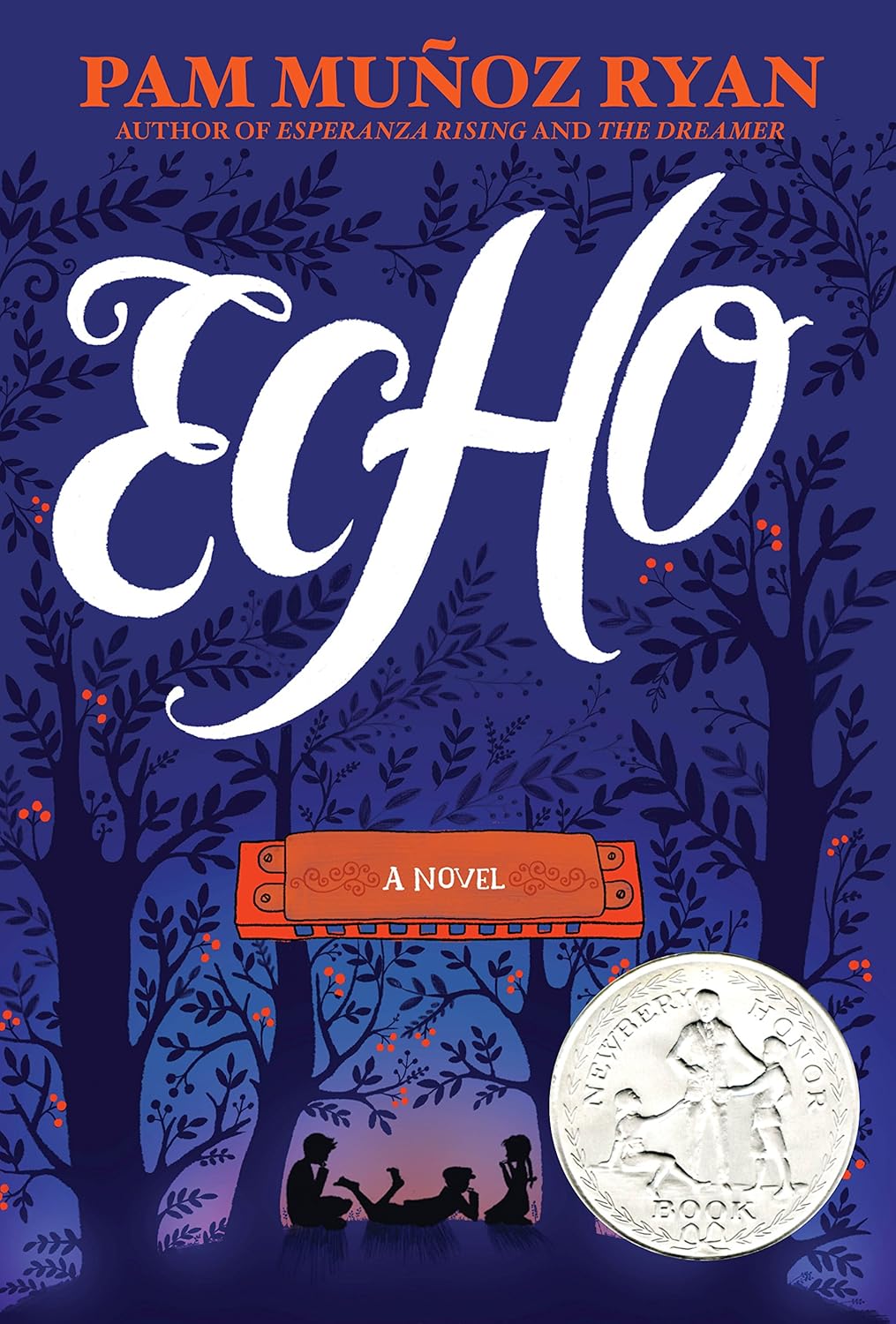
Echo by Pam Muñoz Ryan is a sweeping, structurally ambitious novel that weaves together three separate stories — set in 1930s Germany, 1940s Pennsylvania, and 1940s California — through the thread of a single enchanted harmonica that passes from one child to the next, each carrying it through a moment of crisis before sending it forward in time. Part fairy tale, part historical fiction, part musical meditation, it is one of the most formally inventive novels in the middle grade canon: a book that uses the structure of a musical composition to tell three stories about children at the margins of history, each finding voice and courage through the instrument that connects them. Winner of a Newbery Honor and a Pura Belpré Author Honor, it is one of Pam Muñoz Ryan’s finest achievements. This complete guide covers the reading level, age appropriateness, themes, characters, and everything parents and teachers need to know about this rich and beautiful book.
For Parents
Echo is a novel that requires and rewards patience. Best suited for readers ages 10-13, it opens with a fairy tale prologue and then divides into three novellas — each set in a different time and place, each following a different child — before reuniting them at the end. Parents should know that the historical settings involve World War II, Nazi Germany, the American treatment of Japanese Americans during the war, and the history of orphanages in Depression-era America. All of this is handled with honesty and care, and the novel’s emotional payoff — when the three stories converge and the full architecture becomes visible — is one of the most satisfying experiences in contemporary middle grade fiction. This is a book that rewards the investment it asks for.
For Teachers
A Newbery Honor book well suited to grades 5-7, Echo is an exceptional text for teaching structural innovation, thematic coherence across multiple narratives, and how authors use form to reinforce meaning. The novel’s musical structure — three movements that together form a complete composition — is itself an argument about how individual voices combine into something larger. It opens rich discussions about World War II from multiple civilian perspectives, the treatment of marginalized groups in American history, the role of music in human resilience, and what it means for different people in different circumstances to share a thread of connection across time.
Echo at a Glance
Find on Amazon →| Author | Pam Muñoz Ryan |
| Published | 2015 |
| Grade Level | 5-7 (our assessment) |
| Recommended Age | 10-13 |
| Flesch-Kincaid Grade | 5.3 |
| Word Count | ~117,000 |
| Pages | 591 (standard hardcover) |
| Chapters | Three novellas plus framing prologue and epilogue |
| Genre | Historical fiction / magical realism |
| Setting | Germany (1933), Pennsylvania (1935), California (1942) |
| Awards | Newbery Honor (2016); Pura Belpré Author Honor (2016) |
For official Lexile and AR levels, visit Lexile.com or AR BookFinder. ReadingVine provides independent editorial assessments.
What Reading Level Is Echo?
Echo reads at approximately a 5th-7th grade level by our editorial assessment, with a Flesch-Kincaid grade level of around 5.3. Ryan writes with the lyrical precision that characterizes all her best work — sentences that move like music, with a rhythm that reflects the novel’s harmonica at its center. The prose is accessible but rich, and each of the three novellas has a slightly different voice that reflects its narrator’s circumstances: Friedrich’s Germany is formal and tinged with dread; Mike’s Pennsylvania Depression-era orphanage story is plain and direct; Ivy’s California story is warm and sun-drenched even as it circles a historical injustice.
What makes the novel more demanding than its word-level score suggests is its length and structure. At 591 pages, Echo is one of the longer Newbery Honor books and asks readers to invest in three separate sets of characters and three separate historical worlds before the connections between them become fully visible. Readers who trust the structure — who are willing to follow each novella to its end before seeing how the pieces fit — will find the payoff profound. Readers who require immediate plot momentum may find the early sections of each new novella slow as the new world and characters are established.
The book is most commonly recommended for grades 5-7. For official Lexile and Accelerated Reader scores, visit Lexile.com or AR BookFinder.
What Age Is Echo Appropriate For?
We recommend Echo for readers ages 10-13. The novel’s three historical settings involve serious and sometimes disturbing content: the rise of Nazism in Germany, the treatment of children in Depression-era American orphanages, and the forced removal of Japanese Americans from their homes during World War II. All of this is handled with honesty and historical accuracy, and none of it is gratuitous, but parents should be prepared for a novel that takes these subjects seriously.
Friedrich’s story is set in 1930s Germany and depicts the early years of Nazi rule: anti-Jewish laws, political intimidation, the marking and persecution of people considered undesirable by the regime, and the specific fear of a family with a child who bears a visible birthmark in a society that has begun targeting those it deems imperfect. The depiction is historically accurate and genuinely frightening in places. Mike’s story depicts life in a Depression-era orphanage with a cruel administrator, children who are mistreated and malnourished, and the specific vulnerability of children without family protection. Ivy’s story depicts the forced removal of Japanese American neighbors from their California community following the attack on Pearl Harbor — Executive Order 9066 and the internment camps are part of the story’s backdrop. All three storylines involve children in genuine danger who find their way through it; none end in tragedy. There is no sexual content and no graphic violence. The historical content is the novel’s primary challenge for younger readers, and it is handled with the care and accuracy of a Newbery Honor book.
For students studying World War II, the Depression, or American civil liberties history, the novel provides an unusually humane and child-centered entry point into each of these subjects. The magical harmonica and the fairy tale framing give younger readers a structure that makes the historical difficulty approachable rather than overwhelming.
What Is Echo About?
The novel opens in a forest in Germany, long ago, where a boy named Otto becomes lost and encounters three sisters who have been trapped between the world of the living and the world of the dead. They give him a harmonica — an instrument enchanted with their voices — and charge him with finding it a path forward: it must pass through the hands of three children, each standing at a crossroads, before the sisters can be released. This is the fairy tale that frames the three stories that follow.
The first story follows Friedrich Schmidt, a twelve-year-old boy in 1933 Germany who loves music above everything and who has a large port-wine birthmark on half his face. As the Nazi regime consolidates power, Friedrich begins to understand that his birthmark makes him a target — that the same laws being used against Jewish people and others deemed undesirable by the Third Reich could be used against him. The harmonica comes to Friedrich and becomes, in a particular and irreplaceable way, his voice and his safety. When he can no longer keep it, he sends it forward.
The second story follows Mike Flannery, a twelve-year-old boy in a 1935 Pennsylvania orphanage who has been unable to find a family because he refuses to be separated from his younger brother Frankie. The harmonica arrives and becomes the means by which Mike might secure their future — but only if he can play well enough, and only if the right person hears him. His story is the most immediately affecting of the three, built on the specific love between siblings and the specific cruelty of systems that separate them.
The third story follows Ivy Lopez, a ten-year-old Mexican American girl in 1942 California whose family works as farmworkers on the same property where they have always lived. When the Japanese American family on the neighboring farm is forcibly removed to an internment camp following Executive Order 9066, Ivy must grapple with what it means to watch an injustice happen and not be able to stop it — and with whether the music she carries can be a bridge across the silence that follows. Her story is the novel’s most politically immediate and its most tender.
The epilogue brings the three threads together in a present-day concert hall where the harmonica’s journey comes full circle, and the three sisters of the prologue are finally, quietly released. Pam Muñoz Ryan has described the novel’s structure as intentionally musical — three movements in a single composition — and the experience of reading it, when the final convergence arrives, is very like the experience of hearing a theme return: familiar, earned, and unexpectedly moving.
Echo Characters
Is Echo Banned?
Echo has not been banned or widely challenged. It has been embraced by educators, librarians, and award committees as an important, ambitious, and beautifully executed novel. Its treatment of Nazism, Japanese American internment, and Depression-era orphanages — all historically accurate and handled with care — has been cited as educational strength rather than concern. The Newbery Honor and Pura Belpré Author Honor reflect particularly broad institutional recognition: the Newbery recognizes distinguished American children’s literature generally, while the Pura Belpré Award specifically honors Latino writers and illustrators whose work best portrays and celebrates the Latino cultural experience.
Echo Themes and Lessons
The central theme of Echo is voice — the human need to be heard, and the way music provides a form of expression that survives circumstances that silence ordinary speech. Each of the three children finds in the harmonica something they cannot find anywhere else: Friedrich finds a way to be present in a world that wants to make him invisible; Mike finds a way to make a case for himself and his brother that words alone could not make; Ivy finds a way to honor what has been taken from her neighbors and to insist, through music, that it matters. The harmonica is not a magic solution — it does not prevent the historical horrors each child faces — but it is a voice, and in each case it is enough.
The novel’s three historical settings together constitute an argument about the recurring nature of prejudice and the recurring nature of resistance. Friedrich faces state-sponsored persecution in Nazi Germany; Mike faces institutional cruelty in the American orphanage system; Ivy faces the government-sanctioned removal of her neighbors’ rights and freedom. These are not the same injustice, but they rhyme — and the novel’s structure, which places them in sequence, invites readers to notice the rhyme. The harmonica passes through all three, unchanged, suggesting that what sustains people through injustice is also unchanged: the need to make music, to be heard, to connect.
Sibling love is the novel’s most consistently moving emotional thread, present in all three stories but most central in Mike’s. The specific love of a child who will not abandon a younger sibling — who will sacrifice his own chances rather than leave Frankie behind — is one of the most elemental things the novel contains, and it lands hardest precisely because it is so simple and so unconditional.
Discussion starters for classrooms: What does the harmonica give each child that they cannot get any other way? How are the three injustices in the novel similar, and how are they different? Why does Ryan frame the realistic stories with a fairy tale? What does music do in this novel that words cannot do? How does each child’s act of courage change what happens next?
How Many Pages and Chapters Are in Echo?
The standard hardcover edition of Echo is 591 pages, structured as a fairy tale prologue, three novellas of roughly 150-170 pages each, and a brief epilogue. The word count is approximately 117,000 words, making it one of the longer middle grade novels in common classroom use. Each novella has its own chapter structure — Friedrich’s story has the most chapters and moves the fastest; Ivy’s has the fewest and the most space between events. The total length is substantial, and teachers and parents should plan accordingly.
For readers in the target age range of 10-13, expect a reading time of roughly 10-14 hours, or about three weeks of comfortable reading at 30 minutes per session. As a classroom text, the novel works well in a four-to-five-week unit, with each novella constituting a natural sub-unit. The transition points — when one novella ends and a new world begins — are among the most important discussion moments in the novel, and slowing down at each one to discuss what has been established and what might connect to the next story is time well spent. The convergence at the end rewards readers who have been patient, and many teachers report that students who found the early sections slow become the novel’s most enthusiastic advocates by the final pages.
Books Similar to Echo
About Pam Muñoz Ryan
Pam Muñoz Ryan is one of the most celebrated American authors of middle grade fiction, known for novels that combine lyrical prose, historical depth, and a consistent attention to characters who live at the margins of the social worlds they inhabit. Born in Bakersfield, California, she grew up in a large, multigenerational Mexican American family — her grandmother’s immigration story directly inspired Esperanza Rising (2000), her best-known novel before Echo. She has spoken about Echo as the most technically ambitious project she has undertaken: the challenge of writing three separate historical worlds, maintaining three distinct child voices, and constructing a frame that would hold them together without making the connections feel forced. The Newbery Honor and Pura Belpré Author Honor in 2016 recognized both the literary achievement of the novel and its particular significance in the canon of Latino children’s literature. Her other notable works include Becoming Naomi León (2004) and Riding Freedom (1998). She lives in California.
Echo: Frequently Asked Questions
What reading level is Echo?
Echo has a Flesch-Kincaid grade level of approximately 5.3. Our editorial assessment places it at grades 5-7 (ages 10-13). The prose is lyrical and accessible, but the novel’s primary demands are length (591 pages) and structural patience — readers must follow three separate stories in three historical settings before the full architecture becomes visible. The payoff for that patience is substantial. For official Lexile and AR scores, visit Lexile.com or AR BookFinder.
How are the three stories connected?
The three stories are connected by a single enchanted harmonica that passes from Friedrich in 1930s Germany to Mike in 1935 Pennsylvania to Ivy in 1942 California. Each child receives the harmonica at a moment of crisis, is sustained by it through that crisis, and passes it forward when the time comes. The connections between the stories are not only the physical object but the thematic rhyme: each child faces a form of social marginalization, finds voice through music, and acts with quiet courage in circumstances that do not offer easy options. The epilogue gathers the threads in a present-day concert hall where the full meaning of the harmonica’s journey becomes clear.
Is Echo based on a true story?
The three novellas are historical fiction — set in real historical periods and drawing on real historical events (the rise of Nazism, the Depression-era orphanage system, Japanese American internment) — but the specific characters and the enchanted harmonica are invented. Pam Muñoz Ryan conducted extensive research for each of the three settings, and the historical details are accurate. The fairy tale frame is entirely fictional. The novel is best understood as historical fiction with a magical realist frame: the history is real, the children are invented, and the harmonica carries a kind of truth that the realistic mode alone could not contain.
What is the Pura Belpré Award?
The Pura Belpré Award is given annually by the American Library Association to Latino writers and illustrators whose work best portrays, affirms, and celebrates the Latino cultural experience in literature for children and youth. It is named for Pura Belpré, the first Latina librarian at the New York Public Library, who was also a storyteller and author who preserved and celebrated Puerto Rican folklore. Echo received a Pura Belpré Author Honor in 2016, recognizing Ivy’s story — a Mexican American girl in 1940s California — as a particularly important and beautifully rendered contribution to the literature of Latino experience.
Do I need to read all three stories, or can I read one?
The three novellas can be read independently and each works as a complete story in its own right. Friedrich’s story, Mike’s story, and Ivy’s story each have a beginning, a crisis, and a resolution. However, the novel’s full meaning — the convergence at the end, the revelation of how the harmonica’s journey has shaped a life, the release of the three sisters — is only available to readers who have followed all three. Teachers who are concerned about the length sometimes assign one novella as an entry point; most find that students who read one want to read the others. The complete novel is greater than the sum of its parts.
What historical events are depicted in Echo?
Friedrich’s story depicts Germany in 1933, the year Hitler became Chancellor: the consolidation of Nazi power, the early anti-Jewish laws, and the beginning of the regime’s targeting of people with disabilities and other groups deemed undesirable. Mike’s story depicts Depression-era Pennsylvania in 1935 and the orphanage system of that period, including the specific vulnerability of children without family protection. Ivy’s story depicts California in 1942, following the attack on Pearl Harbor and Executive Order 9066, which authorized the forced removal of Japanese Americans from the West Coast to internment camps. All three are presented with historical accuracy and in enough detail to serve as an introduction to each period for young readers.
What grade is Echo typically assigned in?
Echo is most commonly assigned in grades 5, 6, and 7, both as independent reading and as a class text. It is particularly well suited to units on World War II, Depression-era America, civil liberties, and historical fiction as a genre. The three-novella structure makes it practical to teach in units — one novella per week across three weeks — with the convergence and full discussion reserved for the fourth week. It is also widely used in conjunction with nonfiction resources on Japanese American internment and the Nazi regime, which provide context for the historical material the novel introduces.