
 = Partner Site
Elephant & Piggie: Should I Share My Ice Cream? Reading Level: A Complete Guide
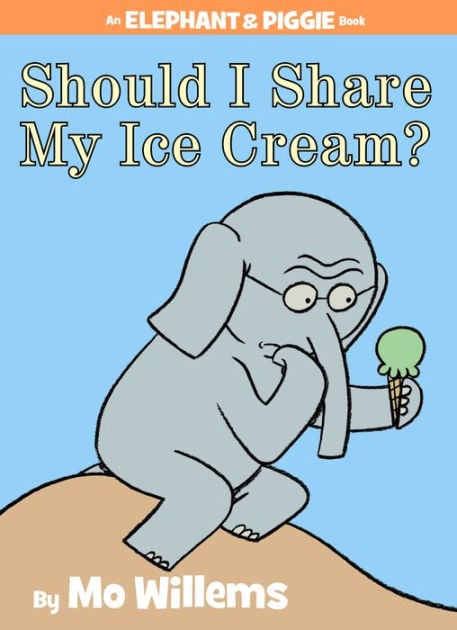
Elephant & Piggie: Should I Share My Ice Cream? by Mo Willems is the fifteenth book in the beloved Elephant & Piggie series — a story about Gerald the Elephant, an ice cream cone, a decision that cannot be made in time, and the particular comedy of doing the right thing at exactly the wrong moment. Published in 2011 as part of the two-time Theodor Seuss Geisel Medal-winning series, Elephant & Piggie: Should I Share My Ice Cream? is a widely recommended book in the series for teaching the concept of sharing — not because it resolves the question neatly, but because it does not. This guide covers the reading level, recommended age, read-aloud vs. independent reading guidance, themes, and everything parents and teachers need to know about sharing this book with young readers.
For Parents
Find out whether Elephant & Piggie: Should I Share My Ice Cream? works best as a read-aloud or independent read for your child, what age range it suits, and why this story about an ice cream cone and a missed opportunity is one of the most emotionally precise books in the Elephant & Piggie series for children who are working through the genuinely hard question of what sharing actually means.
For Teachers
Grade-level data, read-aloud timing, key themes, and discussion questions for a book that uses the comedy of Gerald’s indecision to open one of the most productive available conversations about generosity, regret, timing, and the difference between wanting to do the right thing and actually doing it.
Elephant & Piggie: Should I Share My Ice Cream? at a Glance
Find on Amazon →| Author & Illustrator | Mo Willems |
| Published | 2011 |
| Series | Elephant & Piggie #15 of 25 |
| Grade Level | K–1 (our assessment) |
| Recommended Age | 4–7 |
| Best For | Read-aloud ages 3–7; independent reading ages 4–7 |
| Flesch-Kincaid Grade | 0.6 |
| Word Count | ~275 |
| Pages | 64 |
| Genre | Early reader / humor |
| Setting | An unnamed street; an ice cream cart |
| Awards | #1 New York Times Bestselling Series |
For official Lexile and AR levels, visit Lexile.com or AR BookFinder. ReadingVine provides independent editorial assessments.
What Reading Level Is Elephant & Piggie: Should I Share My Ice Cream?
Elephant & Piggie: Should I Share My Ice Cream? is a K–1 reading level by our editorial assessment, with a Flesch-Kincaid grade level of approximately 0.6. At around 275 words it is one of the shorter books on this list, using the simple vocabulary, short sentences, and dialogue-driven format that characterize the entire Elephant & Piggie series. The text was vetted by an early-learning specialist, and every word in the book is within reach of a beginning reader who has completed Bob Books or a comparable phonics program and is ready to decode simple sentences independently.
What makes Elephant & Piggie: Should I Share My Ice Cream? more sophisticated than its FK score suggests is what it does with that simple vocabulary. Willems uses variation in type size, color, and placement to convey Gerald’s internal states — his deliberation grows louder, his panic is large and red, his quiet defeat is small — and his illustrations carry emotional information that the text does not state. A child reading Elephant & Piggie: Should I Share My Ice Cream? independently is doing real inferential work, reading both the words and the images and understanding the relationship between what Gerald says and what Gerald feels. The book rewards this work generously: the final twist is funny, bittersweet, and emotionally precise in equal measure.
For parents who use specific reading level systems: we recommend checking your child’s level on Lexile.com or AR BookFinder for official scores, or asking your child’s teacher for their Guided Reading or DRA level.
Is Elephant & Piggie: Should I Share My Ice Cream? a Read-Aloud or Independent Read?
Elephant & Piggie: Should I Share My Ice Cream? works beautifully as both a read-aloud for ages 3–7 and an independent read for ages 4–7. As a read-aloud it is one of the most performable books in the Elephant & Piggie series because it is essentially a one-character show — Gerald does almost all the talking, working through his ice cream decision in a long internal monologue while Piggie is away, and his voice of anxious, earnest deliberation is one of Willems’ finest comic creations. Most adults can read Elephant & Piggie: Should I Share My Ice Cream? aloud in about 5–8 minutes.
As a read-aloud, the key is to play Gerald’s deliberation with complete sincerity. He is not being silly about the ice cream — he genuinely wants to share, genuinely can’t decide, genuinely keeps talking himself into and out of it — and the comedy depends entirely on treating his moral reasoning as the serious philosophical enterprise he experiences it as. When he says “Sharing a flavor Piggie does not like would be wrong,” he means it. When his word balloons take the shape of an ice cream cone because he is so excited, that is his honest emotional state. Children who read a straight-faced Gerald find his eventual defeat (“I blew it”) genuinely funny and genuinely moving. Children whose adult reader signals the joke too early miss the emotional precision of the ending.
For independent reading, the simple vocabulary and clear visual storytelling make Elephant & Piggie: Should I Share My Ice Cream? one of the most accessible books on this list for early independent readers. The dialogue format — speech bubbles rather than prose paragraphs — is easy to navigate, the emotional logic of each page is confirmed by the illustrations, and the book’s ending rewards careful attention: children who have been following Gerald’s ice cream as it melts across the pages understand the final panel completely, and children who haven’t been looking will want to go back. Willems designed Elephant & Piggie: Should I Share My Ice Cream? to be re-read, and it is.
Before you start, tell your child to watch the ice cream cone in every illustration. Willems tracks the melting across the whole book — it is the visual clock of the story — and children who notice it have the same information Gerald has, which changes how they experience his deliberation. Then, after the ending, ask: “Did you see it coming?” Children who spotted the melting often say yes, which gives them the particular pleasure of having been smarter than Gerald. Children who missed it will want to read it again immediately, which is exactly what Willems intended.
What Is Elephant & Piggie: Should I Share My Ice Cream? About?
Gerald has just bought an ice cream cone. It is wonderful. He is very excited about it. Then a thought arrives: should he share it with Piggie? Gerald is a good friend. Gerald wants to do the right thing. Gerald begins to deliberate. The ice cream is good. But Piggie is his best friend. But he really wants the ice cream. But sharing is important. But what if Piggie doesn’t even like ice cream? What flavor does Piggie like? Sharing a flavor Piggie doesn’t like would be wrong. And while Gerald deliberates — thoroughly, earnestly, at considerable length — the ice cream melts.
By the time Gerald has talked himself into sharing, it is too late: the cone is empty. He has missed his chance to be generous. He feels terrible. Then Piggie arrives with two ice cream cones and offers one to Gerald. The crisis resolves in the most satisfying possible way — not because Gerald made the right decision in time, but because Piggie was already doing what Gerald was only thinking about doing. Gerald’s final small-print caption — “I blew it” — is one of the funniest and truest lines in the series. He knows exactly what he did, and he knows it doesn’t matter now, and both things are true at the same time.
Elephant & Piggie: Should I Share My Ice Cream? Characters
Elephant & Piggie: Should I Share My Ice Cream? Themes and Lessons
The central theme of Elephant & Piggie: Should I Share My Ice Cream? is the gap between wanting to do the right thing and actually doing it — a gap that is specifically and accurately located in the experience of deliberation. Gerald does not fail to share because he is selfish. He fails to share because he thinks about it too long. This is a more honest and more useful portrait of the sharing problem than most children’s books offer, and children recognize it immediately: they know what it is like to be holding something you want, knowing you should offer it, and talking yourself into and out of offering it until the moment is gone. Gerald is them. “I blew it” is what they feel. The book does not moralize; it simply shows.
Equally important is what the ending does with friendship and reciprocity. Piggie does not arrive to catch Gerald in his failure; she arrives with ice cream, because that is what Piggie does. The resolution is not a lesson about sharing — it is a demonstration of what the relationship between Gerald and Piggie actually is: one in which generosity flows naturally because the friendship is real. Gerald’s relief, and his slight embarrassment, and his genuine gratitude are all legible in the final panel without a single word to explain them. Children who understand the ending understand something important about why friendship makes generosity easier — not because a friend is watching, but because a friend is someone you want to give to.
For teachers, Elephant & Piggie: Should I Share My Ice Cream? is one of the most productive available texts for the SEL conversation about regret and recovery. Gerald blew it — and then it was fine. The mistake did not end the friendship, did not require an apology, did not result in a lesson from Piggie about the importance of sharing. It just happened, and then something better happened, and Gerald knows he got lucky. Children who discuss this sequence often arrive at the insight that the point is not to be perfect but to want to do right — and to trust that friendship is resilient enough to survive the moments when you don’t manage it in time.
Discussion starters for families: Why couldn’t Gerald decide? Have you ever taken too long to decide something and missed your chance? Was Gerald a bad friend? Was Piggie surprised by what happened? What do you think Gerald will do differently next time? Do you think there will be a next time?
How Long Is Elephant & Piggie: Should I Share My Ice Cream?
Elephant & Piggie: Should I Share My Ice Cream? has 64 pages and approximately 275 words. Most adults can read it aloud in about 5–8 minutes. The page count is higher than the word count suggests because many pages carry only a few words — a single exclamation, a pause in the deliberation, a visual beat — and Willems uses white space and pacing the way a stand-up comedian uses silence: to let the joke land fully before moving to the next one.
A child reading independently at a kindergarten or early first-grade level will typically finish in about 6–10 minutes. Like most Elephant & Piggie books, Elephant & Piggie: Should I Share My Ice Cream? generates immediate re-reading requests — children who have heard or read the ending want to go back and watch the ice cream melt with the knowledge of what is coming, which is both a sign of genuine engagement and one of the best literacy activities available: re-reading with a purpose.
Books Similar to Elephant & Piggie: Should I Share My Ice Cream?
If your child loves Elephant & Piggie: Should I Share My Ice Cream?, these titles share its early reader format, its friendship themes, or its place in the Humor and Read-Aloud cluster:
About the Author and Illustrator
Mo Willems (born 1968) is an American author, illustrator, and animator who is among the most decorated and widely read creators in contemporary children’s publishing. He began his career as a writer and animator for Sesame Street, where he won six Emmy Awards; he later created the animated television series Sheep in the Big City for Cartoon Network and The Off-Beats for Nickelodeon. His transition to children’s books in 2003 produced an immediate classic: Don’t Let the Pigeon Drive the Bus! received a Caldecott Honor in 2004, as did Knuffle Bunny: A Cautionary Tale and Knuffle Bunny Too: A Case of Mistaken Identity. The Elephant & Piggie series, which he began in 2007, won the Theodor Seuss Geisel Medal twice — for There Is a Bird on Your Head! and Are You Ready to Play Outside? — and received five additional Geisel Honors. The series ran to 25 books before Willems concluded it in 2016.
Elephant & Piggie: Should I Share My Ice Cream?, published in 2011 as the fifteenth book in the series, is characteristic of Willems’ approach to the early reader format at its most refined. The vocabulary was vetted by an early-learning specialist; every word is within reach of a beginning reader. But the emotional content — the precision with which Willems renders Gerald’s deliberation, the timing of the ice cream’s melting, the quiet perfection of Piggie’s arrival — is as sophisticated as anything in the series. Willems has described the Elephant & Piggie books as requiring more revision than any of his other work, precisely because the apparent simplicity of the format is demanding: every word must earn its place, every image must carry its weight, and the emotional logic of each story must be airtight. Elephant & Piggie: Should I Share My Ice Cream? demonstrates all of that. Willems lives in Northampton, Massachusetts, and was named the Kennedy Center’s first education artist-in-residence in 2019.
Elephant & Piggie: Should I Share My Ice Cream?: Frequently Asked Questions
What reading level is Elephant & Piggie: Should I Share My Ice Cream?
Elephant & Piggie: Should I Share My Ice Cream? is a K–1 reading level by our editorial assessment, with a Flesch-Kincaid grade level of approximately 0.6. The vocabulary was vetted by an early-learning specialist and is accessible to beginning readers who have learned basic phonics. It works best as a read-aloud for ages 3–7 and as an independent read for ages 4–7. For official Lexile and AR levels, visit Lexile.com or AR BookFinder.
What age is Elephant & Piggie: Should I Share My Ice Cream? for?
Elephant & Piggie: Should I Share My Ice Cream? is appropriate for ages 3–7. As a read-aloud it works from age 3 — the ice cream, the deliberation, and Gerald’s eventual defeat are immediately funny for very young children. As an independent read it suits children ages 4–7 who are building early reading skills. The sharing theme makes it particularly resonant for children ages 4–6 who are actively working through what generosity means and why it is sometimes so difficult.
What happens at the end of Elephant & Piggie: Should I Share My Ice Cream?
Gerald deliberates about whether to share his ice cream with Piggie for so long that the ice cream melts. By the time he has decided to share, there is nothing left to share. He feels terrible — his small-print “I blew it” is one of the funniest and most emotionally precise lines in the series. Then Piggie arrives with two ice cream cones and offers one to Gerald, which resolves the crisis entirely. The ending is bittersweet: Gerald didn’t manage to do the right thing in time, but Piggie’s easy generosity means it doesn’t matter. The story is not about whether sharing happens — it is about what it costs Gerald to want to share and fail to, and what it tells him about his friend that she shares without a second thought.
How long does it take to read Elephant & Piggie: Should I Share My Ice Cream? aloud?
Most adults can read Elephant & Piggie: Should I Share My Ice Cream? aloud in about 5–8 minutes. The book’s 64 pages carry only around 275 words — many pages have just a few words or a single exclamation — and Willems uses the white space deliberately: pausing on each page lets the visual storytelling land. The book almost always generates a request for an immediate second reading, which takes less time because children anticipate the jokes and the melting ice cream.
Do I need to read the Elephant & Piggie books in order?
No — each Elephant & Piggie book is completely self-contained, and Elephant & Piggie: Should I Share My Ice Cream? works perfectly as a standalone. Children who already know Gerald and Piggie from other books in the series will have richer prior knowledge of their personalities, but the book introduces Gerald’s worrying nature and Piggie’s easy cheerfulness clearly enough that it works as a first encounter with the characters too. There are 25 books in the series, all equally accessible in any order.
Is Elephant & Piggie: Should I Share My Ice Cream? good for teaching sharing?
It is one of the most useful books available for the classroom sharing conversation precisely because it does not resolve neatly. Gerald wants to share, fails to, and is saved by Piggie’s generosity rather than his own. This is a more honest picture of how sharing actually feels than books that show characters happily sharing and feeling virtuous about it — and children recognize it. The discussion the book opens — about wanting to be generous, about taking too long to decide, about what it means that Piggie shares so easily — is more productive than a tidier moral would generate.