
 = Partner Site
Eragon Reading Level: A Complete Guide
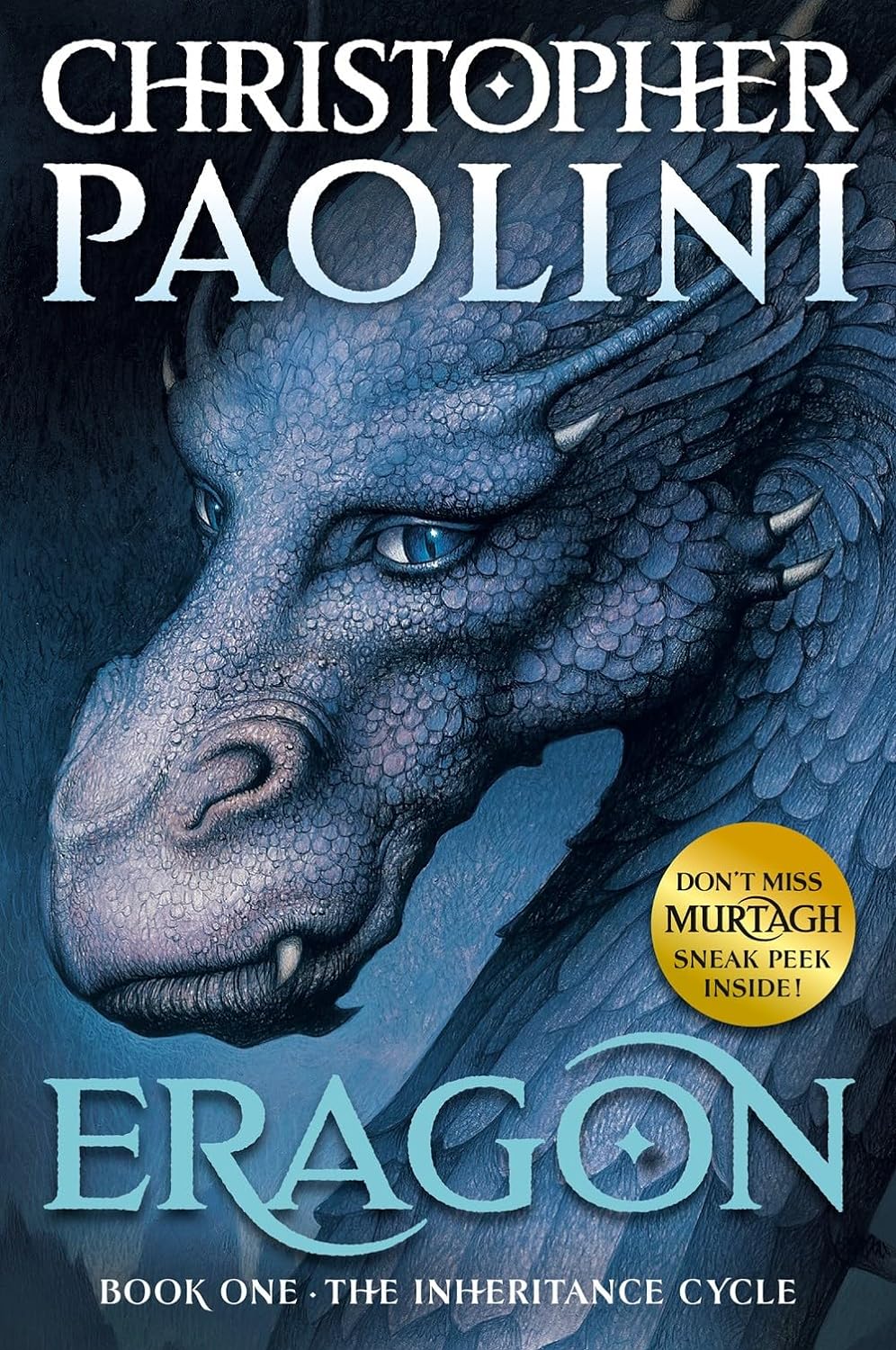
This complete guide to Eragon by Christopher Paolini covers everything parents, teachers, and students need to know — from reading level and age appropriateness to characters, themes, and similar books. Eragon is the story behind one of the most remarkable publishing debuts in American literary history: Christopher Paolini began writing it at fifteen after graduating from homeschool in Paradise Valley, Montana, self-published it with his family at eighteen, and watched it become a New York Times bestseller at nineteen after author Carl Hiaasen’s stepson discovered a copy and brought it to Hiaasen’s publisher, Alfred A. Knopf. The novel follows fifteen-year-old Eragon, a farm boy who finds a strange blue stone in the mountains — a stone that turns out to be a dragon egg. When it hatches, Eragon names his dragon Saphira, and the two are forced to flee their village when the evil King Galbatorix sends his monstrous servants to recover her. Guided by Brom, an old storyteller with secrets of his own, Eragon begins to discover his destiny as the first new Dragon Rider in nearly a century. The Inheritance Cycle has sold more than 41 million copies worldwide and a Disney+ series adaptation is actively in development, with Paolini himself co-writing and executive producing.
For Parents
Eragon is a large, ambitious epic fantasy that will absorb the right reader completely — but its content is meaningfully more intense than its reading level metrics suggest, and it is a better fit for ages 11 and up than for younger middle-grade readers. The novel contains genuine battle violence, including beheadings, torture, and large-scale death described with some graphic detail. Brom, the mentor figure, regularly smokes a pipe filled with “cardus weed,” and main characters drink mead and beer on multiple occasions. Eragon’s uncle is murdered early in the story — his death is the event that sets the plot in motion. The female elf character Arya is imprisoned, tortured, and poisoned before being rescued, and Eragon develops a crush on her that involves noticing her physical appearance. None of this is gratuitously explicit, but cumulatively it places Eragon firmly in the upper range of what is appropriate for middle-grade audiences. For strong readers 11 and up who love high fantasy and can handle battle violence, it is an exceptional book.
For Teachers
Eragon‘s greatest classroom value may be its origin story: the fact that Paolini began writing it at fifteen — the same age as many readers picking it up — is a genuine and meaningful inspiration for student writers. The novel is most commonly used in grades 6–8 and pairs naturally with units on epic fantasy, world-building, and the hero’s journey archetype. Its Ancient Language magic system, Paolini’s invented languages for elves and dwarves (with glossaries in the appendix), and the detailed map of Alagaësia make it rich material for discussions of how authors construct secondary worlds. Teachers should be aware that the novel has drawn some critical attention for its debts to Tolkien and Star Wars — elements worth discussing with older students as an entry point into conversations about influence, homage, and originality in storytelling. Content considerations (battle violence, pipe smoking, drinking) should be reviewed before assigning to younger middle school grades.
Eragon at a Glance
Find on Amazon →| Author | Christopher Paolini |
| Published | 2003 (Knopf; originally self-published 2001) |
| Grade Level | 5–8 (our assessment) |
| Recommended Age | 11–15 |
| Flesch-Kincaid Grade | 5.6 |
| Word Count | 157,220 |
| Pages | 544 (paperback) |
| Chapters | 62 named chapters + epilogue |
| Genre | Young adult high fantasy / Epic fantasy |
| Setting | Alagaësia — a fictional continent with its own languages, races, and history |
| Awards | New York Times and National Bestseller; held the NYT Children’s Books Best Seller list for 121 weeks |
For official Lexile and AR levels, visit Lexile.com or AR BookFinder. ReadingVine provides independent editorial assessments.
What Reading Level Is Eragon?
Eragon has a Lexile score of 710L and an ATOS level of 5.6, worth 25 AR points. The confirmed word count is 157,220 — more than twice the length of most middle-grade novels and roughly equivalent to two full-length Harry Potter books. Our Flesch-Kincaid calculation aligns with the ATOS at approximately grade 5.6. The prose is readable for strong upper elementary students — Paolini writes in a clear, energetic style, and despite his youth at the time of composition, the text is polished and accessible. Chapters are named rather than numbered, which gives the book a more literary feel than its metrics might suggest, and many chapters run 8–12 pages, making the daily reading commitment for a young reader manageable.
The important nuance here — and it is significant — is the gap between the ATOS of 5.6 and the book’s actual appropriate audience. Paolini’s publisher lists the book as appropriate for ages 12 and up; Common Sense Media recommends 11+. Our editorial assessment is grades 5–8, with a recommended age of 11–15. At 157,000+ words, Eragon is a genuinely long book — even enthusiastic readers in 5th grade may find the sustained commitment challenging. More importantly, the content (battle violence with beheadings and torture, pipe smoking by a main character, multiple drinking scenes, the imprisonment and torture of a female character) places it meaningfully above what most parents would consider appropriate for 9–10-year-olds, even those who can decode the text without difficulty. For the right reader — typically 11 and up, comfortable with high fantasy, and prepared for epic-scale battle content — it is a genuinely rewarding experience. For official Lexile and AR scores, visit Lexile.com or AR BookFinder.
What Age Is Eragon Appropriate For?
We recommend Eragon for readers ages 11–15. Common Sense Media rates it 11 and up. The publisher lists the interest level as grades 5–9. This is one of the few books in our guide where the content genuinely warrants a higher age recommendation than its prose metrics alone would suggest. A 9-year-old who can decode ATOS 5.6 text is not the intended audience for this book.
Violence: Eragon contains substantial battle violence throughout, becoming more intense in the novel’s second half. This includes depictions of beheadings, torture, piles of dead bodies on battlefields, and combat described with some graphic detail. A key scene involves the discovery of the body of a murdered infant among battlefield casualties — brief, but cited by multiple readers as the novel’s most disturbing moment. An elf character (Arya) is imprisoned, beaten, poisoned, and tortured before being rescued; the description is not graphic but is sustained over several chapters. None of the violence is gratuitous in a horror-fiction sense, but it is consistently present and sometimes visceral. Smoking: Brom, one of the novel’s primary mentor figures, regularly smokes a pipe filled with “cardus weed” — described as a pleasurable habit. A minor character smokes once as well. Drinking: Main characters drink mead and beer on multiple occasions; one scene involves a day-after hangover. Language: One use of “ass.” Casually derogatory descriptions appear throughout (“the fat one,” “the bald man,” “deformed beggars”). Romance: Eragon develops a crush on Arya, an elf character, noticing her “shapely frame” and describing her as beautiful. A passing mention of an earl having three mistresses appears briefly. There is no sexual content. Death: Eragon’s uncle, who raised him, is murdered early in the story. His death is the event that launches the plot, and Eragon’s grief is a major emotional thread.
Parents who have navigated similar content questions for The Hobbit or Harry Potter and the Goblet of Fire will find Eragon‘s content in a comparable range — perhaps slightly more intense in its battle descriptions than either of those. The novel’s violence is consistently in service of its story rather than present for shock value, and Paolini is clear that killing has moral weight: Eragon is troubled by the lives he takes. For readers 11 and up who are mature enough to engage with those questions, the book handles them with more nuance than its sometimes purple prose might suggest.
What Is Eragon About?
Eragon is a fifteen-year-old orphan living on his uncle Garrow’s farm in the isolated village of Carvahall, at the edge of the Spine — a mountain range that locals consider cursed and avoid. One winter day, hunting in the Spine, he finds a smooth blue stone that he thinks might fetch enough money to buy food for his family through the winter. The stone is not a stone: it is a dragon egg, and when it hatches into a bright blue dragon that Eragon names Saphira, it binds her to him through a permanent telepathic link unique to Dragon Riders and their dragons. Before Eragon can decide what to do with his extraordinary find, two of King Galbatorix’s terrifying servants — the Ra’zac, monstrous creatures in black cloaks — arrive in Carvahall looking for the egg. They find Garrow instead. His death, and the destruction of the farm, leave Eragon with nothing to return to.
He flees with Brom, the village storyteller — a gruff, laconic old man who turns out to know a great deal more about Dragon Riders, magic, and the Ancient Language than anyone would expect from a small-town tale-teller. What follows is a journey across Alagaësia: through its forests, deserts, and cities, past its dwarves and elves and Urgals, toward a reckoning with Galbatorix’s empire that Eragon is not yet remotely prepared for. Along the way, Eragon learns the basics of the ancient magic system — spells must be spoken in the Ancient Language, and the cost of every spell is drawn from the caster’s own physical energy, which keeps magic from being a simple solution to anything. He rescues Arya, an elf ambassador who carries knowledge critical to the resistance against Galbatorix. And he discovers that his own origins may be more complicated than a fatherless farm boy has any right to expect.
The novel culminates in the Battle of Farthen Dûr, a massive assault on the Varden — the rebel faction fighting against Galbatorix — by an enormous Urgal army. The battle is brutal and large in scale, and its resolution leaves Eragon fundamentally changed, pointed toward a future that will require years and three more books to fully reckon with.
Eragon Characters
Is Eragon Banned?
Eragon does not have a documented history of widespread banning or library removal campaigns. It does not appear on the ALA’s most frequently challenged books lists. Given its commercial dominance — 121 weeks on the New York Times bestseller list and 41+ million copies sold — it is one of the most broadly embraced fantasy novels of its generation. Individual parent concerns have occasionally surfaced around the battle violence and the pipe smoking, but these have not generated organized challenges. The novel’s extraordinary origin story, its clear moral framework (good versus an irredeemably evil tyrant), and its adventure appeal have kept it firmly in the mainstream of acceptable young adult reading.
Eragon Themes and Lessons
The most persistent theme in Eragon — one that Paolini has discussed explicitly in interviews — is the relationship between destiny and agency. Eragon is thrust into a role he did not choose: the last Dragon Rider, the potential savior of Alagaësia. He cannot un-hatch Saphira. He cannot un-bind himself from the Varden’s cause once he’s committed to it. But within those constraints, his choices matter. The novel is consistent in showing that being chosen for something doesn’t automatically make you good enough for it, and that becoming the person the role requires takes work, suffering, and a willingness to face your own limitations. This is, arguably, the more honest version of the chosen-one fantasy that genre critics often want: the choice is not the destiny, but how you respond to it.
Paolini also engages seriously with the moral cost of violence in a way that distinguishes Eragon from more straightforwardly triumphalist fantasy. After his first real combat, Eragon is disturbed by what he has done — the physical and psychological reality of killing is not glossed over. Brom’s lessons about the Ancient Language magic system reinforce this: every spell costs the caster physical energy, meaning that magic has genuine stakes, and that power is never free. This embedded consequence-logic runs through the world-building and gives the novel more ethical texture than its derivativeness from Tolkien and Star Wars sometimes obscures. Discussion questions worth exploring: What is the difference between a destiny handed to you and a purpose you choose? When is violence justifiable, and does the story handle that question fairly? What does Eragon’s relationship with Saphira suggest about the responsibilities that come with caring for another being?
How Many Pages and Chapters in Eragon?
Eragon is 544 pages in the standard paperback and 157,220 words — making it one of the longest books commonly recommended for the upper middle-grade and early high school audience. It has 62 named chapters plus an epilogue, with chapters averaging roughly 8–9 pages. The chapter titles are evocative (they read like chapter headings from older-style epics), and the named structure gives the book a more formal, literary feel than numbered chapters would. The appendices include glossaries of the Ancient Language, Dwarvish, and Urgalish, a pronunciation guide, and Paolini’s own notes on Alagaësia’s history — all of which are genuinely useful for readers who want to engage deeply with the world.
At a comfortable reading pace for ages 11–15, expect roughly 8–12 hours of reading time. Most motivated readers finish it over one to two weeks. Because of its length and complexity, Eragon is less commonly used as a full class novel in middle school than shorter dystopian or realistic fiction titles — it is more often an independent reading choice or a gift recommendation for voracious readers. Schools that do assign it typically do so in grades 7–8, often alongside a discussion of Paolini’s own story as a young writer. The novel’s appendix and world-building materials also make it useful for creative writing units focused on fantasy and secondary-world construction.
Books Similar to Eragon
About Christopher Paolini
Christopher Paolini was born on November 17, 1983, in Los Angeles, California, and grew up in Paradise Valley, Montana, in a rustic house on the banks of the Yellowstone River with the jagged, snowcapped Beartooth Mountains rising on one side. He and his younger sister Angela were homeschooled by their parents, Kenneth and Talita Paolini, and Christopher graduated from high school at fifteen through an accredited correspondence program. Not yet ready for college, he spent the following years doing what he later described as the only thing that made sense: reading and writing. At fifteen he began plotting the Inheritance Cycle; the first draft of Eragon took roughly a year, followed by a second year of revision and a third year, with his family’s help, preparing the manuscript for self-publication. Paolini International LLC published the first edition in late 2001, printing 10,000 copies, and the Paolini family spent 2002 promoting it at over 135 libraries, bookstores, and schools across the country, with Christopher dressed in a homemade medieval costume of red shirt, black pants, lace-up boots, and a jaunty cap. Sales were modest until the summer of 2002, when Carl Hiaasen’s stepson found a copy in a Montana bookstore, loved it, and brought it to Hiaasen’s attention. Hiaasen took it to his publisher, Alfred A. Knopf, who acquired the rights to the full cycle and published a revised edition in August 2003. Eragon immediately became a New York Times bestseller. Paolini was nineteen. He completed the Inheritance Cycle with Eldest (2005), Brisingr (2008), and Inheritance (2011) — a tetralogy that has collectively sold more than 41 million copies. He returned to the world with the short story collection The Fork, the Witch, and the Worm (2018) and the spinoff novel Murtagh (2023). His first science fiction novel for adults, To Sleep in a Sea of Stars, was published in 2020. A Disney+ live-action series adaptation of Eragon, with Paolini co-writing and executive producing, entered active development in 2022 and opened a writers room in late 2025, with showrunners Todd Harthan and Todd Helbing and director-executive producer Marc Webb attached as of February 2026.
Eragon: Frequently Asked Questions
What reading level is Eragon?
Eragon has a Lexile score of 710L and an ATOS level of 5.6, worth 25 AR points. The confirmed word count is 157,220. Our editorial assessment is grades 5–8. The prose is accessible for strong upper elementary readers, but the book’s length (544 pages), content (battle violence including beheadings and torture, pipe smoking, drinking), and thematic complexity make it most appropriate for readers 11 and up. The publisher (Knopf) lists it for ages 12 and up. A 9-year-old who can decode the text is not the intended audience for this book.
What age is Eragon appropriate for?
We recommend ages 11–15. Common Sense Media rates it 11 and up; the publisher lists it for ages 12 and up. The primary content considerations are sustained battle violence (beheadings, torture, piles of dead bodies on battlefields, one scene involving an infant among casualties), Brom’s regular pipe smoking, multiple scenes of drinking with one hangover, and the prolonged captivity and torture of a female character. There is no sexual content. For mature, fantasy-loving readers 11 and up who can engage with violence in an epic context, it is a rewarding book.
How old was Christopher Paolini when he wrote Eragon?
Paolini began writing Eragon at fifteen, after graduating from homeschool in Paradise Valley, Montana. He spent one year on the first draft and a second year revising, then a third year preparing the manuscript for self-publication with his family. The first edition was published by Paolini International LLC in late 2001, when Paolini was eighteen. He spent much of 2002 promoting it at over 135 schools, libraries, and bookstores across the country dressed in a medieval costume — a grassroots campaign that sold modest copies until Carl Hiaasen’s stepson found one in a Montana bookstore, loved it, and brought it to Hiaasen, who took it to his publisher Alfred A. Knopf. The Knopf edition came out in August 2003 and was on the New York Times bestseller list. Paolini was nineteen.
Is there an Eragon movie?
Yes — and no. A 2006 film adaptation was released by Fox 2000, directed by Stefen Fangmeier and filmed in Hungary and Slovakia, starring Ed Speleers as Eragon, Jeremy Irons as Brom, John Malkovich as Galbatorix, Djimon Hounsou as Ajihad, and Rachel Weisz as the voice of Saphira. It received generally negative reviews from critics, who cited a compressed and overly simplified plot and dialogue that didn’t do justice to the book’s world. Planned sequels were cancelled after the film’s reception, leaving fans of the full cycle without an adaptation of Eldest, Brisingr, and Inheritance. Paolini himself has been vocal about his dissatisfaction with the film, which is part of why he has been so directly involved in the Disney+ series now in development — with showrunners attached and a writers room actively running as of early 2026, this adaptation has a real chance of being the one that gets it right.
Is there an Eragon TV series coming?
Yes. A Disney+ live-action series adaptation of Eragon is actively in development as of this writing. Christopher Paolini is co-writing and executive producing. In February 2026, showrunners Todd Harthan (High Potential) and Todd Helbing (Superman & Lois) were attached, along with director and executive producer Marc Webb (Crazy Ex-Girlfriend). A writers room opened in late 2025 and is ongoing. The series is being produced by 20th Television with Bert Salke (also a producer on Disney+’s Percy Jackson and the Olympians) executive producing. No release date or casting has been announced. The series is expected to cover the full Inheritance Cycle across multiple seasons.
How many books are in the Inheritance Cycle?
The core Inheritance Cycle runs four books: Eragon (2003), Eldest (2005), Brisingr (2008), and Inheritance (2011). Paolini originally planned the series as a trilogy, but while writing what would have been the third book, he realized the story needed more space than one volume could provide. The expanded series as a whole is called the World of Eragon and also includes the short story collection The Fork, the Witch, and the Worm (2018) and the spinoff novel Murtagh (2023), which follows Eragon’s half-brother after the events of Inheritance. Additional books set in Alagaësia are planned.
Is Eragon a copy of Lord of the Rings?
This is the most common criticism of the novel, and it has some validity — but it requires context. Eragon shares substantial structural and character DNA with both Tolkien’s work and Star Wars: a farm boy orphan with a hidden destiny, a gruff mentor who is more than he appears, a dark lord operating through monstrous servants, an ancient order of warrior-scholars nearly wiped out by betrayal, invented languages, maps of a fictional continent, dwarves and elves. Paolini was fifteen when he began writing it and has always been open about his influences. What distinguishes Eragon is its magic system (grounded in physical cost and linguistic precision), its dragon-bond relationship (the emotional center Tolkien’s work doesn’t have in the same way), and the sheer ambition of its world-building for an author of any age, let alone a teenager. Critics and adult fantasy readers often find the derivativeness more distracting than younger readers do — which is partly why the series connected so powerfully with its intended audience. The question of influence versus imitation is genuinely worth discussing with older students as an entry point into conversations about originality and tradition in storytelling.
What is the Ancient Language in Eragon?
In Eragon, magic is performed by speaking in the Ancient Language — an invented language of Paolini’s own design, with its own grammar, vocabulary, and sound system (glossaries and pronunciation guides appear in the back of each book). The key rule of the Ancient Language magic system is that the cost of every spell is drawn from the caster’s own physical energy: a spell that moves a boulder costs the same energy it would take to move it by hand. This means magic is never a convenient solution to anything — it can only be used at genuine personal cost. The system also binds speakers to honesty: it is impossible to lie in the Ancient Language, which drives several key plot points and gives the magic a moral and philosophical dimension beyond power and spectacle.