
 = Partner Site
Freewater Reading Level: A Complete Guide
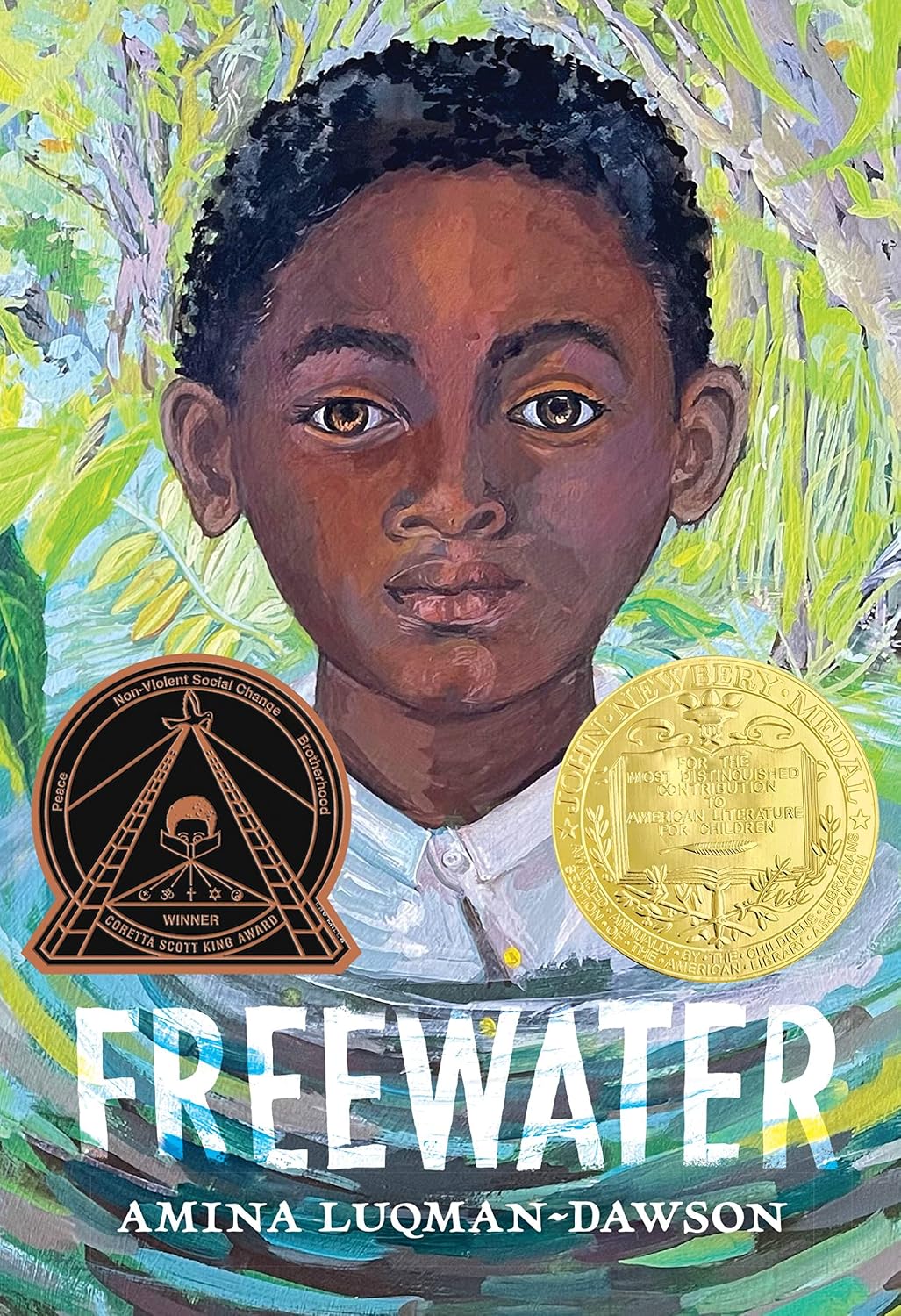
Deep in Virginia’s Great Dismal Swamp, a hidden community of formerly enslaved people has built a life of their own, and it’s there that two escaped children find refuge in Amina Luqman-Dawson’s Freewater. This guide provides parents and teachers with reading level information, age recommendations, content insights, and discussion questions for this dual Newbery Medal and Coretta Scott King Award winner.
For Parents
Find the right reading level for your child, understand how the book handles the realities of American slavery, and get conversation starters about freedom, courage, and community.
For Teachers
Access grade-level guidance, reading metrics, character analysis support, and thematic discussion questions for classroom use. This dual award winner offers rich opportunities for exploring maroon communities, multiple-perspective narrative structure, and the history of resistance to slavery.
Freewater at a Glance
Find on Amazon →| Author | Amina Luqman-Dawson |
| Published | 2022 |
| Grade Level | 5–8 |
| Recommended Age | 9–13 |
| Flesch-Kincaid Grade | ~5.0 |
| Word Count | ~77,000 |
| Pages | 398–402 (varies by edition) |
| Genre | Historical fiction |
| Setting | The Great Dismal Swamp, Virginia/North Carolina, antebellum South |
| Awards | Newbery Medal (2023), Coretta Scott King Author Award (2023) |
For official Lexile and AR levels, visit Lexile.com or AR BookFinder. ReadingVine provides independent editorial assessments.
What Reading Level Is Freewater?
Freewater is appropriate for grades 5–8, with an editorial Flesch-Kincaid estimate of around 5.0. Amina Luqman-Dawson’s prose is accessible and image-rich, with short chapters that keep the pace moving even across a fairly long book.
The main challenge for readers isn’t vocabulary but structure: the book shifts between multiple narrators and time frames, following Homer in the first person alongside several other characters told in the third person. Readers used to a single, linear point of view may need a little time to adjust to tracking several storylines at once.
At nearly 400 pages, Freewater is also longer than many books at this reading level, which can be a lot for younger or reluctant readers even though the individual chapters are short. We recommend it most for grades 5–8, with strong fourth-grade readers likely to manage it as well.
What Age Is Freewater Appropriate For?
We recommend Freewater for readers ages 9–13. The book confronts the realities of American slavery directly, though it’s told largely through children’s eyes and doesn’t linger on graphic detail.
Slavery and its abuses: The book depicts the realities of enslavement, including whippings, families separated by sale, and an overseer who uses a racial slur for enslaved people. It also references, without depicting directly, the broader exploitation enslaved people faced.
A child’s death: One character’s older brother died as an infant during her parents’ escape into the swamp, referenced as part of her family’s history.
Violence: A dog bites one of the main characters, a bear attacks a group of pursuers, and the climax involves a physical confrontation with fire, arrows, and gunfire, though no one is shown being shot.
A protective marking: One character’s mother cuts a small mark into her daughter’s arm before they’re separated, meant as a way to help identify or find her again. It’s presented within the story as an act of desperate love rather than harm.
What’s NOT in the book: There’s no profanity beyond the one period-accurate slur, and no graphic violence or sexual content. Luqman-Dawson tells much of the story’s harder material through implication rather than explicit description, and the book ultimately builds toward a hopeful, triumphant ending.
What Is Freewater About?
Twelve-year-old Homer and his seven-year-old sister, Ada, flee the Southerland plantation in the dead of night with their mother, Rose. When Homer realizes they’ve left his friend Anna behind, he begs his mother to go back for her. Rose does, but is captured and severely whipped for the attempt, leaving Homer and Ada to escape alone, pursued by dogs and armed men.
The siblings are rescued by Suleman, a formerly enslaved man who roams the swamp helping others reach safety, and he leads them to Freewater, a hidden settlement of escaped and freeborn Black people who have built a working community deep in the Great Dismal Swamp. There, Homer and Ada meet other children, including freeborn Sanzi and her older sister Juna, and Billy and Ferdinand, who escaped enslavement themselves. Though grateful for Freewater’s safety, Homer can’t stop thinking about his mother, still suffering back at Southerland, and feels responsible for what happened to her.
As Homer and his new friends settle into Freewater’s rhythms, they also uncover a threat to the community’s safety involving a man named Turner, whose own desperate choices put everyone at risk. When Homer learns of an upcoming wedding at Southerland that will draw attention away from the plantation’s daily routines, he sees his chance to rescue his mother and, with Ada and his friends insisting on coming along, sets out on a dangerous return journey.
The rescue attempt goes wrong in several ways before it goes right: the group is nearly caught, and only quick thinking, courage, and help from unexpected allies, including Nora, the plantation owners’ daughter, allow them to create a diversion and free Rose. Turner ultimately chooses to leave Southerland behind and bring his own family to Freewater rather than continue betraying it. The novel ends with Homer reunited with his mother, several more people freed, and the community of Freewater intact and strengthened.
Freewater Characters
Freewater Themes and Lessons
Freewater explores what freedom actually feels like, day to day, for people who have only known enslavement. Ada’s wonder at simple things, like working for herself rather than for someone else’s profit, makes the idea of freedom concrete rather than abstract for young readers. The book also emphasizes community as something actively built and maintained: Freewater survives because its residents share resources, protect one another, and welcome new arrivals, rather than through any one person’s heroics alone.
Alongside these ideas runs a thread about guilt and responsibility. Homer’s drive to rescue his mother comes from a sense that her capture was his fault, and much of his arc involves learning to act on that guilt constructively rather than letting it consume him. Sanzi’s own arc, wanting to be a hero and making costly mistakes along the way, offers a parallel story about growing into responsibility rather than simply wanting the glory of it.
Discussion questions for families:
- What does freedom mean to Ada that it doesn’t mean to Homer, and why do you think that is?
- Why does the Freewater community work together the way it does, rather than everyone looking out only for themselves?
- How does Homer’s guilt about his mother shape the choices he makes throughout the book?
- Why do you think the author chose to tell this story from so many different characters’ points of view?
How Many Pages and Chapters in Freewater?
Freewater runs 398 to 402 pages depending on the edition and is divided into 91 short chapters, making it approximately 77,000 words in total.
For an independent reader in the target grade range, the book typically takes 8–10 hours total to finish, or about two weeks of reading 30–45 minutes a day. The short chapters and frequent point-of-view shifts help keep the pace brisk despite the book’s length.
As a read-aloud, Freewater takes approximately 10–11 hours total. Its structure, with each short chapter following a different character, makes it easy to read a chapter or two at a sitting and pick back up later.
Books Similar to Freewater
If your child connected with Freewater, here are five similar books that explore family, resilience, and the history of American slavery and its aftermath:
About the Author
Amina Luqman-Dawson is a writer and former policy professional based in Arlington, Virginia. Freewater is her debut novel, inspired by the real history of maroon communities that formed in the Great Dismal Swamp before the Civil War. The book won both the 2023 Newbery Medal and the 2023 Coretta Scott King Author Award, a rare dual honor. Luqman-Dawson has also written on race, culture, and community for outlets including The Washington Post, and is the author of the pictorial history book Images of America: African Americans of Petersburg.
Freewater: Frequently Asked Questions
What reading level is Freewater?
Our editorial assessment places it at grade 5–8, with an estimated Flesch-Kincaid grade of about 5.0. For official Lexile and AR levels, visit Lexile.com or AR BookFinder.
What grade is Freewater appropriate for?
We recommend it for grades 5–8, or roughly ages 9–13, given both its length and its direct treatment of the realities of slavery.
How many pages are in Freewater?
Freewater runs 398 to 402 pages depending on the edition, divided into 91 short chapters.
What is Freewater about?
It follows Homer and his younger sister, Ada, after they escape enslavement and find refuge in a hidden community of formerly enslaved people deep in the Great Dismal Swamp, while Homer works to rescue his mother, who was captured during their escape.
Is Freewater based on a true story?
The characters and specific events are fictional, but the setting is grounded in real history. Maroon communities of escaped and freeborn Black people did exist in the Great Dismal Swamp before the Civil War, though relatively little is documented about daily life within them, which gave the author room to imagine much of the story’s detail.
Is Freewater good for a 9-year-old?
Some 9-year-olds will be ready for it, especially strong or emotionally mature readers, but its length and its direct treatment of slavery’s abuses make it a better fit for many readers a bit older. Reading it together or previewing it first is a good idea for younger or sensitive readers.
Does Homer rescue his mother in Freewater?
Yes. After a tense return to the Southerland plantation and a chaotic rescue attempt, Homer and his friends succeed in freeing his mother, Rose, and the book ends with the family reunited in Freewater.
What awards has Freewater won?
Freewater won both the 2023 Newbery Medal and the 2023 Coretta Scott King Author Award.