
 = Partner Site
Grenade Reading Level: A Complete Guide
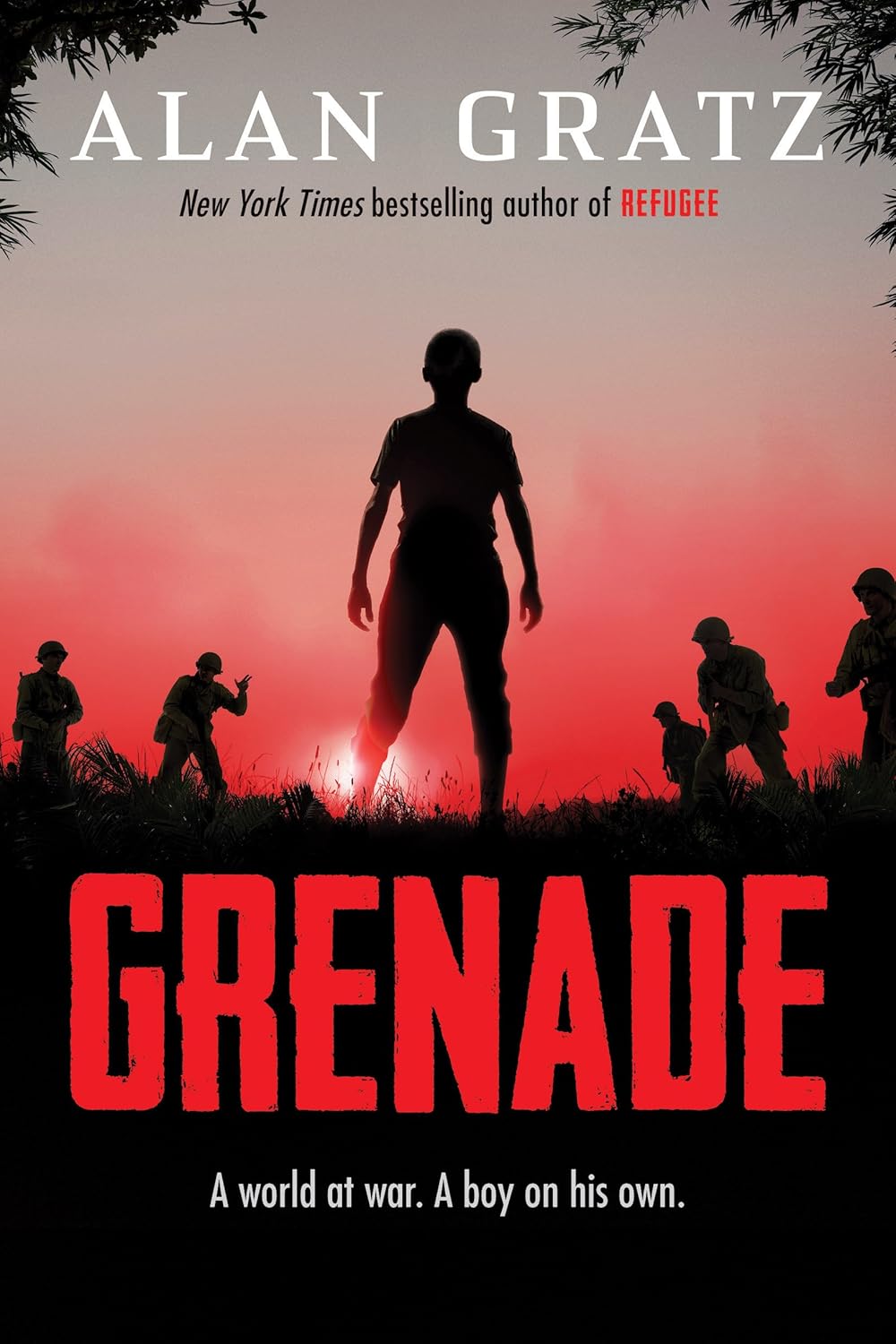
Grenade, written by Alan Gratz, is a 267-page World War II novel set during the Battle of Okinawa, April 1945. On the day American forces land on the island, fourteen-year-old Hideki Kaneshiro is pulled out of school by the Japanese military, given two grenades, and told the instructions: one grenade to kill an American soldier; the other to kill himself. On the same day, young Marine Ray Majors hits the beach at Okinawa for his first battle — fresh from Nebraska, running from an abusive father who came back from World War I a broken man, and terrified of becoming a monster himself. The two boys fight their way across the island from opposite sides until they collide in a single moment that will change both of them. Published in 2018 by Scholastic and an immediate New York Times bestseller, it is the companion novel to Refugee — same author, same dual-narrator structure, same commitment to giving both sides of a conflict human faces. The Battle of Okinawa killed approximately 12,000 American soldiers, 110,000 Japanese military personnel, and more than 100,000 Okinawan civilians. This guide covers reading level, age appropriateness, content, themes, and similar books.
For Parents
A dual-narrative World War II novel told from both an Okinawan boy’s and an American Marine’s perspective during the Battle of Okinawa. Ages 10–14, grades 5–7. Content includes sustained combat violence, death, and period-accurate racial slurs used by American soldiers toward Japanese forces — all historically grounded. One of the most honest and most human treatments of the Pacific War available for middle-grade readers.
For Teachers
A grades 5–7 World War II classroom text — one of the few available that gives the Pacific Theater full narrative attention from both sides. The period-accurate slurs in Ray’s sections require classroom discussion of historical language and its context. The Okinawan civilian perspective (Hideki is not Japanese but Okinawan) adds important nuance to standard Pacific War narratives. Pairs well with Ground Zero for a Gratz author study.
Grenade at a Glance
Find on Amazon →| Author | Alan Gratz |
| Published | 2018 (Scholastic Press) |
| Grade Level | 5–7 (our assessment) |
| Recommended Age | 10–14 |
| Lexile | 760L |
| ATOS Level | 5.2 |
| Word Count | 48,901 |
| Pages | 267–288 (editions vary) |
| Genre | Historical fiction / war |
| Setting | Okinawa, Japan; April–June 1945 |
For official Lexile and AR levels, visit Lexile.com or AR BookFinder. ReadingVine provides independent editorial assessments.
What Reading Level Is Grenade?
Lexile 760L, ATOS 5.2, interest level grades 4–7. Our assessment: grades 5–7, ages 10–14. The prose is Gratz’s characteristic thriller pace — short chapters, alternating perspectives, relentless forward momentum. The reading demands are not primarily linguistic but contextual: readers with no framework for World War II or the Pacific Theater will need background before or during reading. For official scores, visit Lexile.com or AR BookFinder.
What Age Is Grenade Appropriate For?
Ages 10–14, grades 5–7. The content is sustained combat violence — both protagonists are in active battle for most of the novel, people die around them constantly, and the brutality of the Battle of Okinawa is not softened. Two specific content items warrant advance notice:
The novel contains period-accurate racial slurs used by American soldiers toward Japanese forces — historically accurate to how American servicemen referred to Japanese forces in 1945 and included by Gratz deliberately as part of the book’s honest depiction of how dehumanizing language and war reinforce each other. Teachers assigning this book should address this directly with students before reading. The book also depicts the Okinawan mass civilian suicide ordered by the Japanese military at the end of the battle — a real historical event handled with appropriate gravity.
What Is Grenade About?
Hideki’s story: Fourteen-year-old Hideki Kaneshiro is a native Okinawan — not Japanese, a distinction the novel honors — who is pulled from school on April 1, 1945, handed two grenades, and ordered into the jungle. One grenade is for killing Americans; the other is for killing himself when the time comes. Hideki doesn’t want to kill anyone. He wants to find his family. He is also convinced that his ancestor’s cowardly spirit — his mabui — has taken hold of him, and that he is fated to disgrace himself. What Hideki discovers as he moves through the burning island is more complicated than cowardice or courage.
Ray’s story: Ray Majors is nineteen, from Nebraska, and the Battle of Okinawa is his first combat. He enlisted partly to escape a father who came back from World War I traumatized and violent — a monster. Ray’s fear throughout the battle is not only of dying but of becoming what his father became: a man destroyed by what war required him to do. He collects photographs of the dead — soldiers and civilians — as a way of refusing to let them become abstractions.
The two boys’ paths cross the island until they meet in a single moment. The choice each makes in that moment is the novel’s climax and its argument.
The Battle of Okinawa — What the Novel Is Grounded In
The Battle of Okinawa (April 1 – June 22, 1945) was one of the bloodiest battles of the Pacific War. American forces suffered approximately 12,000 deaths and 36,000 wounded. Japanese military deaths exceeded 110,000. Okinawan civilian deaths — from combat, from the Japanese military’s treatment of its own civilians, and from mass suicides ordered by the military — numbered somewhere between 100,000 and 150,000, representing roughly a quarter to a third of the island’s population. The Okinawan civilians were not the war’s combatants; they were its most catastrophic casualties.
The novel’s Hideki is Okinawan, not Japanese — a distinction that matters historically. Okinawa was annexed by Japan in the 19th century; Okinawans had their own language (Ryukyuan) and culture that the Japanese military actively suppressed. Okinawan schoolboys drafted into the Blood and Iron Student Corps were fighting for an imperial power that had occupied their island, not for their homeland. Gratz honors this complexity by making Hideki’s identity explicitly Okinawan throughout.
Grenade Themes and Lessons
The novel’s central argument is the same as Ground Zero‘s, applied to World War II: the person on the other side of the gun is a person, with fear and love and a family and a face. Both protagonists spend the novel learning this in opposite directions — Hideki learning it about Americans, Ray learning it about the Okinawans. What the novel refuses to do is make either boy’s understanding easy. The dehumanizing language Ray uses early in the book — the slurs, the propaganda — is the mechanism by which soldiers are made able to kill; Gratz shows this working and then shows it breaking down.
Discussion questions: Why does Gratz include Ray’s use of slurs — what would be lost if he sanitized Ray’s language? What is the difference between Hideki as an Okinawan and the Japanese soldiers who drafted him? What does Ray mean when he says he’s afraid of becoming his father? What choice does each boy make when they finally meet — and what does that choice cost?
Books Similar to Grenade
About Alan Gratz
See our Ground Zero guide for a full biography. Grenade was published in 2018, one year after Refugee, and uses the same dual-narrator structure to examine the Pacific War with the same refusal to let either side be abstractions. Gratz has said the Battle of Okinawa drew him specifically because of the Okinawan civilian experience — a dimension of the Pacific War that standard American accounts of World War II rarely examine. The choice to make Hideki explicitly Okinawan rather than Japanese is the novel’s most historically important decision.
Grenade: Frequently Asked Questions
What reading level is Grenade?
Lexile 760L, ATOS 5.2. Our assessment: grades 5–7, ages 10–14. Thriller-paced prose with short chapters; reading challenge is contextual rather than linguistic. For official scores, visit Lexile.com or AR BookFinder.
What is Grenade about?
Two boys on opposite sides of the Battle of Okinawa (April 1945): Hideki, a fourteen-year-old Okinawan drafted and handed two grenades, and Ray, a young American Marine in his first battle. They fight their way across the island until they meet in a moment that changes both of them.
Does Grenade use racial slurs?
Yes — Ray and other American soldiers use period-accurate anti-Japanese slurs throughout Ray’s sections. Gratz includes these deliberately as part of the novel’s honest depiction of how dehumanizing language functions in war. Teachers assigning the book should address this directly with students before reading.
Why is Hideki described as Okinawan rather than Japanese?
Because he is. Okinawa was an independent Ryukyuan kingdom before Japan annexed it in the 19th century. Okinawans have their own language and culture, distinct from mainland Japanese. Okinawan schoolboys drafted into the Japanese military were fighting for an occupying power, not their homeland. Gratz honors this historical accuracy throughout the novel — Hideki’s Okinawan identity is explicitly part of who he is.
How does Grenade relate to Refugee and Ground Zero?
All three are Alan Gratz novels using dual or multiple narrators to show both sides of a historical conflict. Refugee covers three refugee crises; Grenade covers the Battle of Okinawa from both sides; Ground Zero covers 9/11 and the Afghan War from both sides. Each stands alone; together they form the most complete picture of Gratz’s argument that understanding history requires more than one perspective.